The short answer
- What does it cost?
- RepairPal's national estimate is $694-$893: labor $101-$148, parts $594-$745. Those are RepairPal's figures, not ours; your engine and ZIP code move them.
- Is the alternator the Altima's weak spot?
- Not on the record. 74% of the Altima's counted electrical complaints sit in 2009-2010 and describe steering-lock and push-button no-starts. The alternator turns up in few narratives.
- Anything Nissan documented?
- One bulletin: early-build 2013 Altimas with the 2.5L engine can develop an alternator groan that Nissan warns may be misdiagnosed as a CVT noise. No alternator recall exists.
The estimate, and whose it is
RepairPal publishes a national estimate for replacing the alternator on a Nissan Altima: $694 to $893, made up of $101 to $148 in labor and $594 to $745 in parts, before taxes and without adjusting for your location. Its page says the figures were last updated September 3, 2026. We read them on October 25, 2026 from the text search engines serve for that page, because RepairPal answers a direct fetch with a block, and two separate searches returned the same range.
Look at how that range is built. Labor is the small line. On RepairPal’s numbers the alternator itself is roughly four-fifths of the bill, which means the biggest decision you make is not which shop but which part: a new Nissan unit, a remanufactured one, or a used one from a salvage yard. We could not verify Kelley Blue Book’s Altima alternator range in this session (its live page rendered no figure), so we quote none. We sell VIN checks, not repairs, and publish no price of our own.
What 764 counted electrical complaints hold
Our corpus of federal NHTSA complaints holds 9,726 owner reports against the 2008–2022 Altima. For each model year it keeps the five most-reported components. ELECTRICAL SYSTEM makes that top five in 8 of the 15 years, and across those years it totals 764 reports. That figure is a floor, not a total: in 7 years, including the whole 2012–2017run, electrical complaints exist but rank below that year’s fifth category, so our data does not count them. The chart draws those years as hollow outlines rather than as zeros for that reason.
The second caveat matters more for anyone pricing an alternator. NHTSA’s ELECTRICAL SYSTEM category is broad. It takes in the 12-volt battery, wiring and connectors, lighting, body and control modules, key fobs and start circuits, and the charging system. The alternator is one part in a long list. A high electrical count tells you owners had electrical trouble; it does not tell you their alternators failed. Treat the category as context and as an upper limit, never as a tally of alternator jobs.
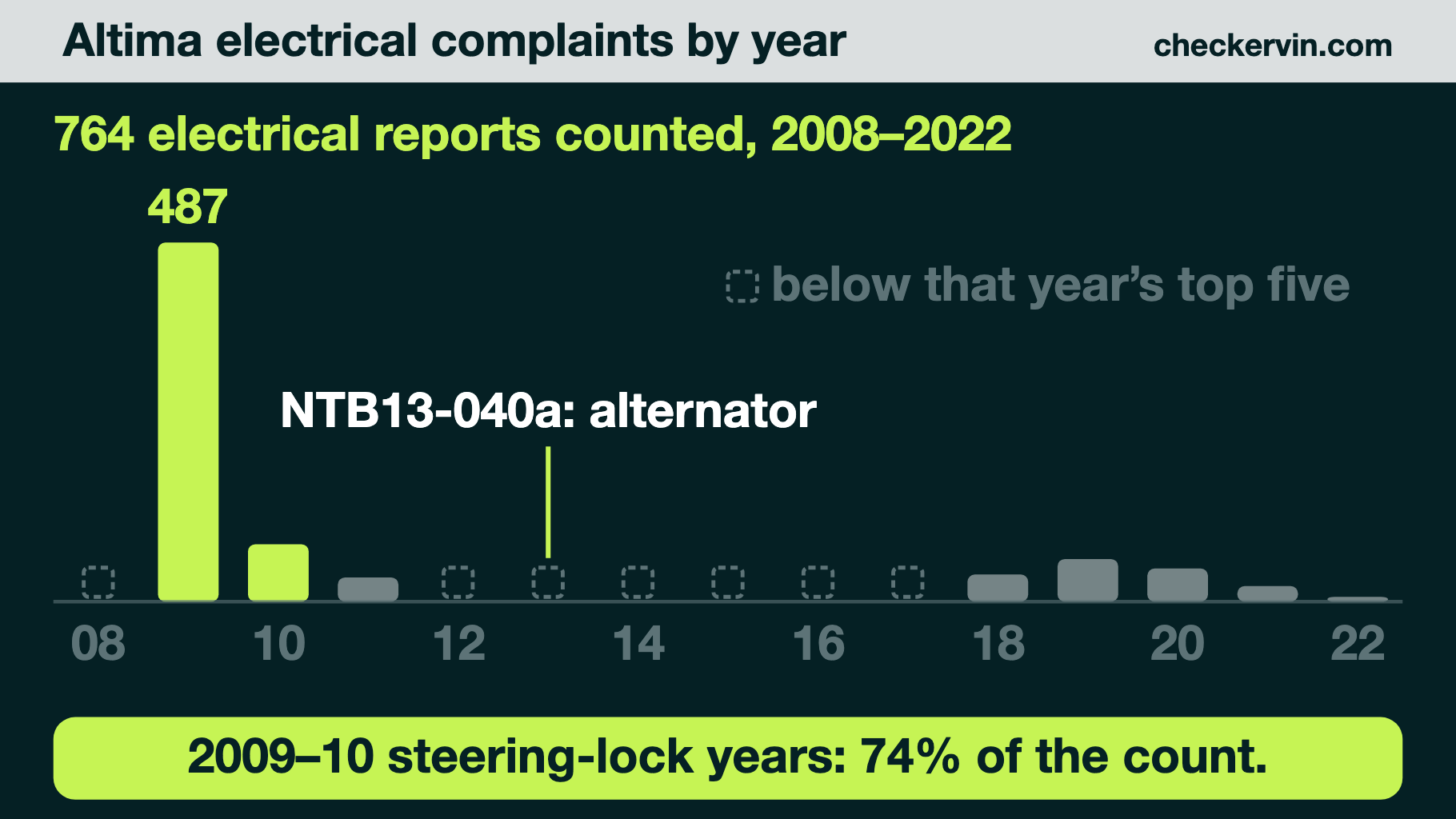
The 2009 spike is a steering lock, not a charging system
The 2009 Altima carries 487 electrical complaints, 64% of everything counted across fifteen model years and 30.4% of that year’s own complaints. Add 2010’s 78 and the two years hold 74% of the count. If you searched for an alternator price because a 2009 Altima will not start, this is the number to understand before you spend anything.
We read the 2009electrical narratives in NHTSA’s complaint file. They are overwhelmingly about starting: the car says the key is not detected, the push-button ignition does nothing, the steering wheel stays locked. The alternator is named in very few. Nissan’s own paperwork tells the same story. In February 2017 it opened voluntary service campaign PC516 on 2009–2010 Altima sedans, coupes and hybrids and 2009–2010 Maximas, replacing the Electronic Steering Column Lock with a part that no longer locks the wheel. The bulletin says the lock “may malfunction after the vehicle is locked and could prevent the engine from starting,” and lists 151,565 Altima sedans among the affected population.
The one Altima alternator bulletin Nissan wrote
We searched every manufacturer communication NHTSA holds for the 2008–2022 Altima for alternator, generator and charging language. One bulletin tells dealers to replace the alternator: NTB13-040a, dated July 5, 2013. It applies to 2013 Altima sedans with the 2.5-liter QR25DE four-cylinder, in two VIN ranges built before April 19 and April 22, 2013 respectively.
The symptom it describes is a rattle or groan from the right front strut tower or engine area, at 20 to 40 mph or with the engine around 1,400 to 1,500 rpm, traced to the alternator. Its most useful line for an owner is the warning that the noise “may be misdiagnosed as CVT or heat shield related.” On a car whose transmission already has a reputation, that is the difference between a few hundred dollars and a few thousand. The fix is a replacement alternator, Nissan part 23100-3TA1B.
Note what the complaint record does with that year. In 2013, ELECTRICAL SYSTEM does not reach the top five; the fifth-ranked category, UNKNOWN OR OTHER, sits at 240 reports, so electrical complaints that year number fewer than that. The single documented Altima alternator problem lands on a year where the electrical category is not prominent at all, which is one more reason not to read the category as an alternator count.
Alternator, battery, or neither
An alternator replacement is often bought on a guess. The federal file has plenty of Altima owners who replaced a battery, then an alternator, and still had the stall, flicker or dead morning they started with. A failing alternator and a failing battery look alike from the driver’s seat. A parasitic drain, a corroded cable end or a weak ground can mimic both.
- A charging-system test with the engine running: is the alternator actually producing current under load?
- A battery load test, separate from the charging test, so a bad battery is not blamed on the alternator
- A check of the battery terminals and the main ground before either part is ordered
- On a 2009-2010 Altima that will not start with a good battery: ask about the steering lock and key detection
- On an early-build 2013 2.5L with a groan at low speed: ask whether NTB13-040a was considered before the CVT
A parts store will often test a battery and alternator free. A shop that wants to replace the alternator without a written charging test result is guessing with your money.
Which engine is under the hood changes the job
The Altima in these years came with more than one engine, and an alternator is matched to its engine. EPA’s fuel-economy listings show a 2.5-liter four and a 3.5-liter V6 from 2008 through 2018. From 2019 the V6 is gone; the 2.5-liter four continues, and SR and Platinum versions add a 2.0-liter turbo, Nissan’s variable-compression VC-Turbo.
| Altima model years | Engines listed by EPA |
|---|---|
| 2008-2018 | 2.5L four-cylinder; 3.5L V6 |
| 2019-2022 | 2.5L four-cylinder; 2.0L turbo four (SR, Platinum) |
Access to the alternator differs between those engines, and so does the time a shop bills. We could not verify book labor hours by engine from a named source in this session, so we print none. Ask the shop for the labor time its estimating guide lists for your exact engine, and compare quotes on that basis. RepairPal’s $101–$148 labor line is a national average across versions, not a promise for yours.
New, remanufactured, or used
Because the part dominates the bill, this choice matters most.
- New from Nissan: the highest parts price, and the route a dealer will quote by default
- Remanufactured: a rebuilt unit, usually with a core charge refunded when your old alternator is returned
- Used from a salvage yard: cheapest, with mileage and condition you cannot check
- Whichever you choose, match it to the engine and build date the VIN decodes to, not to the model year alone
The 2013 bulletin is a reminder that Altima alternators were revised within a model year. A unit that fits a 2013 four-cylinder may not be the revised part Nissan specified, so give the parts counter the VIN, not just the year.
What belongs on the invoice
The alternator is driven by the accessory belt, which also turns the air-conditioning compressor and, on many engines, the water pump. A quote that replaces the alternator but ignores a glazed belt or a tired tensioner may be back in the shop soon. Nissan’s own record shows how connected those parts are: in 2008 it ran a voluntary campaign, PB072, to re-torque the drive-belt tensioner bolts on 2008 Altima sedans with the 2.5-liter engine, noting the condition could affect the air conditioning, the alternator and the water pump. That campaign is no longer active as of March 2021.
- Belt condition, and whether the shop recommends replacing it with the alternator
- Tensioner and idler pulley, checked for noise and play
- Core charge on a remanufactured unit, and whether it is already netted out of the price
- Warranty on the part and on the labor, in months and miles
- A written charging-test result after the repair
No charging recall on record, but check the VIN anyway
We queried NHTSA’s recall database for every Altima model year from 2008 through 2022. No campaign names the alternator or the charging system. The same pull does return electrical-coded campaigns, such as occupant-classification software on 2013–2014 cars, so an alternator recall would have shown if one existed.
The Altima does carry recalls on other systems in these years, including hood latches, airbags and fuel components. If the car is going into a shop for an alternator, run the Nissan recall check first so any open campaign can be handled in the same visit at no cost. Our explainer on how a service bulletin differs from a recall covers why NTB13-040a does not entitle a 2013 owner to a free alternator.
The 2018-2022 cars: electrical climbs the list
The pattern changes at the end of the range. From 2018 on, ELECTRICAL SYSTEM is in the top five every year, with 166 counted reports across those 5 model years, and it is the single most-reported category in 2019 and 2020. These are small cars in the record, with far fewer total complaints than the 2009 or 2013 Altima, so the electrical share is large partly because everything else is small.
The narratives for these years again lean toward key detection, starting, lighting and displays rather than charging output. A newer Altima with a warning light or a slow crank still needs the same test-first approach, and a warranty check by VIN settles whether any factory or extended coverage is left before you pay for anything.
If you are buying the Altima, not repairing it
A fresh alternator receipt on a used Altima is neither a red flag nor a selling point on its own. What matters is whether the seller can say why it was replaced. A Nissan VIN decodeconfirms the model year, plant and engine, which settles which alternator the car takes and whether a 2013 falls in the bulletin’s build window. The engine lookup by VIN answers the four-cylinder or V6 question directly, and the battery size lookup helps if the real fault turns out to be the battery.
For the bigger picture, read which Altima model years draw the most complaints overall. Electrical faults are not the Altima’s main story; the transmission is, and our Altima CVT fluid post walks through that record. If you are cross-shopping the smaller Nissan of the same era, the Sentra transmission cost post shows how its warranty extensions line up with its complaints.
Where this information comes from
- NHTSA — Altima complaint databaseThe federal complaint record this page's figures are computed from, and whose 2009 narratives we read.
- NHTSA-hosted Nissan bulletin NTB13-040a — 2013 Altima QR25DE alternator noiseRead in full: applied build dates, the groan symptom, the CVT misdiagnosis warning and replacement part 23100-3TA1B.
- NHTSA-hosted Nissan campaign PC516 — 2009-2010 Electronic Steering Column LockRead in full: the no-start fault, the replacement part and the affected Altima population.
- NHTSA-hosted PC516 expiration noticeSets May 28, 2020 as the last day for campaign repairs; customer expense afterward.
- NHTSA-hosted Nissan bulletin NTB08-051A — 2008 Altima drive belt tensioner boltsRecords campaign PB072 for 2008 2.5L sedans and its end in March 2021.
- NHTSA recalls API — Altima by model yearQueried for every model year 2008-2022; no alternator or charging campaign, checked against electrical-coded campaigns that do appear.
- EPA fueleconomy.gov — Altima engine listings by yearQueried for each model year 2008-2022; source of the engine offerings in the table above (2019 SR/Platinum shown).
- RepairPal — Nissan Altima alternator replacement cost estimateThe $694-$893 range and its labor and parts split, read from search-served page text on October 25, 2026.
Keep reading
Frequently asked questions
How much does it cost to replace the alternator on a Nissan Altima?
RepairPal's Altima alternator estimate is $694 to $893, with labor at $101 to $148 and parts at $594 to $745. Those are RepairPal's national figures, which its page says were last updated September 3, 2026; we read them from the search-served text of that page on October 25, 2026, because RepairPal blocks automated fetches. The split matters: on RepairPal's numbers the part is most of the bill, so the choice between a new and a remanufactured alternator moves the total more than shop labor does. We sell VIN checks, not repairs, and price none of this ourselves.
Is there a recall on the Nissan Altima alternator?
No. We queried NHTSA's recall database for every Altima model year from 2008 through 2022 and found no campaign covering the alternator or the charging system, after confirming the same pull does surface electrical-coded recalls on the Altima. Nissan issued a technical service bulletin, NTB13-040a, telling dealers to replace the alternator on certain early-build 2013 Altimas with the 2.5-liter engine when it is the source of a rattle or groan, but a bulletin is repair guidance, not a free-repair recall.
Which Nissan Altima years have the most electrical problems?
2009 by a wide margin. Computed from our NHTSA corpus, the ELECTRICAL SYSTEM category reaches a model year's top five in 8 of the Altima's 15 years, for at least 764 counted reports, and 2009 alone holds 487 of them, 30.4% of that year's complaints. Those 2009 reports are mostly push-button-start and steering-lock no-starts, the fault Nissan's campaign PC516 addressed on 2009-2010 Altimas, not charging failures. The category covers the battery, wiring, lighting and modules as well as the alternator.
How do I know if my Altima needs an alternator or just a battery?
Test both before buying either. A battery that will not hold a charge and an alternator that will not deliver one produce the same dead-car morning, and owners in the federal complaint file describe replacing a battery, then an alternator, and still having the fault. A charging-system test with the engine running shows whether the alternator is producing current; a load test shows whether the battery can hold it. On 2009-2010 Altimas a no-start with a healthy battery can also be the steering lock, and on early 2013 four-cylinder cars an engine-bay groan can be the alternator rather than the CVT.
Can a bad alternator be mistaken for a transmission problem on an Altima?
On one group of cars, yes, and Nissan said so. Bulletin NTB13-040a covers 2013 Altima sedans with the 2.5-liter QR25DE engine built before mid-April 2013. It describes a rattle or groan from the right front strut tower or engine area at 20 to 40 mph or around 1,400 to 1,500 rpm, traced to the alternator, and warns that the noise may be misdiagnosed as CVT or heat-shield related. The fix it gives is a replacement alternator, part 23100-3TA1B.
Confirm the engine before you price the alternator
A free CheckerVIN report shows the factory build, engine, specifications and open recalls for any VIN, so the part you order matches the Altima you have.
Run a free VIN check