The short answer
- What does it cost?
- KBB's fair repair range for a 2019 Sentra is $4,198-$6,006 in ZIP 43085; its 2013 page shows $4,314-$5,583 in ZIP 83616. Both are KBB's figures, not ours.
- Which years carry the problem?
- 88.6% of every Sentra power-train complaint on record sits in the 2013-2019 generation. The 2020-2022 redesign never ranks it in a year's top five.
- Will Nissan pay?
- 2013-2019 Sentras got CVT coverage to 84 months/84,000 miles. By late 2026 almost all of them have aged out, so check the VIN's in-service date first.
The numbers, and whose numbers they are
Kelley Blue Book publishes a fair repair range for a Sentra transmission replacement by model year and ZIP code. For a 2019 Sentra in ZIP 43085, outside Columbus, Ohio, it lists $4,198 to $6,006, parts and labor included, with dealer parts at roughly $3,914 to $4,198 and dealer labor at $1,668 to $1,808. Its 2013 Sentra page, priced for ZIP 83616 in Eagle, Idaho, shows $4,314 to $5,583. Those are KBB’s numbers, read on October 25, 2026 from the text search engines serve for those pages; KBB loads its prices in the browser, and a direct fetch only returned a placeholder ZIP with no range at all.
We sell VIN checks, not repairs, so we publish no price of our own. What we can add is the part a flat estimate leaves out: on this car, whether you pay that number at all has depended mostly on which model year is in the driveway and how long ago it was first sold.
What 3,371 complaints say about one generation
Our corpus of federal NHTSA complaints holds 3,371 owner reports against the 2008–2022 Sentra. POWER TRAIN, the category that captures transmission and driveline complaints, names 1,091 of them, or 32.4% of the whole record. That share alone would make the transmission the Sentra’s signature complaint. The distribution is the sharper finding.
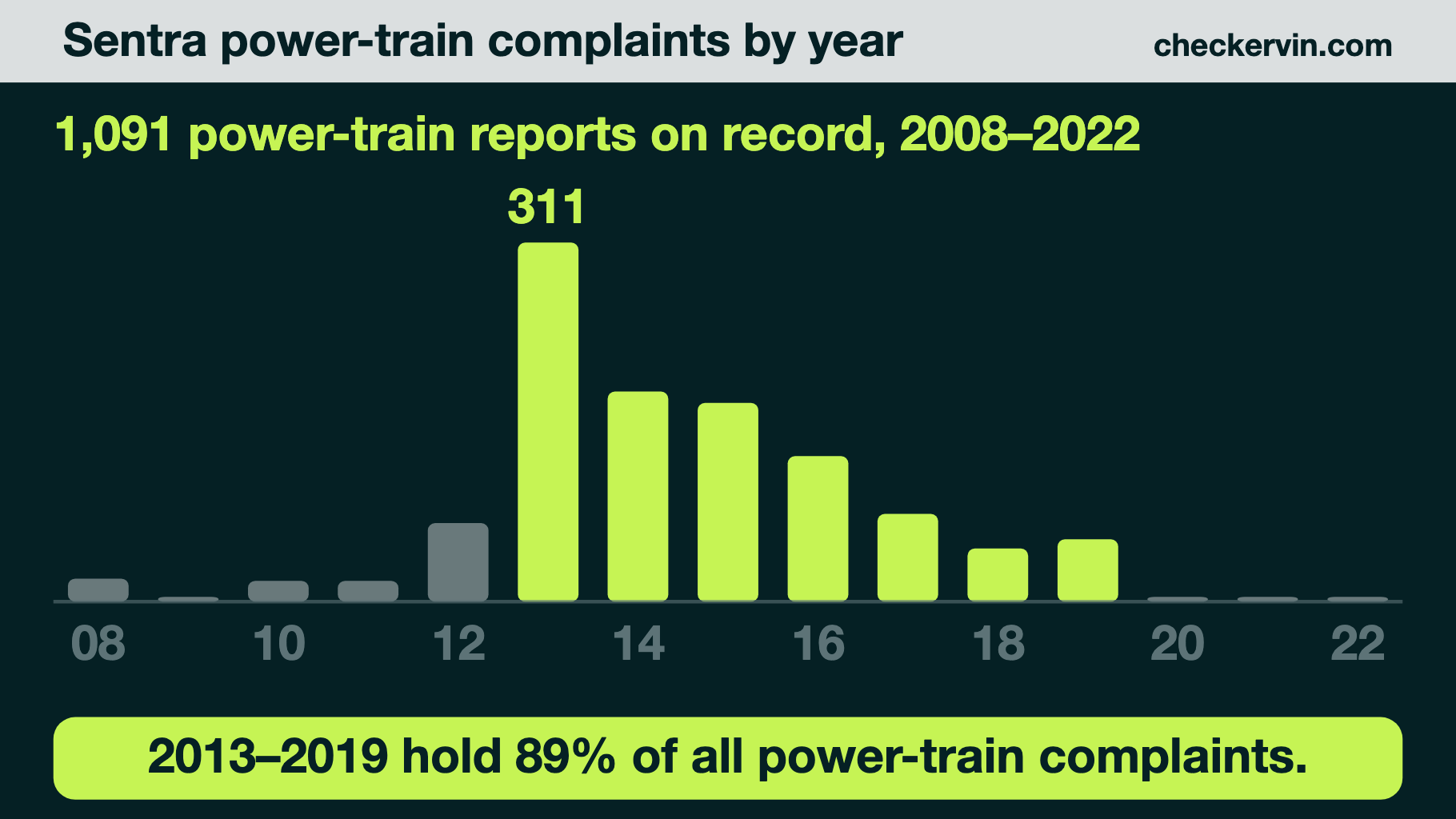
The seventh-generation B17 Sentra, sold as the 2013 through 2019 model years, holds 967 of those 1,091 reports: 88.6% of the nameplate’s power-train history in seven of its fifteen years. The first B17 year is the worst one. The 2013 car alone carries 311 power-train complaints, 28.5% of the nameplate’s total and 48.7% of everything owners reported against that model year. From there the count mostly falls, but POWER TRAIN never drops out of the top two categories in any B17 year, and in 2019, the generation’s last, it still logs 54 reports.
Then it stops. The redesigned B18 Sentra arrived for 2020, and in 3 of its 3 model years on record POWER TRAIN does not appear among the five most-reported categories, which leaves 0 power-train complaints counted for that generation in our top-five data. Steering, forward collision avoidance and electrical complaints fill the space instead. Complaints are unverified owner reports, not a measured failure rate, and a newer car has had fewer years to collect them. Even allowing for that, a drop from a top-two category to nothing in the top five, at the exact model year the car was redesigned, reads as a real change.
Two extensions, seven years, one generation
Nissan settled its US CVT class actions in two rounds, and each one ended in a dealer campaign bulletin that Nissan filed with NHTSA. We read both. The first, activated May 11, 2020, covers 2013–2017 Sentras built from March 2012 to October 2017. The second, activated May 23, 2023 and revised November 2, 2023, covers 2018–2019 Sentras built from September 18, 2017 to November 23, 2019. Both take the CVT’s coverage from its original 60 months/60,000 miles to 84 months/84,000 miles, whichever comes first.
| Sentra model years | What Nissan's bulletin says |
|---|---|
| 2013-2017 (B17) | CVT coverage 60/60 to 84/84; activated May 11, 2020 |
| 2018-2019 (B17) | CVT coverage 60/60 to 84/84; activated May 23, 2023 |
| 2008-2012 (B16) | Not named in either US bulletin |
| 2020 and newer (B18) | Not named; standard powertrain coverage applies |
Put the bulletins next to the complaint record and they line up year for year. The 2020 extension’s five model years hold 867power-train complaints, and the 2023 extension’s two hold another 100. Together that is the same 88.6% the chart shows. On some Nissan nameplates a settlement window and the complaint record only partly overlap; on the Sentra, the two extensions cover the generation that generated the complaints, and nothing else.
The extension covers more than the case. Both bulletins list the CVT assembly and its internal parts, gaskets and seals, the control valve body, the torque converter, the cooler kit where fitted, and reprogramming of the transmission control module. A replaced part also carries Nissan’s 12-month/12,000-mile parts warranty if that runs past the extended coverage. Owners who had already paid for a covered repair could claim reimbursement, but the claim windows were tight: January 30, 2020 for the first group and March 15, 2023 for the second, or within 30 days of the repair, whichever came later.
Where the 84-month clock stands in late 2026
An extension measured in months runs from the day the car was first sold, not from the day Nissan announced it. A 2017 Sentra built in the last month of B17 production for that year and sold new in late 2017 reached 84 months in late 2024. Practically every 2013–2017 Sentra is now outside the extension on time alone, regardless of mileage; only a car that sat unsold for years would still be inside it.
The 2018–2019 group is the one still worth checking. Production ran to November 23, 2019, so the last cars off the line were sold new in late 2019 or later, some well into 2020. A Sentra first sold in early 2020 reaches 84 months in early 2027, provided it is also under 84,000 miles. If you own a late-build 2019 with modest mileage and a CVT that has started to shudder, the next few months may be the last window in which this repair is Nissan’s bill rather than yours.
The years outside both extensions
The 2008–2012 Sentra is the sixth-generation B16, and it is not named in either US bulletin. Its power-train complaints are light by comparison, 124 across five model years, but one of those years stands out. In 2012, POWER TRAIN is the single most-reported category, at 68 reports. That makes it the only year in the record where the transmission tops the list and neither extension reaches.
Secondary sources, including a reproduction of a Nissan owner letter, describe an earlier program that doubled CVT coverage to 10 years/120,000 miles on Nissans built from 2003 through 2010. We could not open a primary Nissan or NHTSA document for that program in this session, so treat it as reported rather than confirmed. It is also moot in 2026: ten years from a 2010 sale ended in 2020, and the 2011 and 2012 Sentra fall outside it as described.
The 2020-and-newer B18 Sentra is outside the extensions too, but for the opposite reason: there was no class action to settle. Its CVT carries the standard powertrain coverage that both bulletins describe as 60 months/60,000 miles, and on a 2022 Sentra sold new in 2022, some of that may remain.
Three different CVTs have worn the Sentra badge
“Sentra CVT” is not one part, and a quote for the wrong one is a quote for nothing. Transend, a remanufactured-transmission distributor whose catalog we checked directly, lists three CVT families across the Sentra’s recent history:
| Sentra application | CVT family, per Transend's catalog |
|---|---|
| 2007-2012, 2.0L and 2.5L | RE0F10A / JF011E |
| 2013-2018, 1.8L MRA8DE | RE0F11A / JF015E |
| 2016-2019 SR Turbo and Nismo, 1.6L | RE0F10D / JF016E |
The practical point is that a 2017 Sentra SR Turbo and a 2017 Sentra SV can need different transmissions with different prices and different stock levels, even though both sit inside the same 84-month extension. A parts listing that matches on “2017 Sentra” alone is not a match. The engine code is in the VIN, and so is the information a supplier needs to confirm the right unit.
New, remanufactured, used, or repaired
Four routes lead to a working car again, and they are not priced or warrantied alike.
- New from Nissan, installed by a dealer: the top of KBB's range, and the route Nissan itself used under the extensions, which allowed a new or remanufactured assembly
- Remanufactured from an independent rebuilder: Transend, for example, lists a standard 18-month/18,000-mile warranty with optional upgrades, and says some units ship with no core charge
- Used from a salvage yard: the lowest parts price and the least information, because the donor car's mileage and history are usually whatever the seller says
- Sub-assembly repair: a valve body or belt-and-pulley kit instead of a whole transmission, when the diagnosis supports it
The fourth route deserves more attention than it gets on the search results. Nissan’s 2023 bulletin tells dealers that control valves and CVT belt-and-pulley kits do not need pre-authorization for warranty repairs within the dealer’s approval limit. In plain terms, Nissan’s own warranty process repairs some CVTs at the component level. A shop that jumps straight to a complete unit without saying why may be right, but ask what the diagnosis found before you accept the larger bill.
On a remanufactured unit, ask about the core. Rebuilders commonly add a refundable charge that comes back only when your old transmission is returned in rebuildable condition, so the price on the listing and the price you finally pay can differ by the amount of that deposit.
What a low quote leaves out
The gap between a cheap Sentra transmission quote and an expensive one is often scope, not markup. Nissan’s extension lists reprogramming the transmission control module and the cooler kit as part of the covered repair, which tells you both belong in a complete job. A quote that prices the unit and labor but leaves those lines blank is pricing a car that may not drive right when it comes back.
- Control-module programming after the swap, and whether the shop has the tooling to do it
- The cooler or cooler kit, if the old unit shed debris into it
- Fluid, and whether the shop fills with Nissan's specified CVT fluid for that unit
- Core charge, shipping and any freight surcharge on a remanufactured unit
- The warranty on the installed job, in months and miles, and who honors it if you move
Fix it, replace it, or sell it
For an owner, the real decision is often whether to put a four-figure transmission into a car that is worth a modest amount more than that. KBB’s own ranges above sit in the $4,000-to-$6,000 band, which on a 2013–2015 Sentra can approach a large share of the car’s market value. Look up that value for your trim and mileage before you decide; it is the other half of the arithmetic.
Three facts push the decision one way or the other. A recent replacement with a written warranty makes the car easier to sell and to keep. A sub-assembly diagnosis can cut the bill well below a complete unit. And a car with a failed CVT sells as a project at a steep discount, so selling instead of repairing only wins if the repair cost exceeds that discount.
Before you authorize the repair
- Decode the VIN to confirm model year, engine and which CVT family the car uses
- Ask a Nissan dealer to read the VIN's extended CVT coverage and original in-service date
- Get the diagnosis in writing: valve body, belt-and-pulley kit, or complete unit
- Compare quotes on the same scope: new, remanufactured or used, with programming and cooler listed
- Pull the VIN's open recalls, which on this car cover other systems, so one visit clears both
If you are buying the Sentra, not repairing it
The same record works as a shopping map. A 2013–2019 Sentra carries most of the nameplate’s transmission history, and its 84-month extension is either finished or close to it, so the seller’s paperwork matters more than the badge. A Nissan VIN decode confirms the model year and engine, which also tells you which of the three CVT families you are buying. A transmission lookup by VIN settles whether the car has a CVT or a manual gearbox, and checking what coverage remains by VIN tells you whether any of this is still Nissan’s problem.
Run the Nissan recall check before you negotiate, and read which Sentra model years draw the most complaints overall rather than judging the car on power train alone. If you are comparing it with a midsize Nissan of the same era, our Altima CVT post walks through how that nameplate’s complaints and settlement line up, and they do not line up the same way. A 2020-or-newer Sentra with a documented service history is the cleanest power-train record on this nameplate.
Where this information comes from
- NHTSA — Sentra complaint databaseThe federal complaint record this page's figures are computed from, browsable by model year.
- NHTSA-hosted Nissan bulletin MC-10176204 — 2013-2017 Sentra CVT warranty extensionRead in full: 60/60 to 84/84 coverage, May 11, 2020 activation, covered parts, production dates and reimbursement deadline.
- NHTSA-hosted Nissan bulletin MC-10246457 — 2018-2019 Sentra CVT warranty extension, Revision 1Read in full: May 23, 2023 activation, build dates to November 23, 2019, not-a-recall answer, goodwill and sub-assembly guidance.
- NHTSA recalls API — Sentra by model yearQueried for every model year 2008-2022; no transmission or power-train campaign, checked against a known-positive vehicle first.
- Kelley Blue Book — 2019 Sentra transmission repair and replacementThe $4,198-$6,006 range for ZIP 43085 quoted above, read from search-served page text on October 25, 2026.
- Kelley Blue Book — 2013 Sentra transmission repair and replacementThe $4,314-$5,583 range for ZIP 83616, read the same way and on the same date.
- Transend — remanufactured CVT catalogSource of the Sentra CVT family codes and the 18-month/18,000-mile standard warranty, opened directly October 25, 2026.
Keep reading
Frequently asked questions
How much does it cost to replace a Nissan Sentra transmission?
Kelley Blue Book's fair repair range for a 2019 Sentra transmission replacement is $4,198 to $6,006 for ZIP 43085 (Columbus, Ohio), parts and labor included; its 2013 Sentra page shows $4,314 to $5,583 for ZIP 83616 (Eagle, Idaho). Both are KBB's figures, ZIP-specific, and were read from search-served page text on October 25, 2026, because KBB's pages load their prices in the browser and would not render for a direct fetch. We sell VIN checks, not repairs, and price none of this ourselves.
Will Nissan fix my CVT transmission for free?
Only if the car is still inside its coverage. Nissan extended CVT coverage from 60 months/60,000 miles to 84 months/84,000 miles, whichever comes first, on 2013-2017 Sentras (activated May 11, 2020) and on 2018-2019 Sentras (activated May 23, 2023). Both extensions count from the car's original in-service date, so by late 2026 nearly every eligible Sentra has aged out. Outside coverage, Nissan's own 2023 dealer bulletin tells dealers to give the owner a repair estimate and, if the owner asks for help, to consult Nissan's goodwill guidelines. That is a request, not an entitlement.
Which Nissan Sentra years have the most transmission complaints?
The 2013-2019 seventh-generation Sentra. Computed from our NHTSA corpus, POWER TRAIN accounts for 1,091 of the Sentra's 3,371 complaints (32.4%), and 88.6% of that power-train total sits in those seven model years. 2013 alone holds 311 reports, 48.7% of that year's complaints. The redesigned 2020-2022 Sentra does not have POWER TRAIN among its five most-reported categories in any year.
Is it cheaper to fix a Sentra CVT or replace it?
Sometimes a repair is cheaper, and Nissan's own process allows for one. Its 2023 warranty-extension bulletin tells dealers that control valves and CVT belt-and-pulley kits can be installed under warranty without pre-authorization when they fall within the dealer's approval limit, which means a CVT fault is not automatically a full-assembly job. Whether your car needs a sub-assembly or a complete unit is a diagnosis question. Get the diagnosis written down before you compare prices, because a valve-body quote and a replacement quote are not the same job.
Is there a recall on the Nissan Sentra transmission?
No. We queried NHTSA's recall database for every Sentra model year from 2008 through 2022 and found no campaign covering the transmission or power train, after confirming the same query does find transmission recalls on a vehicle known to have them. Nissan's 2023 bulletin answers the question directly: asked whether the CVT extension is a safety recall or service campaign, it says no. Check the specific VIN anyway, since Sentras of this era carry recalls on airbags, brake-light switches and other systems.
Confirm the generation before you price the transmission
A free CheckerVIN report shows the factory build, specifications and open recalls for any VIN, so you know which Sentra and which CVT you are pricing.
Run a free VIN check