The short answer
- What does it cost?
- RepairPal's general estimate is $169-$197; its 2015-model-year figure comes back lower, at $149-$177.
- Is my Altima covered by a CVT settlement?
- Only 2013-2016 models, under Gann v. Nissan North America — reimbursement, a $1,000 voucher, or a 24-month/24,000-mile warranty extension.
- Which years carry the power-train history?
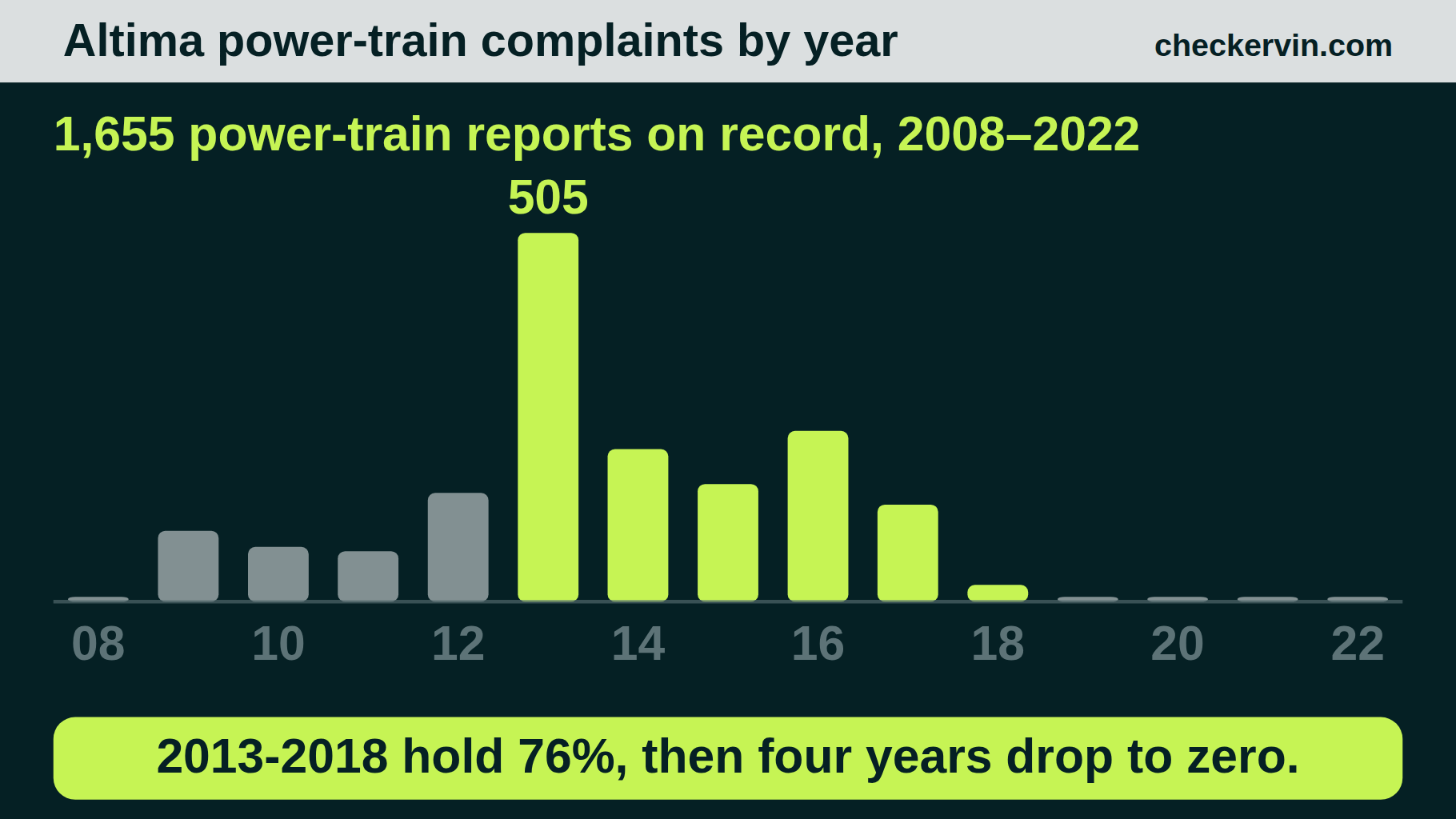
- 76.4% of every POWER TRAIN complaint the Altima has ever recorded sits in the 2013-2018 generation alone — the same six years the settlement targets.
The numbers, and whose numbers they are
RepairPal’s general estimate for a Nissan Altima transmission fluid change is $169 to $197. Its own 2015-model-year page comes back lower, $149 to $177 — and shop reporting outside RepairPal’s own figures runs far wider, from roughly $100 to $455, depending on whether the job is a simple drain-and-fill or a full pan-and-filter service. Every figure here is attributed to whoever published it; we sell VIN checks, not repairs, and price none of this ourselves.
A flat estimator price is a reasonable starting point for a routine fluid service. It says nothing about which of two very different Altima generations is actually parked in the driveway — and on this nameplate, the record shows that distinction matters more than on almost any other car we’ve checked.
What 9,726 complaints say about one hard break
Our corpus of federal NHTSA complaints holds 9,726 reports against the 2008–2022 Altima. POWER TRAIN names 1,655 of them — 17% of the whole record — and it ranks in the model year’s own top-5 complaint types in 10of the nameplate’s 15 years. What sets the Altima apart from every other nameplate posted in this series is how cleanly that history splits: almost all of it sits inside one six-year generation, and almost none of it sits outside it.
The fifth-generation L33 Altima (2013–2018) holds 76.4% of every POWER TRAIN complaint the nameplate has ever recorded — 1,265 of 1,655— ranking as the single most-reported category in three of those six years and peaking at 42.5% of 2016’s own total complaints, the sharpest single-year share in the corpus for this model.
Gann v. Nissan, and why it isn't the Rogue's settlement
Gann v. Nissan North America, Inc. (Case No. 3:18-cv-00966, U.S. District Court for the Middle District of Tennessee) settled a class action over defective CVTs in 2013–2016 model year Altima vehicles, covering roughly 1.4 million cars. Class members could claim reimbursement for qualifying CVT repair costs, a $1,000 voucher toward a new Nissan or Infiniti purchase, or a 24-month/24,000-mile extension of CVT warranty coverage. The court granted final approval in March 2020.
| Nissan CVT settlement | What it actually covers |
|---|---|
| Gann v. Nissan (this page) | 2013-2016 Altima only |
| Stringer v. Nissan | 2014-2018 Rogue, 2015-2018 Pathfinder, 2015-2018 Infiniti QX60 |
These are two separate cases naming two separate sets of nameplates and model years — a Rogue owner and an Altima owner checking “the Nissan CVT lawsuit” are not looking at the same settlement, and one does not extend to the other’s vehicles. Unlike the Rogue’s Stringer settlement, whose 2014–2018 window holds less of that nameplate’s power-train history than the years it doesn’t cover, Gann’s 2013–2016 window sits inside the six-year span that holds the bulk of the Altima’s own power-train complaint record — though it stops two years short of where that generation’s complaints actually end, in 2018.
The generation that breaks clean
The clearest break in the whole record sits at the sixth-generation L34 redesign. POWER TRAIN does not crack the model year’s own top-5 complaint categories at all in 2019, 2020, 2021 or 2022 — 0complaints in that category across four consecutive years — after ranking in the top five in 10 of the previous 14 years. The redesign paired a re-engineered Jatco Xtronic CVT, reported across multiple secondary sources as addressing shudder complaints through chain and control-software changes, with the model’s broader platform overhaul.
Read plainly, that is a real shift in what owners report, and it is a cleaner break than the Rogue shows over the same kind of redesign transition — the Rogue’s equivalent third-generation years still post a small reappearance in their final year on record. It is not proof the underlying CVT design is flawless, and it is not a claim that 2019-and-newer Altimas are defect-free — only that the specific pattern driving this nameplate’s power-train complaints for a decade stops showing up in the record entirely after the redesign.
The 2023 warranty extension nobody's settlement covers
A second, later action sits outside Gann entirely. A 2023 Nissan customer-notification bulletin extended CVT warranty coverage on certain 2017–2018 Altima (along with Sentra and Versa) vehicles from 60 months/60,000 miles to 84 months/84,000 miles, with notices going out starting in May 2023. That window — 2017 and 2018 — is the tail end of the L33 generation’s complaint history and falls entirely outside Gann’s own 2013–2016 coverage, so an owner of a 2017 or 2018 Altima checking only the class-action settlement would miss a warranty extension that actually applies to their car.
NS-2, NS-3, and why the letter matters
Nissan does not specify one CVT fluid across every Altima. Cars built roughly 2007–2012 — the fourth generation — call for NS-2. The fifth-generation L33 (2013–2018) and the redesigned sixth-generation L34 both call for NS-3, a lower-viscosity fluid with different friction modifiers. The two are not interchangeable, and for the 2013-and-newer era this matches the Rogue’s own spec — both nameplates run NS-3 in that window, so a shop quoting “CVT fluid” without naming which letter is quoting an incomplete job regardless of badge.
No federal safety recall has been issued specifically for the Altima’s CVT in this era, across every source checked for this post — the problem has been addressed through the Gann settlement and the 2023 warranty-extension notice rather than a recall campaign, which is one more reason a VIN-based warranty and recall check settles more than a search-result number does.
What a CVT problem sounds like before it costs anything
- A shudder, jerk or hesitation under light acceleration — the symptom most reported against 2013-2016 Altima CVTs in the Gann settlement record
- A whining or humming noise that changes with engine speed rather than road speed
- Delayed or inconsistent engagement when shifting from park into drive
- A dashboard warning or noticeably higher transmission temperature than usual
The order matters because the cheap check comes first: confirm the exact model year and generation by VIN, check whether a warranty extension or settlement benefit ever applied to that specific vehicle, and pull its open recalls — before anyone prices a repair beyond a routine fluid service.
Before you authorize the service
- Confirm the exact model year and generation by VIN before assuming a flat estimator price applies
- Ask whether the CVT has ever had a warranty claim, extension or class-action reimbursement on this specific vehicle's history
- Confirm the shop is using the correct fluid for the generation — NS-2 for 2007-2012, NS-3 for 2013 onward — not a generic universal CVT fluid
- Pull the VIN's open recalls before paying for anything that might already be covered
- Get the quote itemized — fluid brand, quantity and labor — not a single flat-rate line
If you are buying the Altima, not maintaining it
The same record reads as a shopping map. A fifth-generation Altima (2013–2018) carries the heaviest power-train complaint history in the corpus, and whether it falls inside Gann’s 2013–2016 window or the 2017–2018 warranty-extension window changes what benefit, if any, is still available on that specific car. A Nissan VIN decode confirms the exact model year and generation before you price a service or ask a seller about settlement history, and checking what factory or extended coverage remains by VIN settles whether the 2023 CVT warranty extension applies to the car in front of you.
On any candidate car, run the recall lookup before you negotiate, and check which Altima model years show the most complaints overall rather than judging the nameplate by the power-train figure alone. The redesigned 2019-and-newer years show a materially lighter power-train record than the six generations before them — a documented fluid service is usually cheaper than the negotiation it takes to discount around a generation that predates it.
Where this information comes from
- NHTSA — Altima complaint databaseThe federal complaint record this page's figures are computed from, browsable by model year.
- NHTSA — recalls by VINThe official lookup that settles whether a specific Altima has open safety campaigns.
- Gann v. Nissan North America — settlement documentationThe $1,000-voucher/reimbursement/warranty-extension terms for 2013-2016 Altima CVTs, and the March 2020 final approval, cited above.
- NHTSA — Nissan technical service bulletin, 2023 Altima/Sentra/Versa CVT warranty extensionThe manufacturer notice extending CVT coverage on certain 2017-2018 Altimas to 84 months/84,000 miles.
- RepairPal — Altima transmission fluid change estimateThe $169-$197 general range and the lower 2015-specific figure quoted above, retrieved via search September 2026.
Keep reading
Frequently asked questions
How much does it cost to change the transmission fluid in a Nissan Altima?
RepairPal's general estimate runs $169 to $197; its 2015-model-year estimate specifically comes back lower, at $149 to $177. Third-party shop reporting outside RepairPal's own figures ranges much wider, from about $100 to $455, depending on whether the shop treats it as a simple drain-and-fill or a full pan-and-filter service. None of these figures is ours — we sell VIN checks, not repairs — and RepairPal's own site could not be fetched directly in this environment, so treat these as attributed secondary figures, not independently re-verified numbers.
Is the Nissan Altima part of a CVT class-action settlement?
Yes — a different one from the Rogue's. Gann v. Nissan North America, Inc. (Case No. 3:18-cv-00966, U.S. District Court for the Middle District of Tennessee) covers 2013-2016 model year Altima vehicles with a CVT, roughly 1.4 million cars, and offered reimbursement of qualifying repair costs, a $1,000 voucher toward a new Nissan or Infiniti, and a 24-month/24,000-mile extension of CVT warranty coverage. The court granted final approval in March 2020. This is a separate case from Stringer v. Nissan, which covers 2014-2018 Rogue, Pathfinder and Infiniti QX60 vehicles.
Which Nissan Altima model years show the most power-train complaints?
2013-2018 — the fifth-generation L33 Altima, six years out of fifteen. Computed from src/data/models/nissan-altima.json, POWER TRAIN accounts for 1,655 of the Altima's 9,726 total complaints (17%), and 76.4% of that power-train total sits inside those six L33 model years alone. 2016 carries the sharpest single-year share, at 42.5% of that year's own complaints, ranking POWER TRAIN as the single most-reported category that year.
Did Nissan fix the Altima's CVT problem in the 2019 redesign?
The complaint record is consistent with a real shift, though it isn't a defect-free guarantee. POWER TRAIN does not crack the model year's own top-5 complaint categories at all in 2019, 2020, 2021 or 2022 — the sixth-generation L34 redesign, which paired a re-engineered Jatco Xtronic CVT with updated control software — after ranking in the top five in 10 of the previous 14 years. Complaints are unverified owner reports, not a measured failure rate, so this reads as a real change in what owners report, not a certified fix.
What CVT fluid does a Nissan Altima take — NS-2 or NS-3?
It depends on the generation, and the two are not interchangeable. Nissan specified NS-2 for CVTs built roughly 2007-2012, which covers the fourth-generation Altima. The fifth-generation L33 (2013-2018) and the redesigned L34 both call for NS-3, a lower-viscosity fluid with different friction modifiers. For the 2013-and-newer era this matches the Rogue's own spec — both nameplates use NS-3 in that window — so the difference that matters is generation, not badge.
Confirm the generation before you price the service
A free CheckerVIN report shows the factory build, specifications and open recalls for any VIN — confirm what you're actually pricing.
Run a free VIN check