The short answer
- What does it cost?
- RepairPal's per-year figures range from $117-$146 on a 2016 up to $276-$379 on 2018-2022 models. Published estimates, not ours.
- Is the transmission the same across every CX-5?
- Yes. Every model year 2013-2022 uses the same SKYACTIV-DRIVE six-speed automatic and the same ATF-FZ fluid, including across the 2017 redesign.
- Does the complaint record split by generation?
- No. POWER TRAIN places in the nameplate's own top 5 in 8 of 10 model years, spread across both generations rather than concentrated before or after 2017.
The numbers, and whose numbers they are
RepairPal’s own per-model-year estimates for a Mazda CX-5 transmission fluid change spread widely: as low as $117 to $146 on a 2016 model, up to $276 to $379 across 2018, 2019, 2021 and 2022 models, and $347 to $449 on the newest model years it prices. Every figure here is attributed to whoever published it; we sell VIN checks, not repairs, and price none of this ourselves.
None of those estimator pages asks the question this page is actually about: whether the model year you’re pricing sits before or after Mazda’s 2017 redesign, and whether that redesign even changed the job. For the CX-5, it did not.
What SKYACTIV-DRIVE actually is
Every CX-5 built from 2013 through 2022uses the same transmission architecture: Mazda’s SKYACTIV-DRIVE FW6A-EL, a conventional six-speed automatic with a torque converter and a full-range lock-up clutch engaged across all six gears, which Mazda calls “full range direct drive.” It is not a continuously variable transmission (CVT) — a distinction worth stating plainly, because CVTs are common among the CX-5’s own competitors and carry different fluid and service conventions.
The fluid is Mazda ATF-FZ, called out by name in Mazda’s own service literature as the only fluid specified for the SKYACTIV-DRIVE automatic, and Blauparts’ own fitment listings show it applying across the entire 2013-2025 CX-5 span — first generation and second alike, with no change at the 2017 redesign.
The 2017 redesign changed the chassis, not the fluid
Mazda’s second-generation CX-5 (internally “KF”) launched for model year 2017 with what Mazda’s own press materials describe as a reengineered chassis: an expanded front and rear track, and additional high-strength steel that Mazda states raised torsional rigidity by 15.5%. It was a real structural redesign, not a trim refresh.
What it did not touch was the drivetrain. The SKYACTIV-DRIVE FW6A-EL six-speed automatic and its ATF-FZ fluid carried straight across the redesign unchanged, which is a different story from other nameplates in this series — the Toyota 4Runner’s transmission and fluid spec both changed at its own 2010 redesign. A CX-5 shopper does not need to ask “which fluid does my generation take” the way a 4Runner shopper does.
| What changed at 2017 (KF) | What did not |
|---|---|
| Chassis: wider track, reinforced structure (+15.5% torsional rigidity, per Mazda) | Transmission: SKYACTIV-DRIVE FW6A-EL, unchanged |
| Exterior and interior styling | Fluid: Mazda ATF-FZ, unchanged |
What 2,054 complaints say about a break that isn't there
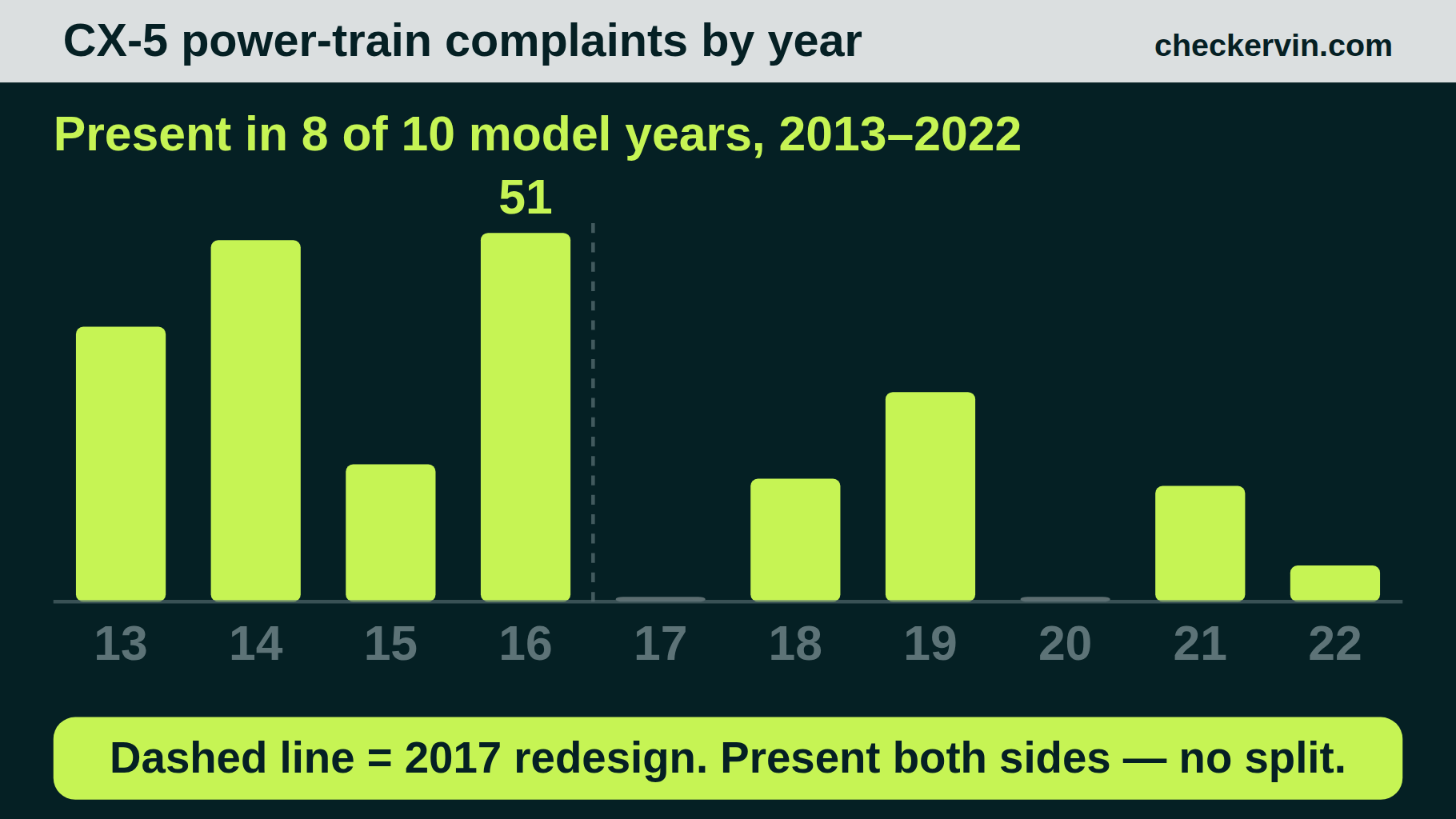
Our corpus of federal NHTSA complaints holds 2,054 reports against the 2013–2022CX-5. POWER TRAIN places in the nameplate’s own top-5 complaint categories in 8 of those 10 model years, at counts ranging up to 51 in 2016 alone. It is absent from the top 5 in only 2017 and 2020— bounded below that year’s own fifth-ranked component count, which ran from 11 to 13. That is not the same claim as zero; it is what the source data can actually support.
What makes this nameplate different from others in this series is where those present years fall: 4 of the 4 first-generation model years (2013–2016) show POWER TRAIN in the top 5, and 4 of the 6 second-generation years (2017–2022) show it too. The two absent years, 2017 and 2020, don’t line up with the 2017 platform break at all — one is the redesign’s own launch year, the other three model years later. Complaints are unverified owner reports, not a measured failure rate, but a pattern spread this evenly across a generation break is itself informative: there is no “bad generation” story to tell here, unlike nameplates elsewhere in this series where the record concentrates tightly around a specific redesign.
“Lifetime fluid” is not “never”
Mazda’s owner’s manuals for SKYACTIV-DRIVE do not list a change interval for the automatic transmission fluid, and Mazda describes the fluid as designed to last the life of the transmission under normal driving. Some owners and even some service writers read that as a lifetime fill that never needs attention.
Independent transmission shops and Mazda forum consensus (Mazdas247, MazdaForum) still commonly recommend a proactive change somewhere around 30,000 to 60,000 miles, sooner in hot climates or under heavy stop-and-go driving. That gap between the factory position and independent practice is exactly the kind of question a flat-price estimator never raises, because it prices the job you already decided to book rather than the decision of whether to book it at all.
What a transmission problem sounds like before it costs anything
- A delay or flare shifting between gears, especially from a stop
- A clunk or hesitation on acceleration under light throttle
- Fluid that looks dark or smells burnt when a shop checks it during service
- Any warning light tied to the transmission or drivetrain
The order matters because the cheap check comes first: pull the CX-5’s open recalls by VIN and get the fluid checked at a routine service before anyone prices a repair beyond what a fluid change actually costs.
Where the money goes
On a routine fluid service, RepairPal’s own spread — $117-$146 on the low end up to $276-$449 on newer model years — tracks fluid quantity and labor rate more than any single defect, and because the transmission hasn’t changed across this nameplate’s run, the job itself doesn’t vary by generation the way it does on other nameplates. On a repair beyond routine service, get the shop to itemize the fluid product by name rather than quoting a single blended “transmission service” line.
Two practical consequences follow. First, confirm the model year by VIN before booking — not because the fluid changes, but because pricing and labor rates still shift with trim and engine option. Second, ask directly whether Mazda ATF-FZ is the product being quoted; a shop substituting a generic ATF is quoting the wrong fluid for this transmission regardless of model year.
Before you authorize the service
- Confirm the fluid quoted is Mazda ATF-FZ by name, not a generic substitute
- Pull the VIN's open recalls before paying for anything that might already be covered
- Don't assume "lifetime fluid" means "never" — forum and independent-shop consensus still points to roughly 30,000-60,000 miles
- Get the quote itemized — fluid brand, quantity and labor — not a single flat-rate line
If you are buying the CX-5, not maintaining it
The record here reads differently than it does for other nameplates in this series: there is no single generation or model-year cluster to shop around. A documented fluid-service history and a clean test drive with no shift delay or flare matter on any CX-5 model year, first generation or second. A Mazda VIN decode confirms the exact model year, engine and transmission before you price a service, and running the Mazda recall check before you negotiate settles whether anything else on the car is already covered.
If the CX-5 is still within its factory coverage window, a warranty check by VINconfirms whether a transmission concern is someone else’s responsibility to fix before you pay for it yourself, and a maintenance report by VIN shows whether the prior owner documented routine service at all.
Keep the power-train figure in proportion, too. Across the full 2013–2022 run, Electrical systemis the single most-cited category in the CX-5’s own record, topping the year-by-year list in 4of the nameplate’s 10model years — more often than power train, engine or any other category. A buyer fixated on transmission history alone is optimizing for a category that isn’t even usually the CX-5’s most frequently reported one.
Where this information comes from
- NHTSA — CX-5 complaint databaseThe federal complaint record this page's figures are computed from, browsable by model year.
- NHTSA — recalls by VINThe official lookup that settles whether a specific CX-5 has open safety campaigns.
- RepairPal — CX-5 transmission fluid change estimateThe per-year $117–$449 range quoted above, attributed to its estimator as retrieved September 2026.
- Mazda USA News — 2017 CX-5 press materialsMazda's own account of the second-generation chassis redesign named above.
Keep reading
Frequently asked questions
How much does it cost to change the transmission fluid in a Mazda CX-5?
RepairPal's own per-model-year figures spread widely: as low as $117-$146 on a 2016, up to $276-$379 across 2018, 2019, 2021 and 2022 models. None of these figures is ours — we sell VIN checks, not repairs, and price none of this ourselves.
Does the CX-5 use the same transmission across every generation?
Yes. Every CX-5 model year from 2013 through 2022, first generation and second alike, uses Mazda's SKYACTIV-DRIVE FW6A-EL six-speed automatic — a conventional torque-converter transmission with a full-range lock-up clutch, not a CVT — filled with the same Mazda ATF-FZ fluid, per Blauparts' own fitment listings spanning 2013 through 2025.
Which CX-5 model years show power-train complaints in the federal record?
Computed from src/data/models/mazda-cx-5.json: POWER TRAIN places in the nameplate's own top-5 complaint categories in 8 of its 10 model years (2013-2022) — on both sides of the 2017 redesign, 4 of 4 first-generation years and 4 of 6 second-generation years. It is absent from the top 5 only in 2017 and 2020.
What changed in the 2017 CX-5 redesign?
Mazda's second-generation (KF) CX-5 launched for model year 2017 with a reengineered chassis and wider front and rear track, reinforced with additional high-strength steel that Mazda states raised torsional rigidity by 15.5%, per Mazda's own 2017 press materials. The transmission and its fluid specification did not change with it.
Does “lifetime fluid” mean the transmission never needs service?
Not in practice. Mazda's owner's manuals for SKYACTIV-DRIVE do not list a change interval for the automatic transmission fluid, and Mazda states the fluid is designed to last the life of the transmission under normal conditions. Independent shops and forum consensus still commonly recommend a proactive change around 30,000 to 60,000 miles, particularly in hot climates or under heavy stop-and-go use.
Confirm the model year before you price the service
A free CheckerVIN report shows the factory build, specifications and open recalls for any VIN — confirm what you're actually pricing.
Run a free VIN check