The short answer
- Does the VIN show the safety equipment?
- It gives you the model year, which is a starting point rather than an answer. The federal mandates key off the manufacture date, and the certification label on the door area carries that.
- The two dates people confuse
- Backup cameras: required on passenger cars manufactured on or after May 1, 2018. Tire pressure monitoring: required on covered vehicles manufactured on or after September 1, 2007.
- Why it matters when buying
- A car sold as a 2018 may have been built months before the camera requirement took effect, so its absence is not evidence anything was removed.
May 2018
Cameras required from
FMVSS 111, manufacture date
Sept 2007
TPMS required from
FMVSS 138 S7.3
25%
Below placard before the light
Not a gentle nudge
2.0 sec
Camera display deadline
From the start of backing
The model year on the paperwork is not the build date
Start with the distinction that the rest of this page depends on, because almost every confusing case comes from collapsing it.
| The date | What it is, and where it comes from |
|---|---|
| Model year | A designation the manufacturer assigns. It appears in the tenth character of the VIN and on your title. A model year commonly begins months before the calendar year it names |
| Date of manufacture | The month and year the vehicle was actually built. It appears on the certification label, not in the VIN |
| Compliance date | What the federal standards are written against — a manufacture date, not a model year |
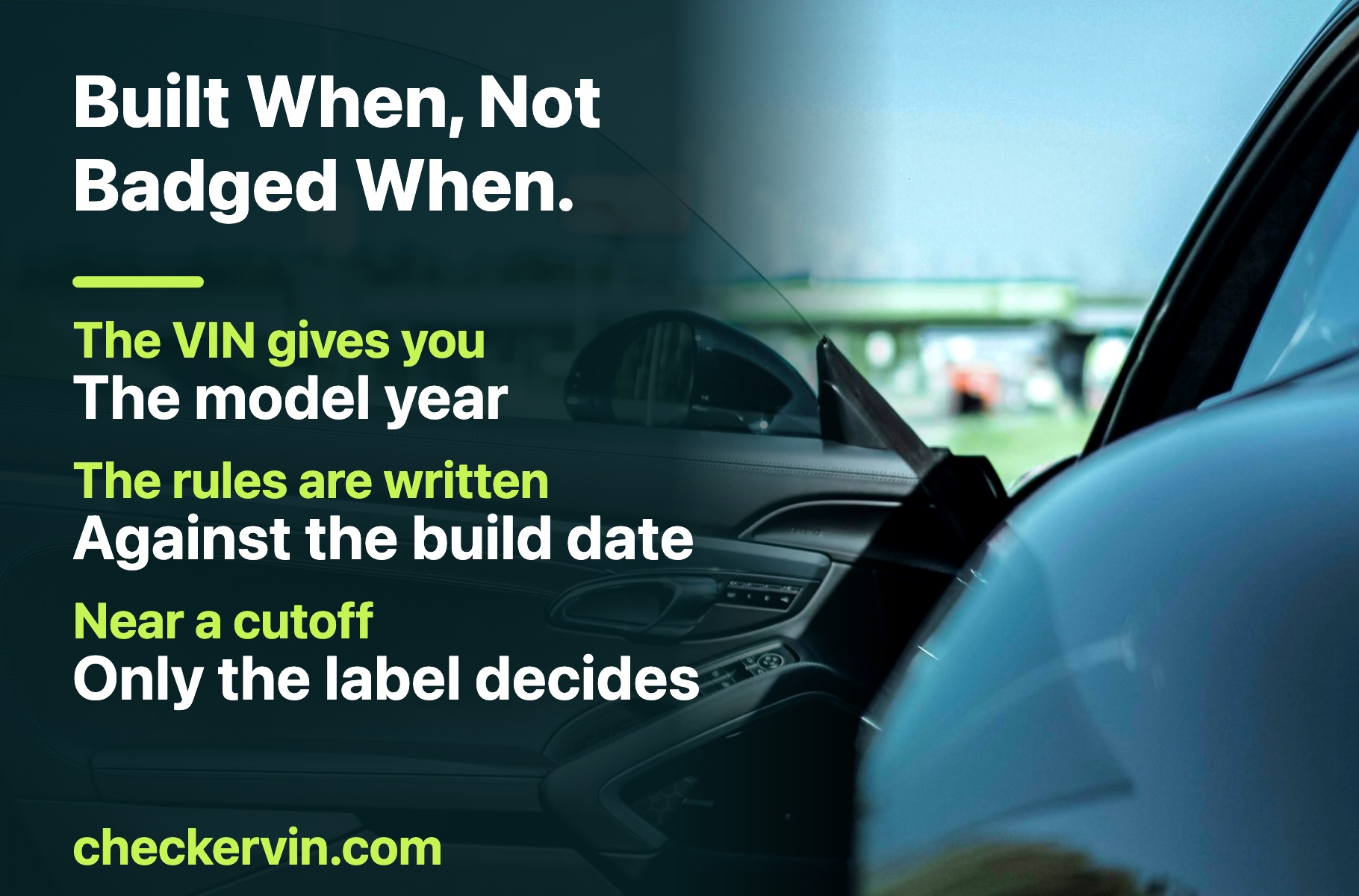
The consequence is concrete. A car registered and advertised as a 2018 model may have rolled off the line in the fall of 2017 or in the spring of 2018. If the requirement you care about started on 1 May 2018, that car sits on one side of the line or the other depending on a fact its model year does not record.
Finding the build date on the actual car
The date of manufacture is on the certification label, in the door area, on the same label that carries the manufacturer name and the weight ratings. It is usually written as a month and year.
That is one of two things worth doing at the car rather than on a screen. The other is confirming the VIN itself matches the paperwork, which is a separate exercise covered on VIN verification.
- Open the driver's door and read the label on the pillar or door edge
- Note the month and year of manufacture, not just the year
- Compare it against the model year the VIN decodes to
- On a car near any cutoff date below, the label is the fact that decides it
- Photograph the label while you are there
When a backup camera became a requirement
Rear visibility is governed by Federal Motor Vehicle Safety Standard 111, at 49 CFR 571.111. The standard applies to passenger cars, multipurpose passenger vehicles, trucks, buses, school buses, motorcycles and low-speed vehicles, with the rear visibility provisions written for vehicles of 4,536 kg GVWR or less.
The dates are stated twice, because the requirement arrived in two stages.
| FMVSS 111 | What it requires and when |
|---|---|
| S5.5(a) phase-in | Passenger cars of 4,536 kg GVWR or less manufactured on or after May 1, 2016 but not later than April 30, 2018 — a percentage of each manufacturer's production had to display a compliant rearview image |
| S5.5(b) final | Each passenger car of 4,536 kg GVWR or less manufactured on or after May 1, 2018 must display a rearview image meeting S5.5.1 through S5.5.7 |
Read the phase-in row carefully, because it is where the intuition breaks. Between May 2016 and April 2018 the obligation fell on a percentage of each manufacturer's production, not on every car. So two identical-looking cars of the same model year, built in the same window by the same company, could lawfully differ. Neither was modified. The rule simply had not reached all of them yet.
What a compliant camera actually has to do
The standard does not merely require a camera. It specifies the picture, and the requirements are worth knowing because they describe what you should see when you test one on a car you are considering.
- S5.5.2 — image size: the visual angle of the specified test objects must average not less than 5 minutes of arc
- S5.5.3 — response time: the image must be displayed within 2.0 seconds of the start of a backing event
- S5.5.4 — linger time: it must not still be displayed once the backing event has ended
- S5.5.5 — deactivation: it stays visible until the driver changes the view or reverse is deselected
- S5.5.6 — default view: it must return to the compliant image at the start of every backing event, whatever the driver selected last time
- S5.5.7 — durability: it must still meet the field of view and size requirements after the specified durability tests
SUVs, trucks and vans: the same dates, a different paragraph
Everything above quotes S5.5, which is written for passenger cars. That leaves the obvious question for anybody shopping for an SUV, a pickup or a van, and the answer is reassuringly simple.
Section S6.2 of the same standard covers multipurpose passenger vehicles, low-speed vehicles, trucks, buses and school buses with a GVWR of 4,536 kg or less, and it carries the identical dates: a phase-in for vehicles manufactured on or after May 1, 2016 but not later than April 30, 2018 covering a percentage of each manufacturer's production, then a final requirement that each such vehicle manufactured on or after May 1, 2018 display a compliant rearview image.
So the cutoff does not shift by body style. An SUV built in June 2018 and a sedan built in June 2018 were under the same obligation. What differs is only which paragraph of the standard you would cite.
When tire pressure monitoring became a requirement
Tire pressure monitoring is Federal Motor Vehicle Safety Standard 138, at 49 CFR 571.138. It applies to passenger cars, multipurpose passenger vehicles, trucks and buses with a gross vehicle weight rating of 4,536 kilograms — 10,000 pounds — or less.
It arrived on a three-step schedule set out in S7, and the dates are precise.
| FMVSS 138 phase | Vehicles manufactured |
|---|---|
| S7.1 | On or after October 5, 2005 and before September 1, 2006 — a specified number of each manufacturer's vehicles |
| S7.2 | On or after September 1, 2006 and before September 1, 2007 — a larger specified number |
| S7.3 | On or after September 1, 2007 — all covered vehicles must comply with all requirements of the standard, except as provided for certain multi-stage vehicles |
For a used car buyer the practical line is September 2007. Before it, monitoring may be present or absent depending on the manufacturer and the individual vehicle. From it, on a covered vehicle, it had to be there.
What that warning light actually means
Here is the part most drivers have wrong, and it changes how you should react to the light on a test drive.
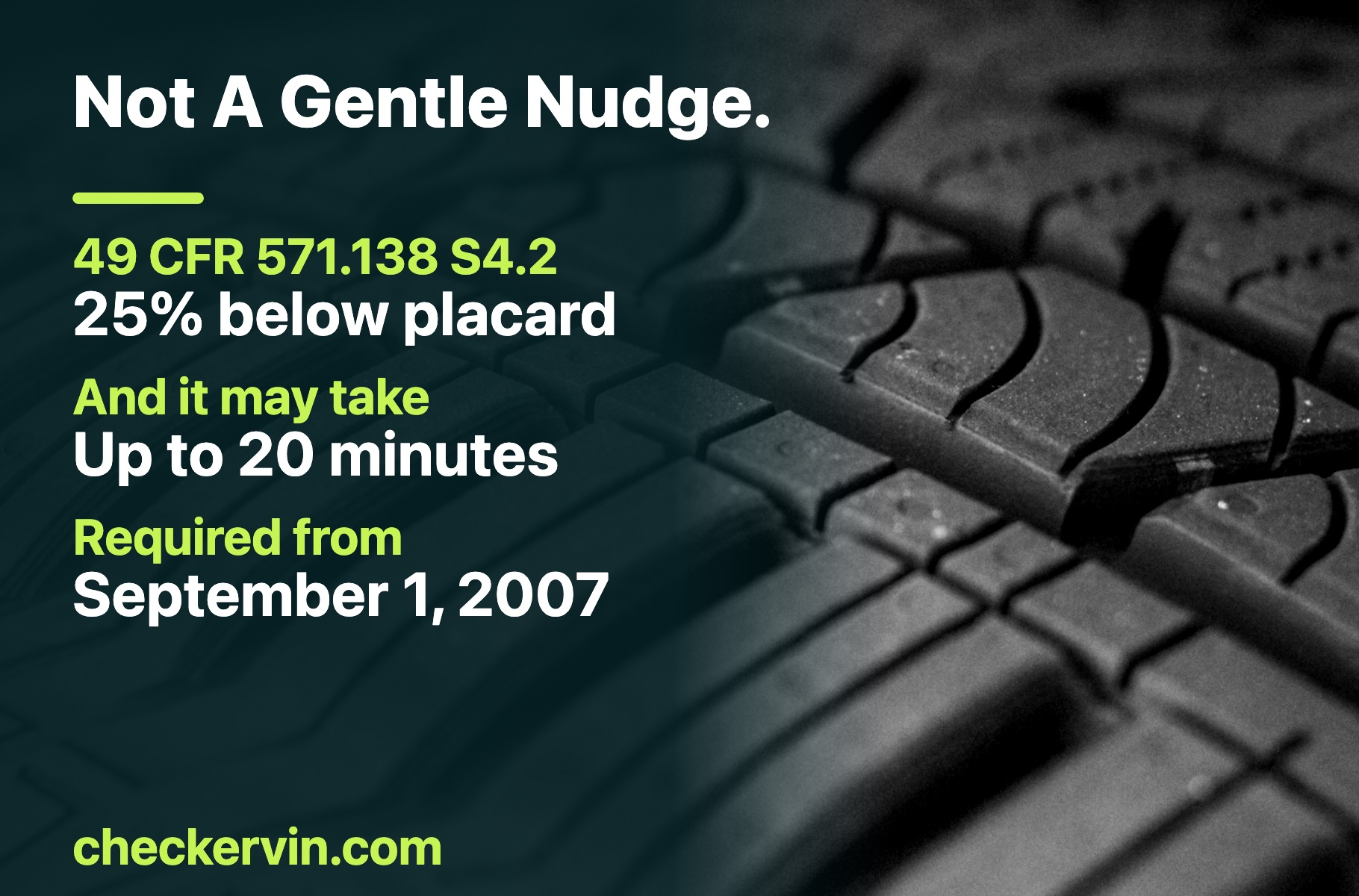
Under S4.2, the system must illuminate a low tire pressure warning telltale not more than 20 minutes after the inflation pressure in one or more of the vehicle's tires, up to a total of four, falls to or below either 25 percent below the manufacturer's recommended cold inflation pressure or a specified minimum level.
Two things follow. The light does not mean slightly soft; by the time it is on, a tire is at least a quarter under the placard pressure, which is a long way down. And the system has a permitted delay of up to twenty minutes, so a tire can already be badly low while the dashboard is still clear. Neither of those is a defect. Both are the standard working as written.
The exception nobody expects
FMVSS 138 carries a carve-out worth knowing if you are looking at anything larger than an ordinary car. The standard applies to covered vehicles of 4,536 kg GVWR or less except those vehicles with dual wheels on an axle.
So a dually pickup inside the weight limit sits outside this requirement. If you are buying one and expecting a pressure monitoring system as standard equipment because of the year, check rather than assume.
The second TPMS light, and what a used-car buyer should read into it
There is a second warning in the same standard that people routinely mistake for the first, and on a used car the difference matters more than almost anything else on this page.
Under S4.4, the vehicle must have a telltale that warns the driver not more than 20 minutes after the occurrence of a malfunction affecting the generation or transmission of control or response signals in the tire pressure monitoring system. That is not a warning that a tire is low. It is a warning that the system which watches the tires has itself stopped working.
The standard offers two ways to provide it. Under S4.4(b) a vehicle may carry a dedicated malfunction telltale, mounted inside the occupant compartment in front of and in clear view of the driver. The alternative in S4.4(c) allows the function to be combined rather than given its own lamp, which is why on many vehicles the same symbol behaves differently — flashing for a period at startup before staying lit — when the fault is the system rather than the pressure.
- A light that flashes at startup and then stays on commonly indicates the system, not the tire
- Sensors have batteries, and they are a normal end-of-life failure on an older car
- They are also a common casualty of cheap tire fitting, which is a repair-quality signal
- A seller saying it just needs resetting is describing the low-pressure warning, not this one
- Ask whether the light was present before the tires were last changed
None of that makes a car a bad buy. It makes the light a question with a specific answer, and the answer tells you something about how the vehicle has been maintained rather than only about its tires.
Stability control, briefly
Electronic stability control is the third mandate people ask about in the same breath, and it is covered in more depth elsewhere on this site. Its standard is FMVSS 126, and the short version for a buyer is that it belongs to the same family of arguments: a requirement with a compliance date written against manufacture, not model year.
The safety case for it, and what the rollover figures actually show, sit on are SUVs safer than sedans, which handles that standard properly rather than in passing.
Checking a specific car, in order
The sequence below takes about five minutes at the vehicle and settles every question on this page for that particular car.
- 1Decode the VIN for the model yearThis narrows the range and tells you which cutoffs are even in play. It is the cheap step and it is free.
- 2Read the build date off the certification labelMonth and year. On any car near May 2018 or September 2007, this is the fact that decides the answer.
- 3Test the camera against the standardSelect reverse and count to two. Check it defaults to the standard view rather than whatever the last driver left selected.
- 4Look at the dashboard before you start the engineNote whether the tire pressure telltale illuminates during the bulb check and then goes out, which is what a working system does.
- 5Ask about anything absent that the dates say should be presentEquipment that was required and is missing is a question worth an answer, and occasionally a sign of a repair nobody mentioned.
What this page cannot tell you
Two honest limits, both worth stating rather than glossing.
First, none of these mandates can be read off a VIN by itself. A decode returns the model year; the standards are written against the date of manufacture; and the label that carries that date is on the car, not in the number. Anyone offering to tell you from a VIN alone whether a specific vehicle has a compliant backup camera is inferring, not retrieving.
It is also worth saying that a standard applying to a vehicle class does not mean every provision inside it applies to every vehicle in that class. The weight thresholds, the dual-wheel carve-out and the multi-stage provisions all narrow it further, and the text itself is the only reliable guide to which of them catches a particular car.
Second, a requirement having applied is not proof the equipment is present and working today. Vehicles get repaired, and cameras and sensors are among the parts a cheap repair can leave disconnected. The dates tell you what should have left the factory. Only looking at the car tells you what is there now.
Our own free check returns the factory build, the specifications and any open safety recall on the VIN. It gives you the model year that starts this process, and the recall check worth running at the same time.
Where this information comes from
- 49 CFR 571.111 — FMVSS 111, rear visibilityThe May 2016 to April 2018 phase-in, the May 1 2018 final requirement, and the S5.5 image specification
- 49 CFR 571.138 — FMVSS 138, tire pressure monitoringThe S7 phase-in to September 1 2007, the 25 percent threshold and the dual-wheel exception
- NHTSA vPIC — public VIN decoderThe model year that starts the comparison, free and without an account
- NHTSA recall lookupOpen safety recalls on the specific VIN, worth running at the same time
Keep reading
Frequently asked questions
Does a VIN tell me if a car has a backup camera?
Not directly. A decode returns the model year, and the federal requirement is keyed to the date the vehicle was manufactured, which is a different thing. The decode narrows it down; the certification label on the door area gives the actual build month and year.
When did backup cameras become mandatory?
Under FMVSS 111, every passenger car with a GVWR of 4,536 kg or less manufactured on or after May 1, 2018 must display a compliant rearview image. A phase-in covering a percentage of production ran from May 1, 2016 to April 30, 2018.
When did tire pressure monitoring become mandatory?
FMVSS 138 phased in from October 2005, and under S7.3 all covered vehicles manufactured on or after September 1, 2007 must comply with the full standard, apart from certain multi-stage vehicles.
What does the TPMS warning light actually mean?
It is not a courtesy nudge. The standard requires the telltale to illuminate when pressure in one or more tires falls to 25 percent or more below the manufacturer's recommended cold inflation pressure, or a specified minimum, and it may take up to 20 minutes to do so.
Can a 2018 car legally have no backup camera?
A car titled as a 2018 model can have been manufactured before May 1, 2018, in which case the final requirement did not apply to it. This is exactly why the build date matters more than the badge on the paperwork.
Start with the model year
Decode the VIN for the factory build and specifications, and check for open safety recalls on that exact vehicle. Free, and no account needed.
Run a free VIN check