The short answer
- What does it cost?
- Estimators run from a $447 average (YourMechanic) to $601–$656 (RepairPal). AutoNation puts the job at about two hours.
- Does a Kia bulletin apply?
- On 2020–2022 Souls with the 1.6-liter turbo, Kia’s August 2026 bulletin ENG263 swaps the alternator pulley to fix stubborn misfires. Ask about it first.
- Is it a Soul EV?
- The 2015–2019 Soul EV has no engine and no alternator. Its 12-volt battery is charged by a DC-DC converter, which Kia has updated by software.
$447–$656
Estimator range, Soul alternator
YourMechanic avg. to RepairPal high; Nov. 2026
12 of 13
Years electrical is in the top five
2010–2022; first only in 2010
0
Soul alternator recalls
NHTSA query, 2010–2022, Soul EV included
1.7 hr
Kia’s time for the turbo pulley job
TSB ENG263, alternator out and back in
The numbers, and whose numbers they are
CheckerVIN decodes VINs and lists open recalls. We do not repair cars, so every price here belongs to someone else, with the date we read it. On November 22, 2026, YourMechanic’s Kia Soul alternator estimate showed an average of $447: about $307 for the part and $140 for labor. AutoNation Mobile Service showed an average of $599, with sample jobs of $411 to $503 on a 2018 Soul and $568 to $694 on a 2021, and said the work takes about two hours. RepairPal’s Soul pages listed alternator replacement at $601 to $656. All three sites refuse direct requests from our research tools, so these figures come from their search listings; each was returned by two separate searches.
Every gas Soul engine is a four-cylinder, and the three estimates sit within a couple of hundred dollars of each other. They still leave out what changes a bill most. A new Kia unit from a dealer costs more than a remanufactured one from a parts store, and the core charge can be a surprise. Compare quotes only once each names the part, its source, the hours and the core. Then ask the question this page is about: does a Kia document change what the shop should be doing?
Where electrical sits in each Soul year
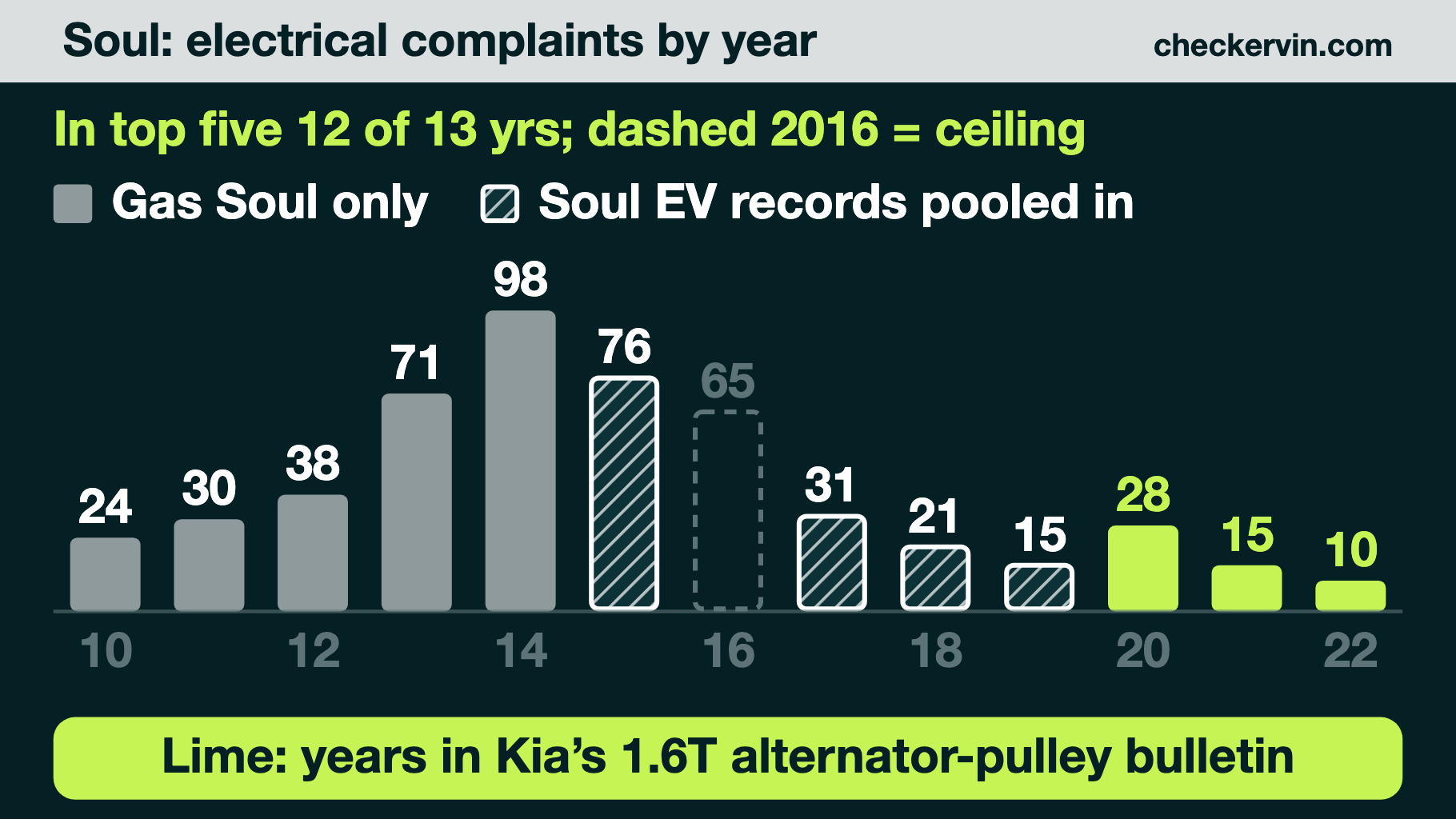
Our corpus holds 5,519 NHTSA complaints against the 2010–2022Soul. NHTSA has no alternator category. The nearest, ELECTRICAL SYSTEM, also takes in the 12-volt battery, wiring, lamps, the radio, locks and control modules, so it is an outer limit on charging trouble and never a count of failed alternators. We keep each year’s top five components. Electrical makes that list in 12 of 13 years, for 457 counted reports, a minimum because anything below fifth place is not in the file. The exception is 2016, when electrical fell below fifth place; the dashed box in the chart is drawn at that year’s fifth-place count of 65, a ceiling, not a measurement.
Electrical ranks first only in 2010, the first model year in our file, with 24 reports out of 135. It is never first again: engine complaints lead in 11 of the Soul’s 13 years. Electrical peaks in 2014 at 98 reports, and it sits at fifth, the bottom of the list, in 2012, 2021 and 2022. The 2010–2014 gas-only years carry 57% of the counted total.
2015–2019: the electric Soul inside the bars
Our files pool every name NHTSA uses for one nameplate, and from 2015 through 2019 NHTSA files Soul complaints under both “SOUL” and “SOUL EV.” The Soul EV is battery-electric. It has no engine, so it has no belt-driven alternator; Kia’s service bulletins describe its 12-volt battery being kept up by a low-voltage DC-DC converter, the LDC. The hatched bars, 143 counted reports or 31% of the total, therefore mix in a car whose electrical complaints cannot be about an alternator. In 2017, the one year where NHTSA’s EV-only list is cleanly separate, more than a third of the 31 electrical reports sit under the EV name alone.
Kia’s own papers show what fills the EV side. Service Action SA201 (bulletin ELE 094, October 2015) reprograms the converter on 2015–2016 Soul EVs built through August 17, 2015, to prevent the 12-volt battery discharging with the car locked and off. Bulletin ELE163 (2019) replaces rear door latches on 2015–2018 Soul EVs that hold a parasitic draw above 50 milliamps after the car goes to sleep; the gas Soul is not on its list. A 2023 Kia note suggests some EV 12-volt drains come from third-party apps logged in to Kia Connect. If anyone quotes an alternator for a Soul EV, ask what part they mean.
What the gas-Soul reports actually describe
A category cannot tell an alternator from a speaker, so we read the complaints. The 2010spike that put electrical first is mostly not charging at all. Owners describe door panels smoking or catching fire around the lighted front speakers, which matches recall 10V388000 for improperly soldered speaker-lighting harnesses, plus dead radios, horns and turn signals. None of that year’s reports mention the alternator.
Across the later years, reports that name the alternator are a small minority, and they follow two patterns. In one, a battery light comes on and the car then loses power steering assist; owners of a 2013, a 2016 and a 2019 describe exactly that, and the 2019 owner says a dealer found a failed screw inside the alternator. In the other, an alternator was replaced and the problem stayed, because the real fault was the engine or the catalytic converter. Given the Soul’s engine recalls, that second pattern deserves weight: a Soul that stalls or loses power is not proven to have a charging fault by a weak battery.
2020–2022 turbo: Kia’s alternator-pulley bulletin
The most specific alternator document Kia has filed for the Soul is recent. Technical Service Bulletin ENG263, dated August 2026, covers 2020–2022 Souls built from November 1, 2018 through May 31, 2022 with the 1.6-liter turbocharged engine, along with the Forte that shares it. The symptom is not a dead battery. It is a misfire, with codes P0300 through P0304, that persists after the plugs, coils and injectors have already been replaced. Kia says the cause can be “excessive torsional oscillation” of the alternator’s overrunning decoupler pulley, the OAD.
The fix takes the alternator out, swaps the OAD for an overrunning alternator pulley (OAP) kit, and replaces the crankshaft damper pulley, its bolt and the drive belt. Kia books it at 1.7 hours on the Soul. It is a field fix done within warranty; past that, a dealer needs approval from Kia’s district manager. Kia also warns its dealers that kit supply “is very limited.” In the chart these years are lime, carrying 53 counted electrical reports at ranks #4, #5 and #5, but those bars count every Soul of those years, including the 2.0-liter cars the bulletin does not cover.
Which Soul, which alternator
“Soul alternator” covers several engines. EPA fuel-economy listings show a 1.6-liter and a 2.0-liter in every year from 2010 to 2019, a 1.6-liter turbo from 2017, and from 2020 a 2.0-liter alongside the turbo. The engine is in the VIN, so an engine lookup by VIN settles which part a parts counter should sell you.
| Soul years and powertrain | What Kia filed about charging |
|---|---|
| 2010–2014, 1.6L or 2.0L | No alternator bulletin found; 2011 battery-terminal notes |
| 2015–2019, 1.6L, 2.0L, 1.6T (2017+) | No alternator bulletin found |
| 2015–2019 Soul EV | No alternator; LDC update SA201, latch drain ELE163 |
| 2020–2022, 2.0L | No alternator bulletin found |
| 2020–2022, 1.6L turbo | TSB ENG263: OAD to OAP pulley kit, 1.7 hr |
Two details in that table are easy to miss. The 2017–2019 Soul also offered a 1.6-liter turbo, but ENG263 names only the third-generation car built from November 2018, so an earlier turbo is outside it even though the engine size matches. And the 2.0-liter of 2020–2022 is the engine Kia recalled for its piston oil rings. On those cars, a complaint of stalling or burning oil points to the engine recalls before the charging system, and a shop that reaches for the alternator first should explain why.
The turbo bulletin also changes how to read a quote. Its kit already includes a new drive belt and crankshaft damper. If a shop proposes an alternator and a belt on a 2020–2022 turbo Soul that has also been misfiring, ask whether the bulletin’s pulley kit should go on instead, and whether the car is still inside the warranty that makes it free.
2011: two notes about the battery terminals
Two short Kia notices from 2011 survive in NHTSA’s files as summaries, without the bulletins attached. TSB-015 warns that adding a ground cable to the battery “may cause sensor problems.” TSB-018 concerns battery terminal covers that some cars received marked with the wrong polarity symbol. Neither is an alternator fault, but both bear on a charging diagnosis. On a 2011 Soul with a battery light, ask whether anything has been added at the battery terminals, and check polarity by the cable, not the cover, before jumping the car or fitting a new battery.
Labor: what Kia’s papers show, and what they do not
The only Kia labor time we found that involves taking a Soul alternator out is ENG263’s 1.7 hours on the 2020–2022 turbo, and that job also includes the crankshaft damper and a new belt. AutoNation’s about two hours for a plain replacement is in the same range. Kia’s flat-rate times for the 1.6-liter and 2.0-liter engines sit in its paid service information, which our tools cannot reach, and we found no primary source saying one Soul engine’s alternator is harder to reach than another. Ask the shop for the hours it bills and the time guide it uses.
One cheaper item belongs on the list first: the battery. The Soul has no alternator-specific recall, and owners in the complaint file describe new batteries and alternators bought one after the other. A battery size lookup by VIN shows what the car should carry, and a load test of the old battery costs little.
Recalls: none name the alternator
We queried NHTSA for every Soul and Soul EV from 2010 to 2022 and searched each campaign for alternator, charging, generator, battery, voltage and 12-volt language, after confirming the search catches those words on a known charging recall for another make. No Soul campaign names the alternator or the charging system. The only match was the 2015–2019 Soul EV’s high-voltage battery recall, 23V218000, which concerns the traction battery, not 12-volt charging. The one electrical-coded Soul recall in our years is 10V388000, the 2010 speaker-lighting harness. A recall check by VIN shows anything still open on a given car.
Before you authorize a Soul alternator
- Ask for the battery test result, the charging voltage with the engine running and the headlights on, and any stored codes
- Confirm the engine by VIN; on a 2015–2019 Soul EV, there is no alternator to replace
- On a 2020–2022 1.6L turbo with a recurring misfire, ask a Kia dealer whether ENG263 applies to the VIN
- On a car that stalls or loses power, ask what ruled out the engine and catalytic converter before blaming charging
- On a 2011 with a battery light, ask whether anything was added at the battery terminals
- Ask whether the alternator quoted is new Kia, remanufactured or aftermarket, and about the core charge
The guide to bulletins versus recalls explains why ENG263 is free only while the warranty lasts, while a recall is free at any age.
If you are buying the Soul, not repairing it
A charging problem rarely shows on a test drive, so ask direct questions. How many batteries and alternators has the car had? Has the battery light come on, or the steering felt heavy at the same time? On a turbo, has it had a misfire repaired more than once? For most Souls the engine record matters more than the alternator, and our Soul engine replacement cost post covers the recalls and extended coverage by year. The Kia Soul years-to-avoid page lays out the full complaint record.
A free CheckerVIN report returns the factory build, engine, specifications and open safety recalls for any VIN. It does not include accident, title, odometer or repair history, so it cannot tell you whether an alternator was replaced or a bulletin was performed. Only the seller’s receipts or a Kia dealer’s VIN lookup can.
Where this information comes from
- Kia TSB ENG263, misfire concern due to overrunning alternator decoupler (NHTSA copy)2020–2022 Soul 1.6L T-GDI built Nov. 2018–May 2022; OAP kit, damper and belt, 1.7 hours.
- Kia TSB ELE 094 / SA201, low voltage DC-DC converter logic improvement (NHTSA copy)2015–2016 Soul EV: converter reprogram to prevent 12-volt battery discharge.
- Kia TSB ELE163, parasitic draw inspection and rear door latch replacement (NHTSA copy)Lists 2015–2018 Soul EV, not the gas Soul; 50 mA threshold.
- Kia Pitstop PS748, Kia Connect and 12-volt battery drain in EVs (NHTSA copy)Third-party apps as a possible cause of EV 12-volt drains.
- NHTSA: recalls by VINOur query of every 2010–2022 Soul and Soul EV found no recall naming the alternator.
- NHTSA: vehicle complaintsThe federal complaint database our electrical counts are computed from.
- EPA and DOE: fueleconomy.govSoul engine and transmission listings by year, including the Soul Electric.
Keep reading
Frequently asked questions
How much does it cost to replace the alternator on a Kia Soul?
Three estimators we checked on November 22, 2026 land in a fairly tight band. YourMechanic shows an average of $447 (about $307 parts, $140 labor), AutoNation Mobile Service an average of $599 with about two hours of labor, and RepairPal $601 to $656. A dealer installing a new Kia unit can charge more. Ask for a quote that names the part, its source, the labor hours and the core charge.
Does the Kia Soul EV have an alternator?
The Soul EV sold from 2015 to 2019 is battery-electric, so it has no engine to turn an alternator. Kia's own bulletins describe its 12-volt battery being kept charged by a low-voltage DC-DC converter (LDC), and Kia issued a software update for that converter on 2015–2016 Soul EVs to stop the 12-volt battery from running down. A quote for an alternator on a Soul EV should be questioned.
Is there a recall on the Kia Soul alternator?
No. Our query of NHTSA's recall database for every Soul and Soul EV from 2010 through 2022 found no campaign naming the alternator or the charging system. The closest Kia document is a service bulletin, ENG263 from August 2026, which replaces the alternator pulley on some 2020–2022 Souls with the 1.6-liter turbo to cure misfires. Bulletins are usually free only within warranty.
How long will a Kia Soul engine last?
There is no single answer, because the Soul used several engines and Kia's records differ for each. Kia ran engine recalls and extended long-block coverage on 2012–2016 Souls with the 1.6- and 2.0-liter direct-injection engines, and piston-ring recalls on 2020–2022 Souls with the 2.0-liter. Our Kia Soul engine replacement cost post goes through those campaigns year by year. For the charging system, owners in NHTSA's complaint file describe alternator replacements at roughly 70,000 to 75,000 miles.
How much is a Kia alternator?
For the Soul, YourMechanic's estimate puts the average part cost at about $307, which reflects non-dealer parts. Genuine Kia units cost more, and price depends on the engine: the Soul used 1.6-liter, 2.0-liter and 1.6-liter turbo engines across these years. Confirm the engine with a VIN decode before buying a part, and ask whether a remanufactured unit carries a core charge.
Check the VIN before you price the alternator
A free CheckerVIN report shows the factory build, engine, specifications and open recalls for any VIN, enough to know which Soul alternator fits, or whether the car has one at all.
Run a free VIN check