The short answer
- What does it cost?
- CarComplaints owner reports put it at $4,620 (2015 Soul) to $7,000 (2016 Soul). Used engines alone listed at about $2,600-$4,800 on Car-Part Planet. None of these are our prices.
- Which years are the problem?
- ENGINE is the Soul's #1 complaint category in every model year 2012-2022. Kia engine recalls or campaigns name 2012-2016 and 2020-2022; none names 2017-2019.
- What should I check first?
- Open recalls on the VIN, then whether the KSDS software campaign was done, then your oil-change records. Any one of them can move the bill to Kia.
12 of 13
Model years with ENGINE in the top five
2010-2022, NHTSA
11 years
ENGINE ranked #1 in a row
2012 through 2022
4
Kia engine safety recalls on the Soul
SC176, SC200, SC209, SC336
14 months
Oil-change gap Kia treats as neglect
Or 10,500 miles, per its bulletin
Three prices, none of them ours
CarComplaints collects owner-reported repair bills, and on the Soul its two most-reported engine pages give the clearest picture of what owners paid. For a 2015 Soul with engine failure, it lists a typical repair cost of $4,620 at an average of 89,500 miles, with “replace engine” as the fix in most of the 26 reports. For a 2016 Soul with a blown engine it lists $7,000 at 100,400 miles, across 10 reports. Both figures were read on November 22, 2026, and both are averages of what a handful of owners chose to report, not a quote you can hold a shop to.
The parts side is easier to pin down. Car-Part Planet, a used and remanufactured engine marketplace, listed used 2015 Soul engines at $2,594 to $3,315 for the 1.6-liter and $2,825 to $3,639 for the 2.0-liter, both with over 110,000 miles on them, and a remanufactured 2015 2.0-liter at $4,558. For the 2021 Soul it listed used 2.0-liter engines from $2,743 to $3,315 and a used 1.6-liter turbo from $3,818 to $4,777. Its used units carry a parts-only warranty, and the listing does not say installation is included, so labor, fluids and any programming come on top.
We sell VIN checks, not engines, and publish no price of our own. The more useful number is often zero: on most Soul model years, Kia has at some point agreed to replace the engine itself when a specific failure shows up. Whether that still applies to your car is what the rest of this page works through.
What 5,519 complaints say about the engine
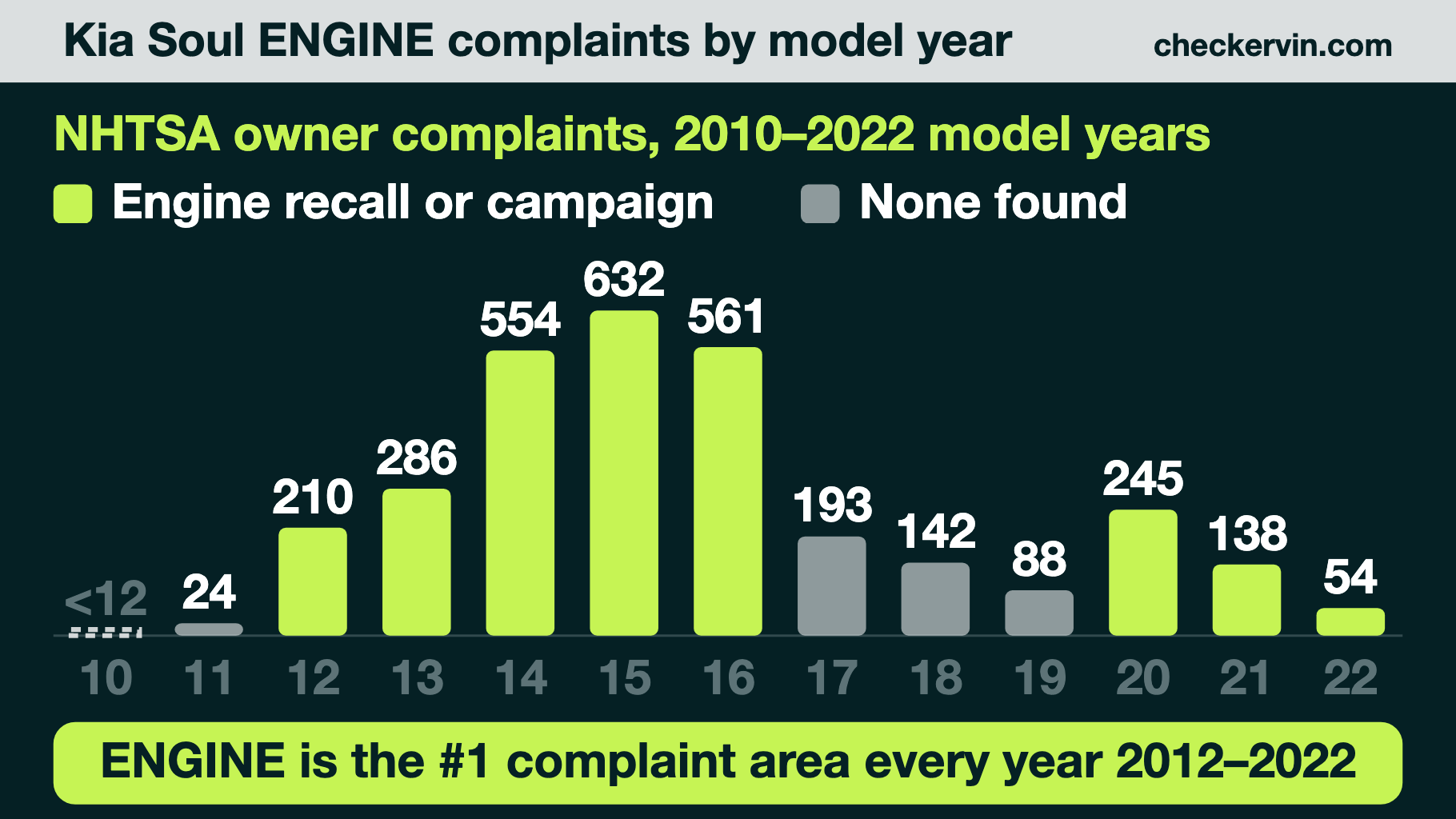
Our corpus of federal NHTSA complaints holds 5,519 owner reports against the 2010–2022Soul. ENGINE appears among a model year’s five most-reported categories in 12 of those 13 years, and it is the single most-reported category in every year from 2012 through 2022. The exception is 2010, where ENGINE sits below that year’s fifth-ranked category of 12 reports.
Counted where it makes the top five, ENGINE accounts for at least 3,127 reports, 56.7% of the whole record, and 71.7% of those sit in the five model years from 2012 to 2016. 2015 is the peak: 632 ENGINE complaints, 69.6% of everything owners filed against that model year.
Read that number carefully. NHTSA has no category for a spun bearing, a scored cylinder or a melted catalytic converter. ENGINE takes every engine fault an owner reports, from a misfire code to a rod through the block, so it is an upper bound on engine trouble and never a count of engines replaced. Complaints are also unverified, and older cars have had longer to collect them. Our data also carries a separate “ENGINE AND ENGINE COOLING” label in 2016, 2021, 2022; we leave it out of the ENGINE totals rather than guess how the two overlap.
Four engines, four different stories
“Soul engine” covers four different engines across these years, and Kia’s documents treat each one separately. EPA fuel-economy listings show a 1.6-liter and a 2.0-liter in every year from 2012 to 2019, a 1.6-liter turbo added for 2017, and a 2.0-liter paired with Kia’s IVT from 2020. The engine is encoded in the VIN, which is why a lookup of the engine by VIN comes before any price comparison.
| Soul years and engine | What Kia filed for it |
|---|---|
| 2012-2016, 1.6L Gamma GDI | Recall SC176 (19V-120); KSDS campaign PI2002A |
| 2014-2015, 2.0L Nu GDI built to May 21, 2015 | Recall SC200 (20V-750), with KSDS |
| 2014-2016, 2.0L Nu GDI | KSDS campaign PI2002B |
| 2017-2019, all engines | No engine recall found |
| 2020-2021, 2.0L Nu MPI | Recall SC209 (21V-259) |
| 2021-2023, 2.0L Nu MPI | Recall SC336 (25V-099) |
| 2017-2022, 1.6L turbo | No engine recall found |
The 2012–2013 Soul’s 2.0-liter is the odd one out among the early cars: Kia’s engine-replacement bulletin for the KSDS campaigns lists the 1.6-liter Gamma for those years and does not list the 2.0. If your 2012 or 2013 has the larger engine, the campaign coverage described below does not reach it.
2012–2016 1.6-liter: the catalytic converter recall comes first
Kia’s first Soul engine recall was not about bearings. Its February 2019 safety recall report to NHTSA, campaign SC176, covers every 2012–2016 Soul with the 1.6-liter GDI built from July 8, 2011 to August 11, 2016, 378,967 cars in all. Kia described a chain of failure: the catalytic converter overheats, substrate particles get drawn back into the combustion chamber, abnormal combustion damages the pistons, and a connecting rod can break through the block. The warning signs it named are a check-engine light and engine knock.
The remedy is an engine-computer update, a new converter if the old one is damaged and, in Kia’s words, depending on the extent of any damage the engine may also be replaced. That last clause is the one that matters for cost. A 1.6-liter Soul with a knocking engine and an open SC176 recall is a recall visit, not a quote.
SC176 did not close the file. A March 2026 revision of Kia’s follow-up bulletin SC176Y tells dealers how to handle cars that already had the recall done and now return with a catalyst efficiency code, P0420, with or without misfire codes. Kia set out a converter-and-engine inspection path for exactly that case, so “the recall was already done” is not the end of the conversation on these cars.
2014–2016 2.0-liter: recall or campaign, depending on the build date
The 2.0-liter GDI Soul sits under two different instruments, and the build date decides which one. Kia’s 2020 safety recall report 20V-750, campaign SC200, lists all 2014–2015 Souls with the 2.0-liter Nu GDI built from July 21, 2013 through May 21, 2015, 123,522 cars, for an engine-compartment fire risk. Dealers inspect for fuel and oil leaks, run an engine test, make repairs up to and including engine replacement, and install the Knock Sensor Detection System software. Because SC200 is a safety recall, it shows on the federal lookup.
The wider group, every 2014–2016 Soul with the 2.0-liter GDI, is covered by product improvement campaign PI2002B, which installs the same software but is not a recall. Both tie the same promise to that install: Kia covers engine long block repairs caused by connecting rod bearing damage for 15 years or 150,000 miles from the first date of service. What the software does, and why the coverage depends on it, is laid out on our Kia engine warranty extension page; we will not repeat it here.
2017–2019: the years no campaign names
Here the record and the paperwork part ways. The 2017, 2018 and 2019 Soul hold 423 ENGINE complaints between them, 64.9% of those years’ reports, and ENGINE is still the #1 category in each one: 193 in 2017, falling to 88in 2019. Yet our queries of NHTSA’s recall database for those model years return no engine recall at all, and the KSDS campaigns stop at cars built by August 11, 2016.
We checked the instrument before trusting that gap: the same query returns all four Soul engine recalls for the years they cover. So the absence is real. For a 2017–2019 Soul, an engine replacement is the owner’s bill unless the car is still inside whatever factory powertrain coverage its first in-service date and mileage leave, which a Kia dealer can read off the VIN.
The volume is lower than in 2014–2016, and a lower count on a newer car is partly just less time on the road. It still does not read like a solved problem, and anyone pricing a 2017–2019 Soul with an engine noise should assume no campaign will pay for it until a dealer says otherwise.
2020–2022: the piston-ring recalls
The redesigned 2020 Soul replaced the 2.0-liter GDI with a 2.0-liter multi-port engine, which Kia’s recall filings call the Nu MPI, and it brought a new failure. ENGINE logs 245 complaints against the 2020 car, the most of any year since 2016, and the 2020–2022 years together hold 437, 60.6% of their own reports.
Kia filed two recalls for it. SC209, NHTSA 21V-259, covers 2020–2021 Souls built from November 24, 2018 to October 24, 2020, where piston oil rings were not heat-treated consistently. SC336, NHTSA 25V-099, followed in February 2025 for 2021–2023 Souls built from July 2, 2020 to April 19, 2022, blaming a quality deviation at the ring supplier. In both, the ring can score the cylinder wall, oil consumption climbs, and the warning signs are noise and the oil-pressure light. Dealers inspect the engine, replace it if needed, and install Piston-ring Noise Sensing System software. Kia’s SC336 filing adds that if that software later sets a fault code, the engine will be replaced.
The 1.6-liter turbo offered on 2020–2022 Souls is not named in either recall, and our NHTSA queries return no engine recall for it. Kia did issue engine-computer logic updates for the 2020 turbo as service actions, which are not recalls and carry no engine coverage.
The oil-change rule that decides a claim
Kia’s campaigns promise a lot, and its dealer bulletins set the conditions. The one that decides most disputed claims is in Kia’s engine-replacement bulletin for the KSDS campaigns, PI2002Y/Z, revised November 2024. Before Kia approves a replacement, the dealer photographs the dipstick, the oil filler cap and the filler opening, and Kia checks oil-change history from dealer records and Carfax-type data, asking the owner for records when those fall short.
- Exceptional neglect includes a single gap between oil changes of more than 14 months and/or 10,500 miles
- It also includes a confirmed excessive-oil-consumption diagnosis that the owner did not have repaired within 30 days or 1,000 miles
- Neglect cannot be applied to an otherwise eligible failure in the car's first 15,000 miles
- Owners get five business days to respond to a records request, and five more to produce them
- Owners who change their own oil can submit a service log with receipts for the oil and filters
Where Kia determines exceptional neglect, the bulletin says repairs are the customer’s responsibility and only the diagnosis is covered. The same flowchart routes cars with a salvage title, or sitting at a used-car dealer or auction, to a separate case before any work starts. For a used-Soul buyer, the seller’s oil-change receipts are worth more than they look.
Reading a replacement quote when Kia won’t pay
When no campaign applies, the gap between two quotes is often scope. Kia’s own bulletins draw the lines a good quote should follow.
- Long block or short block: Kia's KSDS coverage moved from the short block to the long block in 2021, and the two are different jobs at different prices
- Software after the swap: Kia's bulletin pairs engine replacement with an engine-computer update on cars that need KSDS, so ask whether the shop can program it
- The catalytic converter on a 1.6-liter GDI: SC176 links converter damage to piston failure, so a new engine behind a damaged converter is a risk
- Core charge, freight and the warranty term on a used or remanufactured unit, which on the listings we read ranged from parts-only to unlimited miles
- Oil, coolant and filters, which a low quote sometimes leaves to a later line
A used engine with 110,000 miles on it is a used engine of the same design, and on a Soul that matters. If the replacement is a 2012–2016 GDI or a 2020–2022 MPI unit, ask whether it came from a car that had its recall work done.
Before you pay for an engine
- Decode the VIN for model year and engine: 1.6L GDI, 2.0L GDI, 2.0L MPI or 1.6L turbo
- Run the VIN for open safety recalls; SC176, SC200, SC209 and SC336 all appear there
- Ask a Kia dealer whether PI2002A or PI2002B was completed, since those campaigns never show on the federal lookup
- Ask the same dealer for the car's first in-service date and any factory coverage left
- Gather oil-change records before anyone files a claim
- Only then compare used, remanufactured and new engine quotes on the same scope
If you are buying a Soul, not repairing one
Use the same order of checks as a shopping filter. A Kia VIN decode tells you which engine you are buying, and a recall check by VINcatches any of the four engine recalls still open. If the car is a 2012–2016 GDI, the difference between a bulletin, a campaign and a recall is the difference between coverage that shows up on a free lookup and coverage you have to ask a dealer about.
For how the Soul’s other systems compare year by year, our Kia Soul years-to-avoid page ranks every model year on its whole complaint record, not just the engine. And if you are weighing a Soul with a loan against it, our post on whether gap insurance covers a blown engine explains why that policy will not help here.
Where this information comes from
- NHTSA — Kia Soul complaint databaseThe federal complaint record this page's ENGINE figures are computed from, browsable by model year.
- NHTSA — Part 573 recall report 19V-120 (Kia SC176)2012-2016 Soul 1.6L GDI catalytic converter overheating, piston and rod damage; engine replacement depending on damage.
- NHTSA — Part 573 recall report 20V-750 (Kia SC200)Names 2014-2015 Soul 2.0L Nu GDI built July 21, 2013 to May 21, 2015; KSDS and 15-year/150,000-mile long block coverage.
- NHTSA — Part 573 recall report 21V-259 (Kia SC209)2020-2021 Soul 2.0L Nu MPI piston oil rings; inspect, replace engine if needed, PNSS software.
- NHTSA — Part 573 recall report 25V-099 (Kia SC336)2021-2023 Soul 2.0L Nu MPI; engine replaced if the PNSS software later sets a fault code.
- NHTSA-hosted Kia letter — PI2002B owner renotification, February 24, 2026Kia's own wording of the KSDS campaign and the 15-year/150,000-mile long block terms for the 2.0L GDI Soul.
- NHTSA-hosted Kia bulletin — PI2002Y/Z engine replacement instructions, Rev 3Engine list by Soul year and the exceptional-neglect rules: oil-change gaps, records deadlines, first 15,000 miles.
- NHTSA recalls API — Kia Soul by model yearQueried for every model year 2010-2023 on November 22, 2026; no engine recall for 2017-2019.
- CarComplaints — 2015 Kia Soul engine failureSource of the $4,620 typical repair cost at 89,500 miles, read November 22, 2026.
- Car-Part Planet — 2015 Kia Soul enginesUsed and remanufactured engine listing prices quoted above, read November 22, 2026; the 2021 page was read the same day.
Keep reading
Frequently asked questions
How much does it cost to replace a Kia Soul engine?
CarComplaints lists a typical repair cost of $4,620 at an average of 89,500 miles for 2015 Soul engine failures, and $7,000 at 100,400 miles for a blown engine on the 2016 Soul, both from owner reports. The engine alone is a smaller number: Car-Part Planet listed used Soul engines from about $2,600 to $4,800 depending on year and engine, with a remanufactured 2015 2.0-liter at $4,558, before installation. All figures were retrieved November 22, 2026. We sell VIN checks, not repairs, and price none of this ourselves.
Will Kia replace my Soul engine for free?
It depends on the engine, the build date and whether the failure matches a campaign. Kia's recalls on the 2012-2016 1.6-liter GDI (SC176), the 2014-2015 2.0-liter GDI built through May 21, 2015 (SC200), and the 2020-2022 2.0-liter MPI (SC209 and SC336) all allow for engine replacement at no charge when a dealer finds the covered damage. On the 2012-2016 GDI engines, Kia also covers long block repairs for connecting rod bearing damage to 15 years or 150,000 miles once the KSDS software is installed. Under the KSDS campaigns, Kia can refuse a claim it judges to be exceptional neglect, which its own bulletin defines partly by oil-change gaps.
Which Kia Soul years have the most engine complaints?
2015, with 632 ENGINE complaints in our NHTSA data, 69.6% of that model year's reports. ENGINE is the most-reported category in every Soul model year from 2012 through 2022. ENGINE covers every engine fault, from sensors to seizures, so treat it as an upper bound on engine trouble, not a count of engines replaced.
Why do people say don't buy a Kia?
On the Soul, the reputation tracks a real record. Kia filed four engine safety recalls covering Soul model years 2012 through 2016 and 2020 through 2023, plus two software campaigns tied to connecting rod bearing wear, and ENGINE tops the Soul's NHTSA complaints in every year from 2012 on. That says a used Soul needs its campaign status checked before purchase. It does not say every Soul engine fails; complaints are unverified owner reports, and Kia's recall filings estimated about 1% of each population as having the defect.
Will a Kia Soul engine recall show up on the NHTSA lookup?
The four safety recalls will: SC176 (NHTSA 19V-120), SC200 (20V-750), SC209 (21V-259) and SC336 (25V-099). The KSDS product improvement campaigns PI2002A and PI2002B are not safety recalls, so a clean NHTSA result does not tell you whether that software was installed. A Kia dealer can read both from the VIN.
Know the engine before you price the engine
A free CheckerVIN report shows the factory build, engine, specifications and open recalls for any VIN, so you know which Soul and which campaigns you are dealing with.
Run a free VIN check