The short answer
- Can it be done?
- Usually. A junk automobile is bought as material, and most scrap buyers will take a bill of sale and identification instead of a title.
- So no record is created?
- The opposite. The yard owes NMVTIS a monthly inventory of every junk or salvage car it obtains, and the VIN and your name are both required fields.
- What is the real exposure?
- Not the sale falling through. It is your name attached to a VIN in a federal record while you hold nothing proving when the car left you.
What “no title needed” is actually saying
Search this question and every result answers the same narrow version of it: which buyers will accept a car without the certificate, and what to bring instead. That answer is usually correct. A junk automobile is being purchased as material rather than as a vehicle, and the scrap trade is built to work that way.
What none of those pages mention is that the sentence is about the buyer’s intake, not about the record. Whether a title changes hands has no bearing on whether the transaction is reported to the federal government, because the reporting duty was never attached to the title in the first place. It attaches to the yard obtaining the car.
That is the whole reframe this page exists for. You arrive worried the sale cannot happen. The thing worth your attention is what happens after it does.
Monthly
How often the yard reports
An inventory of every junk or salvage car obtained — 28 CFR 25.56(a)
Your name
A required field
§25.56(b)(4) — the individual or entity the automobile came from
Under 5/yr
Who is exempt
§25.56(g) — handlers below five vehicles a year do not report
The report the yard files whether or not you bring a title
The rule is 28 CFR 25.56(a), part of the regulations governing the National Motor Vehicle Title Information System. It requires any individual or entity engaged in the business of operating a junk yard or salvage yard within the United States to provide the NMVTIS operator, on a monthly basis, an inventory of all junk automobiles or salvage automobiles obtained in whole or in part in the prior month.
Read the trigger carefully, because the wording is doing precise work. The duty is owed by an entity that obtained the automobile. It is not conditioned on a title being surrendered, on the seller signing anything, on the car being roadworthy, or on money changing hands in any particular way. If the yard took the car, the car goes on the list.
This is why the two questions come apart so cleanly. Your state decides what paperwork the yard needs from you before it can buy. The federal rule decides what the yard owes afterwards. A guide that answers only the first has answered the easier half.
The five things the monthly inventory has to contain
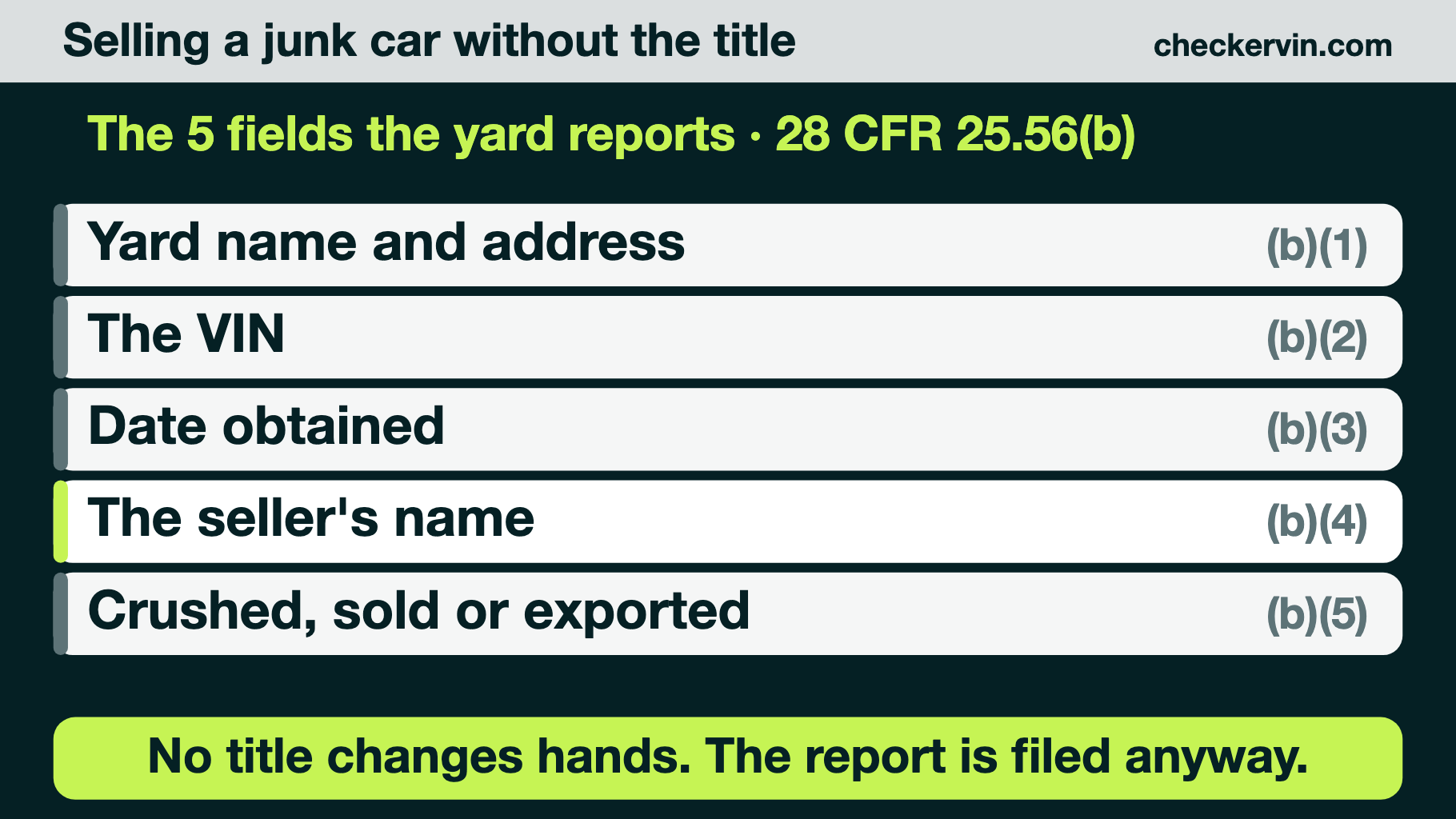
§25.56(b) enumerates them, and the list is short enough to reproduce in full. Each line below is the regulation’s own requirement, not a summary of industry practice.
| Required field | What it is |
|---|---|
| §25.56(b)(1) | Name, address and contact information for the reporting yard |
| §25.56(b)(2) | The VIN |
| §25.56(b)(3) | The date the automobile was obtained |
| §25.56(b)(4) | The name of the individual or entity from whom it was obtained |
| §25.56(b)(5) | Whether it was crushed or disposed of, to whom, and whether it is intended for export |
The fourth row is the one worth sitting with. It is you, by name, recorded against that VIN, in a system built so that a future buyer anywhere in the country can be told this vehicle went to a junk yard.
The fifth row matters for a different reason: it distinguishes a car that was crushed from a car that was sold on, and it flags vehicles headed for export. A junk car is not necessarily destroyed. Parts vehicles get resold, and a shell with a legible VIN can travel a long way after you last saw it.
The five-vehicle line that decides whether anyone reports at all
Buried at the end of §25.56(g) is a threshold that changes the answer entirely for small operators: individuals and entities that handle fewer than five vehicles per year determined to be salvage, junk or total loss are not required to report under the salvage-yard requirements.
So the person answering a classified advertisement with a trailer and cash, who takes three or four cars a year, is outside the reporting regime. The yard on the industrial estate is not. Same transaction from where you stand, entirely different federal footprint, and the dividing line is a number neither party is likely to mention.
It is worth noticing how often this shape recurs in vehicle regulation. The Federal Trade Commission’s used-car rule defines a dealer by a five-vehicle test as well, which is why a private seller owes you no Buyers Guide and a small lot does. Whether a rule reaches the person in front of you frequently turns on a count they keep and you cannot see.
Junk and salvage are different words with different tests
The regulation defines both at §25.52, and they are not interchangeable. Getting them the wrong way round changes what you should expect to happen to the car.
| Term | The test the regulation applies |
|---|---|
| Junk automobile | Incapable of operating on public streets, roads and highways, AND has no value except as a source of parts or scrap |
| Salvage automobile | Damaged by collision, fire, flood, accident, trespass or other event such that salvage value plus repair cost would exceed its fair market value immediately before the event |
The junk test is conjunctive and strict: both limbs must be satisfied. A car that still drives is not a junk automobile however tired it is, and a car with resale value beyond parts is not one either. Plenty of vehicles people describe as junk are, in the regulation’s terms, simply cheap.
The salvage definition is the familiar economic one, and it expressly includes automobiles determined to be a total loss under the law of the applicable jurisdiction or designated a total loss by an insurer under its policy. If an insurer has already touched this car, it is likely salvage rather than junk — and the branding consequences are covered on our pages about salvage certificates and branded titles.
Why your name sitting in that record is the part to plan around
Consider the sequence. The yard takes the car in March and reports it in the April inventory, listing you as the source. Somewhere in that gap, and possibly well beyond it, the state’s registration records still show the vehicle as yours because nothing has been filed to say otherwise.
That interval is where the costs live. Parking tickets, toll charges, abandonment notices and storage fees are all pursued against the registered owner, and none of them care that the car is a cube. If the yard sold the shell on rather than crushing it, the interval can be much longer than you assumed.
The federal report is not your protection here, because it is filed by someone else, on their schedule, for a system you cannot query about yourself in real time. Your protection is the state filing you make on the day — which is the section below, and the step almost every guide to this question leaves out entirely.
The three situations where no separate federal report is filed
§25.56 excuses the yard in three circumstances, and they are worth knowing because each one changes where the record lives rather than whether one exists.
- 1The state already collects it — §25.56(c)Where a junk or salvage yard already reports this information to the state, and the state makes it available to the NMVTIS operator, the yard is not required to report it again. The record exists; it simply arrives by a different route.
- 2An authorized third party reports on their behalf — §25.56(f)Where the required data reaches the operator through an operator-authorized third party, such as a state or another public or private organization, the yard is not required to duplicate the reporting.
- 3Below the five-vehicle threshold — §25.56(g)Handlers of fewer than five salvage, junk or total-loss vehicles a year fall outside the salvage-yard requirements altogether. This is the only one of the three where no federal record is created at all.
There is also a narrower carve-out at §25.56(f) for a vehicle covered by a verification issued under 49 U.S.C. 33110 stating that the automobile or its parts are not reported as stolen. And §25.56(d) allows the operator to require a supplemental report where final disposition was unknown at first filing, or where what actually happened to the car differs from what was first reported.
Shredders, and the point where the VIN stops being readable
§25.56(h) handles the end of the chain, and it explains something that confuses people who go looking for their old car in a database.
Scrap metal processors and shredders that receive automobiles for recycling in a condition that generally prevents VINs from being identified are not required to report, provided the source of each vehicle has already reported it. Where a supplier’s compliance cannot be ascertained, however, the processor must report the vehicles based on a visual inspection if possible.
The design intent is a single reliable record rather than several partial ones. The practical consequence for a seller is that the report which matters is almost always the first one, filed by whoever took the car from you. If that entity was under the five-vehicle threshold, the chain may have no federal entry at any link.
What your state wants, which is the part that actually protects you
Federal reporting builds the national record. It does not release you from ownership. That release is a state filing, and its name varies: notice of transfer, release of liability, notice of sale, seller’s report of sale. The function is identical everywhere — it tells the state you no longer have the vehicle, from a date certain.
Deadlines are short and the clock usually starts on the day of transfer, not on the day you get round to it. Our guide to the release of liability covers the mechanism, and certificates of destruction covers the instrument some states issue when a vehicle is scrapped rather than sold on.
If the title is genuinely gone rather than merely inconvenient, a duplicate titleis often faster and cheaper than sellers expect, and it removes the question entirely. And if the car is not actually yours on paper — a vehicle left on your property, an estate car, something bought years ago and never transferred — that is a different problem with a different route, covered on abandoned vehicle titles.
Before the truck arrives
None of this takes long, and each item exists because someone skipped it and paid for the gap afterwards.
- Photograph the VIN plate and the odometer before the car leaves
- Get a signed bill of sale showing the date, the VIN and the buyer's business name
- Ask whether the yard reports to NMVTIS, and note the answer
- File your state's notice of transfer or release of liability the same day
- Remove the plates unless your state says they stay with the vehicle
- Cancel the registration and insurance only after the transfer is filed
- Keep the bill of sale — it is the only proof of date you will hold
- Check the VIN's record yourself so you know what it said beforehand
The third item is the one nobody thinks to ask, and it takes a sentence. A yard that reports is a yard whose intake becomes part of the national record attached to that VIN. A yard that does not is within its rights if it is small enough — and you now know that your own paperwork is carrying the whole weight.
Where this information comes from
- 28 CFR § 25.56 — Responsibilities of junk yards, salvage yards and auto recyclersThe monthly inventory duty, the five required fields, the exemptions and the five-vehicle threshold. Read in full rather than summarized.
- 28 CFR § 25.52 — DefinitionsWhere junk automobile and salvage automobile are defined, and where the two-limb junk test comes from.
- NMVTIS — approved vehicle history report providersThe Department of Justice's own list of providers licensed to sell the record these reports feed into.
- NHTSA recall lookupFree open-recall check by VIN, useful before deciding a car is worth only its scrap value.
Keep reading
Frequently asked questions
Can I legally sell a junk car without the title?
In many states yes, and the scrap industry is built around it — a junk automobile is being bought as material rather than as a vehicle, so the buyer often accepts a bill of sale, photo identification and a signed statement instead. What varies is the state, not the federal layer. The federal rule does not require you to produce a title to a junk yard; it requires the junk yard to report the transaction. Those are two different questions and the guides answering this query almost always answer only the first.
Does the scrap yard report the car if there is no title?
Yes. 28 CFR 25.56(a) requires any individual or entity operating a junk yard or salvage yard in the United States to give the NMVTIS operator a monthly inventory of every junk or salvage automobile obtained in the prior month. The duty attaches to the yard obtaining the car, not to any document you hand over. A missing title changes nothing about whether the report is filed.
What information does the yard have to report about me?
Five things, listed at 28 CFR 25.56(b): the reporting entity's own name, address and contact details; the VIN; the date the automobile was obtained; the name of the individual or entity from whom it was obtained; and a statement of whether it was crushed or disposed of, to whom it was transferred, and whether it is intended for export. The fourth item is you. Your name enters a federal system attached to that VIN.
Are there scrap buyers who do not have to report?
Yes, and the threshold is specific. Under 28 CFR 25.56(g), individuals and entities handling fewer than five vehicles a year that are determined to be salvage, junk or total loss are not required to report under the salvage-yard requirements. A yard is also excused under 25.56(c) where it already reports the same information to the state and the state passes it to the operator, and under 25.56(f) where an authorized third party reports on its behalf.
Should I file anything with the state before scrapping the car?
Almost always, and it is the step people skip. Most states want a notice of transfer or release of liability filed by the seller, which is what severs your responsibility for the vehicle after it leaves. Scrapping is still a transfer. Filing it protects you against tolls, tickets, abandonment costs and storage fees charged against a car you no longer have, in the window before the yard's own paperwork catches up.
Check the VIN before the car goes
Decode the factory build and any open safety recalls free. Seventeen characters, no account, no card — and worth knowing what the record said while the vehicle was still yours.
Run a free VIN check