The short answer
- What does it cost?
- Estimator averages run $405 (YourMechanic) to $534 (AutoNation). A new Honda 1.5T alternator lists at $857.18, part only.
- Is it really the alternator?
- Test first. Honda filed no CR-V alternator bulletin in 2008–2022, but several on the battery’s charge, including a charge-mode software fix for every 2012–2014 CR-V.
- Hybrid?
- Honda describes the CR-V Hybrid’s 12-volt battery being recharged by a DC-DC converter. Get the part number before approving an alternator.
$405–$534
Estimator averages, CR-V alternator
YourMechanic, AutoNation; Nov. 2026
$857.18
Honda 1.5T alternator list price
HondaPartsNow MSRP, part only
0
CR-V alternator recalls, 2008–2022
NHTSA query, CR-V and CR-V Hybrid
16%
Electrical share, documented years
vs 14% in the other years
The numbers, and whose numbers they are
CheckerVIN decodes VINs and lists open recalls. We do not repair cars, so every price here belongs to someone else, with the date we read it. On November 22, 2026, YourMechanic’s CR-V alternator estimate showed an average of $405, about $223 in parts and $182 in labor. AutoNation Mobile Service showed an average of $534 and said the job takes about two hours. Both sites refuse direct requests from our research tools, so we read those figures from their search listings; two separate searches returned the same YourMechanic numbers. We could not find a RepairPal estimate for this job, and we left out a figure a secondary site attributes to RepairPal because we could not check it.
Those averages lean on aftermarket or remanufactured parts. A new Honda unit costs more on its own: HondaPartsNow lists the 2017–2022 1.5-liter turbo alternator at $857.18 MSRP and the 2012–2014 unit at $969.15, before labor, tax or a core charge. List prices move, too. Our Accord post recorded a lower MSRP for the same turbo part a month earlier. Get a quote that separates part from labor and names the part’s source. Then ask the harder question: what test says the alternator is the problem?
How much of each CR-V year is electrical
Our corpus holds 11,098 federal NHTSA complaints against the 2008–2022CR-V, with the CR-V Hybrid’s reports pooled into 2020–2022. NHTSA has no alternator category. The nearest one, ELECTRICAL SYSTEM, also takes in the 12-volt battery, wiring, lighting, door locks and control modules, so it is an outer limit on charging trouble and never a count of failed alternators. Our data keeps each year’s top five components; electrical makes that list in every CR-V year, so nothing here is uncounted by omission. Across the run, 1,694 counted electrical complaints make up 15% of the total.
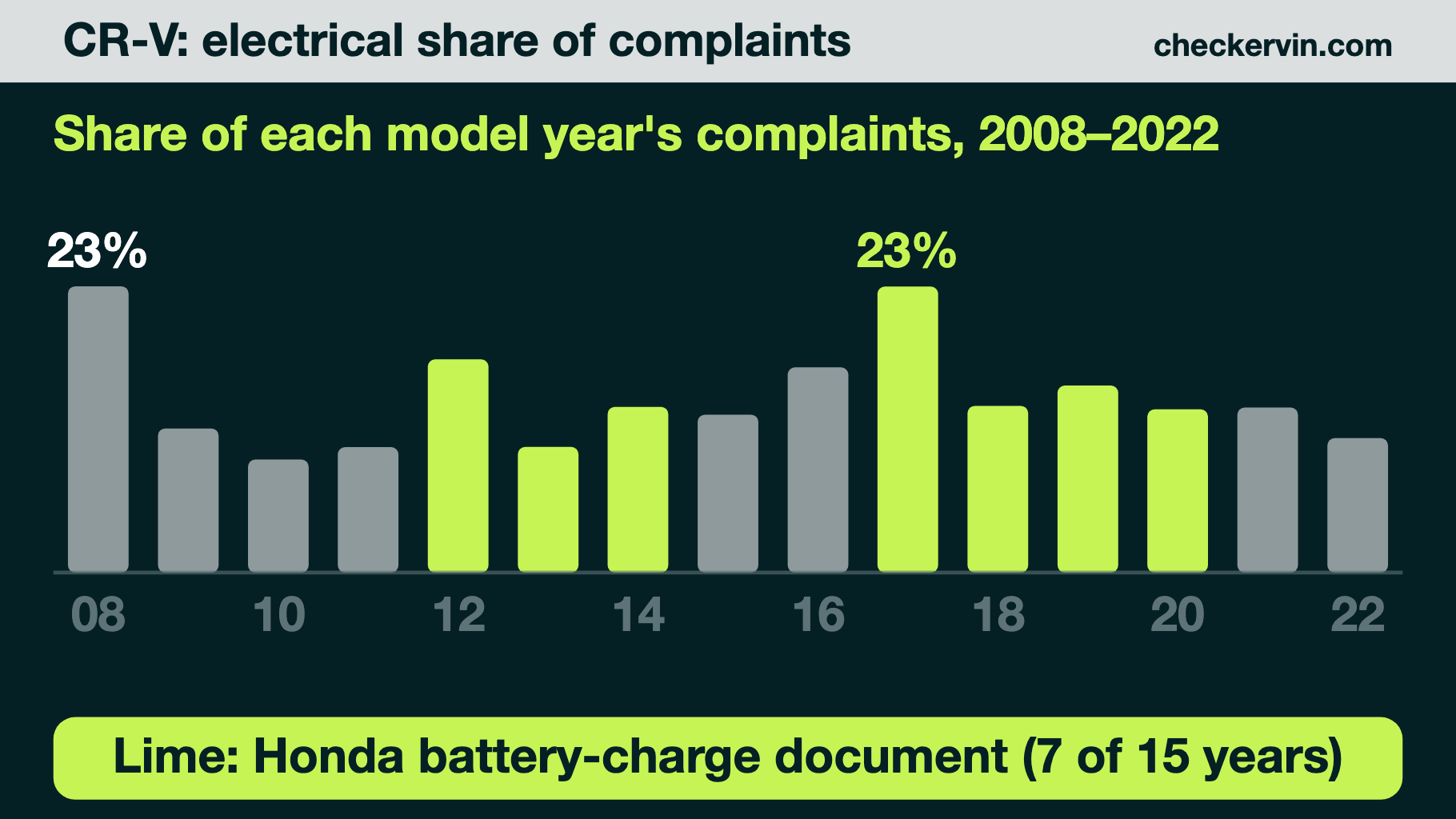
Our starter analysis counted these reports by year. Here the question is share: how much of each year’s complaint load is electrical? Two years stand out above the rest. The 2008 CR-V reaches 23%, and the 2017 reaches 23%. They are not the same story. The 2008’s electrical complaints read mostly as door locks that lock and unlock by themselves, alongside its 200 separately coded latch and lock reports. The 2017’s read as dead batteries and warning lights, and Honda filed paperwork about both.
The lime bars in the chart mark the years where Honda filed a document about the 12-volt battery’s charge. Those years average 16% electrical; the rest average 14%. Among the later years, the 2016, at 16%, is the exception we could not tie to a Honda charging document. None of these documents blames the alternator.
Fifteen model years, no alternator bulletin
We pulled every manufacturer communication Honda filed with NHTSA for the 2008–2022CR-V and the 2020–2022 CR-V Hybrid and searched them for alternator, charging, generator and battery language. To make sure the search could see the word, we checked that it caught the documents we already knew mention it. It did. Only one alternator document turned up, and it is not about the CR-V: Service Bulletin 12-002, Honda’s 2012 rule that a warranty alternator on any 2005–2012 Honda needs a GR8 tester printout reading REPLACE ALTERNATOR. That bulletin covers the 2008–2012 CR-V along with every other Honda. Our Accord alternator post walks through how it works.
The recall database is just as quiet. We queried NHTSA for every CR-V model year from 2008 to 2022and every CR-V Hybrid from 2020 to 2022. No campaign’s component, summary or consequence names the alternator. The one charging recall belongs to the hybrid (more below). For the gasoline CR-V, then, an alternator is a normal wear part with no Honda defect story behind it. When one fails it is a paid repair, and the paper trail Honda did leave points somewhere else first.
2012–2014: the computer decides when to charge
The fourth-generation CR-V does not charge its battery at a fixed voltage. A sensor on the battery reports its condition, and the engine computer picks a charging mode from that. In February 2013 Honda published Service Bulletin 12-041 under a blunt title, “The Battery Is Dead and Needs Multiple Jump-Starts.” By July 2014 the bulletin had been revised twice and widened to every 2012, 2013 and 2014 CR-V. Its stated cause: based on how sulfated the battery is and how the owner drives, the computer “may not select the correct charge mode.”
The fix is software, not hardware. A technician tests the battery on Honda’s GR8 station, replaces it if it fails, then updates the engine computer. Honda booked the job at 0.4 hours under normal warranty. The bulletin’s notes are the useful part for anyone holding an alternator quote. Honda lists the other causes of a CR-V that keeps needing jump starts: a faulty alternator, yes, but also a faulty or sulfated battery, a parasitic draw and loose battery cables. It also warns that a jump start gets a car to a shop and does not recharge the battery.
These three years make up 13% electrical, and the 2012 bar is the tallest of them at 17%. The complaints match the bulletin’s language closely. Owners of 2012 CR-Vs describe batteries replaced again and again, jump starts after short trips, and alternators replaced with nothing changed. A few report that a test found a real charging fault. Honda also ran a separate owner-notified update on 2012 models, covered in our CR-V starter post together with the 2017 and 2019 drain fixes.
2017–2018: Honda wanted the original batteries back
The 2017 CR-V is the tallest documented bar in the chart, at 23%. The 2017 and 2018 together hold 687 counted electrical complaints, 41% of all the CR-V’s. The software drains Honda fixed on these cars are in the starter post. The document that post does not cover tells you Honda itself was looking at the battery.
In September 2018 Honda started a 12-volt battery collection program for 2017 and 2018 CR-Vs. A dealer message dated October 24, 2018 tells dealers what to do when they replace an original Honda battery, part 31500-TLA, more than a year after the car was sold: call Honda’s technical research group, tag the battery with a tracking number, and set it aside from the normal core returns so it can be collected separately. In April 2019 Honda changed the rules and widened the program. It now wanted any original battery on a 2017–2018 CR-V that Honda’s GR8 or ED-18 tester had failed, along with batteries from some Accords and Pilots.
The messages do not say what Honda found, and we located no bulletin that followed them. What they do show is that Honda was collecting failed original batteries from these exact model years for study. For an owner, the lesson is about order. On a 2017–2018 CR-V with charging trouble, the battery is the component Honda itself was investigating, and it costs a fraction of an alternator. The battery size lookup by VIN shows which battery the car should carry.
Every warning light at once is not an alternator diagnosis
A category share cannot tell an alternator from a battery, so we read every CR-V complaint from 2008 to 2022that mentions the alternator. On the 2017–2019 cars one symptom comes up over and over: the dash lights up with every driver-assist, stability and brake warning at once, sometimes with stalling or a shudder. Owners describe paying for a battery, then an alternator, then spark plugs or injectors, and the warnings coming back. Some clear them by restarting the car. Several write that the battery and alternator “tested good.”
The 2015–2016 complaints read like the 2012s: new batteries drained overnight and alternators replaced, sometimes twice, while others report a real failure found on a test, such as a bad diode. On the newest gasoline CR-Vs owners rarely mention the alternator at all. A complaint that mentions the part is not proof the part failed. Read these as a pattern of misdiagnosis risk, not a failure rate.
Which alternator your CR-V takes, and what it lists for
Honda changed the alternator with nearly every generation, and some generations take more than one. The list prices below were printed in HondaPartsNow’s alternator catalog on November 22, 2026. They are MSRP for the part alone; sale prices are lower and vary by seller. Confirm the fit by VIN before you buy.
| CR-V | Part and list price we could confirm |
|---|---|
| 2007–2011 (2.4L) | 31100-RTA-033, Denso; $582.47 MSRP |
| 2012–2014 | 31100-RX0-A01; $969.15 MSRP |
| 2015–2019 (seller fitment) | 31100-5X6-J01RM, Honda remanufactured; $533.37 MSRP |
| 2017–2022 (1.5L turbo) | 31100-5PA-A01, Denso; $857.18 MSRP (shared with Accord, Civic) |
| 2020–2022 Hybrid | Honda documents describe a DC-DC converter charging the 12-volt battery; get the part number in writing |
Two things follow from the table. First, the gap between a Honda part and the estimator averages is mostly the part. Second, a Honda remanufactured unit, where one exists, sits well below new. A Honda VIN decode confirms the engine and trim, which decide the part.
Labor and access: what we could and could not confirm
We could not get Honda’s own flat-rate time for replacing the alternator on any CR-V engine, or its removal procedure. Those live in Honda’s paid service information, which our tools cannot reach. AutoNation’s estimate says about two hours, and YourMechanic’s average labor of $182 is in the same range at independent-shop rates. Neither breaks the time out by generation, so we will not guess which CR-V is hardest to reach.
What we can say is where the labor goes when the diagnosis is wrong. Honda books the 12-041 battery test and software update at 0.4 hours. On the 2017–2018 cars the part Honda itself was collecting for study was the original battery, a fraction of the price. An alternator replaced on a car that needed one of those is a repair you pay for twice. Ask the shop to write down the hours, the test readings, and the part it intends to fit.
CR-V Hybrid: the 12-volt battery is charged another way
The 2020–2022 CR-V Hybrid uses Honda’s two-motor system, and Honda’s own documents describe its 12-volt charging differently from the gasoline car. In December 2020 Honda filed recall 20V-798 for 4,728 CR-V Hybrids built between January and June 2020. Its defect report says the DC-DC converter inside the power control unit can shut down from overvoltage in cold weather, “which prevents the 12-volt battery from recharging.” If the car keeps going after the 12-volt charging indicator lights up, Honda says, the drained battery can restrict or cut drive power. Dealers update the power control unit’s software for free.
Honda’s feature guide adds that the hybrid’s motor/generator only acts as a motor to start the engine and is a generator the rest of the time. Honda’s launch release calls it a generator/starter motor and lists a 12-volt battery-charging system indicator among the equipment. CR-V Hybrid owners told NHTSA about messages reading “Check 12 Volt Charging System. Power Reduced” while the car slowed on the highway.
We did not find a Honda document that says “no alternator” in those words, and some parts catalogs list a CR-V alternator against hybrid trims, so we will not claim more than the documents do. What they do say is enough: on a hybrid a 12-volt charging warning points first at the converter, the 12-volt battery or the hybrid system. The CR-V Hybrid battery post covers the high-voltage side.
Before you authorize a CR-V alternator
- Ask for the battery load test result, the charging voltage with the engine running, and any stored codes
- On a 2012–2014, ask a Honda dealer whether the SB 12-041 charge-mode software is already installed
- On a 2017–2019 with dead batteries, ask whether the 17-032 or 19-039 drain fix applies by VIN
- Check the battery cables, terminals and grounds before anything is replaced
- On a hybrid, get the part number in writing and check recalls 20V-798 and 23V-844
- Ask whether the alternator quoted is new Honda, Honda remanufactured or aftermarket, and about the core charge
A Honda recall check shows any open campaign on the VIN in a minute. The guide to bulletins versus recalls explains why 12-041 is a paid repair once the warranty ends while 20V-798 is free at any age.
If you are buying the CR-V, not repairing it
A charging problem rarely shows on a short test drive, so ask the seller direct questions. How many batteries has the car had? Has it ever needed a jump start after sitting? Was an alternator replaced, and was the problem gone afterward? On a 2017–2019, watch the dash for the all-warnings-at-once display. On a 2020 hybrid, run the VIN for 20V-798. The Honda CR-V years-to-avoid page lays out the full complaint record by year, and the Honda warranty check by VIN estimates whether factory coverage remains.
A free CheckerVIN report returns the factory build, engine, specifications and open safety recalls for any VIN. It does not include accident, title, odometer or repair history, so it cannot tell you whether an alternator or battery was ever replaced. Only the seller’s receipts can.
Where this information comes from
- Honda Service Bulletin 12-041, July 2014 (NHTSA copy): vehicle will not startAll 2012–2014 CR-Vs; the computer may not select the correct charge mode; battery test plus software, 0.4 hr.
- Honda Service Bulletin 12-041, March 2014 revision (NHTSA copy)Shows the bulletin's February 2013 origin as a multiple jump-start fix.
- Honda dealer message, October 2018 (NHTSA copy): 12V battery collection, 2017–2018 CR-VHonda asks dealers to tag and set aside replaced original 31500-TLA batteries.
- Honda dealer message, April 2019 (NHTSA copy): battery collection, multiple modelsWidens the program to original batteries that failed Honda's GR8 or ED-18 test.
- Honda Service Bulletin 12-002 (NHTSA copy): GR8 alternator testerNo warranty alternator on 2005–2012 Hondas, CR-V included, without a REPLACE ALTERNATOR printout.
- Honda defect information report, recall 20V-798 (NHTSA copy)2020 CR-V Hybrid DC-DC converter can stop recharging the 12-volt battery; 4,728 vehicles; free software update.
- NHTSA: recalls by VINOur query of every 2008–2022 CR-V and 2020–2022 CR-V Hybrid found no recall naming the alternator.
- NHTSA: vehicle complaintsThe federal complaint database our electrical shares are computed from.
- Honda Info Center: 2020 CR-V Hybrid two-motor systemHonda's description of the motor/generator that starts the hybrid's engine.
- Honda news release, February 27, 2020: 2020 CR-V HybridNames the generator/starter motor and the 12-volt battery-charging system indicator.
Keep reading
Frequently asked questions
How much does it cost to replace the alternator on a Honda CR-V?
Two online estimators we checked on November 22, 2026 put it at an average of $405 (YourMechanic: about $223 parts and $182 labor) and $534 (AutoNation Mobile Service). Those averages assume non-dealer parts. A new Honda unit lists far higher: HondaPartsNow prints an MSRP of $857.18 for the 2017–2022 1.5-liter turbo alternator and $969.15 for the 2012–2014 unit, part only. Ask for a written quote that names the part and its source.
How do I tell if my CR-V alternator is bad and not the battery?
You need a test, not a guess. A battery that fails a load test, a car that needs jump starts after sitting, or a dash that lights up every warning at once all show up on CR-Vs whose alternators later tested fine. Honda's Service Bulletin 12-041 for 2012–2014 CR-Vs lists a faulty alternator as only one of several causes of repeated jump starts, alongside a sulfated battery, a parasitic draw and loose cables. Ask for the battery test result and the charging voltage in writing.
How many hours of labor does a CR-V alternator take?
We could not obtain Honda's own flat-rate time for a CR-V alternator on any engine. AutoNation Mobile Service says the job takes about two hours, and YourMechanic's average labor charge is $182. Expect the figure to vary by generation and engine, and ask the shop what it is billing in hours, not just dollars.
Is there a recall on the Honda CR-V alternator?
No. Our query of NHTSA's recall database for every CR-V model year from 2008 through 2022, and every CR-V Hybrid from 2020 through 2022, found no campaign naming the alternator. The charging-related recall is 20V-798, which updates software on some 2020 CR-V Hybrids whose DC-DC converter could stop recharging the 12-volt battery. Honda's other charging documents for the CR-V are service bulletins, which are paid repairs once the warranty ends.
Does the Honda CR-V Hybrid have an alternator?
Honda's own documents describe the 2020–2022 CR-V Hybrid's 12-volt battery being recharged by a DC-DC converter inside the power control unit, and its motor/generator starting the engine. We found no Honda document that says 'no alternator' in so many words, and some parts sites list a CR-V alternator against hybrid trims. If a shop quotes an alternator for a CR-V Hybrid, ask for the Honda part number and the test that led to it before approving anything.
Check the VIN before you price the alternator
A free CheckerVIN report shows the factory build, engine, specifications and open recalls for any VIN, enough to know which CR-V alternator fits and whether a recall comes first.
Run a free VIN check