The short answer
- What does it cost?
- YourMechanic averages $205 ($140 labor). Its 2016 2.7L and 2018 3.5L EcoBoost quotes are $399 and $469.
- Why the gap?
- A thermostat alone is cheap. Quotes that include the housing, coolant and an air bleed are not.
- Is there a recall?
- No. Ford's SSM 50835 covers a leaking housing weld on 2021–2022 3.5L EcoBoost trucks.
$205
YourMechanic F-150 average
$65 parts, $140 labor
$537–$737
Shop/dealer range, 2018 3.5L EcoBoost
YourMechanic comparison
0
NHTSA recalls naming the thermostat
F-150, 2004–2022
1 of 15
Years NHTSA's cooling category makes a top five
2008–2022
The numbers, and whose numbers they are
We do not sell repairs, so each price here belongs to whoever published it, and we read all of them in November 2026. YourMechanic’s F-150 page gives the figure that search engines quote back: an average of $205, made up of $65 in parts and $140 in labor. AutoNation Mobile Service lists an F-150 average of $295 and shows a 2011 F-150 with the 5.0-liter V8 at $257 to $315.
The same YourMechanic page then prices specific trucks, and those rows tell a different story from its headline:
| Truck (YourMechanic listing) | Its estimate, and the shop/dealer range it shows |
|---|---|
| 2016 F-150, 2.7L EcoBoost V6 | $399.09; shop/dealer $465.70–$658.02 |
| 2018 F-150, 3.5L EcoBoost V6 | $468.61; shop/dealer $537.23–$737.32 |
| F-150 average, all years | $205 ($65 parts, $140 labor) |
We could not load any of these pages directly; the figures come from the pages’ own search listings, which is why we name each source and date rather than blending them into one range. RepairPal also publishes F-150 thermostat estimates, but its general and model-year listings disagreed when we looked, so we leave them out.
Why the $205 headline undershoots most of these trucks
The headline is an average across many model years and engines, and its own parts line is the giveaway: $65 buys a thermostat. It does not buy a housing, and the engine-specific rows on the same page, $399 and $469 for the two EcoBoost V6s, sit far above it. Somewhere between the average and those rows, the job grows from a valve into a valve, a housing, hoses and a careful refill.
So the first question to ask a shop is not the price. It is what the price covers: the thermostat valve alone, the valve plus a new seal, or the complete housing with the valve already inside. Then ask whether coolant is included, which type, and whether the system will be vacuum-filled or bled by hand. Two quotes that look $250 apart are often quoting two different jobs.
Engine by engine: what we could confirm about the part
The F-150 has carried more than half a dozen engines since 2008, and we did not want to guess at where each one hides its thermostat. This is what Ford’s own parts catalog and service documents let us say, and where they run out:
| Engine | What Ford's documents show |
|---|---|
| 3.5L EcoBoost | SSM 50835 replaces the whole housing (ML3Z-8A586-C) on 2021–2022 trucks; Ford's catalog also lists a 3.5L thermostat with the same ML3Z prefix (RT1250, ML3Z-8575-A) as its own part, with a flange made to seat “in the engine housing” |
| 5.0L V8 (Coyote) | Ford sells a 5.0L thermostat housing connection as its own Motorcraft part (RH216); the video below shows thermostat, housing and hose connector seals replaced together on a 2014 |
| 2.7L EcoBoost | Ford relocated the coolant temperature sensor into a heater hose on 2018–2020 trucks (TSB 21-2168); we found no Ford page settling the thermostat layout |
| 3.3L and 3.5L V6, 6.2L, 4.6L and 5.4L, 3.0L diesel | Not confirmed from a Ford document; ask the shop what part number it is quoting |
Ford’s product pages name the engine in their titles, but the fitment tables did not load when we read them, so we do not tie a part number to exact model years. On the aftermarket side, Dorman sells an “integrated thermostat housing assembly” that retailers cross-reference to Ford housing numbers from the 2011 generation; their fitment lists disagree with each other, which is one more reason to start from the truck’s engine and build date, not from a listing. An F-150 VIN decode gives you both.
The housing Ford flagged, and the hose beside it
Only one Ford document we found in NHTSA’s index blames an F-150 thermostat housing for a leak. Service message SSM 50835 says some 2021–2022 F-150s with the 3.5L EcoBoost, built on or before March 8, 2022, can leak coolant at the thermostat housing because of “an incomplete weld on the thermostat housing.” The fix is a new housing, service part ML3Z-8A586-C. The same message covers Expedition and Navigator models with that engine.
A few months earlier, Ford’s TSB 21-2373 described a second leak point, on a hose attached to the housing: on 2021 F-150s with the 3.5L EcoBoost or PowerBoost built on or before March 31, 2021, the degas bottle hose running to the thermostat housing can leak. A puddle near the housing on one of those trucks may be a hose, which costs far less than a housing.
Neither document is a recall, and a service message pays for nothing on a truck outside warranty. What it does is tell the technician where to look, and tell you what to ask about. If a 2021 or 2022 3.5L is wet around the housing and still inside Ford’s coverage, mention SSM 50835 by number. Our F-150 water pump cost post covers the other coolant leaks near the front of these engines.
What the 5.0 job actually involves
Ford’s catalog does not describe the housing’s material or the labor steps, so the clearest public look at the job is a recorded one. In the video below, a 2014 F-150 with the 5.0-liter V8 goes through all of it: draining coolant, freeing the hoses, removing the thermostat and its housing, cleaning the surfaces, replacing the hose connector’s O-rings, vacuum-filling the system and bleeding the air out, then checking that the fan cycles on at temperature.
Most of that time is not spent on the thermostat. It goes to draining and refilling a large cooling system and making sure no air is trapped, because an air pocket can mimic a bad thermostat right after the repair. Refilling and bleeding is labor you pay for whatever the thermostat costs, and a shop that skips the bleed can leave you back where you started.
P0128 on a 2.7L EcoBoost is not always the thermostat
P0128 is the code most people search with. It means the engine took longer than expected to reach its regulating temperature, and a thermostat stuck open is the textbook cause. On the 2.7L EcoBoost, Ford has written twice about a different one.
| Ford document | What it says causes the codes |
|---|---|
| SSM 48991 (2015–2020 F-150 2.7L) | MIL or over-temperature warning with codes including P0128, from the coolant temperature sensor or knock sensor harness; replace both sensors |
| TSB 21-2168 (2018–2020 F-150 2.7L) | Codes including P0128 from an intermittent drop in sensor voltage; replace the heater hose with a relocated sensor and add a jumper harness |
| SSM 46906 and SSM 47791 (2015–2019 2.7L) | Temperature-sensor codes from a connector not fully seated or damaged wiring |
A thermostat swap on one of these trucks will not clear a wiring fault, and the code comes back. Before approving a thermostat on a 2.7L with P0128, ask whether the shop checked these documents and read live coolant temperature against a second sensor or an infrared reading. Our F-150 head gasket cost post covers what an overheat can cost when it goes further than a thermostat.
No heat isn't always the thermostat either
Weak cabin heat is the other symptom that sends owners shopping for a thermostat. Ford’s bulletins describe three F-150 causes that have nothing to do with it:
- 2015–2019 trucks with the 3.3L, 3.5L, 3.5L EcoBoost or 5.0L: lack of heat when run in temperatures below -20°C (4°F), from coolant deposits trapped in the heater core; the latest bulletin, TSB 20-2034, flushes the system and replaces the heater core
- 2019–2020 3.3L built on or before August 18, 2020: intermittent lack of heat because software did not run the auxiliary coolant pump at stop-start (TSB 20-2292)
- 2015–2020 trucks: lack of heat or cooling when switching settings, from a binding temperature blend door or actuator, often with code B1081:07 (TSB 23-2115 and earlier versions)
A stuck-open thermostat makes the engine run cool, and the gauge usually shows it. If the engine reaches normal temperature and the cabin is still cold, the thermostat is probably fine and one of these is the better lead.
What 19,621 complaints say about cooling
NHTSA has no thermostat category, so no complaint count on this page measures thermostat failures. Our corpus of federal complaints holds 19,621 reports against the 2008–2022 F-150. ENGINE is among the five most-reported components in 14 of those 15 model years, with 3,572 reports counted, peaking at 531 for 2013; in 2022 it falls below the fifth slot, which in our data means smaller than the fifth, not zero, so the total is a minimum. ENGINE covers every engine fault from every engine Ford fitted.
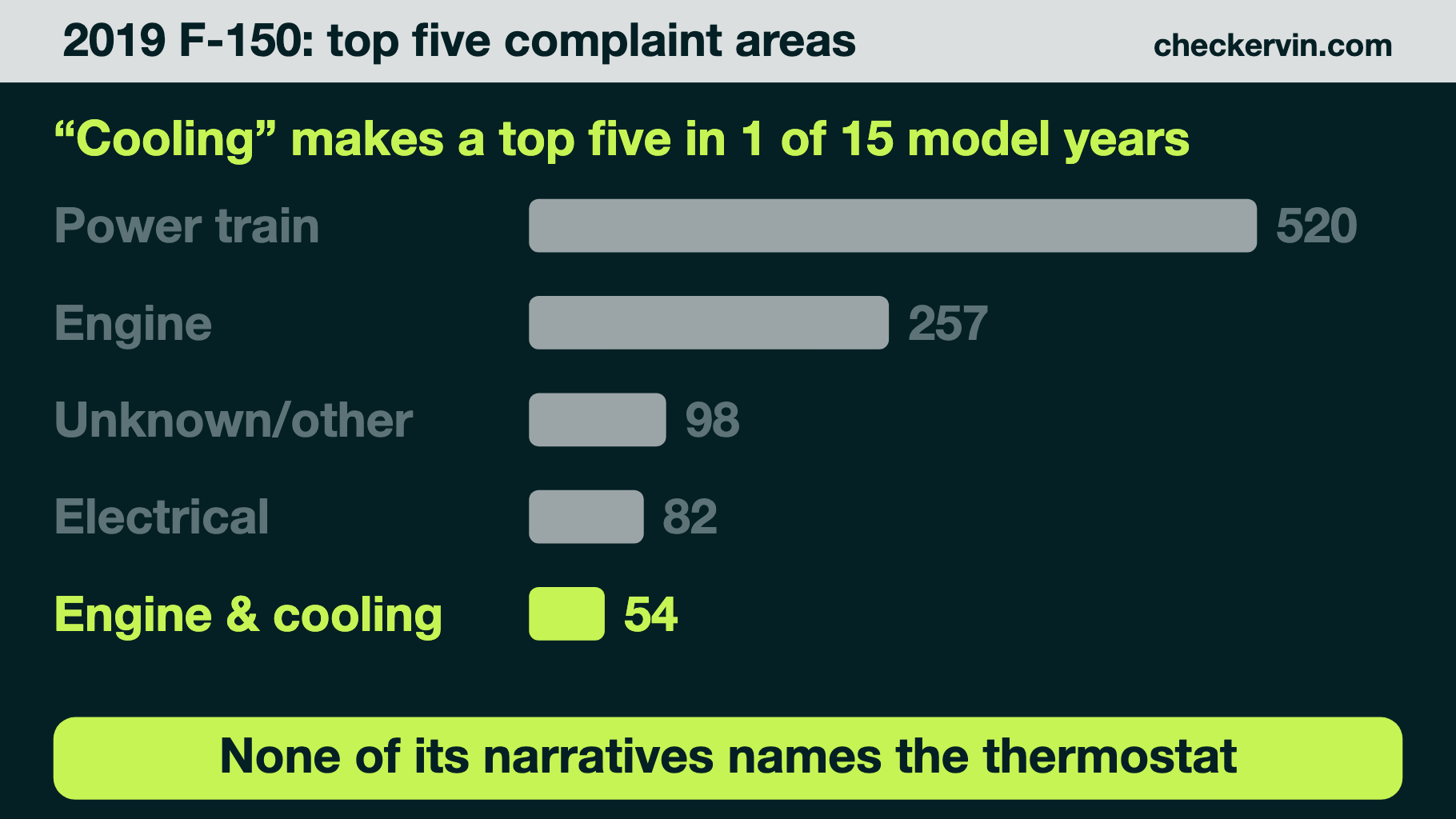
The narrower category, ENGINE AND ENGINE COOLING, reaches a top five once: the 2019 truck, at number 5 with 54 reports out of 1,017 that year, behind 520 for power train and 257 for ENGINE. Its name invites a thermostat reading. We read the narratives filed under it for 2019, and none names the thermostat; most describe rattling at start-up or cam phaser noise. Across the ENGINE narratives we sampled from other years, the recurring themes were stalling and loss of power on the 2011 and 2013 trucks and cam phaser rattle on the 2018 trucks, the subject of our F-150 timing chain cost post.
Is there a recall on the F-150 thermostat?
No. We queried NHTSA’s recall database for every F-150 model year from 2004 through 2022, and no campaign mentions the thermostat or its housing. To make sure the search was reading campaign text, we ran the same pass for cooling-related wording, and it found the two F-150 campaigns filed under NHTSA’s engine-cooling heading: 08V523, which covers propane-converted 2007–2008 trucks, and 24V635, which covers 2021–2022 trucks with intake valves that may break. Neither involves the thermostat.
Most F-150 years carry recalls on other systems, and a used truck can arrive with one still open. The Ford recall check by VIN lists what is open on a specific truck, which is worth doing while it is at the shop anyway.
How to tell if an F-150 thermostat is bad
- Temperature gauge stays low or takes a long time to rise, especially in cold weather (stuck open)
- Weak heat even after a long drive, with the gauge below its normal spot
- Check engine light with P0128
- Gauge climbs quickly after start-up while the upper radiator hose stays cool (stuck closed)
- Coolant seeping or crusted around the thermostat housing
A thermostat stuck open is an inconvenience: poor heat, worse fuel economy and a check engine light. One stuck closed is not. If the gauge is climbing, pull over and stop the engine before it overheats; an engine whose coolant cannot circulate can be damaged quickly. And on a 2.7L EcoBoost, let the shop confirm the temperature reading before replacing anything, given the sensor bulletins above.
Before you authorize the repair, or buy the truck
- Confirm the engine and build date by VIN; the part and the labor differ by engine
- Ask whether the quote is for the thermostat alone or the complete housing
- On a 2021–2022 3.5L EcoBoost, ask about SSM 50835 and the degas hose in TSB 21-2373
- On a 2.7L with P0128, ask whether the sensor bulletins were ruled out
- Ask for the coolant type by name on the invoice, and confirm the system is bled of air
The coolant line matters more than it looks. Ford’s SSM 47740 says 2019 F-150s built on or after January 2, 2019 were filled with Motorcraft Yellow coolant, and tells technicians not to mix colors or types. The coolant type lookup by VIN shows which one a given truck was built with.
If you are buying the truck, not fixing it
A thermostat is one of the smaller risks on a used F-150, and that is the point: it is cheap enough that a seller has no good reason to leave a known one unfixed. A gauge that sits low on the test drive, a heater that never gets hot, or a fresh coolant stain on the housing are all worth asking about before you agree a price, not after.
On a 2021 or 2022 truck with the 3.5L EcoBoost, ask whether the housing in SSM 50835 has been replaced, and ask for the invoice if it has. On a 2015–2020 2.7L, ask whether the coolant temperature sensor or harness has been done under SSM 48991 or TSB 21-2168, because an over-temperature warning on the test drive means something different on a truck that has had that work. On any year, a receipt that names the coolant type tells you someone did the refill properly. Our free report confirms the engine, build date and open recalls; a pre-purchase inspection by a mechanic covers the cooling system itself.
Where this information comes from
- Ford SSM 50835 (NHTSA copy) — 3.5L EcoBoost thermostat housing leakThe 2021–2022 incomplete-weld housing leak and its service part, ML3Z-8A586-C.
- Ford TSB 21-2168 (NHTSA copy) — 2.7L EcoBoost coolant temperature codesLists P0128 among codes caused by sensor voltage drop on 2018–2020 trucks; we quote NHTSA's summary of it.
- Ford SSM 48991 (NHTSA copy) — 2.7L sensor harnessP0128 and over-temperature warnings traced to the coolant temperature and knock sensor harness, 2015–2020.
- Ford TSB 20-2034 (NHTSA copy) — lack of heat in extreme coldHeater core deposits on 2015–2019 3.3L, 3.5L, 3.5L EcoBoost and 5.0L trucks.
- NHTSA — recalls by vehicle and VINOur 2004–2022 query found no F-150 campaign naming the thermostat or its housing.
- Ford — Motorcraft RT1250, 3.5L thermostat (ML3Z-8575-A)Sold as its own part, with a flange made to fit the engine housing; same ML3Z prefix as the SSM 50835 housing.
- Ford — Motorcraft RH216, 5.0L thermostat housingThe 5.0L housing sold separately from the thermostat.
- YourMechanic — Ford F-150 thermostat replacementThe $205 average and the 2016 2.7L and 2018 3.5L EcoBoost estimates, read November 2026.
- AutoNation Mobile Service — F-150 thermostat replacementThe $295 average and the 2011 5.0L figure, read November 2026.
Keep reading
Frequently asked questions
How much does it cost to replace a thermostat on a Ford F-150?
YourMechanic lists an F-150 average of $205, with $65 in parts and $140 in labor, and AutoNation Mobile Service lists an average of $295 (both read in November 2026). Engine-specific quotes run higher: YourMechanic shows $399.09 for a 2016 F-150 with the 2.7L EcoBoost and $468.61 for a 2018 with the 3.5L EcoBoost, with shop and dealer ranges of roughly $466 to $737. The difference is usually whether the quote is for a thermostat alone or for the housing it sits in.
How much will a mechanic charge to replace a thermostat on an F-150?
Labor on YourMechanic's F-150 average is $140. Its shop and dealer comparison for a 2018 F-150 3.5L EcoBoost runs $537.23 to $737.32 all in, and for a 2016 2.7L EcoBoost $465.70 to $658.02. A coolant drain, refill and air bleed is part of the job on every engine, and the coolant itself should match what the truck was built with.
How do I tell if my F-150 thermostat is bad?
A thermostat stuck open usually shows as a temperature gauge that stays low, weak cabin heat and code P0128. One stuck closed shows as rising temperature soon after start-up with a cold upper radiator hose. On F-150s, rule out lookalikes first: Ford has bulletins tying P0128 on the 2.7L EcoBoost to sensor wiring, tying lack of heat on 2015–2019 trucks to a clogged heater core in extreme cold, and tying one 3.3L no-heat condition to software.
Is there a recall on the F-150 thermostat or thermostat housing?
No. We checked NHTSA's recall database for every F-150 model year from 2004 through 2022 and no campaign mentions the thermostat. Ford issued a service message instead, SSM 50835, for 2021–2022 F-150s with the 3.5L EcoBoost built on or before March 8, 2022, whose thermostat housing can leak from an incomplete weld. A service message pays nothing outside warranty.
Does code P0128 mean the thermostat is bad on an F-150?
Often, but not always. P0128 means the engine took too long to reach its expected temperature, and a thermostat stuck open is the usual cause. On the 2.7L EcoBoost, Ford's SSM 48991 (2015–2020) and TSB 21-2168 (2018–2020) list P0128 among codes caused by the coolant temperature sensor circuit, with fixes that replace the sensor and wiring rather than the thermostat.
Confirm the engine before you price the thermostat
A free CheckerVIN report shows the factory build, engine, specifications and open recalls for any VIN, so you know which F-150 thermostat job you are paying for.
Run a free VIN check