The short answer
- What does it cost?
- RepairPal lists $1,137–$1,673 for a Traverse water pump. GM's own warranty time for the 3.6L pump was 1.7 hours.
- Did GM ever pay for it?
- Yes, on 2009–2010 Traverses: Special Coverage 13091, 10 years or 120,000 miles. That window has now closed for almost every car.
- Is there a recall?
- No. No Traverse recall from 2009 to 2022 names the water pump, coolant or engine cooling.
1,049
Engine complaints counted
2009–2022, not pump counts
1.7 h
GM's pump labor time
Special Coverage 13091
2009–10
Years GM replaced pumps
10 yr / 120,000 mi
$1,137+
RepairPal, Traverse
Low end of its range
The numbers, and whose numbers they are
We do not repair cars or sell parts, so each price below belongs to the site that published it. RepairPal’s Traverse water pump page, which says its estimates were last updated on October 16, 2025, puts the job at $1,137 to $1,673. Its 2020 Traverse page lists $1,133 to $1,640. RepairPal blocks our tools, so we read both figures on November 22, 2026 from the text search engines serve for those pages; neither showed a labor and parts split we could read.
Kelley Blue Book had nothing specific. Its 2012 Traverse page said a fair repair range was “not yet available” and offered a general answer of $375 to $787 including parts and labor. That is boilerplate KBB shows across models without a ZIP code, not a Traverse estimate.
The one number with a manufacturer behind it is labor time. When GM extended coverage on 2009–2010 Traverse water pumps in 2013, it told dealers to claim 1.7 hours for “Replace Water Pump,” plus 0.1 to 0.3 hours of diagnosis. That was a warranty rate, and independent shops bill from their own labor guides, but it is a fair sanity check. A quote that books five hours of labor for a pump alone on a 2009–2017 Traverse is pricing something else, and you should ask what.
Belt or chain? What GM's labor time shows
A common claim about this engine is that its water pump is turned by the timing chain and buried behind the front cover. GM’s own numbers do not support that for the 2009–2017 Traverse. The 3.6-liter LLT timing chain job, per GM’s bulletin 12-06-01-009E, pays 9.5 hours on front-wheel drive and 9.7 on all-wheel drive, because the front of the engine has to come apart. A pump inside that chain case could not be swapped in 1.7 hours.
Repair guides describe what that short time implies. A reproduction of GM’s procedure for the same 3.6-liter in a 2010 Cadillac CTS is titled “Water Pump and Generator Belt Replacement” and starts by sliding the drive belt off the water pump pulley. 1A Auto’s video guide for the 2009–2014 Traverse removes four small bolts from a water pump pulley and routes the serpentine belt over it. Owner reports in NHTSA’s file say the same thing the hard way: when a 2011 Traverse’s belt shredded, the pump, power steering and charging all quit together.
The federal fuel economy records list a single engine, the 3.6-liter V6, for every Traverse from 2009 through 2017, a 2.0-liter turbo alongside it in 2018 and 2019, and the V6 alone again from 2020. An engine lookup by VIN settles which one a 2018 or 2019 has before you call anyone.
GM's two water pump programs, and what is left of them
GM issued two Traverse documents about the same failure within a month in 2013, and they are easy to confuse. Owners in NHTSA’s complaint file mix them up all the time, often calling either one a recall. Neither was a safety recall.
| GM program and the Traverses it named | What it did |
|---|---|
| Customer Satisfaction Program 13079 (April 2013): 2009–2013 Traverse, 3.6L | Dealer checked the coolant level and topped it up with Dex-Cool, 0.3 hours. No pump replacement. Ended April 30, 2015 |
| Special Coverage 13091 (May 2013): 2009–2010 Traverse, 3.6L | Dealer replaced a leaking pump free for 10 years or 120,000 miles from the in-service date, 1.7 hours of labor |
Both bulletins give the same cause: leaks at the water pump shaft seal, “often due to vehicle operation with a low engine coolant level.” GM’s fix for the later years was simply to keep the level up. Its fix for 2009–2010 was a new pump. The coverage went out in phases because GM did not have enough replacement pumps at first, and GM’s note to dealers put the number of US vehicles involved across the Traverse, Enclave, Acadia and Outlook at 713,254.
The coverage still matters in two ways, even though the clock has run out. A 2010 Traverse first sold in 2010 reached ten years in 2020, and the 120,000-mile limit ended it sooner for many. First, a 2009–2010 Traverse may already have had its pump replaced under 13091, and a dealer can see that in GM’s warranty history by VIN. Second, the reimbursement deadline for owners who had paid out of pocket before the program was April 30, 2014, so there is no refund route left. A 2011 Traverse was never in the pump coverage at all, only in the coolant top-off program.
What 5,057 complaints say about the Traverse
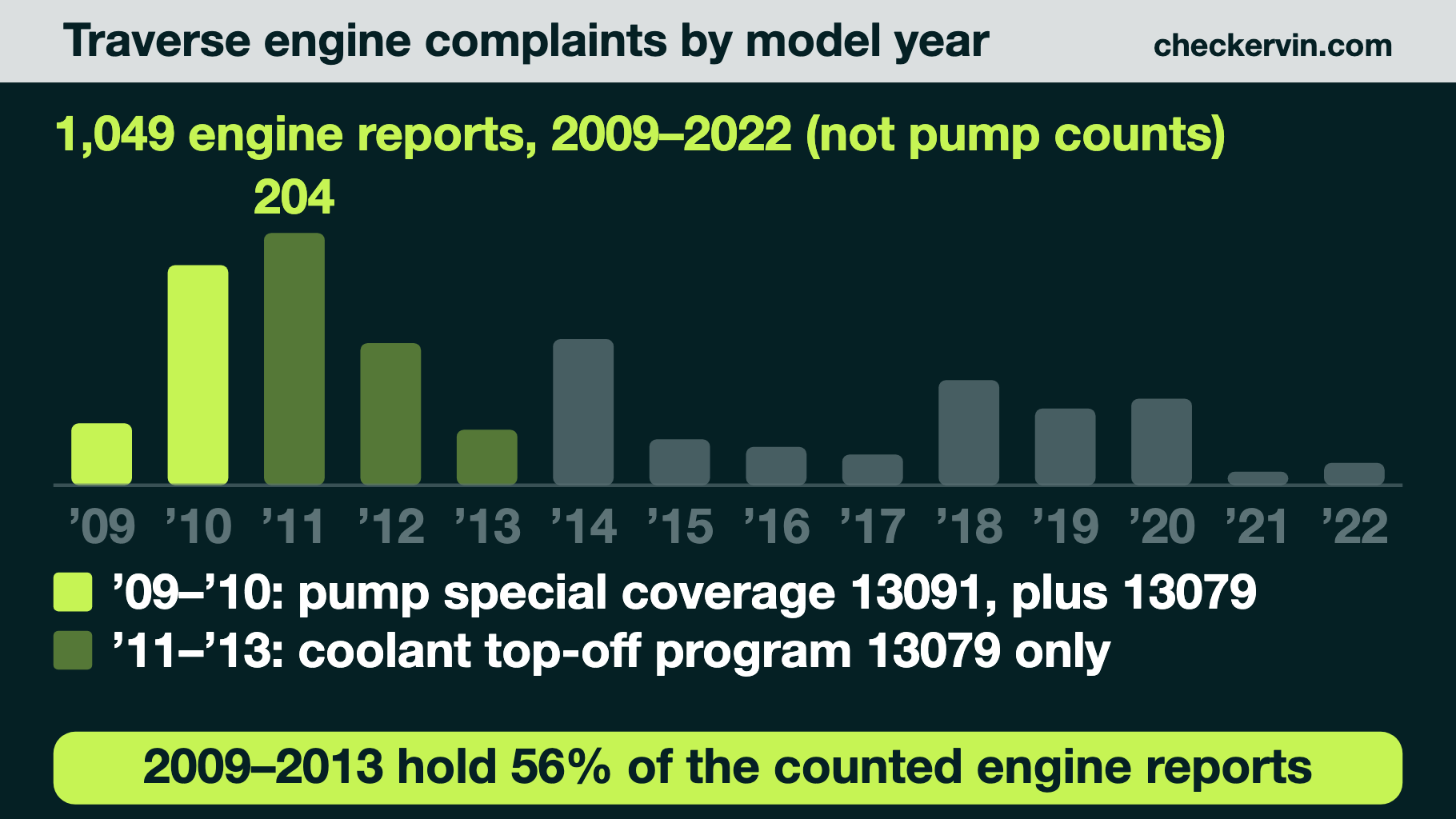
Our corpus of federal NHTSA complaints holds 5,057 reports against the 2009–2022Traverse. ENGINE is in that year’s five most-reported components in 14 of the 14 model years, and those years hold 1,049 engine complaints. It is the single most-reported component in 2011, 2012 and 2020. The peak is 2011, with 204 engine reports.
The weight sits at the front. The 2009–2013 model years, the ones GM’s coolant program named, hold 56% of the counted engine reports, and the two years under pump coverage account for 228 by themselves. Engine reports make up about 26% of all complaints for 2009–2013, against about 19% for 2018–2022. Split by engine generation, the 2009–2017 V6 cars carry 77% of the counted engine complaints and the 2018–2022 cars 23%.
What the record does not prove
NHTSA has no water pump category. ENGINE takes in every engine complaint, and on the early Traverse that includes the timing chain stretch GM addressed in separate bulletins, oil consumption, stalls and warning lights. The bars are an upper bound on cooling trouble and nothing more, and complaints are unverified owner reports, not a failure rate.
We read the narratives anyway, searching every model year’s file for the water pump, coolant and overheating. The pump comes up again and again in the 2009, 2010 and 2011 files: seal leaks, some well short of 100,000 miles, overheating that ended in a tow, owners asking why GM topped up their coolant instead of replacing the pump. It becomes rare in 2012–2014 and disappears from the 2015–2022 files entirely. That matches the program dates, and it is the clearest sign that the pump story belongs to the first few model years.
One trap in the data: for 2020, a component called ENGINE AND ENGINE COOLING reached the top five with 27 reports. It sounds like the pump. Read the narratives and they are mostly exhaust complaints, cracked flex pipes, catalytic converters and rattles underneath, which NHTSA files under that heading. We report it separately and never add it to ENGINE. The Chevrolet Traverse years-to-avoid page breaks down the rest of the record by year.
Is the pump replaced during timing chain work?
On a 2009–2017 Traverse the two repairs are often quoted together, and they do not have to be. GM’s timing chain bulletins for the 2009–2012 Traverse list a chain kit, oil, filter and coolant, but no water pump. GM priced the pump as its own 1.7-hour job. Aftermarket chain kits sold for this engine frequently include a pump anyway, which is where the habit of bundling them comes from.
Whether to add it is a cost question. The chain job already drains the coolant, so a pump fitted at the same visit saves a second drain and refill. If the original pump is still on a high-mileage car, that can be worth paying for. If the pump was replaced under 13091 a few years before, it is harder to justify. Ask for the pump as a separate line with its own parts and labor, so you can decide. The chain itself, with GM’s coverage history and labor clock, is covered in our Traverse timing chain cost guide, and a timing belt or chain lookup by VIN confirms what a particular engine uses.
When the coolant loss is not the pump
A falling coolant level on a Traverse is not proof of a bad pump. GM’s later bulletins describe several leaks that look like pump trouble from the driver’s seat and cost far more to fix.
| GM document and the Traverses it names | What it describes |
|---|---|
| PIP4959C (2012): 2011–2013, 3.6L | Cold-start misfire on one cylinder from coolant seeping in at the liner; GM says replace the engine, not the head |
| 21-NA-147 (2021): 2010–2022, 3.6L | Coolant or oil in a spark plug tube from a porous cylinder head; the head is replaced |
| 21-NA-108 (2021): 2010–2021, 3.6L | Overheating with oil in the coolant; test the oil cooler first, then block porosity means a new engine |
| PIP5674 (2019): 2019, 3.6L | Coolant loss and very dark oil at low mileage from porosity near the head bolts |
| 22-NA-030 (2022): two listed 2021 VINs | Overheating and milky coolant from a block deck out of flatness |
The pattern is the same in each: coolant that disappears without a puddle under the car. A pump seal leak usually leaves a trace at the front of the engine. Coolant that vanishes with no drip, shows up in the oil, or comes with a misfire at cold start points inside the engine instead. Most of those repairs fall under GM’s powertrain warranty while it lasts, and a Chevrolet warranty check by VIN shows whether a later Traverse still has it.
Ask for a pressure test with a dye before agreeing to a pump. A shop that finds the leak at the pump’s weep hole has found the pump. A shop that cannot point to the leak has not found it yet.
2018 and later: what changed and what we could not verify
The second-generation Traverse arrived for 2018 with a new 3.6-liter, GM’s LFY, and an optional 2.0-liter turbo on the RS. GM’s new-model bulletin for 2018 describes the LFY’s chain drive in detail but says nothing about how its water pump is driven, and we found no GM pump bulletin, program or labor time for either engine. No special coverage like 13091 exists for these years in the manufacturer communications NHTSA lists.
One later part is worth knowing about because it is called a pump. On the 2021 Traverse, GM’s preliminary information PIT5804 covers a check-engine light with code P2B87, auxiliary coolant pump underspeed. GM told technicians not to replace the G17 heater coolant pump for that code, because a body control software update was the fix. If a 2021 is quoted for a “coolant pump” on the strength of that code alone, ask whether the software was updated first and which pump the quote is for.
Can you keep driving it?
- Temperature gauge climbing, or an engine overheating warning
- Coolant reservoir dropping again within days of a top-up
- Coolant smell, steam, or a drip at the front of the engine
- Belt squeal followed by a battery light and heavy steering
- Reduced engine power message along with any of the above
The first and fourth are reasons to stop. On the 2009–2017 Traverse the belt that turns the pump also drives the power steering and the alternator, so a thrown belt takes all three at once. GM itself says these seals fail more often when the engine runs low on coolant, so topping up and driving for weeks is the habit most likely to finish the pump off. Keep a jug of the correct coolant aboard on the way to a diagnosis, not as a substitute for one.
Before you authorize the repair, or buy the car
- Confirm the model year and engine by VIN; GM's pump coverage only ever named 2009–2010
- On a 2009–2010, ask a Chevrolet dealer whether 13091 already replaced the pump
- Compare the labor line with GM's 1.7 hours for the 2009–2017 3.6L
- Ask for a pressure test with the leak point written on the invoice
- Refill with the specified coolant; GM's 2013 programs used Dex-Cool on the 3.6L
A coolant type lookup by VIN confirms the specification for a particular Traverse, and the Chevrolet recall checkshows any open safety recalls worth clearing while the car is in the shop. For a shopper, a receipt naming the leak source and the pump fitted is better evidence than a clean engine bay. GM’s own bulletins are repair guidance rather than free repairs, and our TSB versus recall page explains the difference.
Where this information comes from
- GM 13091 — Special Coverage Adjustment, Water Pump Shaft Seal Leaks (NHTSA)May 2013. 2009–2010 Traverse 3.6L; 10 years or 120,000 miles; 1.7 hours to replace the pump.
- GM 13079 — Customer Satisfaction Program, Water Pump Shaft Seal Leaks (NHTSA)April 2013. 2009–2013 Traverse 3.6L; coolant check and top-off only, until April 30, 2015.
- GM dealer notice for 13091, with US vehicle count (NHTSA)May 21, 2013. 713,254 US vehicles across four GM brands; phased release for pump supply.
- GM 12-06-01-009E — High Feature V6 Timing Chain Kits (NHTSA)April 2014. Chain kit parts list with no water pump; 9.5–9.7 hours of labor.
- GM 21-NA-108 — Engine Overheating, Cooling System Contaminated with Oil (NHTSA)May 2021. 2010–2021 Traverse 3.6L; oil cooler test, then block porosity.
- GM 21-NA-147 — Fluid in Spark Plug Tubes, Coolant or Oil Leak (NHTSA)June 2021. 2010–2022 Traverse 3.6L; porous cylinder head.
- GM PIT5804 — DTC P2B87, Auxiliary Coolant Pump (NHTSA)December 2020. 2021 Traverse; do not replace the heater coolant pump for this code.
- NHTSA — recalls by vehicle and VINOur 2009–2022 Traverse query found no campaign naming the water pump, coolant or engine cooling.
- EPA and DOE — fueleconomy.gov vehicle recordsThe per-year Traverse engine listings: 3.6L throughout, 2.0L turbo in 2018–2019.
Keep reading
Frequently asked questions
How much does it cost to replace the water pump on a Chevy Traverse?
RepairPal's Traverse estimate, last updated October 16, 2025, is $1,137 to $1,673, and its 2020 Traverse page lists $1,133 to $1,640. Kelley Blue Book shows no Traverse figure without a ZIP code and falls back on a generic $375 to $787 that is not specific to the Traverse. GM's own warranty time for the job on 2009–2010 Traverses with the 3.6-liter V6 was 1.7 hours, which is a useful check on the labor line of any quote.
Is there a recall or extended warranty on the Traverse water pump?
There is no safety recall. GM's Special Coverage 13091 replaced leaking water pumps on 2009–2010 Traverses for 10 years or 120,000 miles from the date the vehicle was first put in service, so almost every eligible Traverse has now aged out of it. A separate program, 13079, only checked and topped up coolant on 2009–2013 Traverses and ended on April 30, 2015. A dealer can confirm by VIN whether either was ever applied.
Is the Traverse water pump driven by the timing chain?
Not on the evidence we found for the 2009–2017 3.6-liter. GM paid dealers 1.7 hours to replace the pump under its 2013 special coverage, against roughly 9.5 hours for the timing chain job on the same engine, and repair guides for these Traverses show the pump turned by a pulley on the serpentine belt. We did not find a GM document describing the pump drive on the 2018-and-later engines, so ask the shop for those years.
Should I replace the water pump when the timing chain is done?
It is a judgment call, not a requirement. GM's own timing chain bulletins for the 2009–2012 Traverse list coolant among the parts but no water pump, and GM priced the pump as a separate 1.7-hour job. Many aftermarket chain kits include a pump anyway. If the original pump is still on a high-mileage Traverse and the coolant is already drained, adding it can make sense; ask what the pump adds to the bill in parts and labor.
Can I drive a Traverse with a bad water pump?
Only briefly, while the temperature gauge stays normal and the coolant stays at the mark. GM's own bulletins say pump seal leaks on these Traverses often start with running the engine low on coolant, so a leak tends to get worse the longer it is topped up and ignored. If the belt has come off, the pump, power steering and charging all stop at once, and the engine should not be driven.
Confirm the year and engine before you price the pump
A free CheckerVIN report shows the factory build, engine, specifications and open recalls for any VIN, so you know whether GM's pump coverage ever applied and which engine a quote should assume.
Run a free VIN check