The short answer
- What does it cost?
- RepairPal lists $1,134–$1,498 for a 2010 Equinox chain and gear set; owner reports cluster higher, around $2,800, when the job grows.
- Why do quotes disagree?
- Scope. On the 2010–2013 2.4L, documented oil consumption starves the chain — so an honest repair often includes more than the chain.
- Which years carry the risk?
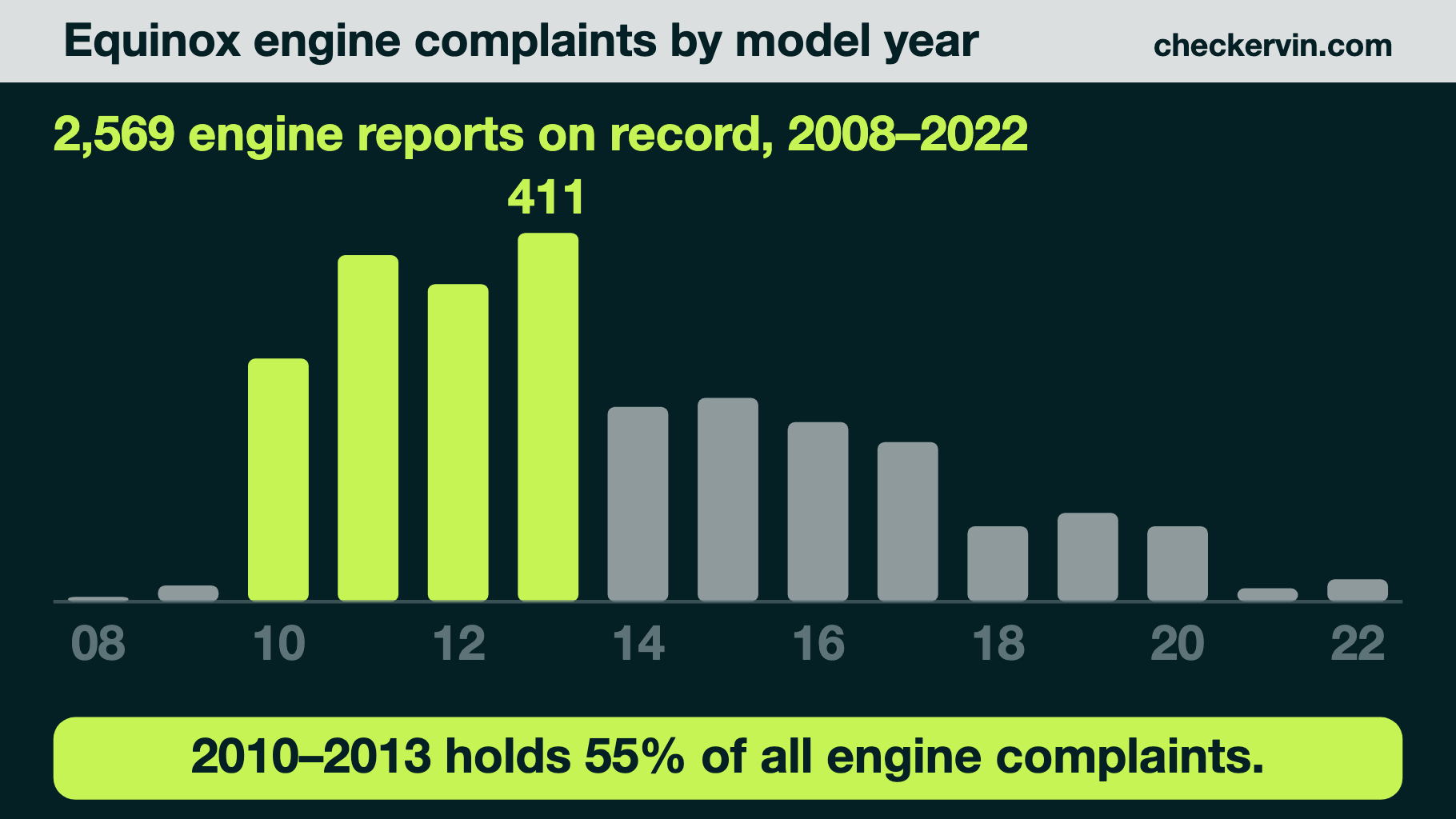
- The record is concentrated: 2010–2013 holds 55% of the Equinox's engine complaints, peaking at 411 reports in 2013.
The numbers, and whose numbers they are
Two estimator figures anchor this SERP, and neither is ours. RepairPal lists $1,134 to $1,498 for a 2010 Chevrolet Equinox timing chain and gear set replacement, parts and labor together. Kelley Blue Book’s page for the same query shows $409 to $919 — retrieved September 2026 and quoted with attribution, because we sell VIN checks, not repairs, and publish no price of our own.
Then there is the number owners trade in forums: a GMC Terrain thread — same platform, same engine — titled around a $2,800 timing chain job. That spread, nearly three to one, is not shops being greedy. It is three different repairs wearing one name, and the rest of this page is about telling them apart before one of them is quoted to you.
A chain, not a belt — and a SERP that blurs them
Every engine offered in the US Equinox — the 2.4-liter four and the V6s — times its valves with a metal chain, not a rubber belt. The distinction is not pedantic. A belt is a scheduled maintenance item with a replacement interval printed in the owner’s manual; a chain is designed to last the engine’s life and only becomes a repair when something has gone wrong around it.
The confusion is live on the results page: when we pulled this query’s SERP in September 2026, the KBB result answering it was titled as a timing belt replacement price for a 2012 Equinox — a component that vehicle does not have. If a page prices the wrong part, its number is noise. It is also the cheaper number, which is exactly how a shopper walks into a quote conversation anchored a thousand dollars low.
What 6,587 complaints say about four model years
Our corpus of federal NHTSA complaints holds 6,587 reports against the 2008–2022 Equinox, 2,569 of them filed against the engine. The distribution is the story: the 2010–2013 model years — the first generation of the 2.4-liter direct-injection four — account for 55% of the engine complaints in the nameplate’s year-by-year top-component record, peaking at 411 reports against the 2013 car alone.
From 2020 on, the same column averages 41 reports a year. Complaints are unverified owner reports rather than failure rates — the honest caveat this site attaches to every such figure — but a concentration that steep, on the exact engine generation the timing-chain reputation comes from, is not an artifact. It is the reputation, counted.
Why these chains died: the oil connection
A timing chain is lubricated by engine oil under pressure. Run it low, or run it on degraded oil, and the chain and its guides wear fast — the chain “stretches” as its pins and plates wear, valve timing drifts, and the codes and rattle follow. On the 2010–2013 2.4L, the oil side of that equation is documented rather than folklore: GM’s own service bulletins acknowledged excessive oil consumption in those engines, traced to piston rings, and a federal class action over the same engines was settled.
That is why the chain quote and the real bill diverge on these cars. Replace a worn chain on an engine still burning a quart every couple thousand miles and the new chain inherits the old chain’s working conditions. The forum numbers are not a different price for the same job — they are the price of the job that actually fixes the car.
The recall that does not exist — and what exists instead
A steady trickle of searches asks for the “Equinox timing chain recall,” and the honest answer is that there is none. Federal recalls address unreasonable safety risk; chain wear is classed as a durability problem, so it produced service bulletins and extended-coverage programs rather than a recall. Expecting a recall letter to pay for this repair is waiting for mail that is not coming.
| Program | What it actually pays for |
|---|---|
| Recall | Safety defect — free fix at any dealer, no time limit on the remedy |
| Special coverage | GM extends warranty on a known problem — mileage and year limits apply |
| Technical service bulletin | Repair instructions to dealers — pays nothing by itself |
| Class-action settlement | Court-supervised remedy with its own claim windows, now largely closed |
What a VIN check does settle is whether the specific car in front of you has open recall campaigns of any kind — the Equinox years above carry several, on other systems — and that lookup is free at CheckerVIN or straight from NHTSA.
What failure sounds like before it costs anything
- A rattle at cold start that fades with oil pressure — the classic first symptom owners report
- Check-engine light with camshaft/crankshaft correlation codes on a scan
- Oil level chronically low between changes — on a 2.4L, cause and warning at once
- Rough running or hard starts — late-stage signs that timing has already drifted
The sequencing matters because the early symptoms are cheap and the late ones are not. An interference engine with slipped timing can put pistons into valves, which converts a four-figure chain job into an engine replacement. A rattle investigated early is the cheapest moment this problem will ever offer.
Where the money goes
The chain kit itself — chain, guides, tensioner, sprockets — is a few hundred dollars in parts. The bill is labor: the timing set lives behind the front of the engine, and reaching it means hours of disassembly before the first worn part comes off. That inverts the hybrid-battery economics we wrote about on the CR-V pack cost post: there the part dominates and labor is noise; here labor dominates and the parts are noise.
Two practical consequences. First, while the front of the engine is open, marginal parts cost little to replace — which is why an honest shop quotes the water pump or seals alongside and a bargain quote does not. Second, labor-heavy jobs reward a second opinion more than parts-heavy ones, because hourly rates and book times vary between shops far more than a chain kit’s price does.
Before you authorize the repair
- Scan the codes and keep the printout — correlation codes are the chain's signature
- Check oil level and consumption history first; a chain quote on an oil-burner is half a diagnosis
- Ask what the quote includes — chain only, or guides, tensioner, sprockets and seals
- Pull the VIN's open recalls before paying for anything a campaign might cover
- On 2010–2013 cars, get the with-rings price too, so you are comparing repairs and not fragments
If you are buying the Equinox, not repairing it
The same record reads as a shopping map. The 2010–2013 cars are the ones whose service history needs to show the oil problem addressed — rings done, or consumption test passed — before a fair price includes the engine at all. A Chevrolet VIN decode confirms engine and build; our Equinox years-to-avoid breakdown scores every model year against the nameplate’s own median, from the same corpus this page computes from.
On any candidate car, five minutes of diligence beats an hour of negotiation: cold-start it yourself and listen, check the dipstick, run the recall lookup, and check what factory coverage remains by VIN. The years after 2017 — and especially 2020 on — carry a fraction of the engine baggage in the record, and the price difference between a loud year and a quiet one is usually smaller than one timing chain job.
Where this information comes from
- NHTSA — Equinox complaint databaseThe federal complaint record this page's figures are computed from, browsable by model year.
- RepairPal — Equinox timing chain estimateThe $1,134–$1,498 figure quoted above, attributed to its estimator as retrieved September 2026.
- KBB — the timing belt page in questionCited as evidence of the belt/chain confusion this post corrects, not as a price for this repair.
- NHTSA — recalls by VINThe official lookup that settles whether a specific Equinox has open campaigns — none of them a chain recall.
Keep reading
Frequently asked questions
How much does an Equinox timing chain replacement cost?
RepairPal's estimator lists $1,134 to $1,498 for a 2010 Equinox timing chain and gear set, parts and labor — their figure, quoted with attribution. Owner reports run higher, with forum threads around $2,800, and the gap is usually scope: guides, tensioners, sprockets, seals, and on oil-burning 2.4L engines the ring problem underneath. A quote's range says less than what the quote includes.
How long does a timing chain last on a Chevy Equinox?
A timing chain is designed to last the engine's life and has no scheduled replacement interval — which makes the 2010-2013 record the useful signal, not the design intent. Those four model years hold the bulk of the Equinox's engine complaints in the federal database, driven by the 2.4L's documented oil-consumption problem starving the chain. A later Equinox with healthy oil habits has no calendar date when a chain is due.
Is there a recall for the Equinox timing chain?
No. Federal recalls address safety defects, and timing chain wear is treated as a durability problem, so it never produced one. What exists instead is service-bulletin and special-coverage territory: GM's bulletins for the 2010-2013 2.4L's excessive oil consumption, and a federal class action over those engines that was settled. Check the VIN's open recalls anyway — other campaigns may apply — but do not expect a free chain from a recall.
How can you tell if the timing chain is going bad?
The pattern owners report most is a rattle at cold start from the passenger side of the engine bay that fades as oil pressure comes up, followed by a check-engine light with camshaft or crankshaft correlation codes. By the time timing has slipped far enough for rough running or a no-start, valve damage is on the table. On a 2.4L, check the oil level first — a low reading is both a cause and a warning.
Is it worth replacing a timing chain on an older Equinox?
Price the whole engine's condition, not the chain. On a 2010-2013 car burning oil, a chain-only fix treats the symptom, and the arithmetic should include rings or a used engine against the vehicle's value. On later years the calculus flips: engine complaints fall to around 41 a year in the record from 2020 on, so a chain job on an otherwise healthy car buys a lot of remaining life.
Price the car's record before you price the repair
A free CheckerVIN report shows the factory build, specifications and open recalls for any VIN — and the difference between a loud model year and a quiet one is usually bigger than any quote spread.
Run a free VIN check