The short answer
- What does it cost?
- RepairPal lists $1,082–$1,442 for the Silverado 1500, with parts the larger share. Its 2020–2023 rows run $1,375–$1,793.
- Is it really the pump?
- Check first. GM bulletins trace Silverado coolant loss to porous cylinder heads and thermostat-cracked radiators, and a whine to the thermostat.
- Which engine changes the job?
- The 2.7L turbo four. Its pump is electric and computer-controlled; the V8 and V6 pumps run off the serpentine belt.
$1,082–$1,442
RepairPal Silverado 1500 range
Retrieved October 2026
2,155
Counted ENGINE complaints
2008–2022, all engines, all faults
34%
Engine share, 2019–2022
vs 8% for 2008–2013
0
Water pump recalls found
NHTSA, every model year
The estimates, and who published them
RepairPal’s Silverado 1500 estimator lists water pump replacement at $1,082 to $1,442 nationally, split into $783 to $1,004 for parts and $299 to $439 for labor. The page says it was last updated September 3, 2026, and that the range leaves out taxes, fees and location. Its per-year rows put the 2020 to 2023 trucks higher, at $1,375 to $1,793. We read those figures on October 26, 2026, from the page’s own listing, because RepairPal blocks direct downloads.
Kelley Blue Book was less help. Its 2019 Silverado 1500 Double Cab water pump page, opened without a ZIP code, shows “No Pricing Data Available” and only an FAQ line saying a Chevrolet pump job runs $375 to $787. That line is generic, not a Silverado figure, so we do not lean on it.
Two details in RepairPal’s split are worth noticing. Parts outweigh labor, and the labor band is close to the one our F-150 water pump post quotes for Ford’s truck, where the pump also bolts to the outside of the engine. That fits a job where the pump comes off the front of the block rather than from behind a timing cover. It is our reading of the numbers, not something RepairPal explains. We sell VIN checks, not repairs, and publish no price of our own; what we can add is the record and the documents GM filed with NHTSA.
Belt or electric: what GM's documents show
The method here is the one our F-150 and Ram posts used: prove the pump drive from the manufacturer’s own catalog and documents, not from forums. GM’s parts catalog lists its current Silverado V8 pump, part 12724894, with a water pump drive type of “Serpentine Belt,” the pulley and gasket included. A second catalog pump, 12740339, is listed for the 2019, 2020 and 2021 Silverado 1500 and is likewise described as belt-driven. The same catalog marks some older ACDelco pumps as timing-belt driven, so the field is not boilerplate. GM’s catalog blocks direct downloads, so we read those listings through search extracts of the pages, on October 26, 2026.
GM’s bulletins point the same way. A 2013 dealer note, PIP5108A, covers 2011–2013 Silverados with the 5.3L and 6.2L and has the technician remove the serpentine belt to see whether a whine goes away before touching the pump. A 2022 bulletin on the newer 5.3L and 6.2L describes a noise “near the water pump area” that “goes away when the belt is removed.” A pump that quiets with the belt off is a pump the belt turns.
The 2.7L turbo four is the exception. GM’s technician magazine, TechLink, introduced the engine in July 2019 and says its coolant flow “is supplied through the entire active thermal management system by an electric water pump.” The engine computer runs the pump over a data link and keeps it spinning after shutdown to cool the engine. On that truck a pump fault can be an electrical diagnosis as much as a mechanical one, and there is no belt to remove.
Which engine, which year
A Silverado pump quote depends on the engine, and the half-ton has offered a long list of them. The table below follows EPA’s fuel economy listings for each model year. Confirm yours with a Chevy truck VIN decode before comparing quotes; a shop pricing a V8 job for a 2.7L truck is pricing a different repair, with a different pump and no belt.
| Model years | Engines in EPA's listings |
|---|---|
| 2008 | 4.3L V6; 4.8L, 5.3L and 6.0L V8 |
| 2009 | 4.3L V6; 4.8L, 5.3L, 6.0L, 6.2L V8; 6.0L two-mode hybrid |
| 2010–2013 | 4.3L V6; 4.8L, 5.3L, 6.2L V8; 6.0L two-mode hybrid |
| 2014–2015 | 4.3L V6; 5.3L and 6.2L V8 |
| 2016–2018 | 4.3L V6; 5.3L and 6.2L V8; 5.3L eAssist hybrid |
| 2019 | 2.7L turbo four; 4.3L V6; 5.3L and 6.2L V8 |
| 2020–2021 | 2.7L turbo; 3.0L diesel; 4.3L V6; 5.3L and 6.2L V8 |
| 2022 | 2.7L turbo; 3.0L diesel; 5.3L and 6.2L V8 |
What 2,155 counted engine complaints say
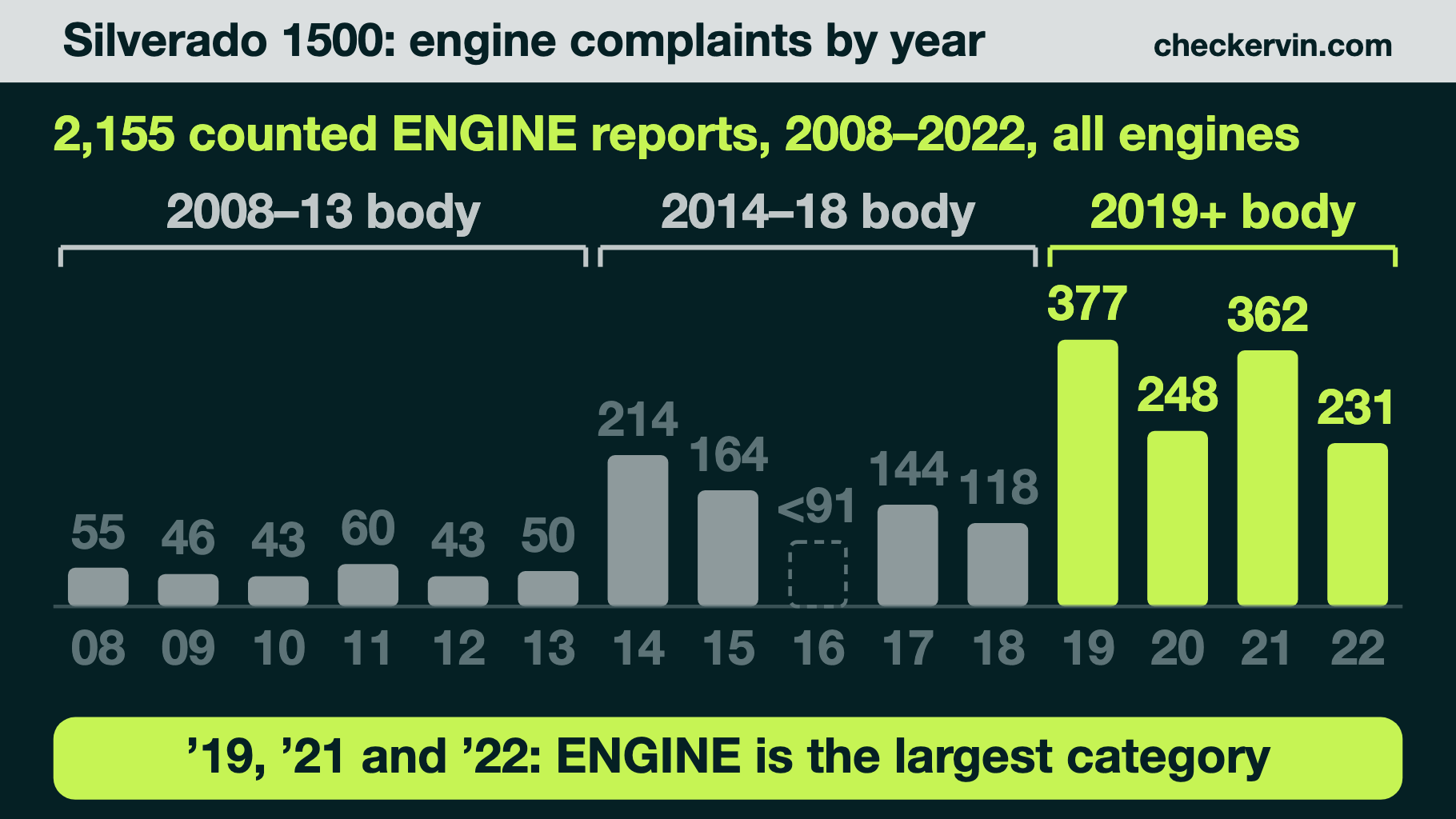
Our corpus of federal NHTSA complaints holds 12,743 reports against the 2008–2022 Silverado 1500, and at least 2,155 of them, about 17%, are filed under ENGINE. “At least,” because our file keeps only each year’s five largest categories, and in 2016 ENGINE fell below the fifth, which had 91 reports. That year is not a zero; it is a count we do not hold, and the chart draws it as an outline.
The pattern by body generation is stark. The 2008–2013 trucks put 8% of their complaints under ENGINE, 297 reports across six years. The 2014–2018 trucks put at least 12% there, 640 counted. The 2019–2022 trucks put 34% there, about 4 times the older share, and those four years alone hold 57% of every engine report we counted. ENGINE is the single largest category for the 2019, 2021 and 2022 models, and the 2019 model peaks at 377 reports, 33% of that year’s complaints.
The limit, stated plainly: ENGINE covers every engine GM sold that year and every kind of engine fault, so it is context and an upper bound, never a count of water pumps. NHTSA has no water pump category, and its ENGINE AND ENGINE COOLING heading never reaches a Silverado year’s top five in our data.
What the newer trucks' engine complaints mostly are
A rising ENGINE line on a page about water pumps invites the wrong conclusion, so we read the complaint narratives NHTSA publishes for the 2019, 2021 and 2022 Silverado 1500. The part owners name most often in the engine reports is the valve lifter, usually alongside the camshaft, a misfire or a ticking noise. Some mention the cylinder deactivation system GM uses on its V8s. Connecting rod and crankshaft reports appear too, and on 2021–2024 trucks with the 6.2L V8 they are now the subject of recall 25V-274, under which dealers inspect the engine and repair or replace it free.
The water pump barely appears. One 2021 owner wrote that the pump “just started making a grinding sound” at 31,000 miles and that the dealer wanted over $1,400 to replace it. That is one owner’s account, not a price survey, but it sits inside the range RepairPal publishes for that year. The broader point is that the Silverado’s engine record is a lifter story, and a pump quote should be judged on its own evidence, not on the truck’s reputation. Our Silverado transmission post covers the other half of the truck’s powertrain record.
Coolant loss GM traces to the cylinder heads
The most consequential Silverado coolant document is not about the pump at all. GM dealer note PIP5330D, published November 22, 2019, covers 2014–2019 Silverados with the 4.3L, 5.3L and 6.2L (engine codes LV3, L83 and L86). Its complaint is coolant loss or a coolant smell after driving. Its instruction: if the coolant is low, pressure test the system “looking for leaks at the outer head bolts,” and if a leak is found, replace that cylinder head.
A March 2022 bulletin, 22-NA-047, extends the list to the 2019–2021 new-model Silverado 1500 and the 2019 Silverado LD, and adds the newer L82, L84 and L87 engines. It says the leak at the outer head bolt boss “may be caused by porosity within the right or left cylinder head,” and that technicians may see coolant streaks down the side of the head.
This matters for a pump quote in two directions. A truck losing coolant with no obvious drip under the pump may be seeping from a head, and a new pump will not stop it. And a head replacement is a far bigger job than a pump, so if the pressure test finds a head leak, the warranty question becomes urgent. GM’s note books the repair under powertrain coverage; a Chevrolet warranty check shows whether a specific truck is still inside it.
The radiator that cracks because of the thermostat
A second GM bulletin, PI1513G, revised in January 2021, covers 2015–2016 Silverados and some 2014 trucks, depending on the build plant and towing package, with the 4.3L, 5.3L or 6.2L. Owners smell coolant or find a leak under the front of the truck. GM traces it to radiator tubes that fatigue and crack at the headers because the thermostat cycles too often, and the fix is a new radiator plus a redesigned thermostat housing. The bulletin names the thermostat as the causal part and says both are covered under the powertrain warranty.
The labor times are telling. GM books 1.4 hours for the job on the 5.3L and 6.2L, but 5.2 hours on a V6 truck. A leak at the front of a 2014–2016 Silverado, then, can be a radiator and thermostat rather than a pump, and the price gap between those engines is GM’s own number. One 2014 owner’s NHTSA complaint describes the pattern: a pump and thermostat replaced, and the radiator cracked again roughly every two years.
A whine near the pump is not a verdict
Bearing noise is the classic sign of a failing belt-driven pump, and GM has twice told dealers to slow down before acting on it. PIP5108A covers 2011–2013 Silverados with the 5.3L or 6.2L that whine at 1,500 to 1,800 rpm, audible near the right side of the dash. The steps are in order: check the coolant level, remove the belt, rotate the thermostat a quarter turn and retest, replace the thermostat. Only “if thermostat replacement made no change” does the note say to replace the water pump.
The second case is subtler. Bulletin 22-NA-216, from November 2022, covers Silverado 1500s from 2014 through 2023 and describes an engine running hot with a tick from the thermostat area after a previous repair. The cause is a cylinder head gasket installed backwards during an earlier head job, which restricts coolant flow. On the newer V8s, the bulletin says, the noise can sound like a scraping, failed-bearing noise near the water pump that disappears with the belt off. If your truck has had head work and now runs hot and sounds like a bad pump, that bulletin is the first thing to raise with the shop.
What the recall record covers, and what it doesn't
We queried NHTSA’s recall database for every Silverado 1500 model year from 2008 through 2022, under both model names GM files the truck under. As a check that the query worked, the 2014 results include the well-known transmission cooler line recall, 14V-152. No campaign names the water pump, the radiator, the thermostat or coolant.
Two campaigns sit under NHTSA’s engine-and-cooling heading, and neither is a pump. 14V-007 covers 2014 trucks with the 4.3L or 5.3L, where overheated exhaust parts could melt nearby plastic; dealers reprogram the engine computer. 25V-274 is the 6.2L connecting rod and crankshaft recall above. The Chevrolet recall check shows which campaigns are still open on a specific VIN, and our TSB versus recall explainer covers why the dealer bulletins in this post are not free repairs on their own.
Before you authorize the repair
- Confirm the engine by VIN: 2.7L turbo, 4.3L, 4.8L, 5.3L, 6.0L, 6.2L or 3.0L diesel
- Ask for a pressure test and a photo of where the coolant is actually leaving
- On a 2014–2021 V6 or V8, ask whether the outer head bolt bosses were checked
- On a 2014–2016 truck with a front leak or coolant smell, have the radiator headers inspected
- For a whine, ask whether the belt was removed and the thermostat ruled out first
- On a 2.7L truck, ask how the electric pump fault was diagnosed
Then read the quote line by line. Coolant, a thermostat and a belt often ride along with a pump, and each is a separate decision. Use the coolant the factory specified when the system is refilled; a coolant type lookup by VIN lists it. If a cylinder head or radiator turns out to be the leak, check the warranty before you pay anything.
If you are buying the Silverado, not repairing it
For a shopper, the record says the coolant system is not where the Silverado’s engine trouble concentrates. Still, check the coolant level cold, look for dried coolant crust down the sides of the cylinder heads and at the radiator’s tube ends, and listen for a whine or scrape at the front of the engine. On a 2019-or-later V8, the lifter reports matter more than the pump, and on a 6.2L from 2021 on, ask whether recall 25V-274 has been done.
A pre-purchase inspection with a cooling-system pressure test costs a fraction of any repair on this page. The Silverado years-to-avoid breakdown covers the rest of the record, including the airbag complaints that dominate the older trucks. If you are cross-shopping, the Ram 1500 water pump post walks through the parts Stellantis says get mistaken for the pump on its rival truck.
Where this information comes from
- GM PIP5330D (NHTSA copy): coolant loss at the outer head bolts2014–2019 Silverado 4.3L, 5.3L, 6.2L: pressure test the head bolt area; replace the head if it leaks.
- GM bulletin 22-NA-047 (NHTSA copy): coolant loss and odorExtends the head bolt boss leak to 2019–2021 trucks and names cylinder head porosity.
- GM PI1513G (NHTSA copy): coolant smell or slight leak at the radiator2014–2016 Silverado: thermostat cycling cracks radiator tubes; 1.4 hours on the V8, 5.2 on the V6 truck.
- GM PIP5108A (NHTSA copy): engine whine at 1,500–1,800 rpm2011–2013 Silverado V8: belt off, thermostat first, pump last.
- GM bulletin 22-NA-216 (NHTSA copy): thermostat tick and running hotA backward head gasket after head work sounds like a failed pump bearing on the newer V8s.
- NHTSA: recalls by VINThe official lookup, including 14V-007 and the 6.2L engine recall 25V-274.
- GM TechLink: New Turbocharged 2.7L 4-Cylinder Engine Powers Full-Size TrucksGM's own technician publication, July 2019: the 2.7L uses an electric water pump.
- GM Genuine Parts: water pump 12724894GM's catalog listing with a serpentine-belt drive type and pulley included.
- RepairPal: Chevrolet Silverado 1500 water pump replacement costThe $1,082–$1,442 range and parts and labor split quoted above, retrieved October 2026.
- Kelley Blue Book: 2019 Silverado 1500 Double Cab water pump replacementShowed no truck-specific price without a ZIP; the $375–$787 line is generic.
Keep reading
Frequently asked questions
How much does it cost to replace a water pump on a Chevy Silverado?
RepairPal's Silverado 1500 estimator lists $1,082 to $1,442 nationally, with $783 to $1,004 in parts and $299 to $439 in labor, on a page last updated September 3, 2026; its rows for the 2020 to 2023 trucks run $1,375 to $1,793. Kelley Blue Book's 2019 Silverado 1500 page showed no truck-specific price without a ZIP code, only a generic $375 to $787 figure for Chevrolet pumps. Coolant and a thermostat are often added to the bill.
Is the Silverado water pump driven by the belt or the timing chain?
On the V8s and the V6, the serpentine belt. GM's parts catalog lists current Silverado pumps with a serpentine-belt drive and a pulley included, and GM bulletins for the 5.3L and 6.2L tell technicians to take the belt off to check a noise before replacing the pump. The 2.7L turbo four, offered from 2019, is different: GM's technician magazine says its coolant is moved by an electric water pump that the engine computer controls.
What else causes coolant loss on a Silverado besides the water pump?
GM names two in its own bulletins. On 2014 to 2021 trucks with the 4.3L, 5.3L or 6.2L, coolant can seep from porosity at the outer cylinder head bolt bosses, which GM fixes by replacing the head. On 2014 to 2016 trucks, radiators can crack at the tube headers because the thermostat cycles too often; GM replaces the radiator and the thermostat housing together. A pressure test shows where the coolant is actually leaving.
Is there a recall for the Chevy Silverado water pump?
Not that we found. We queried NHTSA's recall database for every Silverado 1500 model year from 2008 through 2022, under both names GM files the truck under. No campaign names the water pump, radiator, thermostat or coolant. The engine recalls that do exist cover an exhaust overheating reprogram on 2014 trucks and connecting rod and crankshaft defects on 2021 to 2024 trucks with the 6.2L V8.
Which Silverado years have the most engine complaints?
By count, the 2019 model, with 377 ENGINE complaints in our federal record. By share, the newer body stands out: ENGINE is 34% of complaints against the 2019–2022 trucks against 8% for 2008–2013, and it is the largest single category for the 2019, 2021 and 2022 models. In those years' engine narratives, the parts owners name most are lifters and camshafts; the water pump is rarely named.
Confirm the engine before you price the repair
A free CheckerVIN report shows the factory build, engine, specifications and open recalls for any VIN, so you know which GM bulletin or recall applies.
Run a free VIN check