The short answer
- What does it cost?
- YourMechanic lists a $204 average ($64 parts, $140 labor) for an Impala starter and $384 for the 2014-2016 Impala Limited. Those are its figures, not ours.
- Is it really the starter?
- Often not. GM ties Impala no-starts to the key and ignition on older cars, and to loose grounds, a relay or rubbed wiring on 2014-2016 cars. A grinding 2.5-liter car may need a flex plate, not a starter.
- Is there a recall?
- None names the starter. Recall 14V355000 fixes the ignition-key stall on 2006-2014 Impalas for free.
$204
YourMechanic Impala starter average
Read Nov. 22, 2026
7.2 hr
GM time for a 2015 Impala flex plate
Service update 14659, 2.5L
1,137
Electrical reports counted
2008–2020, 2016 excluded
6
Years electrical ranks #1
Of 12 model years used
The estimates, and whose they are
YourMechanic’s Impala starter page lists an average of $204, made up of $64 for parts and $140 for labor. Its separate Impala Limited page, which covers the older-body car sold from 2014 to 2016, lists an average of $384: $188 for parts and $196 for labor. YourMechanic blocks direct fetches from our tools, so we read both figures on November 22, 2026 from the page text search engines serve, and two separate searches returned the same numbers for each.
The $64 parts figure is low for a new starter on any engine the Impala has used since 2008, so treat the $204 as a floor rather than a quote. The Limited figure is closer to what a 3.6-liter V6 job looks like on YourMechanic’s own numbers. We sell VIN checks, not repairs, and publish no price of our own. RepairPal’s Impala ranges surfaced with different numbers in different searches, so we have left them out rather than pick one.
The only Impala labor time we found in a GM document that touches the starter is not for the starter at all. Service update 14659, from October 2014, allowed 7.2 hours to replace the automatic transmission flex plate on a 2015 Impala with the 2.5-liter four, against 6.0 hours on the Malibu. The flex plate is the toothed ring the starter gear spins. When it breaks, a good starter grinds or spins freely, and that job dwarfs a starter swap. It has its own section below.
Two different Impalas share the name
Before any part is priced, settle which Impala it is. The 2008 through 2013 car is the older body, with a key-and-cylinder ignition and V6 engines from 3.5 to 3.9 liters, plus a 5.3-liter V8 in 2008–2009 and a 3.6-liter direct-injected V6 from 2012. The 2014 Impala was a new car on a different platform, offered with a 2.5-liter four or a 3.6-liter V6 and, in 2014 only, a 2.4-liter eAssist mild hybrid. GM kept building the older car as the Impala Limited for 2014 through 2016, mostly for fleets and rental lots, so two unrelated cars wear the badge in those three years.
| Impala model years | Engines listed by EPA |
|---|---|
| 2008-2009 | 3.5L V6, 3.9L V6, 5.3L V8 |
| 2010-2011 | 3.5L V6, 3.9L V6 |
| 2012-2013 | 3.6L V6 |
| 2014 | New body: 2.5L four, 3.6L V6, eAssist 2.4L; Impala Limited 3.6L V6 |
| 2015-2016 | New body: 2.5L four, 3.6L V6; Impala Limited 3.6L V6 |
| 2017-2019 | 2.5L four, 3.6L V6 |
| 2020 | 3.6L V6 |
Starters are catalogued by engine, and most of the GM documents below apply to one body and sometimes one engine. GM’s own bulletins mark the new car as “VIN 1” to keep it apart from the Limited. We could not confirm from a GM document whether the 2014 eAssist car also carries a conventional 12-volt starter. The engine lookup by VIN settles which engine you have, and the Chevrolet VIN decoder confirms the model year and body before anyone orders a part.
What the electrical record can and cannot say
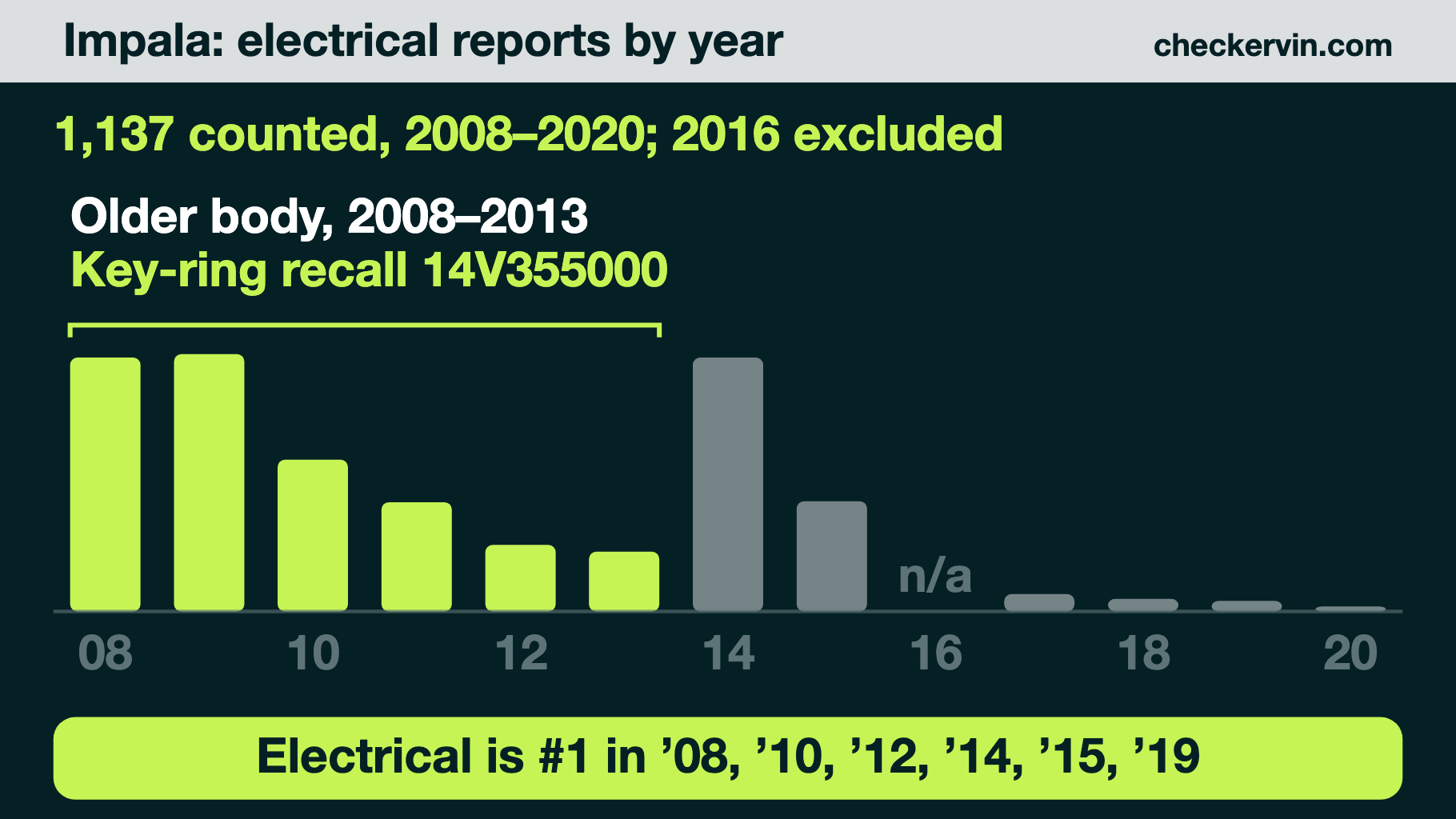
Our corpus of federal NHTSA complaints holds 4,267 owner reports against the 2008–2020 Impala once 2016is set aside. ELECTRICAL SYSTEM is among each year’s five most-reported categories in every one of the 13 model years, 1,137 counted reports or about 27% of the file, and it is the single most-reported category in 2008, 2010, 2012, 2014, 2015 and 2019. The older-body years, 2008–2013, carry 782 of those reports (25% of their combined complaints); the 2014–2020 years carry 355 (31%).
It is an upper bound on starter trouble, not a count of it. The category holds the battery, cables, grounds, body and engine modules, keys, lighting and the starter circuit, and reading the Impala’s complaint narratives for every model year, the word “starter” turns up rarely. Since the data layer keeps only each year’s top five categories, the counted figure is a minimum for the category, not a total.
2008-2014: the key, not the starter
The older Impala’s no-start stories cluster around the key. Owners describe keys that stick in the ignition and will not come out in Park, keys that will not turn, and batteries that are flat by morning because the key never left the run position. Others describe the engine shutting off on the road. Electrical complaints peak in 2009, at 224 counted reports, where electrical ranks second behind air bags.
GM’s recall 14V355000, filed in June 2014 as GM campaign 14299, covers 2006–2014 Impalas along with several Buick, Cadillac and Monte Carlo models. NHTSA’s summary says the weight on the key ring and a jarring event can move the ignition switch out of run, turning off the engine and with it power steering, power brakes and possibly the air bags. The free remedy is two key rings and an insert in the key slot, or a cover over the key head. Until it is done, GM tells owners to carry the ignition key alone on its ring.
A correction for anyone researching this: the larger July 2014 recall, 14V400000, is the one most articles cite, but it covers 2000–2005 Impalas only. The 2008–2014 cars are in 14V355000. Two GM documents NHTSA indexes for these years add a stuck-key story of their own: bulletin 08-07-30-007 for a 2008 key that cannot be removed with the lever in Park, and preliminary information PI0091B for a key that intermittently will not rotate in the ignition cylinder. We could read only NHTSA’s summaries of those two, not the bulletins. A key that will not turn is a lock cylinder or shifter question, and no starter will fix it.
2008-2013: a security light and a silent key
The older Impala does not use the PASSLock system many forum posts name. GM’s preliminary information PIC5037B, from November 2012, describes the 2006–2013 Impala’s system as PASS-Key III+: a transponder in the key head, read by a coil around the ignition cylinder that belongs to the theft deterrent module, which then trades passwords with the engine computer. GM notes that depending on the state of that exchange, the car can show a no crank no start or a crank, start and stall. Neither involves the starter.
Two more GM documents follow from that design. Diagnostic tip PIT5028B covers 2006–2012 Impalas that start and stall the first time after a theft deterrent module is replaced, because a counter in the new module was not set to zero. And diagnostic tip PIC5650, revised again in August 2025 and indexed by NHTSA against every Impala year from 2008 to 2020, covers an intermittent no crank or start-stall with the security light on. GM blames radio interference from devices on or near the key ring, such as other cars’ keys, toll passes and gate cards, and tells technicians not to replace any parts until they have duplicated the concern.
2008-2011: clicks, fuses and a misleading message
For a 2010 Impala that clicks and will not crank, NHTSA’s index summary of GM’s PI-0249 (we could not read the document itself) says to remove, clean and tighten the battery cable ground on the transaxle. A click with no crank is the classic starter symptom, and a bad ground gives exactly the same one. For 2006–2008 cars that crank and will not start, the summary of bulletin 08-06-04-039 describes a blown fuel pump fuse and a wiring repair.
The phrase that sends many owners shopping for a starter appears in the narratives for 2008 through 2011: a dash message reading “starter disabled” alongside “service throttle” and “engine power reduced”, often while driving. Owners describe it as part of a throttle fault, not a starting one. GM issued two special coverages for those symptoms: 14582A replaced the throttle body or its position sensor on 2008–2011 Impalas, and 14636 replaced the accelerator pedal assembly on 2009–2011 cars. Both ran 10 years or 120,000 miles from the date the car entered service, so for nearly every car they have run out. The diagnosis they describe still applies.
NHTSA also indexes GM’s preliminary information PI0412B, a dead battery and no crank caused by an OnStar module draining the battery, against 2011–2013 Impalas. A starter cannot cure a battery that something else is emptying overnight.
2014-2016: three grounds, a relay and a seat bracket
The new Impala has the densest set of no-start bulletins, and every one of them is cheaper than a starter. Preliminary information PI1017A, from July 2013, covers 2014 Impalas that crank long or slowly with a fully charged battery and code P0513. GM’s fix is to clean and tighten ground G103, on the frame rail ahead of the battery, and allows 0.3 hours. A slow crank sounds like a tired starter; on these cars GM says check that ground first.
Bulletin 16-NA-024 covers 2014–2016 Impalas that will not start while the theft deterrent message is displayed, with P0513 in the body control module. GM notes the message lasts 15 minutes, after which the car starts, and traces it to a loose Ground 110, allowing 0.2 hours to tighten it. Bulletin 16-NA-161 covers 2015–2016 Impalas with the 3.6-liter V6 that intermittently will not crank, with push-button and remote start dead and the anti-theft light on, and sends technicians back to a loose or corroded G103.
Two more 2014-era documents describe an intermittent no crank with causes far from the engine bay. Preliminary information PIC5971A covers 2014 Impalas with an intermittent crank or no start and code P1682, and after normal diagnosis replaces an ignition relay in the underhood fuse block, 0.4 hours. And PI1487A covers 2014–2015 Impalas built before March 26, 2015, where the right rear seat-back bolster bracket can rub through the body harness and short it, causing sweeping gauges, lost power steering assist, reduced power and an intermittent no crank. GM allows half an hour to repair the wiring and re-angle the bracket.
The 2014row, which pools the new car and the Limited, is one of the Impala’s largest electrical years, with 221 counted reports, ranked first that year, ahead of steering at 140.
2014-2015: a wet bumper sensor
A large share of the 2014–2015 electrical narratives begin with a “service side detection system” message and end with a car that throws warnings across the dash, shows a theft alert, or will not start. GM wrote this up as special coverage N172097060 in April 2019, for 2014–2015 Impalas with side blind zone alert, along with some Cruze and Acadia models. Its document says water gets into the blind zone modules in the rear bumper, and a failed module can corrupt one of the car’s data networks, knocking out the cluster, displays, chimes and the passenger air-bag sensing.
GM’s document does not list a no-start among the symptoms; owners do, repeatedly. The coverage ran six years or 80,000 miles from the in-service date, so it has expired for nearly every car. The 2014–2015 rows carry 317 counted electrical reports. If a 2014 or 2015 Impala showed the side detection message before it stopped starting, the blind zone modules belong on the diagnosis before the starter does.
2.5-liter cars: the flex plate, and GM's 7.2 hours
Two GM documents for the Impala do involve the starter, and both point past it. The first was service update 14659, from October 2014, for 2015 Impalas and Malibus with the 2.5-liter LKW engine that were still in dealer stock: about 947 cars in the United States between the two models. GM warned that teeth on the flex plate ring gear could chip or break, causing a grinding noise when the starter engaged or a no start. Dealers cranked each car 20 times, a minute apart, listening for grinding or a starter spinning free, and replaced the flex plate if they heard it. The update expired on October 31, 2015, so it is history, but its 7.2-hour Impala labor time is the clearest measure we have of what that repair involves.
The second is bulletin 21-NA-276, which replaced preliminary information PIP5708 in November 2021. It covers 2019–2020 Impalas with the 2.5-liter LCV, the same condition on the Blazer, Acadia and other GM models, and its symptoms are a starter that spins without cranking the engine, or a grinding noise when starting. The cause is broken flex plate teeth. The fix is a new flex plate, and GM tells technicians to inspect the starter’s gear and reuse the starter if it shows only small imperfections or pitting, replacing it only if pieces are missing. A June 2024 revision added “starter inoperative” as a symptom and a note to check the 500-amp starter fuse first. Our Equinox starter post covers the same bulletin on that model.
EPA’s fuel-economy listings show no 2.5-liter Impala for 2020, so in practice this mostly means 2019 cars. The 2019–2020 rows are small, 12 counted electrical reports out of 43 complaints, and every year from 2017 on holds only 219 complaints between them, so the record is too thin to say how common the fault is. If a 2.5-liter Impala grinds, ask for the flex plate to be inspected before anyone bolts in a starter and calls it fixed.
No starter recall, three that matter
We queried NHTSA’s recall database for every Impala model year from 2008 through 2020. No campaign names the starter motor. The one that bears most on starting and stalling is 14V355000, the ignition key recall above, which NHTSA returns for every year from 2008 to 2014. Recall 14V614000 covers some 2014 Impalas, among other GM models, whose chassis electronic module could short internally and stall the car; dealers replace the module. Recall 14V092000 covers 2014 Impalas whose shift cable could detach, which NHTSA’s summary says breaks the federal standard covering the starter interlock and can leave the car out of Park when the lever says Park.
A recall repair is free on any car, at any age. A bulletin like 16-NA-024 or 21-NA-276 is guidance for the technician, and it is only free if the car is still under a warranty that covers it. Our explainer on the difference between a TSB and a recall covers why it still pays to bring the bulletin number. Run the Chevrolet recall check before the car goes in.
Tests to ask for before the starter
Every pattern above ends with an owner turning the key or pressing the button and getting nothing useful. A written diagnosis is what separates a starter job from a ground strap, a relay, a key-ring recall or a flex plate.
- Does the engine crank? If it spins normally and will not fire, the starter is not the fault
- A battery load test and both cable ends checked, including the ground at the transaxle on older cars
- Whether the security or theft light is on during the no-crank, which points to the key, the theft module or interference (PIC5650)
- On a 2008-2014 car: whether recall 14V355000 has been done, and whether the key turns and releases freely
- On a 2014-2016 car: grounds G103 and G110 checked and tightened (PI1017A, 16-NA-024, 16-NA-161)
- On a 2014-2015 car: any side detection system message before the no-start (N172097060)
- On a 2.5-liter car that grinds: the flex plate inspected before the starter is condemned (21-NA-276)
A single loud click with a healthy battery, clean grounds and no security light is the case for a starter. A grinding noise is a case for looking at what the starter meshes with. The battery size lookup helps if the load test fails.
If you are buying the Impala, not repairing it
A receipt for a starter on a used Impala is not a warning sign on its own. A run of them is: two starters on a 2014–2016 car suggest nobody tightened the grounds GM names, and a starter on a grinding 2.5-liter car suggests the flex plate may still be broken. On an older car, ask whether recall 14V355000 was done, and look at the key: a heavy ring of fobs and keys is the condition GM recalled it for. A warranty check by VIN shows whether any factory coverage remains, and the Impala complaint ranking by year compares each model year across every category, not only electrical.
Where this information comes from
- NHTSA — Impala complaint databaseThe federal complaint record this page's figures are computed from, and whose no-start narratives we read for every model year.
- NHTSA recalls API — Impala by model yearQueried for every model year 2008-2020; no starter campaign; 14V355000, 14V614000 and 14V092000 found.
- NHTSA-hosted GM service update 14659 — flex plate auditRead in full: 2015 Impala and Malibu 2.5L in dealer stock; 7.2 hr Impala flex plate replacement.
- NHTSA-hosted GM 21-NA-276 — starter not cranking, grindingRead in full: 2019-2020 Impala 2.5L; replace the flex plate, reuse a lightly pitted starter.
- NHTSA-hosted GM 16-NA-024 — no start, theft deterrent messageRead in full: 2014-2016 Impala; loose Ground 110; 0.2 hr.
- NHTSA-hosted GM 16-NA-161 — intermittent no crank, anti-theft lightRead in full: 2015-2016 Impala 3.6L; loose or corroded G103 ground.
- NHTSA-hosted GM PI1017A — slow or long crankRead in full: 2014 Impala; G103 ground; 0.3 hr.
- NHTSA-hosted GM PI1487A — intermittent no crank, harness rubRead in full: 2014-2015 Impala built before March 26, 2015; rear seat bolster bracket.
- NHTSA-hosted GM PIC5037B — Impala theft deterrentRead in full: 2006-2013 Impala uses PASS-Key III+; can cause no crank or start-stall.
- NHTSA-hosted GM N172097060 — side blind zone module water intrusionRead in full: 2014-2015 Impala; 6 years / 80,000 miles special coverage.
- EPA fueleconomy.gov — Impala engine listings by yearSource of the engine table, including the Impala Limited and eAssist listings.
- YourMechanic — Chevrolet Impala starter replacementThe $204 average ($64 parts, $140 labor), read from search-served page text on November 22, 2026.
- YourMechanic — Chevrolet Impala Limited starter replacementThe $384 average ($188 parts, $196 labor), read from search-served page text on November 22, 2026.
Keep reading
Frequently asked questions
How much does it cost to replace a starter on a Chevy Impala?
YourMechanic lists an average of $204 for an Impala starter, $64 in parts and $140 in labor, and $384 for the 2014-2016 Impala Limited, $188 in parts and $196 in labor. We read both on November 22, 2026 from the page text search engines serve, because YourMechanic blocks automated fetches. They are the publisher's figures, not ours. Give the shop the VIN: the Impala name covers two different cars and five engines from 2008 to 2020.
How much does it cost to replace an engine starter?
On YourMechanic's Impala numbers, labor is the bigger half of a starter job: $140 of the $204 average, and $196 of the $384 Limited figure. The bill changes completely if the starter is fine and the flex plate it drives is broken. GM's service update 14659 allowed 7.2 hours to replace the flex plate on a 2015 Impala with the 2.5-liter engine, and its 2019-2020 bulletin tells technicians to reuse a starter whose gear shows only light pitting.
What is the lifespan of a car starter?
Neither GM nor NHTSA publishes a starter lifespan for the Impala, and we will not invent one. What the federal record does show is that Impala owners rarely name the starter at all. Their no-start reports far more often describe a key stuck in the ignition, a security light, a dead battery or a dash full of warnings, which GM traces to keys, grounds, modules and wiring rather than to a worn-out starter.
Is there a recall on the Chevy Impala starter or ignition?
No recall names the starter on any 2008-2020 Impala. The ignition is a different matter: recall 14V355000 covers 2006-2014 Impalas whose ignition switch can be knocked out of the run position by a heavy key ring, shutting the engine off. The free fix is two new key rings and an insert in the key slot or a cover over the key head. The better-known 14V400000 recall covers only 2000-2005 Impalas.
Why does my Impala say theft deterrent and will not start?
On 2014-2016 Impalas, GM bulletin 16-NA-024 says a loose ground can cause exactly this, a no start with the theft deterrent message showing for 15 minutes, and allows 0.2 hours to tighten it. Bulletin 16-NA-161 names a second ground on 2015-2016 V6 cars. On older Impalas, GM's diagnostic tip PIC5650 blames interference from devices on the key ring and tells technicians not to replace parts until they can duplicate the fault.
Confirm the engine before you price the starter
A free CheckerVIN report shows the factory build, engine, specifications and open recalls for any VIN, so you know exactly which Impala you are quoting before anyone orders a part.
Run a free VIN check