The short answer
- What does it cost?
- YourMechanic lists a $312 average ($172 parts, $140 labor); AutoNation Mobile Service lists $453. Those are their national figures, not ours.
- Which years need extra care?
- 2019–2020 with the 2.0L turbo, where GM blames a starter that spins without cranking on broken flex plate teeth, and 2021–2022 with the 1.5L turbo, where GM points at a corroded power stud on the starter first.
- Is there a recall?
- No Equinox recall from 2008 to 2022 names the starter. GM's starter-circuit documents are bulletins, which are not free repairs.
$312
YourMechanic Equinox starter average
Read Nov. 22, 2026
$453
AutoNation Mobile Service average
Read Nov. 22, 2026
702
Electrical reports counted
2008–2022, a minimum
+1.3 hr
GM time to drop the transfer case
AWD 1.5T, PIT5887C
The estimates, and whose they are
YourMechanic’s Equinox starter page lists an average of $312, made up of $172 for parts and $140 for labor, and notes that prices vary by location. AutoNation Mobile Service’s Equinox page lists an average of $453. Both sites refuse direct fetches from our tools, so we read the figures on November 22, 2026 from the page text search engines serve; two separate searches returned the same numbers. Neither figure, as we could see it, says which model years or engines it assumes. AAA’s repair estimator page for a 2013 Equinox starter returned no figure at all, only a note that the information was not available.
Both publishers send mobile mechanics, so these are not dealer prices. We sell VIN checks, not repairs, and publish no price of our own. What we can add is a factor neither average shows: on the current Equinox, GM’s own labor allowance changes with the drive type. A bulletin for 2021-on cars with the 1.5-liter turbo adds 1.3 hours on all-wheel-drive models to take the transfer case off before anyone can touch the starter’s power terminal. That is a bulletin-only labor figure, not a book time for a starter swap, but it says plenty about where the part sits.
GM has also told technicians, more than once, that the starter is not the first part to replace on a no-crank Equinox. The sections below go through those documents by model year.
What the electrical record can and cannot say
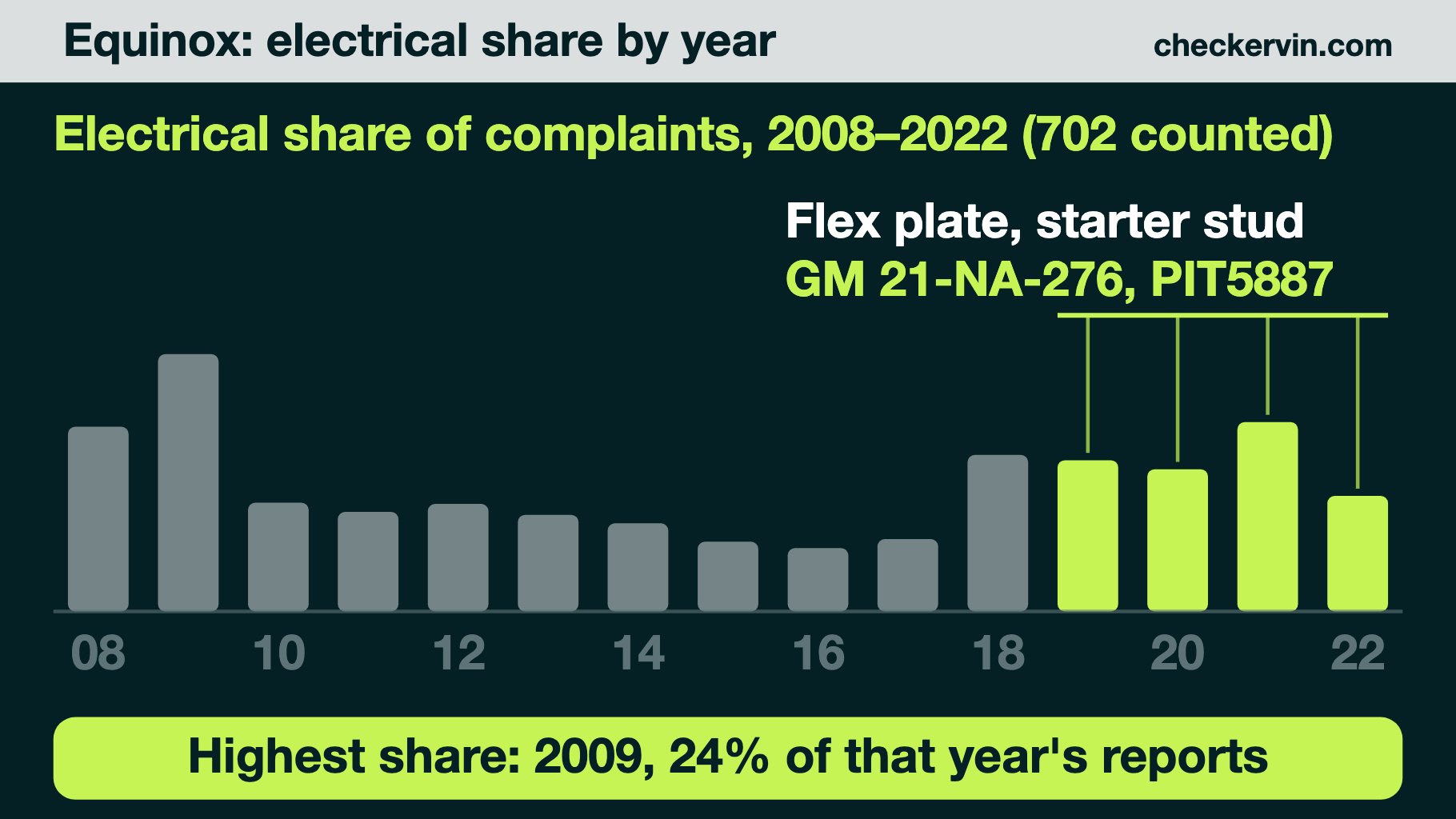
Our corpus of federal NHTSA complaints holds 6,686 owner reports against the 2008–2022Equinox, pooling every name NHTSA files the vehicle under. ELECTRICAL SYSTEM is among each year’s five most-reported categories in all 15 model years, 702 counted reports or about 10% of the whole file. It never leads; its best finish is second, in 2008, 2009, 2021. The chart shows the category as a share of each year’s complaints. The share is highest in 2009, at 24% of only 94 reports, averages 9% across 2010–2017 when the engine dominates the file, and climbs again in the turbo years.
That is an upper bound, not a starter count. The category holds the battery, cables, fuse blocks, body modules, lighting, the ignition and keyless-start hardware, and the starter circuit. When we read the Equinox narratives for every model year, the word “starter” turned up rarely. Most no-start stories are about a dead battery, a car that stalled and would not restart, or a warning-light cascade. The 2021 share looks high partly because that model year has only 100 complaints in the file, so a few reports move it.
2019-2020 2.0L turbo: the flex plate, and GM changing its mind
In January 2020 GM issued preliminary information PIP5708 for 2019–2020Equinoxes with the 2.0-liter turbo (RPO LTG), along with several other GM models. The complaint, which GM called rare, is a starter that spins without turning the engine over, or a grinding noise on starting. The cause is broken teeth on the flex plate, the toothed ring at the back of the engine that the starter’s gear engages. The first version told technicians to replace both the flex plate and the starter.
By July 2021, revision PIP5708B had narrowed that: replace the flex plate, then inspect the starter’s pinion and reuse the starter if it shows only small imperfections or pitting. Bulletin 21-NA-276 replaced the preliminary information in November 2021 with the same instruction, and a June 2024 revision added “starter inoperative” to the symptoms with a note to check the 500-amp F5BA fuse for an open circuit. Only a pinion with pieces missing earns a new starter.
The 2019 and 2020 model years carry 87 counted electrical complaints, 14% of their combined reports. The bulletin applies only to the 2.0-liter turbo, not to the 1.5-liter that EPA also lists for those years, so many of those reports have nothing to do with it. One 2019owner’s story fits it closely: a new battery, then a starter, then another starter after a whirring noise, then a mechanic saying the flywheel was damaged. The owner tied the noise to auto stop/start at traffic lights. The report does not say which engine the car has.
2021-2022 1.5L turbo: power at the battery, none at the starter
The 1.5-liter turbo (RPO LYX) is the only engine EPA lists for the 2021–2022Equinox, and GM has a specific document for it. Preliminary information PIT5887, first issued in January 2022, covers an intermittent no crank where the car powers up normally: lights, dash and radio all work, and nothing happens when you try to start it. GM’s stated cause is an oxidized nut or stud on the starter solenoid’s battery terminal. The fix is to replace the nut and clean the stud, and only if that fails to continue with starter diagnosis or replacement.
The April 2023 version, PIT5887C, extends coverage to 2023 and to the LSD engine, and adds a labor operation for bulletin use: half an hour base, up to half an hour of diagnosis, and 1.3 hours more on all-wheel-drive cars to remove the transfer case. A related engineering request, PIE0703, asked dealers in June 2022 to measure voltage at the battery cable nut and at the starter’s stud on 2019–2022 1.5-liter cars and call an engineer before taking anything apart if the stud had none. GM closed that request in October 2022 and sent technicians to the standard starter diagnosis.
The 2021–2022 years hold 38 counted electrical complaints, 13% of their 282 reports. One 2021report describes a car that lost power at 55 mph and was diagnosed with a failed starter at 54,000 miles. GM’s index also lists PIT6170 for 2022 cars, a no crank caused by a loose ground at G100; we read only its summary.
2018-on: a body module that forgets the fob
Two GM bulletins revised in March 2025 cover the 2018–2024 Equinox and a long list of other GM models. In 23-NA-163, the car will not crank, or starts and stalls, and the fobs stop working. In 23-NA-164, the doors lock and unlock from the fob, but the car will not crank. GM traces both to memory corruption in the body control module after a low-voltage event, a jump start, battery charging, battery replacement or disconnecting the battery, and both apply only to cars with GM’s GEN3R module. The fix is a reprogram and key relearn, not a starter.
The 2018–2022 Equinoxes in our data hold 186 counted electrical complaints. Repeat dead batteries and drains on these cars are covered in our Equinox alternator post; the point here is the sequence. If the car stopped cranking right after a jump start or a new battery, tell the shop: that is the trigger GM names. GM’s long-running diagnostic tip PIC5650, which NHTSA’s index files against every Equinox year from 2008 to 2022, adds another look-alike: an intermittent no crank with the security light on, caused by radio interference from toll passes, aftermarket LED bulbs or chargers. It tells technicians not to replace any parts before duplicating the fault.
2010-2014: the folding key, and other old no-cranks
The second-generation Equinox has a switchblade key that folds into the fob. GM’s diagnostic tip PIT5030E, from May 2013, covers the 2010–2014Equinox among several GM models: if the blade is not fully extended and locked, the head angles down in the ignition and the car may not crank. GM says it can happen when a thumb brushes the release button while inserting the key, and asks dealers to show owners the right way to hold it. It can leave a no-transponder code, B3055, in the module’s history.
Two other GM documents from this era describe no-cranks that started elsewhere. PI0412B, from March 2013, covers 2011–2013 GM vehicles with OnStar whose module could draw about 380 milliamps with the car off and flatten the battery. And a 2009 preliminary item for the 2010 Equinox, PIP-4710, survives in NHTSA’s index only as a summary: a slow or no crank caused by a seizing alternator, after technicians may have replaced the battery, starter or cables with no change. The 2010–2014 model years hold 340 counted electrical reports. Owner narratives from 2011 include a battery, alternator and starter all replaced with the no-start coming back.
When the engine turns over, it is not the starter
A no-start where the engine cranks normally but will not fire is not a starter problem, and several Equinox bulletins describe exactly that. NHTSA’s index lists 20-NA-218 for 2020–2021 cars, a crank-no-start or extended crank with code P12A6, and 24-NA-139 for 2021–2022 cars, a fuel pump control module that can cause a crank-no-start or a stall. If you can hear the engine spinning over at normal speed, a starter quote is aimed at the wrong system.
The 2010–2013 four-cylinder adds a noise that sounds like a starter. Several 2011 owners describe a rattle at startup that they took for a starter not engaging; one dealer ended up replacing a balance shaft chain and tensioner instead. In those years ENGINE complaints make up 47% of the Equinox file, and our Equinox timing chain cost post covers that engine’s chain and oil-consumption history. A startup rattle that fades in a second or two on one of those cars deserves a chain inspection before a starter.
No starter recall on record
We queried NHTSA’s recall database for every Equinox model year from 2008 through 2022and read all 23 campaigns it returned. None names the starter. No GM ignition-switch campaign returns for any Equinox year either. The same pull does return 16V502000, coded under the electrical system’s ignition, for 2010–2013 Equinoxes that may have been serviced with a defective park lock lever, so an electrical starter recall would have shown up.
The one campaign with stop/start in its text is easy to misread. Recall 20V668000 covers 2018–2020 Equinoxes whose start/stop accumulator, a part inside the automatic transmission, may be missing bolts and leak fluid. It has nothing to do with the starter motor. A recall repair is free; a bulletin such as 21-NA-276 or PIT5887 is not unless the car is under warranty, and our explainer on the difference between a TSB and a recall covers why the bulletin number is still worth handing over. Run the Chevrolet recall check before the car goes in so any open campaign is handled on the same visit.
Which engine, and how hard the starter is to reach
Starters are listed by engine, and both turbo-era documents above apply to one engine each. These are the Equinox engines EPA’s fuel-economy listings show.
| Equinox model years | Engines listed by EPA |
|---|---|
| 2008-2009 | 3.4L V6; 3.6L V6 |
| 2010-2012 | 2.4L four; 3.0L V6 |
| 2013-2017 | 2.4L four; 3.6L V6 |
| 2018-2019 | 1.5L turbo (LYX); 2.0L turbo (LTG); 1.6L turbo diesel |
| 2020 | 1.5L turbo (LYX); 2.0L turbo (LTG) |
| 2021-2022 | 1.5L turbo (LYX) |
The engine codes in the table come from the GM bulletins quoted above. Labor is where the engines differ most, and we could not find a GM document that gives book hours for a starter alone on any Equinox engine, so we print none. The one hard figure is PIT5887C’s: on an all-wheel-drive 1.5-liter car the transfer case comes off first, 1.3 hours by GM’s bulletin-only count. Ask each shop for the time its estimating guide lists for your engine and drive type, and compare quotes on that basis. The engine lookup by VIN settles which engine you have, and the Chevrolet VIN decoder confirms the model year and drive type.
Tests to ask for before the starter
Every pattern above ends with a driver turning the key or pressing the button and getting nothing, and only some of them end at the starter. A written diagnosis is what separates a $312 to $453 starter job from a cleaned stud, a key relearn or a flex plate.
- A battery load test and both battery cable ends checked, written down
- Whether the engine cranks at all; a normal crank with no start points away from the starter
- On a 2019-2020 2.0L turbo: the flex plate teeth and the 500A F5BA fuse inspected (21-NA-276)
- On a 2021-2022 1.5L turbo: voltage at the starter's B+ stud, and the stud and nut inspected for oxidation (PIT5887)
- On a 2018-or-later car: whether the no-crank began after a jump start, battery charge or new battery (23-NA-163, 23-NA-164)
- Whether the security light is on during the no-crank (PIC5650 interference)
- On a 2010-2014 car: the folding key fully extended and locked (PIT5030E)
A starter that clicks without spinning, with a healthy battery, clean cables and power at its stud, is the classic case for replacement. A starter that spins and grinds without turning the engine is a flex plate question first. If the battery fails its load test, the battery size lookup gives the right group size.
If you are buying the Equinox, not repairing it
A recent starter receipt on a used 2019–2020 2.0-liter Equinox deserves one question: was the flex plate inspected? Two starters in a short time is a sign the bulletin’s fix was not done. On a 2021–2022 car, ask whether the starter was replaced or only the stud cleaned. A warranty check by VIN shows whether any factory coverage remains, and the Equinox complaint ranking by year shows how each model year compares across every category.
Where this information comes from
- NHTSA — Equinox complaint databaseThe federal complaint record this page's figures are computed from, and whose starter and no-start narratives we read for every model year.
- NHTSA-hosted GM bulletin 21-NA-276 — starter not cranking, grindingRead in full (June 2024 revision): 2.0L LTG Equinox; broken flex plate teeth; do not replace a starter with only small imperfections; check the 500A fuse.
- NHTSA-hosted GM PIP5708 — flex plate broken teethRead in full with revision PIP5708B: 2019-2020 Equinox 2.0L; first told technicians to replace flex plate and starter, later only the flex plate.
- NHTSA-hosted GM PIT5887C — powers up but will not crankRead in full: 2021-2023 Equinox 1.5L; oxidized B+ stud on the starter; 1.3 hours added on AWD to remove the transfer case.
- NHTSA-hosted GM PIE0703 — intermittent no start, vehicle has powerRead in full with its October 2022 closure: voltage checks at the battery nut and starter stud on 1.5L cars.
- NHTSA-hosted GM bulletin 23-NA-163 — no crank, fobs inoperativeRead in full with 23-NA-164: 2018-2024 Equinox; body module memory corruption after a jump start or battery work.
- NHTSA-hosted GM PIT5030E — intermittent no crank, key not extendedRead in full: 2010-2014 Equinox; folding key not locked straight can prevent cranking.
- NHTSA-hosted GM PIC5650M — security light, no crank, RF interferenceRead in full: aftermarket devices that can jam the key signal; replace nothing until the fault is duplicated.
- NHTSA recalls API — Equinox by model yearQueried for every model year 2008-2022; no starter campaign, checked against the ignition-coded park lock recall that does appear.
- EPA fueleconomy.gov — Equinox engine listings by yearSource of the engine table; queried for each model year, FWD and AWD.
- YourMechanic — Chevrolet Equinox starter replacementThe $312 average ($172 parts, $140 labor), read from search-served page text on November 22, 2026.
- AutoNation Mobile Service — Chevrolet Equinox starter replacementThe $453 average, read from search-served page text on November 22, 2026.
Keep reading
Frequently asked questions
How much does it cost to replace a starter on a Chevy Equinox?
YourMechanic's Equinox starter page gives an average of $312, split $172 for parts and $140 for labor. AutoNation Mobile Service's Equinox page gives an average of $453. We read both on November 22, 2026 from the text search engines serve for those pages, because both sites block automated fetches. They are national figures before tax and without your ZIP code. On an all-wheel-drive 2021 or later Equinox with the 1.5-liter turbo, GM's own bulletin adds 1.3 hours to remove the transfer case just to reach the starter's power stud, so ask whether a quote assumes front- or all-wheel drive.
What year to stay away from Chevy Equinox?
By total owner complaints in our NHTSA corpus, 2010 has the most of any Equinox model year, 784. Across 2010–2013, ENGINE complaints alone make up 47% of the file; those are years covered by GM special coverage 14882 for oil consumption on the 2.4-liter four-cylinder. Starter trouble is not what separates good and bad Equinox years; the engine is. Our Equinox years-to-avoid page ranks every year across all categories.
Is replacing a starter a big job on an Equinox?
It depends on the engine and drive type. GM's bulletin PIT5887C, for 2021-2023 Equinoxes with the 1.5-liter turbo, allows half an hour to replace the nut and clean the stud on the starter's power terminal, then adds 1.3 hours on all-wheel-drive cars to remove the transfer case first. That tells you the starter sits behind the transfer case on those cars. If the flex plate is broken, as GM describes on some 2019-2020 cars with the 2.0-liter turbo, the job becomes a flex plate replacement, which is much larger. We could not verify book hours for a starter alone on any Equinox engine.
Can I still drive my Equinox with a bad starter?
Once the engine is running, it does not use the starter, so a car that started can usually be driven to a shop. The risk is that it will not start again where you shut it off, and on cars with auto stop/start that can be at a traffic light. A grinding noise on starting is a reason to stop trying: GM's flex plate bulletin for 2019-2020 turbo cars tells technicians to clear broken flex plate teeth and metal debris from the bell housing, and repeated attempts on broken teeth can damage the starter's pinion as well.
Is there a recall on the Chevy Equinox starter?
No. We queried NHTSA's recall database for every Equinox model year from 2008 through 2022 and no campaign names the starter. The one recall with stop/start in its description, 20V668000 for 2018-2020 cars, concerns missing bolts on a start/stop accumulator inside the automatic transmission, not the starter motor. GM's flex plate and starter-stud bulletins are repair guidance, not recalls, so they do not make the repair free outside warranty.
Confirm the engine before you price the starter
A free CheckerVIN report shows the factory build, engine, specifications and open recalls for any VIN, so you know exactly which Equinox you are quoting before anyone orders a part.
Run a free VIN check