The short answer
- What is autoDNA?
- A vehicle history service run by AUTODNA Sp. z o.o. of Łódź, Poland. It says its data covers more than 26 European countries plus the US and Canada.
- Is it an approved NMVTIS provider?
- No. It is not on the Department of Justice list. Its US sample report credits its NMVTIS data to VinAudit, which is on the list.
- When is it worth it for a US buyer?
- When the car was registered in Europe before it came here. For a US-only car, an NMVTIS report from a listed provider covers the same title record.
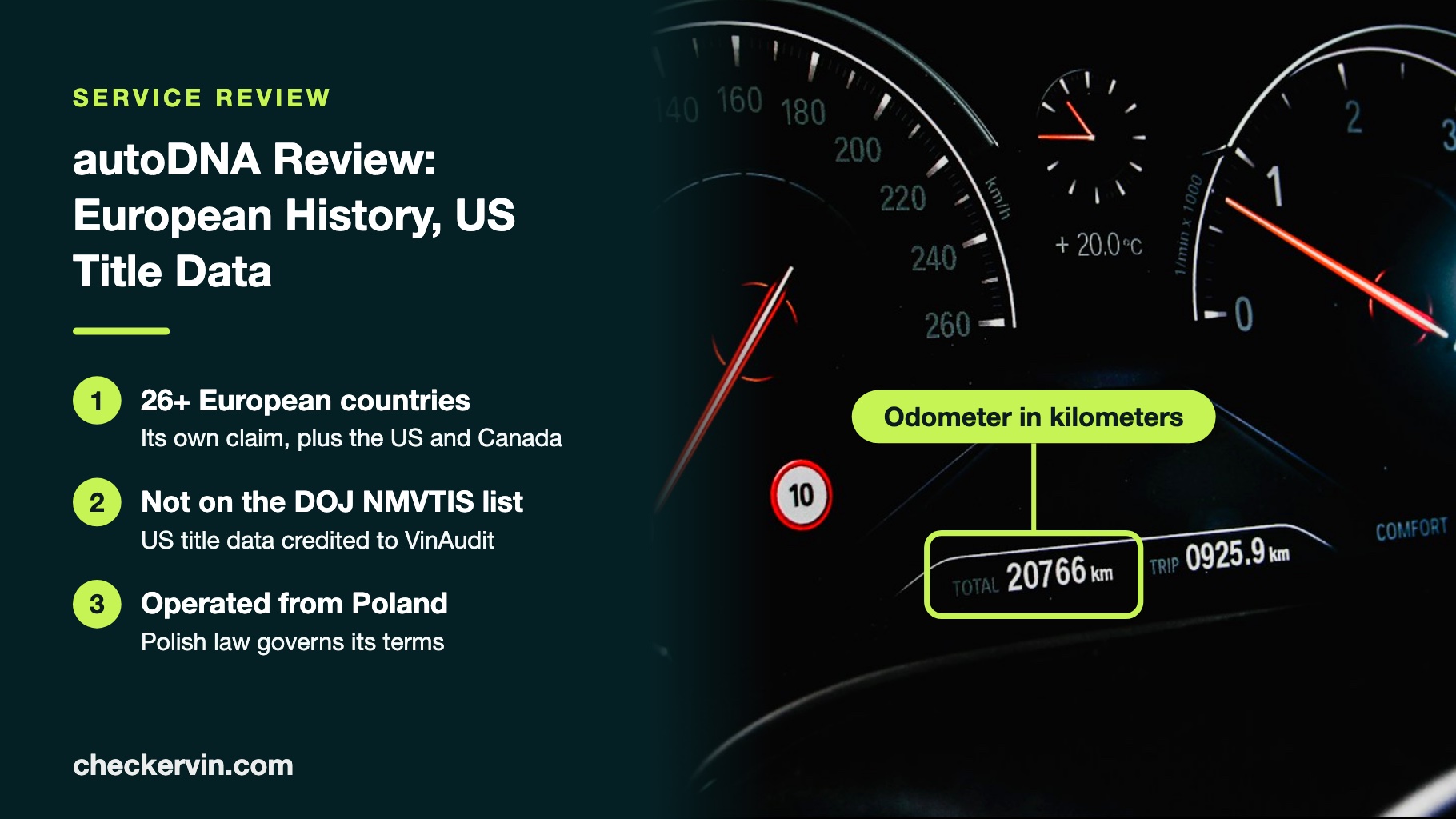
Poland
Where the operator is registered
AUTODNA Sp. z o.o., Łódź
26+
European countries it claims
Plus the US and Canada
Not listed
DOJ NMVTIS provider status
US data credited to VinAudit
Polish law
Governs its terms
Terms §14.1, read Nov 2026
The short verdict
autoDNA earns its fee on one kind of car: one that spent part of its life on European roads. Its European data covers registrations, periodic inspections, mileage readings, damage entries and archived photos. American databases do not hold any of that, and the gap matters most for the years before a car was imported. On a car that has only been titled in the US, its own US sample says the title data comes from NMVTIS through VinAudit. In that case you are paying a European company for a federal record that listed US providers sell directly.
Who runs autoDNA
The terms on autodna.com name the seller as AUTODNA Spółka z ograniczoną odpowiedzialnością, registered at ul. Obywatelska 128/152 in Łódź, Poland, under court register (KRS) number 0000349742. The company says it has served customers since 2010. Its terms say contracts made on the site follow Polish law, and that consumers keep the mandatory protections of their own country. For a US buyer that means the seller, the currency and the contract are all European.
The company describes its reach in large numbers: more than 26 countries, more than 50,000 data sources across dealers, workshops, inspection stations, financial institutions, police and state administrations, and more than 500 million vehicles. Those are its own claims. We could not verify them independently, and they say nothing about how much data exists for any particular VIN.
What the autoDNA vehicle history report holds for European cars
autoDNA publishes a sample report. The sections it shows give a fair picture of what a European-history car can return:
| Section in the sample | What it shows |
|---|---|
| Information about vehicle | VIN decode: make, model, body, engine, country of origin, model year, gearbox, steering, plus a check-digit test |
| Odometer readings | A mileage chart built from inspections, service visits and registrations |
| Vehicle history | A timeline of registrations, deregistrations, tax liens, listing prices, inspections, damage and uses such as taxi |
| Stolen vehicle database | Results from what it calls over a dozen stolen-vehicle databases |
| Manufacturer recalls | Service campaigns with the problem, the fix and production ranges where known |
| Equipment and archive photos | Factory-fitted features, and older photos of the car where they exist |
| Last enquiries | When and where the VIN was looked up on autoDNA itself |
The last row is worth noticing. A car whose VIN was checked repeatedly in the months before it reached you has been shopped around, and that is a fair question to put to a seller. The sample also includes autoDNA’s own warning: it gathers data from many sources, “including public Internet sources,” and that data can repeat errors made at the source.
The autoDNA US report, and where its data comes from
The second sample on autodna.com covers US vehicles. It is a US title report with sections for title brands, title records, theft records, accident records, junk, salvage and insurance records, and US sale listings. The sample says it comes “with the purchase of an autoDNA Vehicle History Report,” so it is bundled with the main report rather than sold alone.
The sample says where the data comes from. It carries the standard NMVTIS consumer disclaimer and then states that “NMVTIS data are provided by VinAudit Inc., official NMVTIS system partner.” So the US title part of an autoDNA report is federal NMVTIS data passed through VinAudit, a provider on the Department of Justice list. Our NMVTIS report guide explains what that record does and does not contain.
Not on the DOJ approved-provider list
The Department of Justice publishes the companies approved to sell NMVTIS reports. As read on November 24, 2026, the tier that serves the public names these businesses:
- Bumper.com
- Carsforsale.com
- Carvertical.com
- Checkthatvin.com
- Clearvin.com
- EpicVin.com
- GoodCar.com
- Titlecheck.us
- Vinaudit.com
- Vindata.com
- VinReport
- Vinsmart.com
That is 12names. autoDNA is not among them, and the page’s list of other websites selling a provider’s data names only VinCheck.Info under VinAudit. Those are the facts the list supports. It does not tell you that autoDNA does anything improper. autoDNA names VinAudit as its source, and VinAudit is approved. What it does tell you is that if federal title data is all you need, you can buy it from a listed US provider, without the European layer you would not use.
How autoDNA charges, and the terms behind it
We do not print other companies’ prices, because they change and a stale figure misleads. Here is how autoDNA structures its charges, per autodna.com/packages and its terms as read on November 24, 2026. Current prices are on its own site.
| Option | How it works |
|---|---|
| Single report | One vehicle history report, bought for one VIN, with a validity window shown on the packages page |
| Multi-report packages | Bundles of several reports at a lower per-report cost; larger bundles carry a longer validity window |
| US report | Offered with the purchase of the main autoDNA Vehicle History Report rather than sold on its own |
| Subscription | A recurring plan charged automatically at the start of each 30-day settlement period (terms §3.2.3) |
| Business packages | A separate offer aimed at dealers and other business customers |
Prices are set in euros and, per the terms, include taxes. Three points from the terms matter more than the price itself:
- Subscriptions renew on their own: the recurring fee is charged automatically at the start of each 30-day settlement period
- Consumers get 14 days to withdraw, but the right is lost for digital content delivered after you expressly consent and acknowledge losing it
- Payment is in euros, so a US card issuer may add a foreign transaction fee on top
For how report pricing works across the US market, see how to choose a VIN check.
When a European history report helps a US buyer
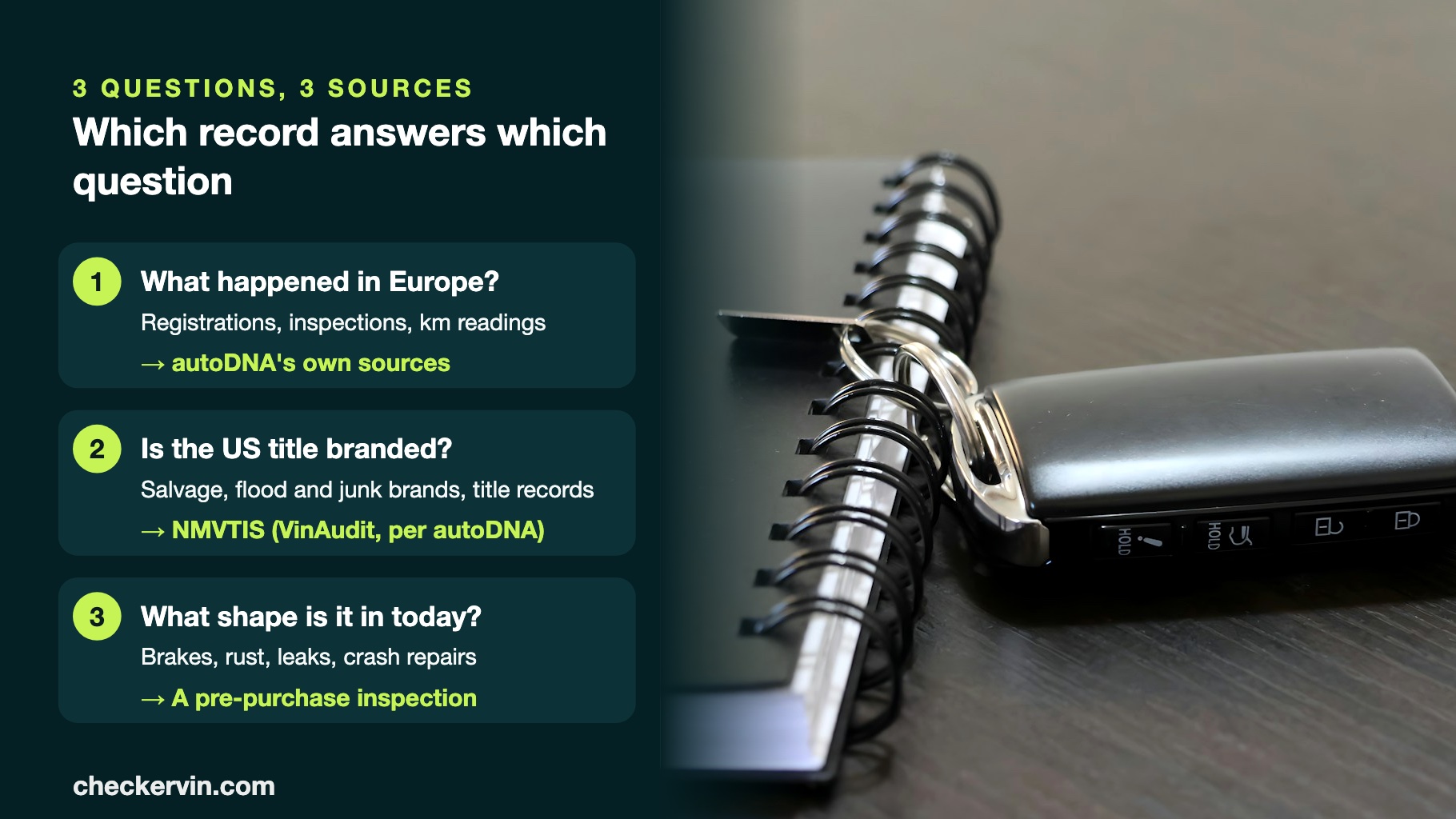
A car imported into the US starts its American paper trail on the day it is first titled here. Federal rules allow a car 25 or more years old to be imported without meeting US safety standards (49 CFR 591.5(i)(1)). A younger non-conforming car has to come in through a registered importer under a bond of 150% of its dutiable value (591.5(f)). Either way, the years it spent abroad are invisible to NMVTIS. Those are the cases where a European report is worth paying for:
- A 25-year-old European-market car brought in under the age exemption, where most of its life happened abroad
- A gray-market car with a foreign registration history and a US title only a few years old
- A car brought over by a returning owner or a service member after a European posting
- Any import whose odometer reading at export is unknown, since kilometers recorded at European inspections can show whether the dial was wound back
The rules on which imports are legal to own, and the documents to ask for, are on our imported car VIN check page. A European report tells you what happened to the car. It does not tell you whether it cleared US Customs.
When a US NMVTIS-backed report is the right tool
For a car that has spent its whole life in the US, the main thing a history report should catch is title washing: a salvage, flood or junk brand dropped by retitling the car in another state. NMVTIS exists to catch exactly that, and states, insurers and salvage yards must report into it. autoDNA’s own US disclaimer says so. Any provider on the DOJ list sells that record directly, so for a domestic car there is little reason to buy it wrapped in a European report.
Canada is the edge case. A Canadian-certified car can be imported for personal use under its own rule (591.5(g)), and its Canadian years sit outside NMVTIS as well. autoDNA says its data includes Canada, but we could not check how deep that coverage goes for any given car. Use its free VIN check to see what it reports finding.
autoDNA vs carVertical
The two get compared because both are European companies selling to American buyers. We cover carVertical’s European angle in our carVertical review, so here is only the difference you can check. Carvertical.com appears on the DOJ approved-provider list in its own name. autoDNA does not, and its US sample says its US title data comes from VinAudit. On European coverage, each publishes its own claims and neither can be tested without a VIN. The honest way to choose for a specific import is to run both free VIN checks and compare what each says it found.
autoDNA vs Carfax vs CheckerVIN
A fair comparison has to include what our own report does and does not do today. We limit it to what the sources on this page show.
| Question | autoDNA · CheckerVIN |
|---|---|
| European registrations, inspections, mileage | autoDNA: Yes, its core product. CheckerVIN: No. |
| US title brands from NMVTIS | autoDNA: Yes, credited to VinAudit. CheckerVIN: Title timeline and brands launching soon; today, buy the title record from a DOJ-listed provider. |
| On the DOJ public provider list | autoDNA: No. CheckerVIN: No. |
| Factory build, specifications and warranty terms | autoDNA: Decode and equipment, in the report. CheckerVIN: Yes, free. |
| Open safety recalls | autoDNA: Yes, in the report. CheckerVIN: Yes, free, from NHTSA. |
| Damage, odometer and ownership history | autoDNA: European records, plus US data via VinAudit. CheckerVIN: Launching soon, not live today. |
| Photos and market prices | autoDNA: Archive photos and listing prices where found. CheckerVIN: Photos filed against the VIN and market and listing prices, free. |
| How you pay | autoDNA: Single reports, packages or a subscription, in euros. CheckerVIN: Free, no account. |
On autoDNA vs Carfax, the one checkable fact is on the DOJ list: CARFAX.com appears only in the commercial tier, for commercial customers in California. Carfax’s product is its own US network of records, which is a different thing from European registry data, and we compare it with other US options on Carfax alternatives.
What CheckerVIN gives you today is free: the factory build and specifications, factory warranty terms, open NHTSA safety recalls, photos filed against the VIN, and market and listing prices. That confirms what the car is before you spend anything. Title, damage, odometer and ownership history are launching soon and are not on our report today, so for the federal title record right now, buy from one of the DOJ-listed providers above.
Free VIN decode and recall check, no sign-up
Decoded from official manufacturer and NHTSA records
How to use the free autoDNA VIN check well
autoDNA lets you enter a VIN for free and shows which kinds of records it holds before you pay. Used in order, that preview helps you decide whether to buy:
- 1Decode the VIN firstConfirm year, make, model and engine free, here or on NHTSA's decoder. If the listing describes a different car, stop there.
- 2Run the free autoDNA VIN checkLook at which categories it says exist for this VIN: registrations in which countries, odometer readings, damage entries, photos.
- 3Buy only if Europe shows upIf the preview shows no European registrations, the report's main value is gone, and a listed NMVTIS provider covers the US title record for less.
- 4Line up the kilometers with the dialConvert the last European reading to miles and compare it with the odometer and the US title's mileage entry. A lower number later is the red flag.
- 5Book an inspection anywayNo report shows the condition of the car in front of you. A pre-purchase inspection does.
What none of these reports show
- Mechanical condition today, which only an inspection reveals
- Repairs paid in cash and never reported to an insurer, inspection station or registry
- Whether an import cleared US Customs and NHTSA properly, which the entry papers settle
- Owner names and addresses, which no consumer report includes
- Complete coverage: autoDNA's own terms warn that not all of the information in a report may be available, complete and correct
Where this information comes from
- autoDNA — homepageCoverage claims, report contents and the free VIN check, read November 24, 2026
- autoDNA — packagesSingle reports, packages and validity windows, read November 24, 2026
- autoDNA — terms and conditionsOperator, Polish law, subscriptions, withdrawal and data disclaimers
- autoDNA — about the companyRegistered address and court register number
- autoDNA — sample European reportSection list and the public-Internet-sources disclaimer
- autoDNA — sample US reportStates its NMVTIS data is provided by VinAudit Inc.
- NMVTIS — approved data providersThe Department of Justice list, read November 24, 2026
- 49 CFR 591.5 — import eligibilityThe 25-year rule, registered importers and Canadian-certified vehicles
- How we made this pageWritten by the CarCheckerVIN editorial team with AI assistance from autoDNA's own pages, the DOJ NMVTIS provider list and federal regulations; facts checked November 2026.
Keep reading
Frequently asked questions
Is autoDNA legit?
autoDNA is run by AUTODNA Sp. z o.o., a company registered in Łódź, Poland, under the Polish court register number 0000349742, and its terms name that entity as the seller. It publishes sample reports, its package terms and a 14-day withdrawal procedure for consumers. It is not on the Department of Justice list of approved NMVTIS data providers; its US sample report credits its NMVTIS data to VinAudit, which is on that list.
Is autoDNA reliable for American cars?
For a car that has only ever been titled in the US, its own sample says the US title, brand, theft and salvage data comes from NMVTIS through VinAudit. That is the same federal record any approved provider sells, so autoDNA adds little for a purely domestic car. Its strength is the European registration, inspection and odometer data, which matters only if the car spent time in Europe.
How does autoDNA charge for a vehicle history report?
Per its packages page and terms, checked November 24, 2026: you can buy a single report, or a multi-report package that lowers the cost per report, each with a validity window. The US title report comes with the main report rather than on its own, and there are subscriptions that renew automatically every 30 days. Prices are set in euros, so a US card may also see a currency conversion charge from its issuer. Check autodna.com for current prices.
Is there an autoDNA USA site?
The service runs from autodna.com, which offers a US sample called a local history of the US vehicle alongside its European reports. The operator is the Polish company; we found no separate American company behind autodna.com.
Is autoDNA the same as an LLC in the United States?
The operator named in autodna.com's terms is AUTODNA Spółka z ograniczoną odpowiedzialnością, the Polish form of a limited liability company. Any US business with a similar name is a separate matter we did not research, so check the company name on your receipt.
autoDNA vs carVertical: which should I use?
Both started in Europe and both lean on European data. The checkable difference for a US buyer is that Carvertical.com is on the DOJ approved NMVTIS provider list in its own name, while autoDNA is not and sources its US title data from VinAudit. For a European import, compare what each one's free VIN check says it found before you pay either.
Does the autoDNA VIN decoder work on European-market cars?
Its sample report shows a decoded vehicle section with make, model, body, engine, country of origin, model year, gearbox and steering, plus a check-digit test. Decoding is the easy part. Whether the car has records behind it is what the free VIN check tells you before purchase.
Start with the free decode, wherever the car came from
Decode any VIN free for the factory build, specifications, warranty terms and open safety recalls. Full vehicle history reports are launching soon.
Run a free VIN check