The short answer
- Is it legitimate?
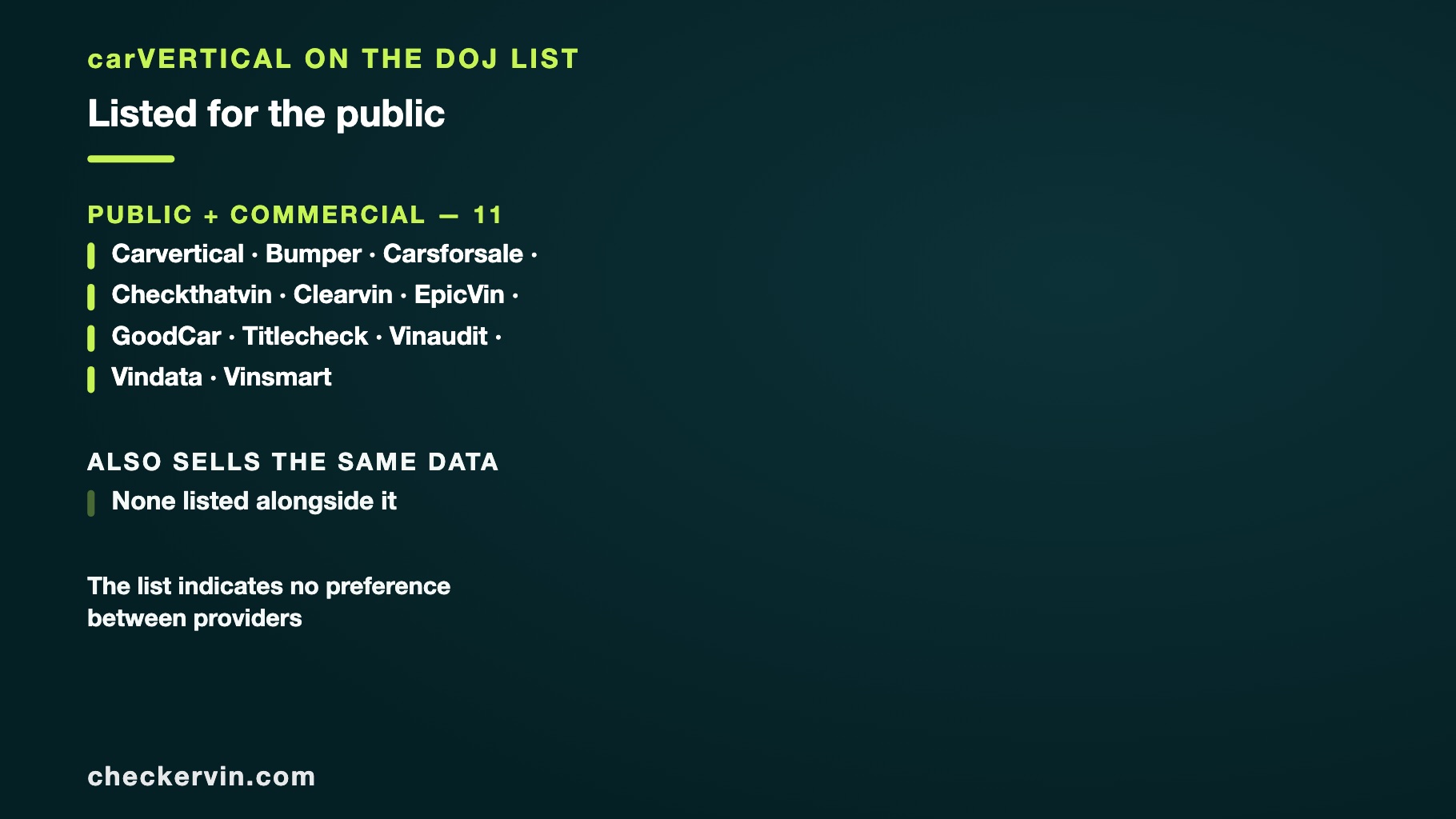
- Yes — Carvertical.com is on the Department of Justice's approved NMVTIS provider list for public customers, the same verifiable credential the better US providers hold.
- What is it uniquely good at?
- Vehicles with a European chapter. Its registry relationships find history on imported cars that American-first providers simply never saw.
- When is it the wrong choice?
- A purely domestic car with a long US service history — that is where Carfax's and AutoCheck's decades of American network depth win.
Approved
NMVTIS provider status
Listed for public customers
European
Where its data edge comes from
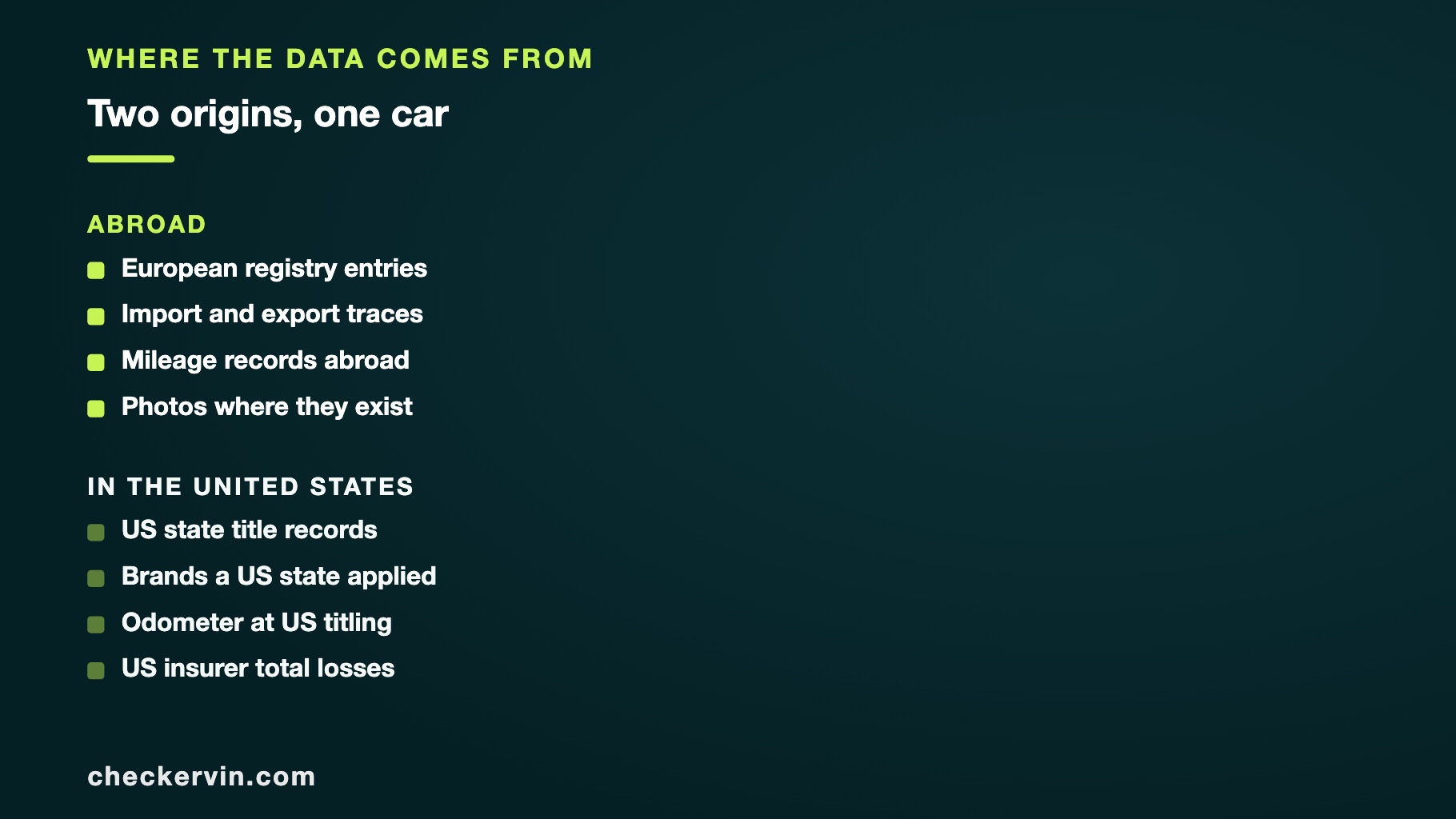
Registry relationships abroad
Imports
The use case it wins
Cars with a life before the US
Marketing
What the blockchain framing is
Judge the sources instead
The short verdict
carVertical is a legitimate, federally approved provider whose value to an American buyer depends almost entirely on one question: has this car ever been registered outside the United States? If yes, it may find records no domestic competitor holds. If no, it is a competent but unremarkable option among several cheaper ones.
The genuine differentiator — registries American providers never touched
Vehicle history is a data-relationship business, and relationships are regional. The US incumbents spent decades wiring themselves into American dealer groups, repair chains, insurers and auctions. carVertical did the same work across European markets first, which means it can often speak to a car’s life in Germany, Lithuania or the Netherlands — mileage records, registration events, damage entries — that simply do not exist in any American system.
That matters more than it sounds, because European mileage fraud is a large, well-documented problem and imported cars arrive with their odometers effectively unaudited by US databases. A record from the country of origin is sometimes the only way to test the number on the dash — a task our rollback guide covers from the domestic side.
Approved provider status
Carvertical.com is named on the Department of Justice’s published list of NMVTIS data providers serving public and commercial customers. That means its US title-brand data comes from the federal system state agencies, insurers and salvage businesses must report into — the same source behind every approved provider. As always, the list is public and worth checking yourself before paying anyone; the NMVTIS guide explains what that record holds.
The blockchain claim, assessed
carVertical launched with a pitch built around recording vehicle data immutably on a blockchain, and that framing still colors its marketing. Assessed honestly: what determines whether a report tells you something useful is which registries and databases feed it, not the storage architecture behind the results. A report drawing on rich European registry access is valuable whether it is stored on a distributed ledger or a conventional database; a report drawing on nothing useful is not rescued by either.
What a report includes
| Section | What to expect |
|---|---|
| Title and brand records | NMVTIS-sourced US title history as an approved provider |
| European registry data | Registration, mileage and damage entries from its home markets |
| Mileage timeline | Readings gathered across jurisdictions — the import-fraud check |
| Damage records | Where reported, often with photographs on European-market cars |
| Specifications | Factory build data decoded from the VIN |
Why imports are the real use case
A car imported into the US arrives with a documentary blank slate. The title record starts when it was first titled here; the odometer disclosure starts from whatever the importer wrote down. Everything before that — the years of European ownership, the mileage at export, the damage repairs — exists only in databases outside the reach of American providers. That gap is precisely where carVertical earns its fee, and it is a gap that grows more relevant as more enthusiast cars pass the 25-year import threshold each year.
Where it stops
- US service and maintenance history is thinner than the American incumbents' networks
- Domestic accident reporting does not match Carfax's or AutoCheck's decades of local relationships
- European coverage varies by country — some registries are far richer than others
- Owner identity is never included; federal privacy law binds every provider equally
- Mechanical condition remains invisible, as it is to every report ever sold
Who it suits
It suits buyers of imported vehicles, gray-market cars, and anything whose history has a hole that American databases cannot explain. It suits enthusiasts importing under the 25-year rule, where the car’s entire meaningful life happened abroad. It suits less well the buyer of an ordinary domestic used car, who is better served by a cheap NMVTIS report plus one of the US-network incumbents if the price justifies it.
Start free: decode the VIN and check open recalls
Decoded from official manufacturer and NHTSA records
Where this information comes from
- NMVTIS — approved data providersThe official list naming Carvertical.com
- NHTSA — vehicle importation and the 25-year ruleThe federal rules that create the import market this serves
- NICB VINCheckFree US theft and salvage screen, worth running alongside
- NHTSA recall lookupUS recall campaigns, free, by VIN
Keep reading
Frequently asked questions
Is carVertical legitimate?
Yes. Carvertical.com appears on the Department of Justice's published list of NMVTIS data providers approved to sell reports to the public, which is the checkable credential in this market. It is a European company that expanded into the US, and that origin is the source of both its main strength and its main limitation.
What makes carVertical different from Carfax?
Geography. Its data relationships were built across European registries and databases first, so it frequently has history on vehicles that spent part of their life in Europe — cars that American-first providers know nothing about until they were imported. For a purely domestic vehicle it has no comparable advantage.
Is the blockchain part meaningful?
It is a marketing frame more than a buyer benefit. The company's original pitch centred on recording data immutably; what actually determines a report's usefulness is which registries and databases feed it, not how the results are stored. Judge it on the NMVTIS approval and the European coverage, both of which are real, rather than on the technology narrative.
Is carVertical good for American cars?
It is adequate rather than exceptional. As an approved NMVTIS provider it can supply federal title-brand data like any other, but on domestic service and accident history it does not match the networks Carfax and AutoCheck built over decades in the US market.
When should I use it?
When the car is an import or has any European chapter — a gray-market vehicle, a car brought over by a returning owner, or anything whose history has a gap that American databases cannot explain. That is the scenario where it finds records nobody else holds.
Free decode, wherever the car came from
Decode any VIN free for the factory build, specifications and open safety recalls. No account, no card.
Run a free VIN check