The short answer
- How do you check a car's history in Virginia?
- Run the free national checks — VIN decode, NHTSA recalls, NICB theft and salvage — then the national NMVTIS title record through an approved provider. Then the Virginia layer: price in the annual property tax on the car's value, read the inspection sticker, and water-check anything from Tidewater.
- What surprises buyers most in Virginia?
- The car tax. A valuable used car bills its owner every year on assessed value, so two similar cars at the same purchase price can carry very different lifetime costs. Look up the local rate before you decide what to buy, not after.
- Can you look up a license plate in Virginia?
- No — the federal DPPA restricts plate-to-owner lookups to permitted uses in every state. The VIN is the number that answers purchase questions.
Annual
The personal property tax
Billed on value, every year
Sticker
Yearly safety inspection
Emissions in NoVA
Tidewater
The flood-exposed coast
Norfolk to Hampton Roads
DPPA
Plate lookups restricted
Federal, all states
The car tax: how it works
Virginia localities levy an annual personal property tax on vehicles, assessed on each car's value and billed to whoever owns it — every year, for as long as they own it. Rates and relief programs vary by county and city, and the state offsets part of the bill on personal-use vehicles, but the structure is constant: value in, tax bill out, annually.
For a used buyer this rewires the comparison between candidates. A newer, more valuable car does not just cost more once — it costs more every year it sits in your driveway, at your locality's rate. Two similar cars, one a few years older, can differ by hundreds of dollars a year in carrying cost before fuel or insurance enter the picture.
Budgeting the tax into the purchase
- 1Look up your locality's rate before shortlistingCounty and city rates differ meaningfully. The same car carries a different annual bill across a county line.
- 2Estimate the bill on each candidate's valueAssessed value tracks market value. A rough calculation per candidate turns the tax from a surprise into a criterion.
- 3Weigh depreciation differentlyIn Virginia, a car that has already shed most of its value has also shed most of its tax. The older candidate's advantage compounds annually.
- 4Keep the paperwork tight at transferRegistering promptly and accurately keeps the assessment clean and avoids billing disputes with the prior owner's locality.
The annual inspection
Virginia requires a yearly state safety inspection at licensed stations, evidenced by a windshield sticker, with an emissions program layered on in the Northern Virginia counties near Washington. The buyer's reads are the same two as Pennsylvania's sticker economy: a current sticker is a modest genuine positive, and a sale timed close to expiry is a question worth asking out loud.
Virginia's salvage rules only reach some cars
Most state salvage schemes apply to any vehicle. Virginia's applies to a defined class, and everything that follows depends on whether a particular car is inside it.
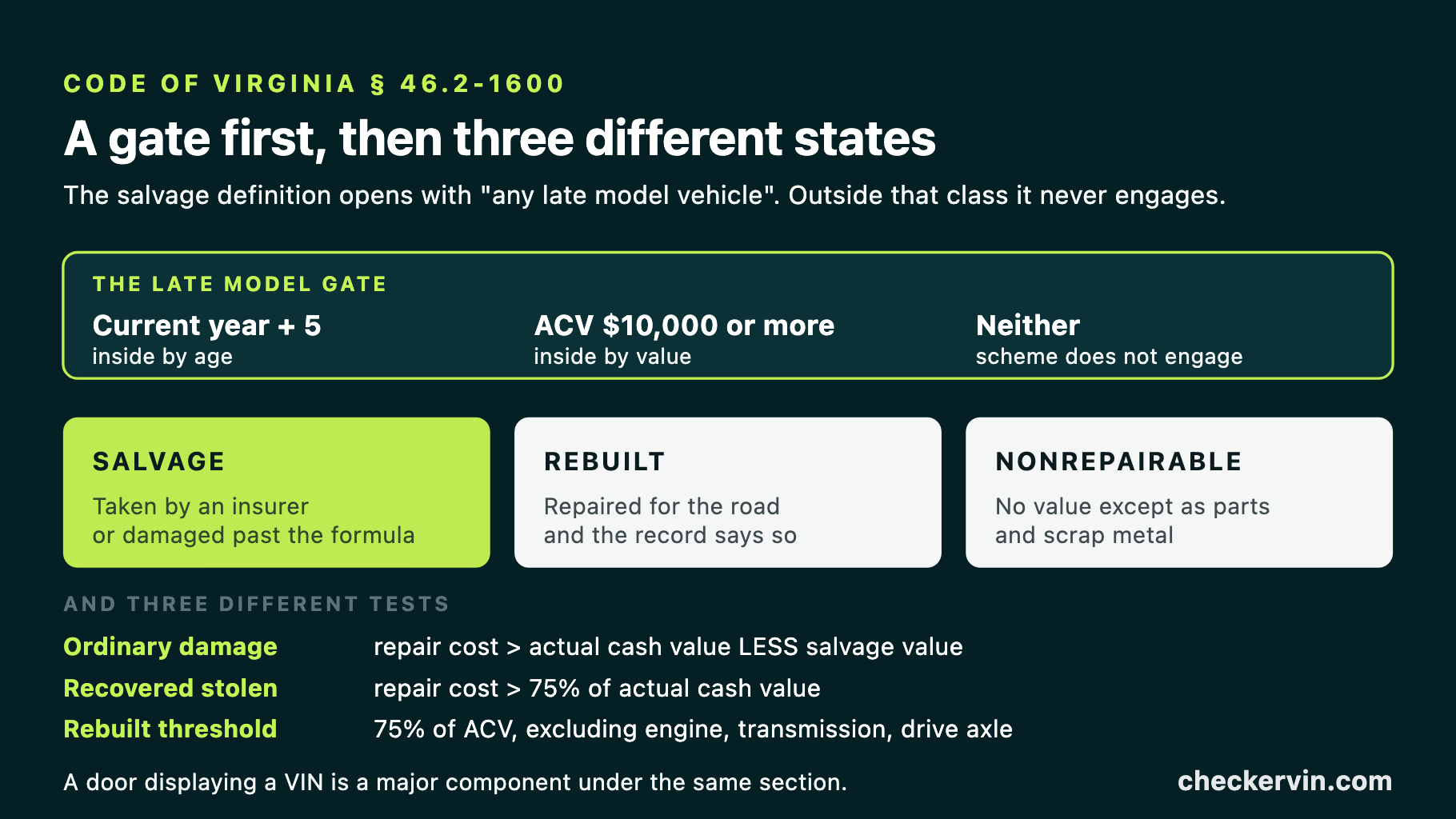
Section 46.2-1600 defines a late model vehicleas “the current-year model of a vehicle and the five preceding model years, or any vehicle whose actual cash value is determined to have been at least $10,000 prior to being damaged.” The salvage definition then opens by applying to “any late model vehicle” that meets its damage tests.
| The vehicle | Whether the salvage definition reaches it |
|---|---|
| Current model year, or one of the five before it | Yes — inside the late model class by age alone |
| Older, but worth $10,000 or more before the damage | Yes — inside by value |
| Older, and worth less than $10,000 before the damage | Outside the class, and outside the definition |
Read that third row carefully, because it is the one with consequences. An older, inexpensive vehicle can be comprehensively wrecked in Virginia without meeting the statutory definition of a salvage vehicle at all. The car is no less damaged; it simply falls outside the class the branding scheme was written for.
The value limb repays a second look too. It is not the car's worth today, nor what it fetched at auction afterwards — the statute fixes on the actual cash value “determined to have been at least $10,000 prior to being damaged.” So the test looks backwards to the car as it stood before the event, which is a figure nobody can read off the vehicle and which an insurer or owner arrives at rather than a public register.
For a buyer that has one practical consequence. Whether a particular Virginia car was ever inside the salvage scheme can depend on a valuation made privately at the time of the loss, and you will not find that number in any record you can search. It is one more reason the paperwork trail and a physical inspection answer different questions, and why neither substitutes for the other.
The test is a formula, not a percentage
Ask what percentage of a car's value triggers a salvage title in Virginia and you will get a number from most sources. The statute does not work that way for ordinary damage.
A late model vehicle is a salvage vehicle where it has been damaged “by collision, fire, flood, accident, trespass, or any other occurrence to such an extent that its estimated cost of repair ... would exceed its actual cash value less its current salvage value.” Not a fixed share of value — the repair estimate measured against what the car is worth minus what the wreck is worth.
The estimate is also defined by what it leaves out. The statute excludes charges for towing, storage, and temporary replacement or rental vehicle, and payment for diminished value compensation. Those can be substantial after a serious accident, and none of them counts toward the threshold.
| Route into salvage status | The test that applies |
|---|---|
| Acquired by an insurer through the claims process | A late model vehicle taken as part of a claim, other than a stolen vehicle, qualifies on that basis |
| Damaged by collision, fire, flood or other occurrence | Estimated repair cost exceeds actual cash value less current salvage value |
| Recovered stolen vehicle acquired by an insurer | A separate test: estimated repair cost exceeding 75 percent of actual cash value |
The third row is the one people miss. Recovered stolen vehicles get their own percentage test, distinct from the formula that governs collision damage — so two cars with identical repair estimates can land on opposite sides of the line depending on how they were damaged. Our salvage title check covers how these designations behave nationally.
The rebuilt test ignores the engine and transmission
“Rebuilt vehicle” has its own definition, and it contains an exclusion that changes what the brand tells you.
A rebuilt vehicle is “(i) any salvage vehicle that has been repaired for use on the public highways or (ii) any late model vehicle that has been repaired and the estimated cost of repair exceeded 75 percent of its actual cash value, excluding the cost to repair damage to the engine, transmission, or drive axle assembly.”
That exclusion is doing real work. Powertrain repairs are among the most expensive things that can happen to a car, and under limb (ii) they do not count toward the threshold. A vehicle whose engine and transmission were destroyed and replaced can therefore fall short of the 75 percent line that would have branded it, while a car with cheaper but more extensive body damage crosses it.
- The exclusion applies to the calculation, not to the repair — the work still happened
- Two cars with the same total repair bill can end up branded differently depending on where the damage was
- A clean title is therefore not evidence that the powertrain is original or undamaged
- Service records and a physical inspection are what answer that, and neither is in any database
Our guide to what a rebuilt title meanscovers the national picture; the point here is that Virginia's arithmetic has a hole in it exactly where the most expensive components sit.
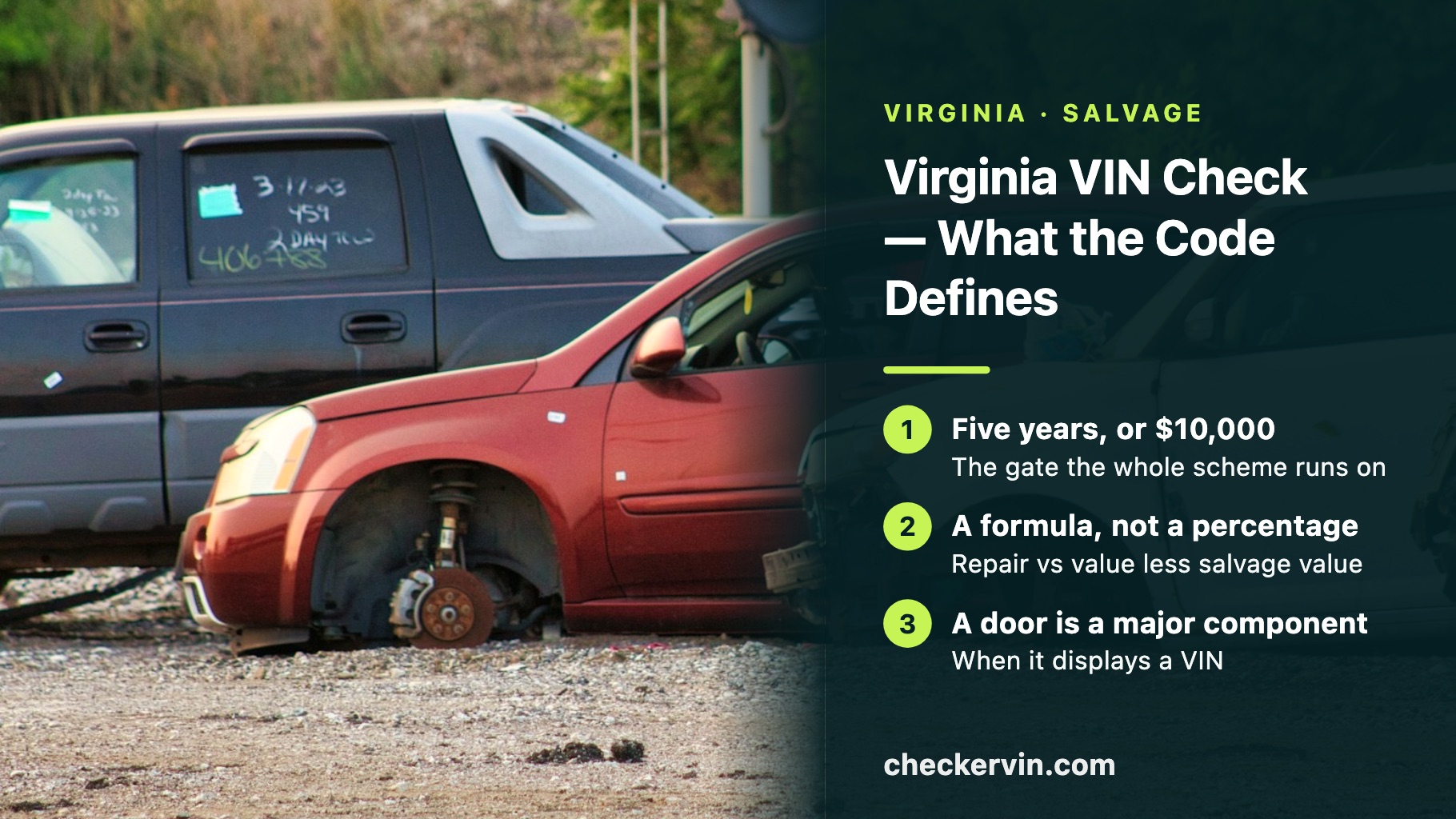
A door with a VIN on it is a major component
Buried in the same definitions section is the most directly VIN-relevant provision we have found in any state code, and it explains something about how cars are put back together.
Virginia defines a major component as any one of: the front clip assembly — fenders, grille, hood, bumper and related parts; the engine; the transmission; the rear clip assembly — quarter panels, floor panels, trunk lid, bumper and related parts; the frame; the air bags; and any door that displays a vehicle identification number.
That last item is there because the VIN is not only on the windshield plate. Federal parts-marking puts identifying numbers on doors of covered vehicles, which is why a door carrying one is treated as a component of record rather than a panel. Swap it, and you have moved a piece of the car's identity onto a different vehicle.
Tidewater flood exposure
The Hampton Roads region — Norfolk, Virginia Beach, Newport News — combines low elevation, tidal flooding and one of the largest vehicle populations on the Atlantic coast. Storm surge and nuisance flooding put water into cars there regularly, and the insured ones surface as brands while the dried-out uninsured share returns to market clean-titled.
On any car with Tidewater history, run the full water inspection — silt in the spare well and seat rails, corrosion on connectors, water lines in light housings, intermittent electrics. The Florida guide carries the complete checklist, and everything there applies to a Norfolk car.
Plates, briefly
Virginia plate lookups run into the same federal wall as every state's: the DPPA limits owner information to permitted uses, and private curiosity does not qualify. The full legal picture is on the license plate lookup guide — in a sale, ask for the VIN.
The Virginia check sequence
- 1Run the free national checksVIN decode, NHTSA recalls, NICB theft and salvage — all free, all before money moves.
- 2Pull the national title record — a few dollarsThrough an NMVTIS approved provider, for brands from every reporting state.
- 3Estimate the annual tax on each candidateYour locality's rate against the car's value. This is the Virginia-only step.
- 4Read the inspection sticker against the sale dateAnd ask what the next inspection will need.
- 5Water-check anything from TidewaterCoastal Virginia history means the full flood inspection.
- 6Complete the transfer through the DMVPromptly, so the assessment and title both land clean.
Three designations, and the one that ends a car
Chapter 16 of Title 46.2 is called “Salvage, Nonrepairable, and Rebuilt Vehicles,” and those three words are three different states a vehicle can be in. Buyers routinely treat them as synonyms for “damaged”. They are not.
| Designation | What the statute says it is |
|---|---|
| Salvage | A late model vehicle taken by an insurer in the claims process, or damaged past the repair-cost formula. It can be repaired and retitled |
| Rebuilt | A salvage vehicle repaired for use on the public highways, or a late model vehicle repaired past the 75 percent test. It is back on the road, and the record says so |
| Nonrepairable | A vehicle determined by its insurer or owner to have no value except for use as parts and scrap metal, or for which a nonrepairable certificate has been issued or applied for |
The third is the one that matters most and appears least in buying advice. A nonrepairable vehicle is not a car with a difficult history — it is a car the system has finished with, defined by having no value except as parts and scrap. A vehicle on that certificate is not a candidate for repair and return to the road.
Virginia also defines the trades around these vehicles, which tells you who you may be dealing with. A rebuilderis “any person who acquires and repairs, for use on the public highways, two or more salvage vehicles within a 12-month period” — so rebuilding at any scale is a licensed activity rather than a hobby. A demolisheris defined by reducing a vehicle “to a state where it can no longer be considered a vehicle,” and a vehicle removal operator acquires vehicles to resell to demolishers, scrap processors or salvage dealers.
Reading a Virginia car in the right order
The definitions above turn into a short sequence, and it runs cheapest first — which is the order you want when any step can end the conversation.
- 1Establish whether the car is even inside the schemeCurrent model year plus the five before it, or an actual cash value of $10,000 or more before the damage. Outside that class, the absence of a brand tells you much less than it appears to.
- 2Read the title designation, and read it preciselySalvage, rebuilt and nonrepairable are three different statements. The third means the vehicle was written off as parts and scrap.
- 3Check the doors as well as the windshieldVirginia counts a door displaying a VIN as a major component. Read the label, read the plate, read the title, and confirm all three agree before anything else happens.
- 4Ask what was repaired, not just how much it costThe rebuilt threshold excludes engine, transmission and drive axle repair costs, so the brand is a poor guide to whether the powertrain was replaced. Ask directly and ask for invoices.
- 5Run the VIN for open recalls before you travelFree, federal, and independent of any of the above. A recall is repaired at no cost by the manufacturer regardless of how many owners the car has had.
- 6Then pay for an inspection of your own choosingStructural repair quality is what none of these designations measure. That is the gap a physical inspection exists to fill, and it is worth paying for only once the free checks have passed.
Step one is the one that is genuinely Virginia-specific, and it is the one nobody does. Whether the statutory scheme reached a particular car at all changes what every later record is worth.
Where this information comes from
- Code of Virginia § 46.2-1600 — salvage, nonrepairable and rebuilt definitionsLate model, salvage, rebuilt, nonrepairable and major component, in the state's own words
- Virginia DMVVirginia's vehicle agency — titles, registration and inspections
- NMVTIS — National Motor Vehicle Title Information SystemThe national title record, covering brands from every reporting state
- NICB VINCheckFree theft and salvage lookup from participating insurers
- NHTSA recall lookupFree open-recall check by VIN
Keep reading
Frequently asked questions
How do I check a VIN in Virginia?
Run the free national checks — a VIN decode, the NHTSA recall lookup and the NICB theft and salvage search — then pull the national NMVTIS title record through an approved provider. Virginia titles run through the state DMV, and every registered car takes an annual safety inspection.
What is Virginia's car tax?
An annual personal property tax on vehicles, assessed by the county or city on the vehicle's value. Unlike a one-time sales tax, it bills every year you own the car — which means a more valuable used car carries a permanently higher annual cost in Virginia than the same car would in most states.
Does Virginia have vehicle inspections?
Yes — an annual state safety inspection with a windshield sticker, plus an emissions inspection in the Northern Virginia counties near Washington. The sticker date is worth reading against the sale date, exactly as in Pennsylvania.
Are there flood cars in Virginia?
The Tidewater region — Norfolk, Virginia Beach, Hampton Roads — floods routinely from storms and tidal surge, and it hosts one of the country's largest concentrations of personal vehicles near sea level. On any car with coastal Virginia history, run the water inspection.
Can I look up a license plate owner in Virginia?
Not as a private individual — the federal Driver's Privacy Protection Act restricts owner information to permitted uses in every state. Ask the seller for the VIN instead; it unlocks every check that matters.
Check a Virginia car before the deposit
Decode any VIN free for the factory build, specifications and open safety recalls. No account, no card.
Run a free VIN check