The short answer
- What is a VIN?
- The unique 17-character identifier a manufacturer assigns to a vehicle, in a format fixed by federal rule so anyone can identify the vehicle consistently.
- Why does it exist?
- Part 565 states the purpose: to simplify retrieval of vehicle identification information and to make recall campaigns accurate and efficient.
- Is it only on the dash?
- No. A separate standard, Part 541, requires an identifying number on 18 listed major parts, and its purpose is theft recovery rather than recalls.
2
Federal rules, two purposes
565 for recalls, 541 for theft
18
Major parts 541 lists
Engine and transmission through to the tailgate
6,000 lb
The rating that bounds 541
And a high-theft determination for light trucks
Free
Decoding yours here
Build, specifications and open recalls
What a VIN legally is
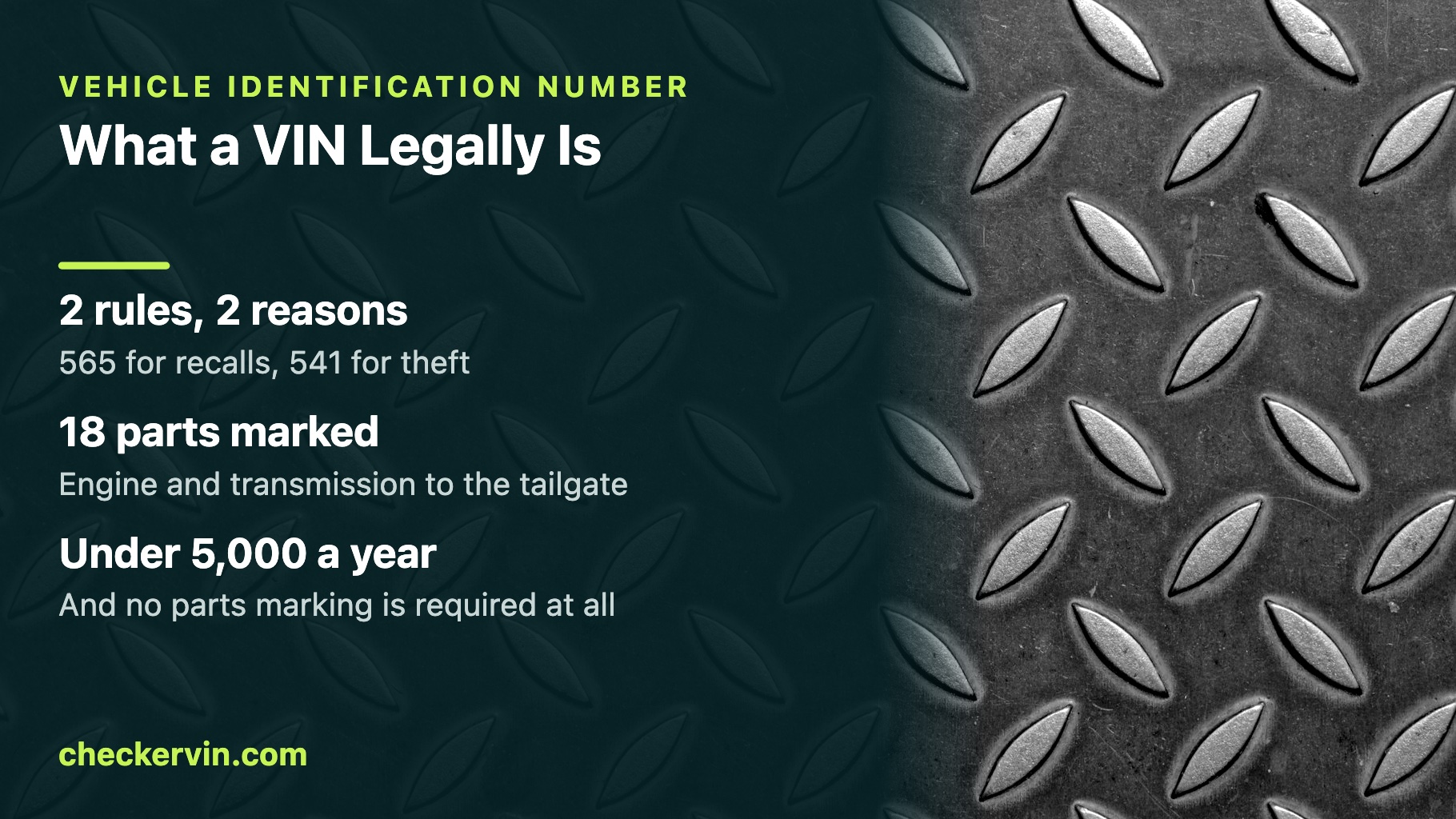
A vehicle identification number is the unique identifier a manufacturer assigns to a road vehicle, in a format the federal government fixes so that the number means the same thing whoever reads it. Seventeen characters, no exceptions, for vehicles built to the standard.
The important word is identifier. A VIN names a vehicle. It does not contain the vehicle’s story, and it is not a license, a registration or a title. Those are documents that refer to a vehicle; the VIN is what they refer to it by.
That distinction sounds pedantic until you watch what it explains. It is why a VIN survives a change of owner, a change of state and a change of plate. It is why every record system that touches vehicles is keyed to it. And it is why a VIN can decode perfectly and tell you nothing whatever about whether the car is any good.
Two rules put numbers on a car, for two different reasons
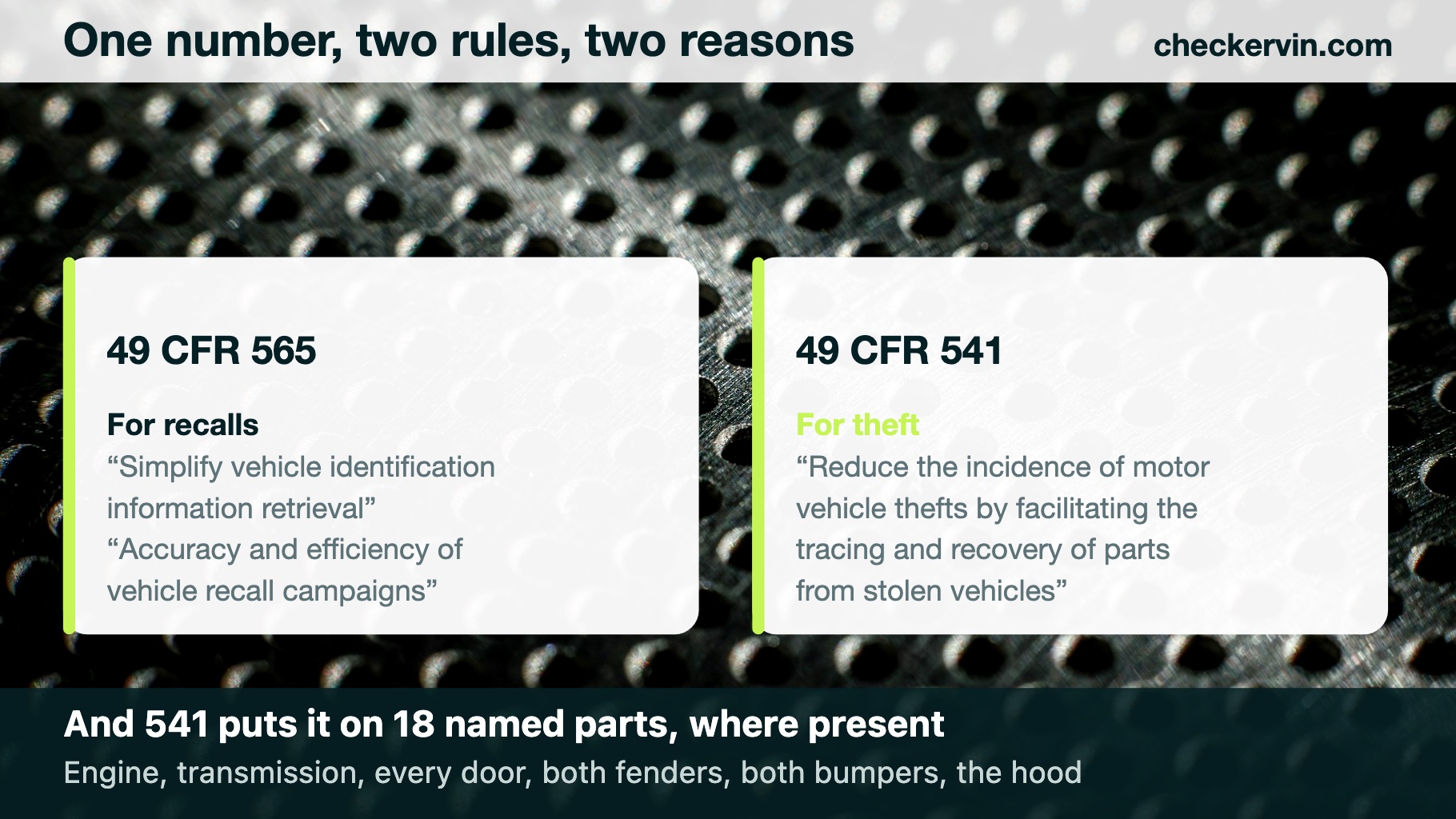
This is the fact the page is built around, and it is not widely known outside the trade. There are two separate federal standards requiring identifying numbers on a passenger vehicle, written decades apart, with different scopes and different aims.
| The rule | What it is for |
|---|---|
| 49 CFR Part 565 — the VIN | Identification retrieval, and the accuracy and efficiency of recall campaigns |
| 49 CFR Part 541 — parts marking | Reducing motor vehicle theft by making stolen parts traceable and recoverable |
Read those two purposes side by side and a lot falls into place. One rule exists because a manufacturer needs to reach the owners of a defective batch. The other exists because a stolen car is worth more dismantled than whole, unless the pieces can be traced.
Why the VIN exists, in the rule's own words
Part 565 states its purpose plainly rather than leaving it to be inferred: it specifies the format, content and physical requirements for a VIN system and its installation to simplify vehicle identification information retrieval and to increase the accuracy and efficiency of vehicle recall campaigns.
Everything about how a VIN behaves follows from that sentence. The fixed length exists so the number can be handled mechanically. The uniqueness requirement exists so a campaign cannot reach the wrong car. The check digit exists so a mistyped number fails arithmetic instead of quietly matching a different vehicle.
It also explains what the VIN system pointedly does not do. Nothing in that purpose concerns resale, condition, ownership or value. A system built to make recalls accurate has no reason to carry any of it, and it does not.
Who assigns the number
Manufacturers assign VINs to their own vehicles, but not freely. The first characters of the number are a World Manufacturer Identifier, which is allocated to the manufacturer rather than chosen by it, and manufacturers file the meanings of their own descriptor characters with the agency.
That filing is what makes decoding possible at all. A decoder is not inferring anything from the shape of the number; it is looking up what the maker said those characters mean. It is also why a decode returns exactly as much detail as the manufacturer chose to file, and no more.
Small manufacturers get a different structure
The rule does not treat every manufacturer the same, and the difference is written into the identifier itself rather than handled by exception.
For a high-volume manufacturer, the first three characters alone must uniquely identify the manufacturer and the type of vehicle. For a low-volume manufacturer, that job is shared: the first three characters together with characters twelve to fourteen are what uniquely identify the maker and type. And a 9 is placed in the third position to mark the arrangement.
| Manufacturer | What identifies them |
|---|---|
| High-volume | The first three characters alone |
| Low-volume | The first three characters plus characters twelve to fourteen |
| Low-volume, marker | A 9 in the third position |
The reason is arithmetic. Three characters can only carry so many manufacturers, and spending a block of them on a company that builds a few dozen cars a year would exhaust the space. Borrowing three characters from further down the number lets the system identify small makers without enlarging the identifier for everyone.
The Canadian exemption, and what it says about the system
One short provision is worth surfacing because of what it implies. Part 565 exempts motor vehicles conforming to Canada Motor Vehicle Safety Standard 115 from one of its requirements, rather than demanding they be re-identified to satisfy the US rule.
That is a small clause with a large idea behind it. Vehicle identification only works if the number means the same thing across borders, and a system that forced re-numbering at every frontier would defeat its own purpose. Recognizing an equivalent standard is cheaper and more reliable than duplicating one.
It is also a useful corrective to a common assumption. A VIN is not a purely American artifact; the seventeen-character format is an international convention that the United States made mandatory, and the rule is written in awareness of that.
The 18 parts the number is stamped on
Part 541 requires each subject vehicle to have an identifying number affixed or inscribed on each of eighteen listed parts, if the part is present on the vehicle. The list is worth reading in full, because its specificity is the whole point.
| Group | Parts named in 49 CFR 541.5(a) |
|---|---|
| Powertrain | Engine; transmission |
| Front body | Right front fender; left front fender; hood |
| Doors | Right and left front doors; right and left rear doors; sliding or cargo doors |
| Bumpers | Front bumper; rear bumper |
| Rear body, cars | Right rear quarter panel; left rear quarter panel |
| Rear body, MPVs | Right-side assembly; left-side assembly |
| Trucks | Pickup box, and/or cargo box |
| Rear closure | Rear door or doors, decklid, tailgate or hatchback, whichever is present |
Look at what is on that list and the reasoning is obvious: these are the parts a stolen car gets broken into. Nobody steals a vehicle to sell its wiring harness. They steal it to sell the doors, the fenders, the hood, the bumpers and the powertrain.
And it is the same number, with one exception
A reasonable question at this point is whether those eighteen marks carry the VIN itself or some separate part number. The rule answers it: the number required to be inscribed or affixed shall be the VIN of the passenger motor vehicle.
There is a carve-out. Manufacturers who were already marking engines and transmissions with a VIN derivative may continue to use one, consisting of at least the last eight characters of the VIN, in place of the full number on those two parts.
Only some vehicles, and the reason is data
Parts marking does not apply to everything on the road, and the boundary is drawn in an interesting place. The standard applies to passenger cars, to multipurpose passenger vehicles with a gross vehicle weight rating of 6,000 pounds or less, and to light-duty trucks at or under that rating that NHTSA has determined to be high theft.
That last clause is not a category the manufacturer picks. It is an agency determination made under a separate part of the regulations, based on whether a vehicle line is actually being stolen. The requirement follows the theft data rather than the badge.
It also reaches replacement parts. The standard covers replacement versions of those same listed parts for the vehicles it applies to, which is what stops the marking being defeated by simply fitting an unmarked door.
The small-manufacturer exclusions
Two exclusions are worth knowing because they explain why some vehicles have no marked parts at all, and neither is about the vehicle being unusual.
- Vehicles from a manufacturer making fewer than 5,000 vehicles a year for sale in the United States
- Vehicles in a line with an annual production of not more than 3,500
- Certain light-duty trucks whose sibling line is itself exempt from parts marking
The logic is proportionality: the marking requirement imposes real cost, and a low-volume manufacturer or a low-volume line contributes correspondingly little to the theft problem the rule is aimed at.
The practical consequence for a buyer is that the absence of marked parts on a low-production vehicle is not by itself suspicious. On a mainstream, high-theft line, the same absence is a question worth asking about.
An identifier, not a record
Everything above describes a labeling system. It is worth being explicit about what that means for the question most people actually arrive with.
A VIN carries a description of how the vehicle was built and a serial that makes it unique. It does not carry, and cannot carry, anything about what happened afterward. The number was fixed at the factory and has not changed since; the car has.
| Lives in the VIN | Lives elsewhere, keyed to the VIN |
|---|---|
| What the manufacturer built | Accident and damage records |
| Which individual vehicle it is | Title brands assigned by states |
| Where and when it was assembled | Odometer readings at each transfer |
| The maker's own descriptor coding | Theft reports and recoveries |
Both columns are real and both are useful. The mistake is treating a complete answer from the left column as any kind of answer about the right.
What a VIN is not
- Not proof the vehicle still exists — a scrapped car's VIN decodes exactly as cleanly
- Not proof of ownership, which is what a title is for
- Not a registration, which is a state permission to use the vehicle on the road
- Not a license plate, which changes and belongs to a jurisdiction rather than the car
- Not an engine number, which is a separate identifier on the engine itself
- Not confidential — it is visible through the windshield of every car on the street
That last point deserves a sentence of its own, because people worry about it. A VIN is designed to be read from outside the vehicle without permission, which is what makes recall checks and inspections possible. Treating it as a secret misunderstands the object.
What to actually do with yours
- 1Read it off the car, not off a documentDocuments inherit typos. The number at the base of the windshield and on the door frame label is the one the vehicle carries.
- 2Decode it, freeThe factory build and specifications tell you whether a vehicle is what it is being described as, which is a surprisingly common place for a listing to be wrong.
- 3Check open safety recallsFree from the federal regulator, and the reason Part 565 exists in the first place. Running the decode without the recall check misses the point of the system.
- 4On a used purchase, have the other numbers checkedThe eighteen marked parts exist so that a professional can compare them. That comparison is a job for an inspection, not a walkaround.
What this page does not cover
It does not explain what each of the seventeen characters means. That is a different question with its own page, and repeating it here would serve nobody.
It also does not tell you where to find the number on a particular vehicle beyond the two usual places, which again has its own page and more detail than belongs in a paragraph.
And it does not turn a VIN into a history. Our own free check reads the factory build and the open safety recalls, at no cost and with no account. It does not return accident, title, odometer or theft history, because those records are not in the number and never were.
Where this information comes from
- eCFR — 49 CFR Part 565, vehicle identification number requirementsFixes the format and states the purpose: identification retrieval, and the accuracy and efficiency of recall campaigns
- eCFR — 49 CFR Part 541, Federal Motor Vehicle Theft Prevention Standard541.2 states the theft-reduction purpose; 541.3 the application and exclusions; 541.5(a) lists the 18 parts and 541.5(b) requires the number to be the VIN
- NHTSA vPIC — the federal VIN decoderDecodes a VIN against the build information manufacturers file with the agency
- NHTSA — check for open recalls by VINFree, and the reason the VIN system exists at all
Keep reading
Frequently asked questions
What is a vehicle identification number?
The unique 17-character identifier assigned to a road vehicle by its manufacturer, in a format fixed by federal rule so that any vehicle can be identified consistently by anyone. It is an identifier rather than a record: it names the vehicle, and other systems hang their information off that name.
Why do VINs exist at all?
The rule states its own purpose. 49 CFR Part 565 says the VIN system exists to simplify the retrieval of vehicle identification information and to increase the accuracy and efficiency of vehicle recall campaigns. It was built so a manufacturer discovering a defect can say precisely which vehicles are affected.
Is the VIN stamped anywhere other than the dash?
On many vehicles, yes, and by a separate federal rule with a different purpose. 49 CFR Part 541 requires an identifying number on each of 18 listed major parts, from the engine and transmission to individual doors, fenders, bumpers and the hood, where those parts are present.
Is the number on those parts the same as the VIN?
Generally yes. Part 541 says the number required to be inscribed or affixed shall be the VIN of the passenger motor vehicle, with a provision allowing certain manufacturers to use a VIN derivative of at least the last eight characters on engines and transmissions instead.
Why is parts marking about theft rather than recalls?
Because that is what it was written for. Part 541 states its purpose as reducing the incidence of motor vehicle thefts by facilitating the tracing and recovery of parts from stolen vehicles. Marking the parts makes a dismantled car harder to sell piece by piece.
Does every car have marked parts?
No. The standard applies to passenger cars, to multipurpose passenger vehicles at or under 6,000 lb gross vehicle weight rating, and to light-duty trucks at or under that rating which NHTSA has determined to be high theft. It also excludes vehicles from manufacturers making fewer than 5,000 vehicles a year for US sale, and lines producing not more than 3,500.
Why do some VINs have a 9 in the third position?
It marks a low-volume manufacturer. Part 565 requires the first three characters alone to uniquely identify a high-volume manufacturer and type; for a low-volume manufacturer that identification is shared between the first three characters and characters twelve to fourteen, with a 9 placed third to signal the arrangement.
Does a VIN contain the vehicle's history?
No. A VIN contains a description of how the vehicle was built and a serial that makes it unique. Everything about what has happened since — accidents, title brands, odometer readings, ownership — lives in other systems that use the VIN as a key. The number is the filing label, not the file.
Where do I find my VIN?
Most commonly at the base of the windshield on the driver's side, readable from outside, and on the certification label in the driver's door frame. It also appears on your title, registration and insurance documents, which is often the quicker place to look.
Decode your VIN, free
The factory build, the specifications and open safety recalls. No account required.
Run a free VIN check