The short answer
- Is it the same as a VIN?
- Only if the car was built for the United States. On a Japanese-market Toyota it is a different identifier entirely — a model code and a serial, in a shorter format.
- Why does no decoder read it?
- Federal decoders read 17-character VINs issued under 49 CFR Part 565. A Japanese frame number is not one, so the tool has nothing to apply.
- Then what do I do?
- Work out which of the two you have first, using the length and the format. Everything after that depends on the answer, and the two paths share almost nothing.
17
Characters in a VIN
Fixed by 49 CFR 565 — anything else is not one
25 years
The import door
49 CFR 591.5(i)(1), and it moves every year
Errors 6 + 7
What NHTSA returns for a frame number
Incomplete VIN, manufacturer not registered
Free
Decoding a 17-character VIN
No account needed
One word doing three jobs
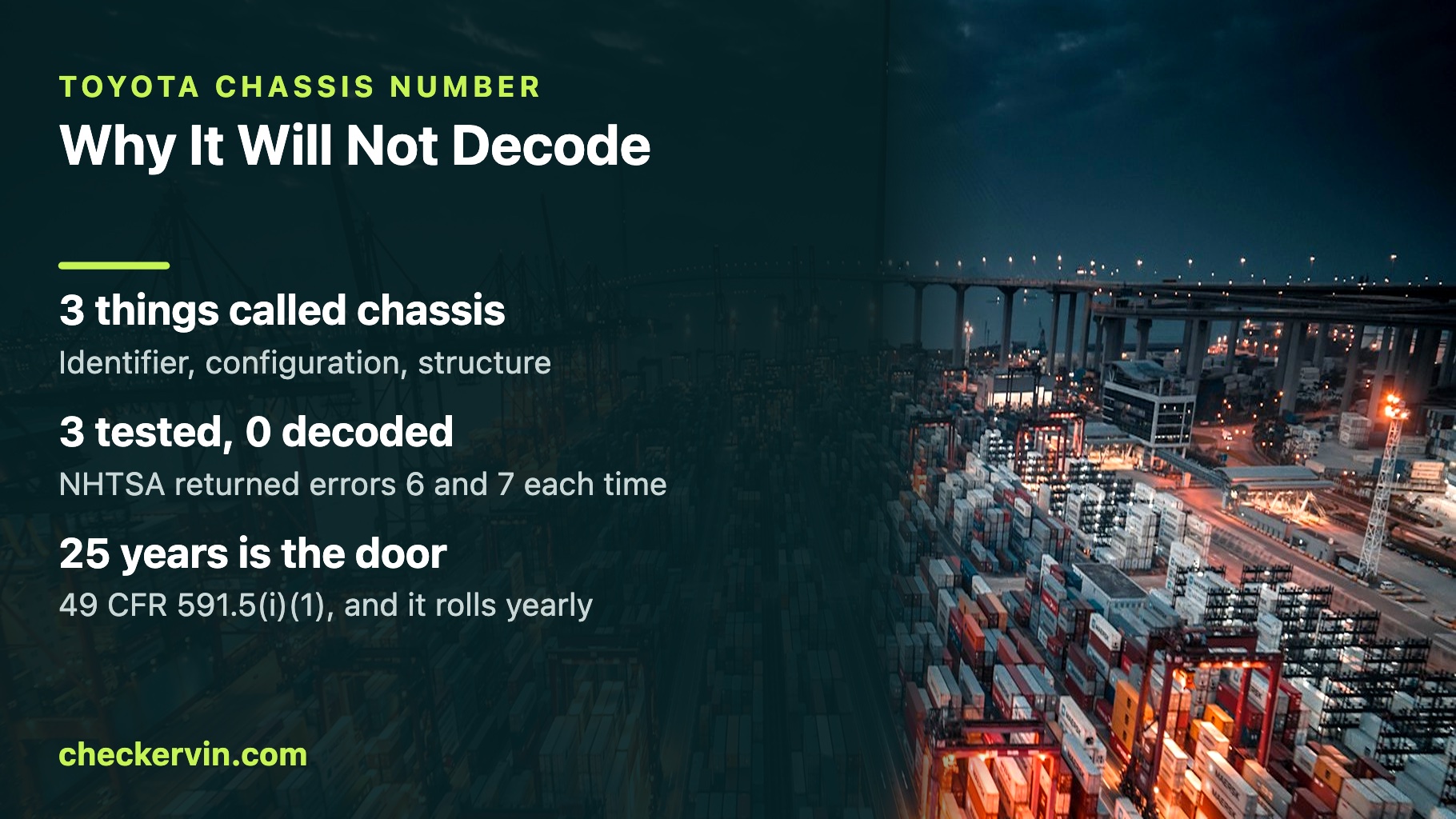
Most of the confusion here is vocabulary rather than mechanics. “Chassis” is used for three separate things in the same conversation, and until you know which one somebody means, nothing else makes sense.
| When someone says chassis... | They may mean |
|---|---|
| The chassis number | An identifier for one specific vehicle |
| The chassis code | A configuration — a platform and engine combination, shared by thousands of cars |
| The chassis | The physical structure the vehicle is built on |
The third meaning is the one federal regulation uses. Part 591 defines a reconstructed motor vehicle as one whose body is mounted on a chassis or frame that is not its original chassis or frame — unmistakably the metal, not a number. So a US regulator saying “chassis” and a Toyota owner saying “chassis number” are not using the word the same way at all.
Why a Japanese-market number is not a VIN
The 17-character VIN is not a convention that manufacturers converged on. It is a specification. 49 CFR Part 565 fixes the length, fixes what each position means, bars the letters I, O and Q from appearing anywhere in it, and puts a mathematical check digit at position nine so a mistyped number fails arithmetic rather than passing silently.
That specification governs vehicles built for sale in the United States. A car built for the Japanese domestic market was never in its scope, so it carries its own manufacturer identifier instead — shorter, structured differently, and with no check digit to validate it.
| 17-character VIN | Japanese frame number |
|---|---|
| Fixed at 17 characters | Variable length, typically shorter |
| Every position has an assigned meaning | A model code and a serial, separated by a hyphen |
| Check digit at position nine | No check digit — nothing validates a typo |
| I, O and Q never appear | No such restriction |
| Readable by any federal decoder | Readable by none of them |
None of that makes the Japanese number worse. It identifies the car perfectly well in the system it was built for. It simply is not the thing US tools are built to read, which is a statement about the tools and not about the car.
What the number actually looks like
A Japanese frame number takes the form of a model code, a hyphen, and a serial number. The model code is alphanumeric and identifies the platform and engine combination; the serial identifies the individual car built to it.
The immediate practical consequence is that you can usually tell which kind of number you are holding without knowing anything about Toyota at all. Count the characters and look for a hyphen.
- Exactly 17 characters, no hyphen, no I or O or Q — that is a VIN, and it should decode
- Shorter than 17, with a hyphen splitting a short code from a serial — that is a frame number
- A short code on its own, with no serial after it — that is a chassis code, not an identifier for any one car
- Seventeen characters that still fail — suspect a transcription error first and re-read the plate
Chassis code and chassis number are not the same thing
This is the distinction most listings get wrong, and it matters because one of the two identifies your car and the other identifies a category.
A chassis code is a short designation for a specification — a platform paired with an engine. Enthusiasts use it as the name of the car, parts catalogs are organized by it, and forums are effectively indexed by it. Every single vehicle built to that specification shares it.
A chassis number is that code followed by a serial. The serial is what makes it an identifier for one vehicle rather than a description of thousands.
| Chassis code | Chassis number |
|---|---|
| Names a configuration | Names one vehicle |
| Shared by every car of that specification | Unique within the model code |
| Useful for parts, forums and specifications | Useful for paperwork, title and identity |
| Cannot check a recall or a history | Is what the documents are keyed to |
What the federal decoder actually returns
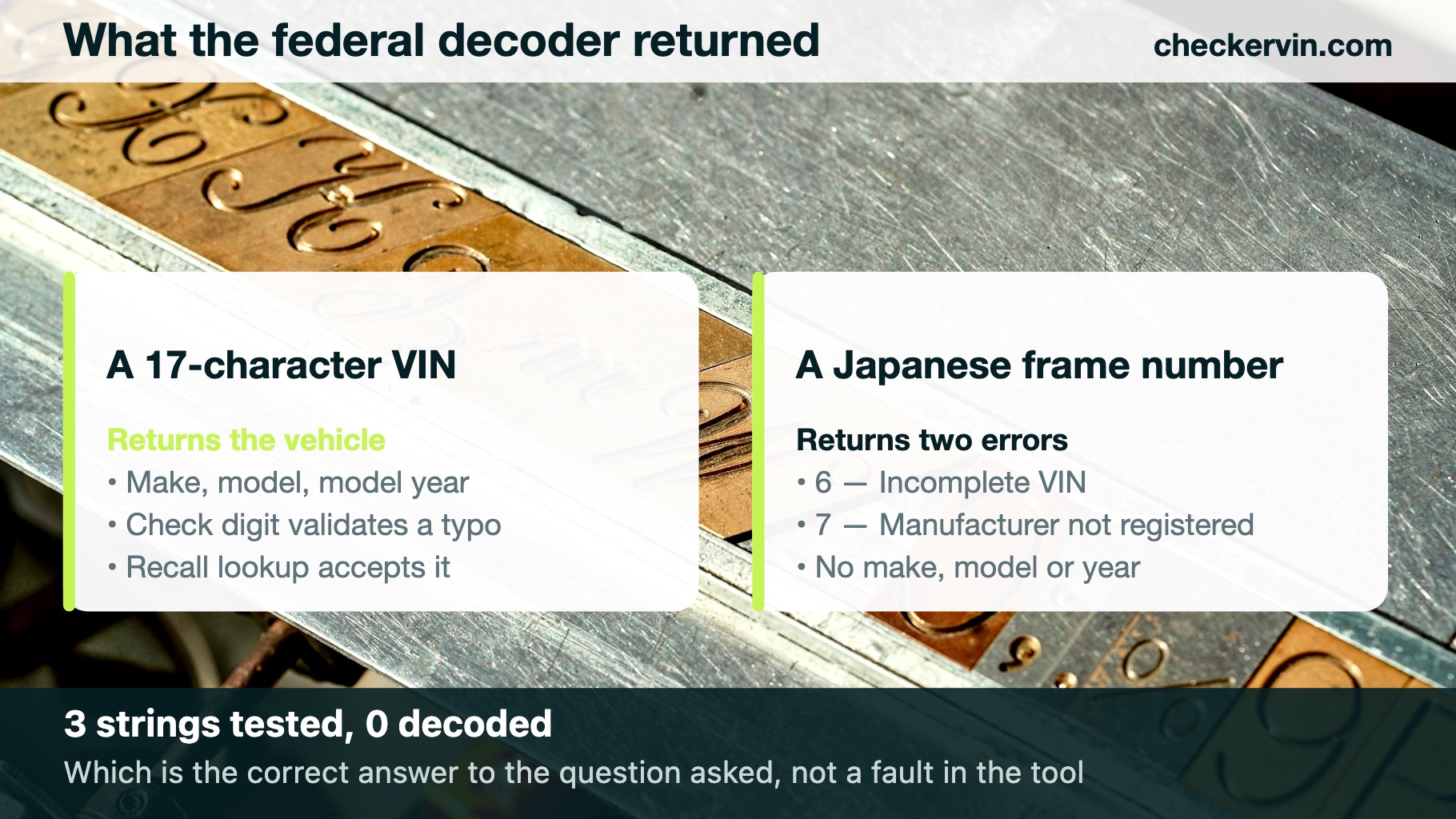
Rather than describe this, we tested it. NHTSA publishes a free public VIN decoder, and we put three Japanese-format strings through it: two full frame numbers in model-code and serial form, and one bare model code with no serial.
All three came back the same way, with two error codes rather than a result. The first was error 6, incomplete VIN. The second was error 7: the manufacturer is not registered with NHTSA for sale or importation in the United States for use on US roads.
| What we submitted | What came back |
|---|---|
| A frame number in model-code and serial form | Errors 6 and 7 — no make, no model, no year |
| A second frame number, same format | Errors 6 and 7 — identical result |
| A bare model code with no serial | Errors 6 and 7 — identical result |
| A well-formed 17-character US-market VIN | Make, model and model year returned |
Read those two errors together and they are not a malfunction. They are the decoder correctly reporting that the string is not a VIN and that the vehicle it describes was never entered into the US system. That is an accurate answer to the question asked. It is simply not the question most people think they are asking.
What the rule actually requires
It is worth reading the requirement rather than inferring it, because the wording explains both why the decoder behaves as it does and why your car is not in trouble.
Part 565 states its own purpose plainly: it specifies the format, content and physical requirements for a VIN system and its installation, in order to simplify the retrieval of vehicle identification information and to increase the accuracy and efficiency of vehicle recall campaigns.
Recalls are the point. The 17-character VIN exists so that a manufacturer issuing a safety recall can identify exactly which vehicles are affected and so an owner can check one number and get a real answer. That is what a car outside the system loses, and it is a more concrete loss than the inability to run a decoder.
The exclusion written into the rule itself
Here is the part that surprises people, and it is the strongest evidence that a non-conforming number is a recognized situation rather than an anomaly.
Part 565 explicitly carves imported vehicles out of some of its own requirements. Vehicles imported into the United States under 49 CFR 591.5(f), other than by the corporation responsible for assembling the vehicle or a subsidiary of it, are excluded from several named sections of the VIN rule.
In other words, the regulation anticipates vehicles arriving in the country without a conforming VIN and says so in its own text. A car whose number does not decode is not outside the law. It is inside a provision written for exactly that case.
How the car got here at all
One provision explains the entire supply of these vehicles in the United States. Under 49 CFR 591.5(i)(1), a vehicle that is 25 or more years old may be imported without conforming to the federal motor vehicle safety standards.
The threshold is a rolling one. Every year, another model year of cars that were never sold in America becomes importable, which is why the population of Japanese-market Toyotas on US roads grows steadily rather than being a fixed stock of old imports.
It also explains the shape of the market. Because the rule is about age rather than about the vehicle’s merits, the cars arriving are simply whatever crossed the line most recently, and a large fraction of them carry frame numbers rather than VINs precisely because they were built for a market that never used them.
The recall you cannot check, which is the real cost
Everything above is administrative until you reach this, and this is the part that actually matters for safety rather than for paperwork.
Part 565 says why the VIN system exists: to simplify retrieval of vehicle identification information and to increase the accuracy and efficiency of vehicle recall campaigns. The number is the mechanism by which a manufacturer that discovers a defect can say precisely which cars are affected, and by which an owner can check one string and get a definite answer.
A vehicle outside that system has no access to it. The free federal recall lookup takes a 17-character VIN; a frame number returns the same non-answer the decoder does. Whatever safety campaigns were issued in the vehicle’s home market went to owners recorded in that market’s system, and nothing forwards them to a car that has since been exported.
It is also the strongest argument for buying an import from someone who has kept records. Where a recall lookup would ordinarily do the work, service documentation has to do it instead.
Insurance, parts and paperwork
Three ordinary tasks behave differently on a vehicle whose number is not a VIN, and it is better to know which before you are standing at a counter.
| Task | What changes |
|---|---|
| Getting insured | Quote systems are keyed to a 17-character VIN; expect to speak to a human, and expect specialist insurers to be more comfortable with imports |
| Ordering parts | This is where the chassis code is the right tool — catalogs are organized by configuration, not by individual vehicle |
| Titling and registration | A separate process from a domestic car, varying by state, built around the import documents rather than around the number alone |
| Selling it later | The next buyer hits every one of these, so keep the paperwork together from the day you buy |
The parts row is worth dwelling on, because it inverts the usual advice. Almost everywhere else on this site the message is that a configuration code is not a substitute for the individual vehicle’s number. At a parts counter the opposite is true: what you need is the specification, and the chassis code is exactly the right identifier for it.
So the two identifiers are not competing. Each is correct for a different question, and most of the frustration around this topic comes from using one where the other belongs.
Outside the United States, it usually just means VIN
A large share of everyone searching this phrase is not looking at an import at all. In the United Kingdom, Australia, India, South Africa and much of the world, “chassis number” is simply the everyday name for what Americans call the VIN. The document says chassis number; the number is seventeen characters; nothing unusual is happening.
If that is you, and your car was built for a market that uses the seventeen-character standard, then your chassis number should decode like any other VIN, and a failure points at a transcription error rather than at a format mismatch. Re-read it off the vehicle rather than off a document that may itself contain a typo.
| What you have | What the phrase means for you |
|---|---|
| A US-market Toyota | Chassis number is loose usage for VIN — 17 characters, and it decodes |
| A UK, Australian or Indian Toyota | Same thing under a different everyday name — 17 characters |
| A Japanese-market Toyota | A genuinely different identifier that no federal decoder reads |
Where to find the number on the car
- 1Through the windshield, driver's sideOn a US-market car the VIN is visible at the base of the windshield from outside. If you can read seventeen characters there, that is your number and the chassis-number question is settled.
- 2The driver's door jamb labelThe certification label repeats the VIN alongside the tire and weight information. On a Japanese-market car there is no US certification label to find.
- 3Stamped into the body structureBoth kinds of vehicle carry a stamped number on the structure itself. On a Japanese-market car this is commonly in the engine bay or under interior trim, and it is the authoritative one.
- 4The paperwork that came with the importExport certificate, auction sheet, customs entry and any translation. On an imported car these are not supplementary — they are the record the number lives in.
What to do with a number that will not decode
Work through this in order, because the first step resolves most cases and costs nothing.
- 1Count the charactersSeventeen with no hyphen means you have a VIN and something else is wrong — most often a misread character. Fewer, with a hyphen, means you have a frame number and no US decoder will help.
- 2Re-read it off the vehicle, not the advertisementListings and documents propagate typos. The stamped number on the car is the one that matters, and photographing it beats transcribing it.
- 3If it is a frame number, stop asking decodersThey cannot answer, and each one you try will return the same non-answer. The information you want lives in the import and auction paperwork instead.
- 4Get the export and auction documentsFor a Japanese import these carry the identity, the recorded mileage and often a graded condition assessment. Ask the seller for them and be wary if none exist.
- 5Ask your state before you buyTitling an imported vehicle is a different process from titling a domestic one and it varies by state. The time to discover your state's requirements is before money moves.
Why this question lands on Toyota more than anyone else
The chassis-number question is not exclusive to one marque, so it is worth asking why Toyota is where it concentrates. Two things compound.
The first is that Toyota enthusiasts genuinely talk in chassis codes. Cars are named by them in conversation, parts catalogs are indexed by them, and forum knowledge is organized around them. An owner therefore encounters the word “chassis” constantly and reasonably assumes it is the identifier they should be searching with.
The second is volume. The Japanese domestic market produced a very large number of Toyotas that were never sold in America and that people now want, and the rolling age threshold keeps making more of them importable. Every one that arrives brings an owner with a number that does not decode.
Put those together and you get a search pattern that looks strange from outside: a question about identification, asked overwhelmingly about one manufacturer, by people who are mostly not confused about their car at all. They are confused about which of the marque’s two numbering conventions the internet wants from them.
Buying an import: what you can and cannot check
The honest position is that an imported car is harder to verify than a domestic one, and the gap is not something any website closes for you.
- You cannot run a US recall check on a vehicle that has no US VIN
- You cannot run a US history report on a life that was lived in another country
- You can read the export certificate and the auction sheet, if the seller has them
- You can match the stamped number on the car against every document, character by character
- You can pay for an inspection, which is the one check that examines the car rather than a file
- You can confirm your state will title it, in advance and in writing if possible
The first two are the ones that catch people out. A buyer who is used to running a VIN through a free federal recall lookup arrives expecting the same reassurance and finds it simply is not available. That is not a red flag about the specific car; it is a structural feature of buying a vehicle that spent its life outside the US record systems.
What none of this settles
Establishing which kind of number you have tells you which tools can help. It does not tell you anything about the car. A frame number that reads cleanly off the structure and matches the paperwork is evidence of identity, not of condition, mileage or history.
Our own free check is a 17-character decoder. It returns the factory build and specifications from the VIN, plus open safety recalls, at no cost and without an account. On a Japanese-market frame number it will return nothing, and this page exists so that the nothing reads as the expected answer rather than as a fault in the car or the tool.
Where this information comes from
- eCFR — 49 CFR Part 565, vehicle identification number requirementsFixes the 17-character format and its purpose, and excludes certain vehicles imported under 591.5(f) from several of its own sections
- eCFR — 49 CFR 591.5, importation of nonconforming vehiclesParagraph (i)(1): the vehicle is 25 or more years old — the provision every JDM import comes through
- NHTSA vPIC — the public VIN decoderThe federal decoder we tested; returns error 6 and error 7 for Japanese-format frame numbers
- NHTSA — check for open recalls by VINFree, and keyed to a 17-character VIN — which is what a non-conforming vehicle cannot use
Keep reading
Frequently asked questions
Is a Toyota chassis number the same as a VIN?
It depends entirely on where the car was sold. On a Toyota built for the United States, chassis number is just a loose way of saying VIN — one 17-character number. On a Toyota built for the Japanese domestic market it is a different identifier in a different format, and no decoder built for the federal standard can read it.
Why won't my Toyota chassis number decode?
Because the federal decoder is built to read a 17-character VIN issued under 49 CFR Part 565, and a Japanese-market frame number is not one. We tested three of them against NHTSA's own public decoder and all three came back with the same two errors: incomplete VIN, and manufacturer not registered with NHTSA for sale or importation in the United States.
What is the difference between a chassis code and a chassis number?
A chassis code identifies a configuration — a platform and engine combination shared by every car built to that specification. A chassis number identifies one individual vehicle. The code is the first part of the number on a Japanese-market car, which is why the two get confused constantly in listings and forums.
Can I run a history report on a JDM Toyota?
Not in the way you can on a US-market car, because the US record systems are keyed to a 17-character VIN and the vehicle spent most of its life outside them. What exists instead is the Japanese auction and export paperwork that came with the car, plus whatever US record has accumulated since it was imported and titled.
How is a 25-year-old Toyota legal to import?
Under 49 CFR 591.5(i)(1), a vehicle that is 25 or more years old may be imported without conforming to the federal motor vehicle safety standards. That is the door every JDM import comes through, and it is why the supply of them grows by one model year every year.
Does the federal VIN rule apply to imported cars?
Not in full. The rule itself carves them out: vehicles imported under 49 CFR 591.5(f), other than by the manufacturer or its subsidiary, are excluded from several sections of Part 565. The regulation contemplates vehicles arriving without a conforming VIN rather than pretending they do not exist.
Can I check recalls with a chassis number?
No. The free federal recall lookup is keyed to a 17-character VIN, so a Japanese frame number returns nothing. That is the most consequential thing a vehicle loses by being outside the US system, and the honest substitute is service documentation plus a physical inspection rather than an assumption that no campaign existed.
Should I use the chassis code or the chassis number to order parts?
The code, and this is the one situation where the configuration identifier is the correct one. Parts catalogs are organized by platform and engine combination, which is exactly what a chassis code names. Use the full number for anything to do with identity, title, insurance or history.
Where is the chassis number on a Toyota?
On a US-market Toyota, the VIN is visible through the windshield at the base, on the driver's door jamb label, and stamped on the body. On a Japanese-market car the frame number is stamped into the body structure — commonly in the engine bay or under the interior trim — and repeated on the vehicle's registration paperwork.
Does my state DMV accept a chassis number?
States title imported vehicles routinely, but the process is not the same as titling a domestic car and it varies by state. Expect to produce the import paperwork, and expect the vehicle to be inspected so the number on the car can be matched to the number on the documents. Ask your state before you buy, not after.
If yours is seventeen characters, decode it free
Factory build, specifications and open safety recalls from the VIN. No account required.
Run a free VIN check