The short answer
- Is a family gift really a transfer?
- Yes. Ownership changes, so the title is signed over and retitled. What a gift usually changes is the tax treatment, not the paperwork.
- Does the odometer disclosure still apply?
- Unless the vehicle is exempt, yes. The federal rule attaches to the transfer of ownership, not to whether money changed hands or who the parties are.
- What goes wrong most often?
- Two things: a lender still holds the title, or nobody ever signs it over at all and the car sits in a relative's name for years.
It is a real transfer, whatever it feels like
The word “family” does very little work here. A state records ownership of a vehicle the same way whether the car passed between strangers for money or between a parent and a child for nothing. The title is signed over, the new owner applies, and a new title is issued in their name.
What the relationship usually does change is tax. Most states that charge sales or use tax on a vehicle transfer exempt gifts between close relatives, and several extend that to transfers between spouses or to a surviving spouse. That exemption is almost always something you claim on a specific form rather than something the counter assumes, so arriving without it means paying tax on a gift.
Yes
Title must be retitled
A gift is a change of ownership, and the state records it as one
49 CFR 580
Odometer disclosure
Attaches to the transfer, not to whether money changed hands
20 years
Exemption for 2011 and newer
Double the 10 years that applies to 2010 and older
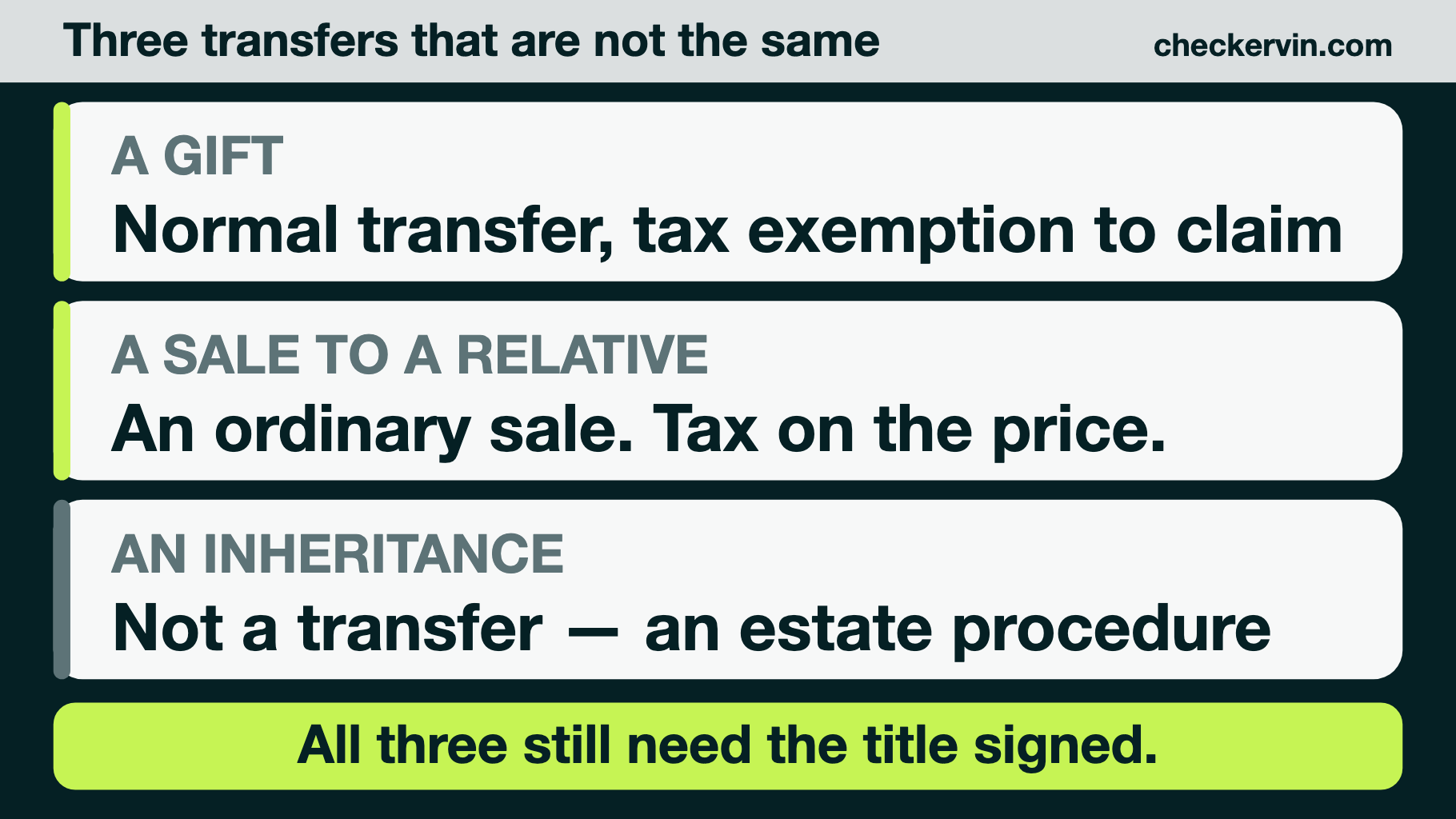
Gift, family sale, or inheritance — they are not the same
People arrive at this question from three different places and the answer diverges early.
| Situation | What is different |
|---|---|
| A gift | No money changes hands. The title transfer is normal, and the tax exemption is the thing to claim. Expect a form declaring the relationship and the fact that consideration was zero. |
| A sale between relatives | Money changes hands, so it is an ordinary sale that happens to be between family. Tax is generally due on the price, and a suspiciously low declared price is exactly what a state's minimum-value rules exist to catch. |
| An inheritance | The owner has died, so the signature the title needs cannot be given. This is a probate or small-estate procedure rather than a transfer, and it is the one case where the usual steps do not apply at all. |
Getting this wrong at the start wastes a trip. A gift filed as a sale costs tax that was avoidable; a sale filed as a gift is a misrepresentation on a state form.
The steps, in the order they actually work
- 1Confirm the title is clear firstIf a lender is recorded on it, nothing below can happen until the lien is released. Check this before anyone takes a day off work.
- 2Complete the odometer disclosureOn the title itself, at the point ownership transfers, unless the vehicle is exempt. The next two sections cover which vehicles are.
- 3Sign the title over accuratelyNames exactly as they appear, no corrections, no white-out. An altered title is a rejected title, and the fix is a duplicate rather than a tidier pen.
- 4Claim the family exemption on the right formThis is state-specific and it is the step that saves money. The exemption is claimed, not assumed.
- 5The new owner applies for the title and registrationUsually within a stated window measured in days, and usually with a late penalty attached to missing it.
- 6The previous owner files the release of liabilityUntil the state records the change, the vehicle can still be associated with the person who gave it away. This is the step people skip and then regret when a ticket arrives.
The odometer disclosure comes with the transfer
This is the part every ranking guide leaves out, and it is federal rather than state law, so it does not vary with where you are.
49 CFR Part 580 requires the mileage to be disclosed by the transferor when ownership changes. Section 580.5(a) puts it on the document itself: at the time a title is issued or made available to the transferee, it must contain “the mileage disclosed by the transferor when ownership of the vehicle was transferred.”
The exemption that moved, and why two similar cars differ
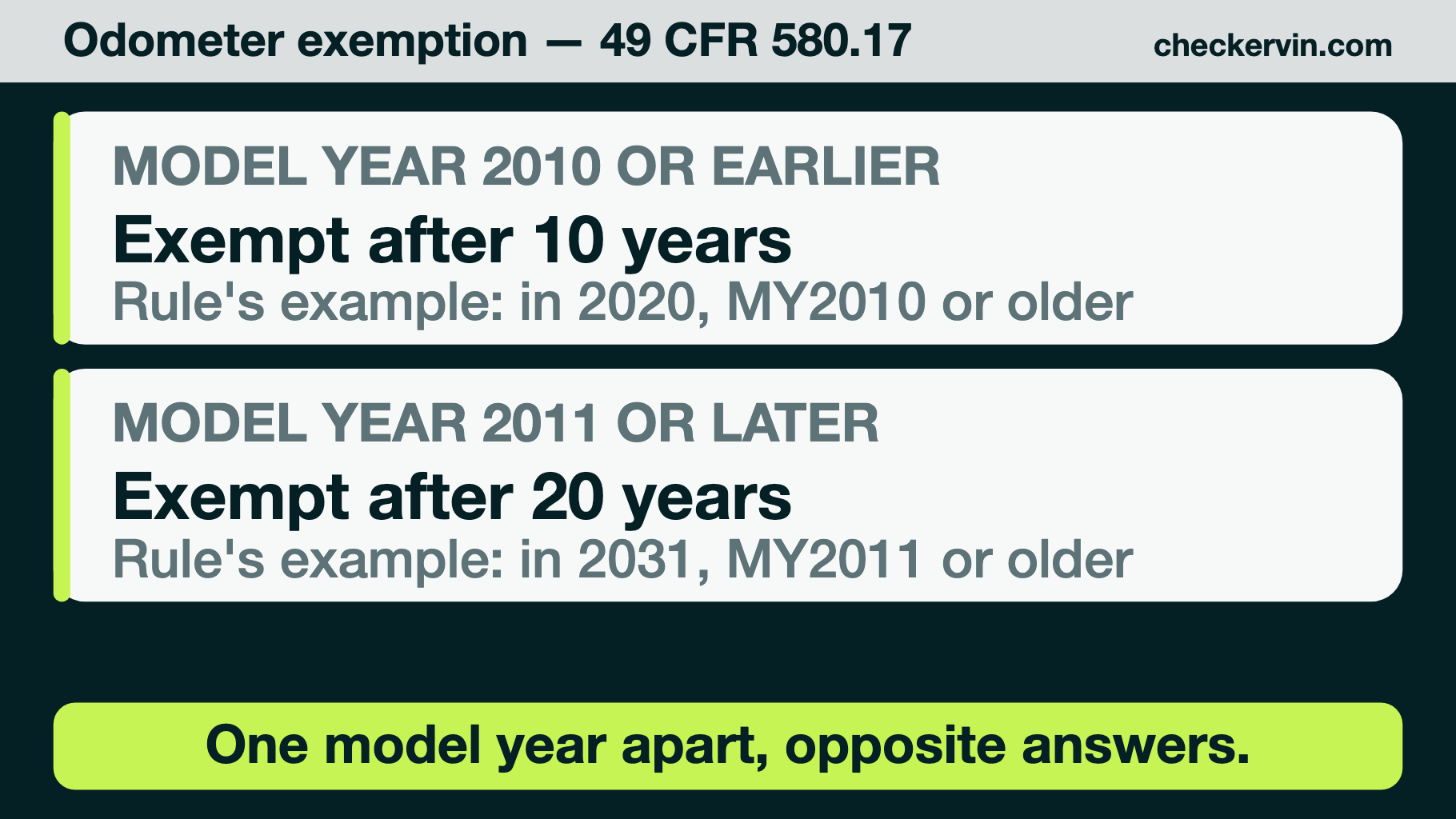
Older vehicles are exempt, and the rule is more specific than the common shorthand about “cars over ten years old.” It changed at the 2011 model year, and the two halves run in parallel rather than one replacing the other.
| Model year | When it becomes exempt — 49 CFR 580.17 |
|---|---|
| 2010 or earlier | Exempt once 10 years have passed since January 1 of the calendar year matching its model year. The regulation's own example: "for vehicle transfers occurring during calendar year 2020, model year 2010 or older vehicles are exempt." |
| 2011 or later | Exempt only once 20 years have passed. The regulation's own example: "for vehicle transfers occurring during calendar year 2031, model year 2011 or older vehicles are exempt." |
Two further exemptions sit alongside these and catch far fewer vehicles: a gross vehicle weight rating above 16,000 pounds, and a vehicle that is not self-propelled. Neither is likely to be the reason a family car is exempt.
The consequence is worth stating plainly, because it defeats the rule of thumb most people are carrying. Today, a 2010 vehicle is exempt and a 2011vehicle is not — and will not be until 2031. Two cars built one model year apart, the same age on the driveway, opposite answers on the form. If you are handing an older car to a relative and assuming it is past all this, that is the boundary to check first.
If a lender still holds an interest
A recorded lien stops the transfer, and it does so at the counter rather than in advance, which is why it wastes a trip.
The order is fixed: settle the loan, obtain the release from the lender, get the release recorded so the title is clear, and transfer after that. Where a loan was paid off years ago and nobody chased the release, the lien can still be recorded against the vehicle even though nothing is owed — a paid loan and a released lien are two different events, and only the second one shows on the title.
Check this before anything else. It is the single most common reason a family transfer that everyone agreed on does not happen on the day.
When the owner has died
This is genuinely a different procedure, not a variation on the steps above, because the signature the title requires belongs to someone who cannot give it.
Broadly, states offer two routes. Where an estate is small, many allow a surviving spouse or heir to transfer a vehicle on an affidavit without full probate, which is quick and inexpensive. Otherwise the transfer runs through the estate and the person with authority to sign is whoever the court has appointed.
The handshake transfer, and what it costs later
The most common failure in family transfers is not doing them at all. The car moves, everyone agrees whose it is, and the title stays in the original owner’s name for years.
That arrangement holds until it does not. The registered owner remains the person the state contacts about tickets and toll notices. Insurance becomes awkward when the person driving is not the person on the title. And when the car is eventually sold, the seller is not the person named on the title — which is the situation that produces an open title and, if it changes hands again in that state, the practice our title jumping page is about.
Fixing it later is harder than doing it now, because the paperwork has to reconstruct a transfer that everyone remembers differently and no document records.
If the title was signed but never filed
This is the most common repairable mess in family transfers, and it is worth recognizing before it hardens. The previous owner signed the title, handed it over with the keys, and the new owner never took it to the state. The document now sits in a drawer with a signature on it and no name filled in on the buyer’s side.
That is an open title, and it is not a neutral state of affairs. Until the transfer is recorded, the state still regards the signer as the owner — so tickets, tolls and any liability associated with the vehicle keep pointing at someone who believes they gave the car away years ago. The signature does not transfer ownership on its own. The filing does.
The fix is usually straightforward if the signer is available and willing: file it late, pay whatever penalty applies, and accept that the paperwork will reflect the real date rather than the intended one. It becomes hard when the signer has moved, lost touch, or died, which is exactly why the cheap moment to do this is the day the keys change hands.
Insurance, and the order it has to happen in
The insurance step is the one that catches people out at the counter, because it has to be in place before the registration rather than after.
Coverage does not follow the car. The previous owner’s policy covered them driving that vehicle; it does not silently transfer to a relative because the vehicle did. Most states require proof of insurance in the new owner’s name to complete the registration, which means arranging cover on a car they do not yet formally own. Insurers deal with this constantly and it is a normal request, but it is a phone call to make the day before rather than a discovery to make in the queue.
- The new owner arranges coverage in their own name, effective on the day the car changes hands.
- The previous owner cancels or amends their policy only after the transfer is recorded, not on the day the keys move.
- Both parties keep proof of the changeover date, because a claim in the gap between the two is the expensive version of this mistake.
- If the car is going to a household member who is already a named driver, confirm with the insurer rather than assuming the existing policy covers a change of ownership — those are different things.
The gap between one policy ending and the next beginning is short and entirely avoidable, and it is the window in which an otherwise routine family handover becomes an uninsured loss.
Before you sign
- Confirm no lien is recorded, and if one ever existed, that the release was recorded rather than merely paid.
- Check whether the vehicle is exempt from the odometer disclosure using the model-year rule above, not the ten-year rule of thumb.
- Find your state's family-transfer exemption form before the visit, so the tax exemption is claimed rather than argued.
- Have both parties present, or check what your state accepts instead — some require notarization and some do not.
- Run the VIN. If the car has carried a brand at some point in its life, the new owner should learn it from you rather than from a buyer years later.
- File the release of liability the same day, not when you remember.
Where this information comes from
- 49 CFR Part 580 — odometer disclosure requirementsThe disclosure duty at 580.5 and the model-year exemptions at 580.17
- NHTSA recall lookupOpen safety recalls by VIN, free — worth clearing before the car changes hands
- NMVTIS — U.S. Department of JusticeThe federal title record, and any brand the vehicle already carries
- NHTSA vPIC VIN decoderThe factory build as filed, free and without an account
Keep reading
Frequently asked questions
Do I still need to do paperwork if I am giving the car to my child?
Yes. A gift between family members is still a transfer of ownership, and the title has to be signed over and retitled in the new owner's name. What changes with a gift is usually the tax treatment, not the paperwork. Most states exempt a transfer between close relatives from sales tax but require a specific form or affidavit to claim it, so the exemption is something you apply for rather than something that happens automatically.
Does the odometer disclosure apply to a family transfer?
Yes, unless the vehicle is exempt. The federal rule at 49 CFR Part 580 attaches to the transfer of ownership, not to whether money changed hands or whether the parties are related. The disclosure belongs on the title itself at the point it is issued to the new owner. Family transfers are where this gets skipped most often, because it feels like a formality between people who trust each other.
Which older cars are exempt from the odometer disclosure?
The rule changed at the 2011 model year and the two halves run in parallel. A vehicle from the 2010 model year or earlier is exempt once ten years have passed since January 1 of its model year. A vehicle from 2011 or later is not exempt until twenty years have passed. So the same calendar year can produce opposite answers for two cars built one model year apart.
Can I transfer a title if the car still has a loan on it?
Not until the loan is settled. The lender holds a recorded interest in the vehicle and the title cannot pass cleanly while it stands. The sequence is to pay the loan off, obtain the lien release from the lender, get that recorded so the title is clear, and only then transfer. Starting at the counter without the release is the most common way a family transfer stalls on the day.
What if the owner has died?
That is a different procedure and it depends on how the estate is being handled. Some states allow a small-estate affidavit that lets a surviving spouse or heir transfer the vehicle without full probate; others require documentation from the estate. The vehicle usually cannot simply be signed over by a relative holding the keys, because the person whose signature the title needs is no longer able to give it.
Check the VIN before the title moves
Decode any VIN free for the factory build and open safety recalls — worth knowing before a car changes hands, even inside a family.
Run a free VIN check