The short answer
- Why was it totaled if it drives?
- Because the repair estimate crossed a percentage of the car's value. That ratio has nothing to do with whether the car moves, and an older vehicle reaches it on cosmetic damage alone.
- Can I keep it?
- Usually. The insurer pays you the value minus what the wreck would have fetched at salvage, and you keep the car — and a branded title that is permanent.
- What is the real cost of keeping it?
- Not the repair bill. It is the brand: a lower payout now, a re-inspection before it is road-legal, narrower insurance, and a resale value cut for as long as you own it.
Why a car that drives perfectly well gets totaled
The phrase “total loss” sounds mechanical and is not. It describes a decision made with a calculator: the insurer estimates repair cost, compares it against the vehicle’s pre-accident value, and declares a total loss when the ratio crosses a threshold. Nothing in that arithmetic asks whether the car still starts.
Which is why the outcome surprises people. Deployed airbags are expensive to replace, a quarter panel is labor-intensive, and a ten-year-old car simply is not worth very much. Add those together and you can cross the line while the vehicle is sitting in your driveway, running, with four good tires.
The threshold itself is a state-level question and the answer varies more than most people expect — the percentage differs, what counts as “repair cost” differs, and some states use a different instrument altogether. We keep that analysis on its own page rather than compressing it here, because a rounded version of it is exactly how people reach the wrong conclusion about their own state.
Accounting
Not mechanical
The decision compares repair cost to value — not whether the car drives
Permanent
The title brand
It travels with the VIN through every future sale, in every state
$0
To check the record
A VIN decode and the federal recall check cost nothing
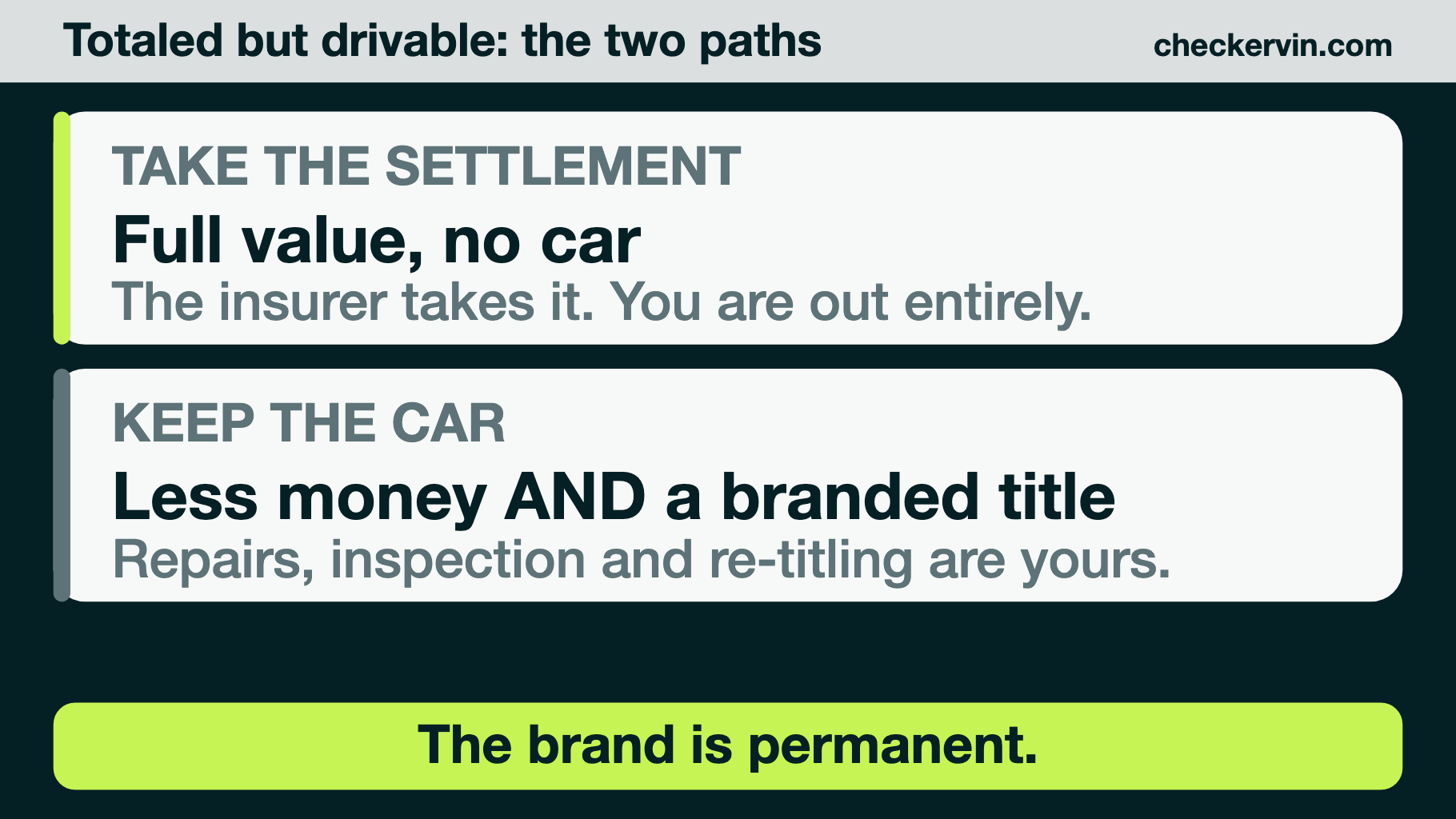
The two paths, and what each one actually is
Once the insurer has declared a total loss you are choosing between two things, and they are less symmetrical than they look.
| Path | What happens |
|---|---|
| Take the settlement | The insurer pays the vehicle's pre-accident value, less your deductible, and takes the car. It goes to a salvage buyer, gets a branded title, and stops being your problem. You are out of the vehicle entirely. |
| Keep the car (owner retention) | The insurer pays the same value less the deductible AND less the salvage value they gave up by not taking it. You keep the car, the reduced payment, and a title that is now branded. Repairs, inspection and re-registration are yours. |
The word people miss in the second row is and. A buyback is not the settlement plus a car. It is a smaller settlement plus a car that is worth materially less than it was the day before the accident, for reasons that have nothing to do with how well it was repaired.
What happens to the title, which is the part that lasts
This is the consequence the law-firm pages leave out, and it outlives every other part of the transaction.
When an insurer settles a claim as a total loss, that settlement is reported, and the vehicle’s title is branded. The exact wording is a state matter — salvage is the common one, and states use their own variants — but the effect is consistent: the title now carries a permanent statement that this vehicle was once declared a total loss.
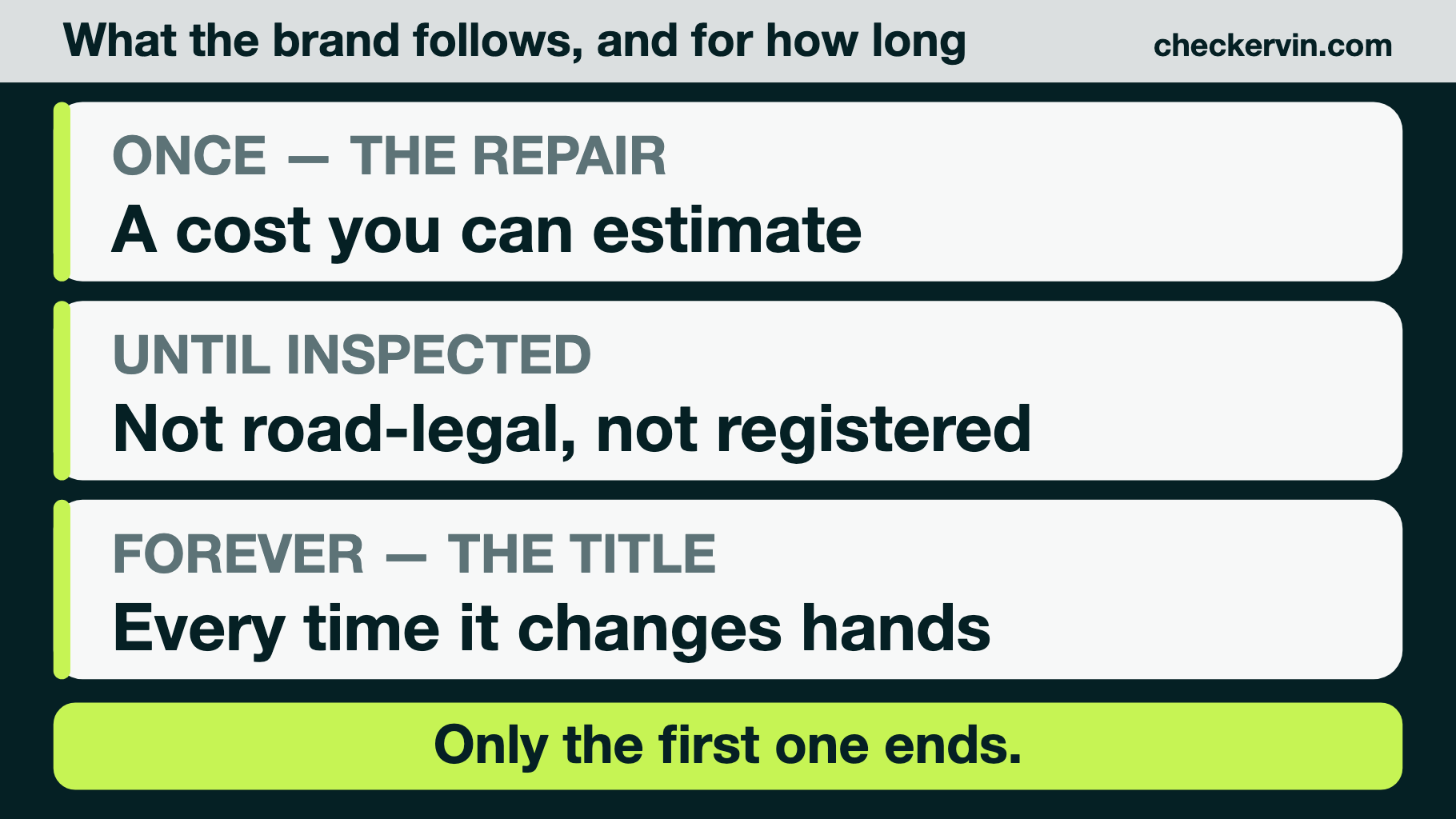
That permanence is the whole reason to think carefully before accepting a buyback on a car you are fond of. The repair is a one-off cost you can estimate. The brand is a standing deduction on the vehicle for as long as it exists, and it narrows who will buy it, who will finance it and who will insure it.
What keeping it actually costs
Sellers of the buyback idea present it as getting a car for the salvage deduction. The real cost has four parts and only one of them is the repair.
- The reduced settlement — you give up the salvage value the insurer would have realized, and that is money you never see.
- The repair itself, which you are now managing rather than the insurer, at estimates you obtain and pay for.
- The inspection and re-titling process required before the vehicle is road-legal again, which costs time and fees and can fail.
- The permanent reduction in what the vehicle is worth, which you will meet again on the day you sell it — and which is usually the largest of the four.
Run those four against the settlement you would otherwise take. On a late-model car with light damage the arithmetic can favor keeping it. On an older car with a modest value it usually does not, because the brand takes a proportion of a number that was already small.
Getting it road-legal again
A branded vehicle does not simply resume its old registration. The general shape of the process is consistent across states even though the details are not.
- 1The salvage title is issued firstThe vehicle is retitled to reflect the total loss. In this state it is generally not legal to drive on the road — it is a document describing a vehicle awaiting repair, not a license to use it.
- 2The repairs are completed and documentedKeep receipts and records for parts, especially major components. The inspection stage will ask where things came from, and unsupported parts are a common reason inspections fail.
- 3The vehicle is inspectedA state-authorized inspection confirms the vehicle is roadworthy and, importantly, that the parts used in it are not stolen. This is an identity and safety check rather than a judgment about repair quality.
- 4A rebuilt title is issuedPass, and the vehicle is retitled as rebuilt — or the state's equivalent wording — and can be registered and driven. The brand remains. Rebuilt is a different brand from salvage; it is not the removal of one.
Insuring it afterwards
Expect the market to be narrower rather than closed. Liability coverage is generally available. Comprehensive and collision on a branded vehicle is where insurers become selective, because establishing what the vehicle was worth before a future loss is genuinely harder when its history includes a total loss already.
The practical step is to ask before you commit, not after. If you are weighing a buyback, call your insurer and ask what they will write on the vehicle once it is rebuilt. An answer you get in advance is worth more than an assumption you test after the repairs are paid for.
What it is worth when you come to sell
A branded vehicle sells for materially less than an equivalent one with a clean title, and the discount is not a negotiating position — it is the market pricing a permanent disclosure.
Two practical consequences. The pool of buyers narrows, because many buyers screen brands out before they look at anything else, and financing on a branded vehicle is harder to arrange, which removes another slice of the market. And the discount does not fade with time or with good repairs. A well-rebuilt car ten years later still carries the brand.
None of that makes keeping the car wrong. It makes the decision a trade you should price rather than a bargain you found. If you intend to keep the vehicle until it is scrap, the resale discount is largely theoretical. If you expect to sell in three years, it is the single biggest number in the calculation.
When keeping it genuinely makes sense
There are real cases for a buyback, and they share a shape.
- The damage is cosmetic and the estimate was inflated by parts prices rather than by structural work.
- You plan to keep the vehicle for a long time, so the resale discount is a number you never actually pay.
- You can do the repair competently yourself or have a trusted shop, so the repair cost is closer to parts than to a body-shop estimate.
- The vehicle is unusual, sentimental or hard to replace, and an equivalent one is not simply available for the settlement amount.
- Your insurer has confirmed in advance what they will cover on it once rebuilt.
When it does not
The cases against are less about the car and more about what the damage was.
- Structural or frame damage. This is the category where repair quality is hardest to verify and where the safety consequences of a poor repair are real.
- Water. A vehicle that has been submerged develops electrical faults on a timeline nobody can predict, and this is the case where a drivable car today tells you least about next year.
- Several deployed airbags, where the restraint system has to be restored correctly and the cost of doing it properly is a large share of the value.
- An older, common vehicle where an equivalent clean-titled example costs about what the settlement pays.
- Any situation where you would need to finance the repair, because financing a branded vehicle is exactly where lenders decline.
If the accident was not your fault
This is the most common variant of the question, and it changes less about the vehicle than people expect. Fault decides who pays. It does not decide whether the car is a total loss, and it does not change what happens to the title.
If the other driver’s insurer is settling, the arithmetic is the same one: their estimate of repair cost against their valuation of your car, measured against the same state threshold. A car totaled by somebody else’s insurer is branded exactly as it would have been by your own. The brand records the settlement, not the blame.
What fault does change is the money, and there the picture is genuinely different: you are typically dealing with a company that has no contract with you, your deductible is treated differently, and in some states there is a route to claim the loss of value that a total-loss history imposes on a repaired vehicle. Those questions are about a claim rather than about a car, and they are where the personal-injury firms that dominate this search result are actually useful. We are not a law firm and will not pretend to advise on a settlement.
Before you decide, in order
The decision improves a great deal with four pieces of information, and all four are obtainable before you sign anything.
- 1Get the settlement figure and the buyback figure separatelyThe difference between them is the salvage value you are giving up. That is the actual price of keeping the car, before any repair.
- 2Get a real repair estimate, not the insurer'sThe insurer's estimate was built to answer a different question. Get your own from a shop that would do the work.
- 3Check what the record already saysRun the VIN. If the vehicle already carried a brand before this accident, the calculation changes completely — and it is better to find that out now than at the point of sale.
- 4Ask your insurer what they will write afterwardsBefore you commit, not after. Narrower coverage on a rebuilt vehicle is normal; discovering it after the repairs are paid for is avoidable.
Where this information comes from
- NMVTIS — U.S. Department of JusticeThe federal title record states must report brands into, and where a brand from another state surfaces
- NHTSA recall lookupOpen safety recalls by VIN, free — worth clearing before any repair work
- NHTSA vPIC VIN decoderThe factory build, including the restraint systems a rebuild has to restore
- FTC — buying and owning a carFederal consumer guidance on vehicle transactions and disclosures
Keep reading
Frequently asked questions
Why would an insurer total a car I can still drive?
Because a total loss is an accounting decision rather than a mechanical one. The insurer compares the estimated repair cost against the vehicle's pre-accident value, and when repairs exceed a threshold the vehicle is declared a total loss. Cosmetic damage on an older car reaches that ratio easily. Bent metal, several deployed airbags and a quarter panel can outrun the value of a ten-year-old sedan without touching anything that stops it driving.
Can I keep a car the insurance company has totaled?
Usually yes. It is called an owner-retained settlement or a buyback, and the insurer pays you the vehicle's value minus what they would have received selling the wreck to a salvage buyer. You keep the car and the reduced payment. What you also keep is a branded title, which is the part of the transaction that follows the vehicle for the rest of its life.
Does the title change if I keep the car?
Yes, and this is the consequence people underestimate. Once an insurer settles a claim as a total loss the vehicle is reported as such, and the title is branded — salvage, or a state-specific equivalent. That brand is permanent and it travels with the VIN through every future sale, in every state. The car does not have to be undrivable for this to happen; it has to have been settled as a total loss.
Can I just drive it and not tell anyone?
The brand is not created by you telling anyone. Insurers report total-loss settlements, and the record moves independently of what you do with the vehicle. Continuing to drive a car that has been settled as a total loss but never re-titled is how people end up unable to register it, unable to insure it properly, and holding something they cannot sell.
How do I find out whether a car already carries this brand?
Check the federal title record, which is what NMVTIS exists for — states are required to report title brands into it, so a brand applied in another state surfaces there. A free VIN decode and the NICB theft and salvage screen are worth running alongside it. If you are the owner deciding whether to accept a buyback, run the VIN before you sign so you know what the record already says.
Check the VIN before you sign
Decode your VIN free for the factory build and any open safety recalls — worth knowing before you accept a buyback or a settlement.
Run a free VIN check