The short answer
- Which route pays the most?
- A private sale, on the headline number, because there is no reseller taking a margin. It also takes the longest and carries the most risk, and those are real costs even though they never appear as a figure.
- So why would anyone trade in?
- Tax. Most states charge sales tax on the purchase price minus the trade-in allowance, so trading in cuts the tax on your next car. That offset can outweigh a higher private-sale price.
- What decides the number?
- The same short list everywhere: what the car is, what it has done, what is owed on it, and what its record says. The VIN establishes most of that before anyone looks at the car.
There is no best route — there is a best route for your car
Every guide to this question ranks the channels and stops. The ranking is the least useful part, because the order changes with the car. A three-year-old crossover with 30,000 miles and a clean record is competed over by instant-offer buyers. A fifteen-year-old car with a branded title has one realistic buyer and it is not any of them.
What does not change is the arithmetic underneath. Everyone who makes you an offer is answering the same question — what can I resell this for, minus what it costs me to get it there — and they all start from the same handful of facts. Understand those and the channel question mostly answers itself.
4
Realistic routes
Instant online offer, dealer trade-in, private sale, wholesale or auction
1
Set of inputs
Every route computes its offer from the same short list of facts
$0
To establish most of them
The VIN decode and the federal recall check cost nothing
What every offer is actually computed from
Before anyone looks at your car, the offer is already roughly formed. It is built from a short list, and the list is the same whether the buyer is a franchise dealership, an online buying service or the person who answered your listing.
| Input | Why it moves the number |
|---|---|
| Exactly what the vehicle is | Trim, engine, drivetrain and factory options. Two cars with the same badge and year can be thousands apart, and the buyer resolves this from the VIN rather than from your description. |
| Odometer reading | The single largest lever after the model itself, and the one figure a buyer will always verify against the record rather than take on trust. |
| Title status | Clean, or carrying a brand. A brand does not stop a sale, but it moves the number by a proportion rather than a few hundred dollars, and it narrows who will buy at all. |
| What is owed on it | The payoff comes out of the proceeds first. This does not change what the car is worth; it changes what reaches you, which is what most sellers actually care about. |
| Reconditioning cost | Tires, brakes, glass, bodywork. A reseller subtracts what they will spend making it retail-ready, which is why an offer can be well under a valuation guide's number without being unfair. |
| Demand for that exact car | Seasonal and regional. A convertible in February and an all-wheel-drive wagon in February are not the same conversation. |
The first four are settled by documents and the VIN, before any inspection. That is why a buyer can quote you a number from a web form: they are not guessing, they are reading the same record you can read.
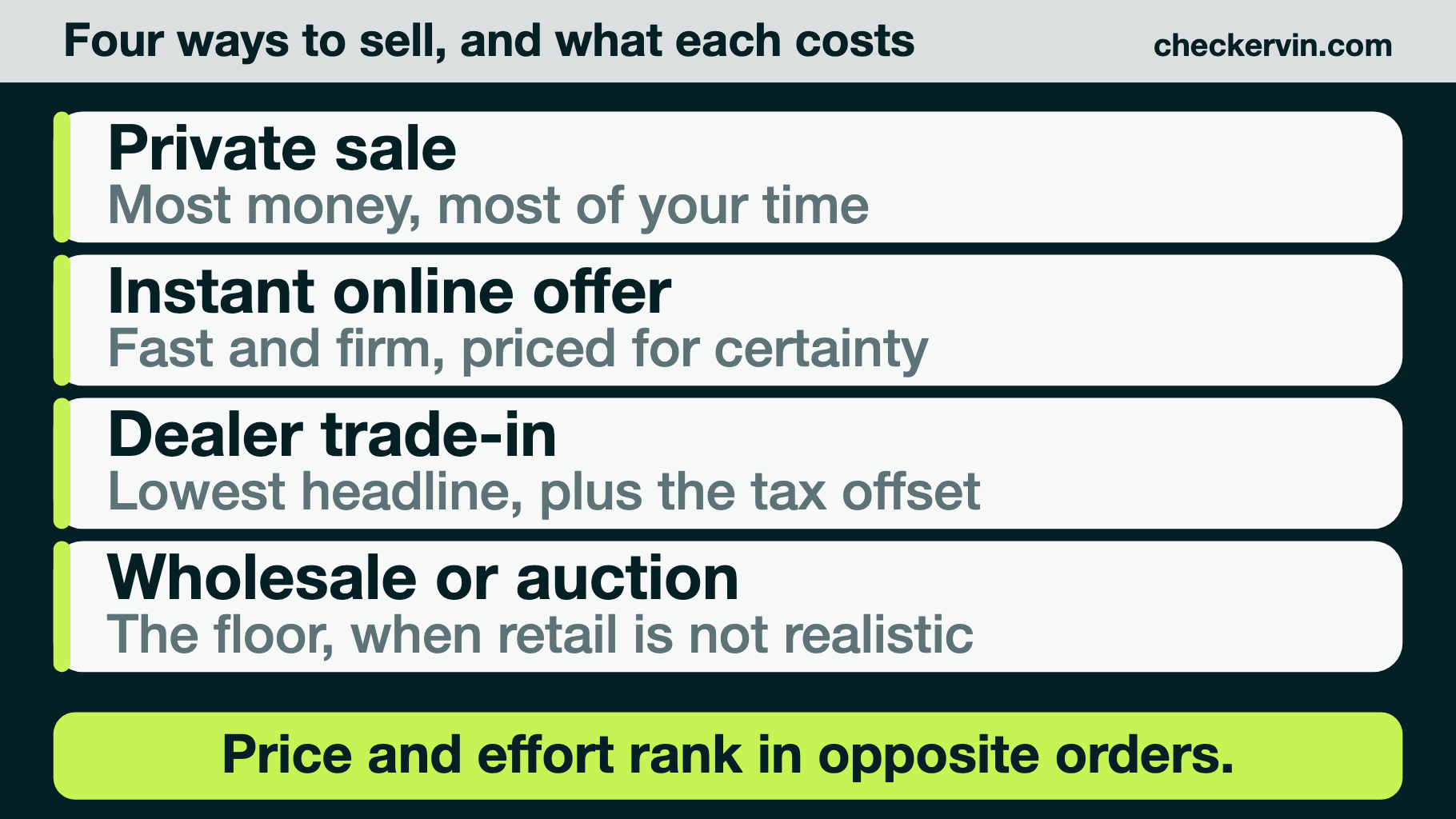
The four routes, and what each one trades
Ranked by the size of the payment, the order is fairly stable. Ranked by how much of your life it costs, the order reverses almost exactly.
| Route | What you trade |
|---|---|
| Private sale | Highest headline price, because no one is taking a resale margin. You take on the listing, the strangers, the test drives, the payment risk and the paperwork — and you carry the car until someone turns up. |
| Instant online offer | Fast, firm and low-effort, with the offer usually conditional on an inspection. You pay for that certainty in price. Strongest on late-model, common, clean cars and weakest on anything unusual. |
| Dealer trade-in | Usually the lowest headline number and the simplest transaction — one appointment, one signature, payoff and title handled. In most states it also carries the tax offset below, which is what makes the comparison less lopsided than it looks. |
| Wholesale or auction | The floor. Fast and near-certain, and the right answer for a car that is hard to retail — high mileage, a branded title, or mechanical trouble you do not want to warrant to a private buyer. |
Two practical notes. Getting an instant offer costs nothing and takes minutes, so it is worth collecting one even if you intend to sell privately — it establishes a floor you can refuse to go below. And a dealer trade-in offer is a negotiable part of a larger deal, so it is worth agreeing the trade figure separately from the price of the car you are buying, rather than letting the two move against each other.
The trade-in tax offset, which is where the comparison usually turns
This is the piece most sellers leave out, and it is often worth more than the difference between the offers.
In most states that charge sales tax on a vehicle purchase, the tax is calculated on the purchase price minusthe trade-in allowance. Trade a car in against your next one and you are not taxed on that portion of the new car’s price. The saving is real money and it lands in the same transaction.
The way to use it is simple. Take the trade-in offer, add the tax you would avoid on your next purchase, and compare thatfigure against the private-sale price you realistically expect — not the one you hope for. Sellers who do this arithmetic are often surprised which side wins, and it is the single calculation that most changes the answer to this page’s question.
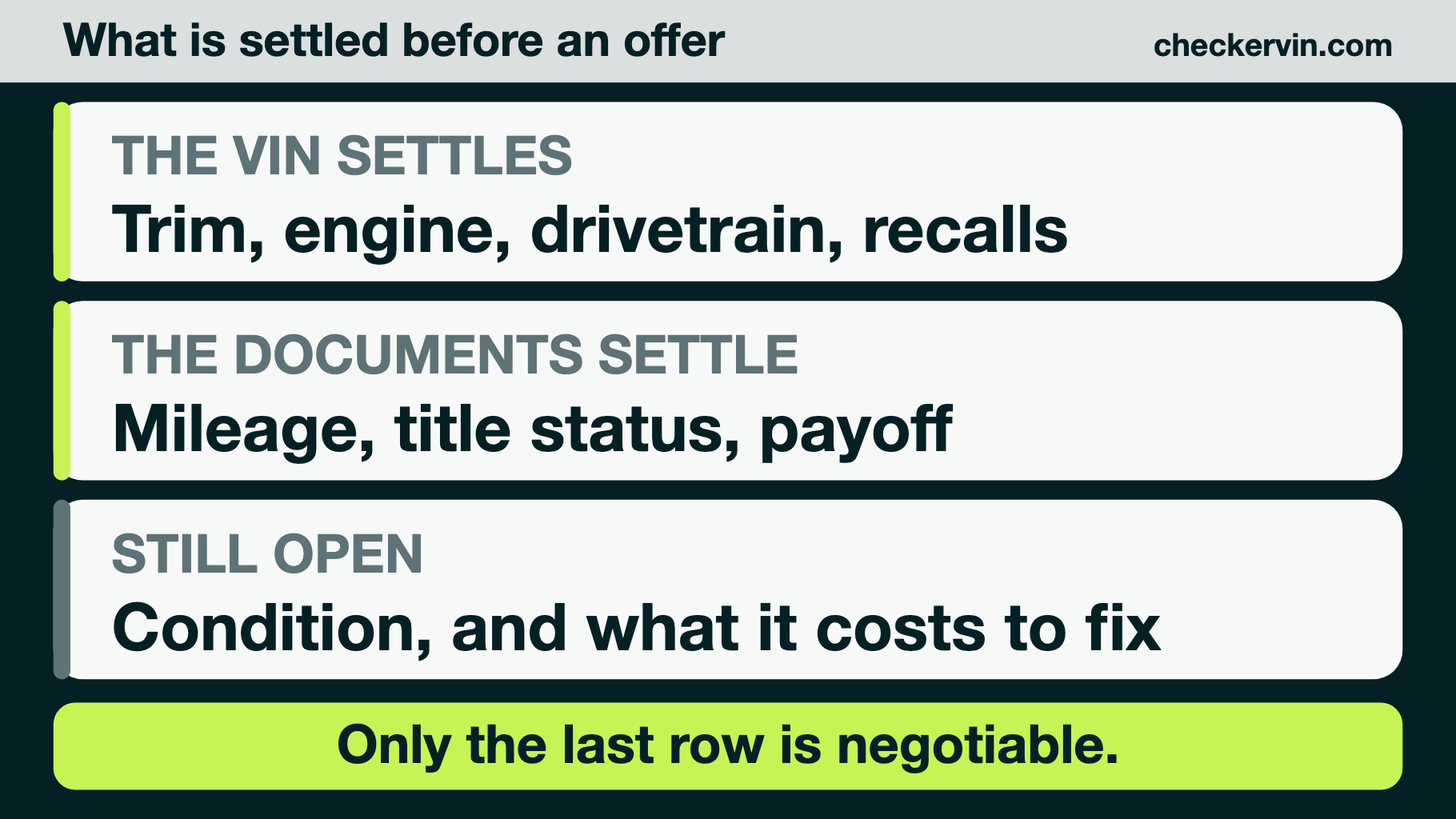
What the VIN settles before anyone looks at the car
A seller is usually the last person in the transaction to look up their own vehicle, which is backwards. The buyer will do it, and arriving at the conversation knowing what they will find is worth more than any negotiating tactic.
A free decode returns the factory build — the engine, drivetrain, body style and restraint systems the vehicle was manufactured with. That matters because trim disputes are where offers quietly shrink. If your listing says one thing and the VIN says another, the buyer will believe the VIN, and you will lose the difference at the worst possible moment.
It is also how you find out what you actually own. Cars acquire descriptions over time — from the previous owner, from a listing you bought it through, from memory. The VIN is the only description that was filed by the manufacturer, and it is the one every buyer checks against.
Open recalls, and what they do to an offer
An unrepaired safety recall against your VIN is free to look up, free to fix, and worth resolving before you ask anyone for a number.
The remedy costs you nothing — the manufacturer owes it — so this is the rare case where an hour at a franchise dealer removes a discount without spending anything. A buyer who finds an open recall has a concrete, documented reason to reduce their offer, and reconditioning is exactly where resellers build in margin.
On the legal question, we keep the analysis on its own page rather than summarizing it here, because it is more nuanced than either side of the usual argument: the federal limitation on selling with an open recall is written around new vehicles and rental fleets, and does not reach a private used-car sale. That is a reason to check and fix, not a reason to assume nobody minds.
If you owe more than the car is worth
Being upside down is common and it is not an obstacle to selling. It is an obstacle to walking away with money, which is a different problem.
- 1Get the payoff figure in writingNot the balance on your statement — the payoff quote, which is good through a stated date and is the number that actually settles the loan.
- 2Get real offers, not estimatesA valuation guide is a starting point. Two or three actual offers tell you what the market will pay for your specific car this month.
- 3Subtract one from the otherThe gap is your negative equity. It is a fact about the loan rather than a judgment about the car, and knowing it before you sit down changes the conversation.
- 4Decide how the gap gets paidCash closes it. Rolling it into the next loan defers it and costs more, because you finance the shortfall on top of the new purchase and start the next car already behind.
What to have ready before you ask for an offer
None of this raises the offer on its own. Each missing item hands the buyer a reason to discount, and one of them can stop a sale on the day.
- The title, in your name, with any lender's lien formally released — an unreleased lien on a paid-off loan is the single most common reason a sale stalls at the counter.
- The current odometer reading, photographed, so the disclosure you sign matches the car.
- Both keys. A missing second key is a real, quotable replacement cost and buyers deduct it.
- Service records, however incomplete. They rarely add a specific amount and they consistently move a buyer's read of the car.
- A free recall check, resolved if anything is open.
- A VIN decode, so your description of the trim matches the manufacturer's.
Reading an offer, and the parts worth questioning
Most offers are honest and mechanical. The ones that are not tend to fail in the same few ways.
- A number that drops at signing with no itemized reason. Conditional offers moving after inspection is normal; a vague reduction at the last moment is not.
- A trade figure that only exists inside a specific new-car price. Agree the two separately or you cannot tell which one moved.
- Pressure to sign before the payoff quote arrives. The payoff is arithmetic and it can wait for the paperwork.
- A private buyer proposing any payment method that clears after you hand over the title. The title moves when the money is final, in that order.
- An offer conditional on you not checking something. Nobody legitimate needs you uninformed.
Where this information comes from
- NHTSA recall lookupOpen safety recalls by VIN, free — resolve these before asking for an offer
- NHTSA vPIC VIN decoderThe factory build as the manufacturer filed it, which is the trim a buyer will believe
- FTC — buying and owning a carFederal consumer guidance covering used vehicle transactions
- NMVTIS — U.S. Department of JusticeThe federal title record, and the brands a buyer will find on it
Keep reading
Frequently asked questions
Where can I sell my car for the most money?
A private sale almost always produces the highest headline number, because you are selling to the person who will drive the car rather than to someone who has to resell it at a profit. It also costs you the most time and carries the most risk. The right question is not which route pays most in the abstract, but which pays most after the tax offset, the hours and the risk are priced into the comparison for your specific car.
Is a trade-in ever worth more than a private sale?
Yes, and the reason is tax rather than generosity. Most states that levy sales tax on a vehicle purchase charge it on the price minus the trade-in allowance, so a trade-in reduces the tax on the car you are buying. Where that applies, a trade-in offer can beat a higher private-sale price once the tax saved is added to it. A few states do not allow the offset at all, so this has to be checked for your state rather than assumed.
Do the instant online offers actually pay what they quote?
The quote is conditional on an inspection, and the number can move once someone sees the car. That is not automatically a bait tactic — the initial figure is generated from what you typed, so it is only as accurate as the condition you claimed. The way to test a buyer is to compare the first number with the final one and ask what specifically changed. A clear, itemized reason is normal. A vague reduction at the point of signing is not.
What do I need to have ready before I ask for an offer?
The VIN, the odometer reading, the title in your name with the lender's lien released if there was one, both keys, and any service records you can lay hands on. Run the free recall check too. None of that raises the offer by itself, but every missing item gives the buyer a reason to discount, and an unreleased lien can stop a sale entirely on the day.
Can I sell a car that still has money owing on it?
Yes, and it is routine. The lender holds the title until the loan is settled, so the payoff comes out of the sale proceeds before anything reaches you. Dealers and the large online buyers handle this daily. If the car is worth less than the balance you have negative equity, and you either bring the difference in cash or roll it into a new loan, which is the more expensive of the two options.
Look up your own car first
Decode your VIN free for the factory build and any open safety recalls — the same record every buyer will check before they make you an offer.
Run a free VIN check