The short answer
- Can a free US decoder read a Scania VIN?
- Not a modern truck. NHTSA's decoder answers a VIN beginning YS2 with error code 7: manufacturer not registered for US sale or importation. Scania's only identifier on file is a 1980s bus code.
- Chassis number or VIN?
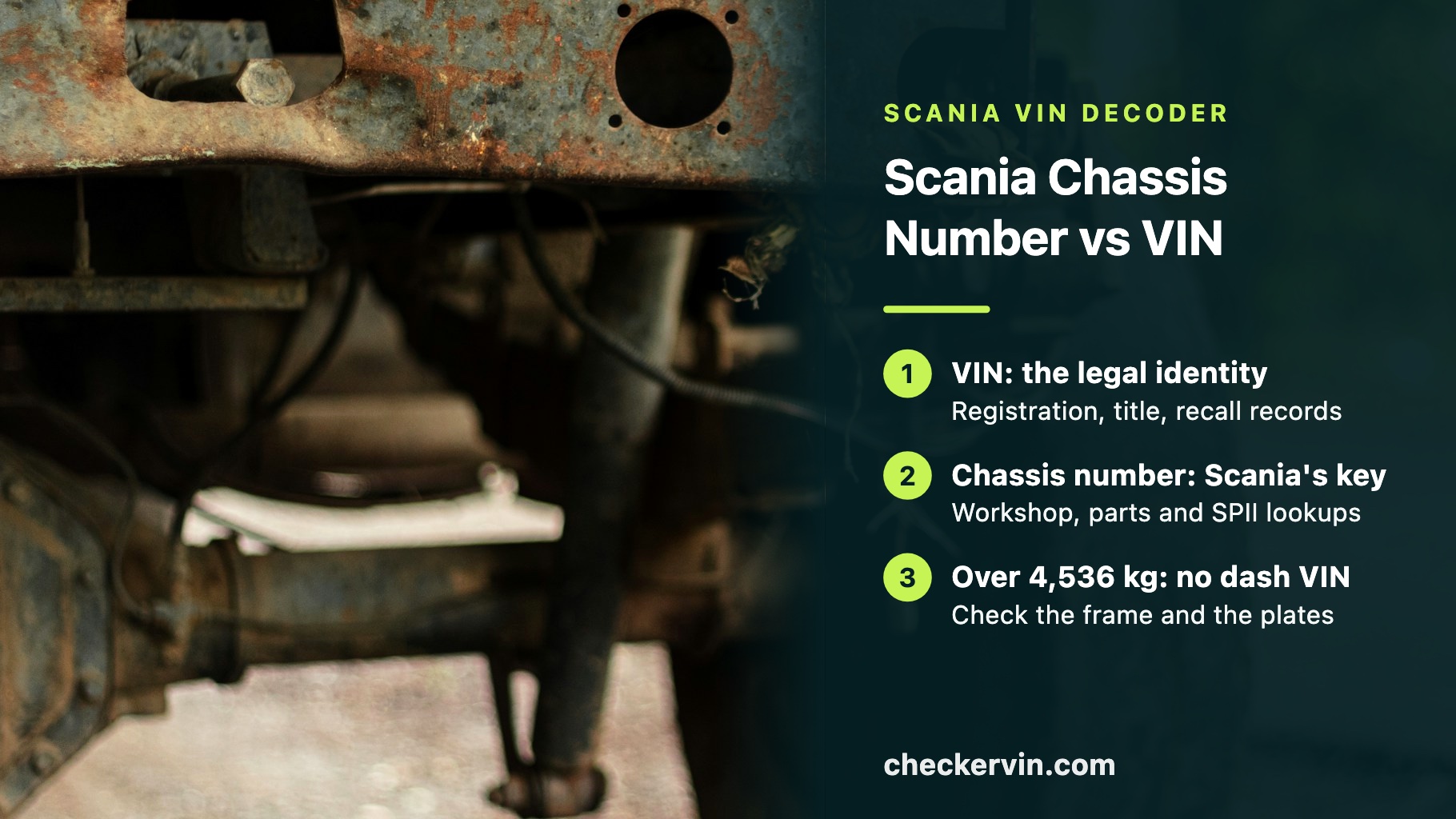
- Both identify the truck. The VIN is the legal identity on the registration; the chassis number is what Scania's workshop, parts and specification systems are searched by.
- Where is the VIN on a Scania?
- Not behind the windshield. That rule covers trucks up to 4,536 kg GVWR. On a heavy truck, look on the frame and on plates in the cab and door area, then match the number to the papers.
Error 7
What vPIC returns for YS2
Not registered for US sale
4 years
Scania trucks in NHTSA records
1985–1989
4
US recall campaigns
All on 1980s trucks
Chassis no.
Scania's own lookup key
Workshop, parts, SPII
Why a US decoder comes back empty on a Scania
A US VIN decoder is only as good as what manufacturers have filed with NHTSA. Under 49 CFR 565.16 and Part 566, a company selling vehicles here has to tell NHTSA how its VINs are built, and that filing is what lets a free decoder turn seventeen characters into a model, an engine and a plant. Scania has not filed a structure for the trucks it sells in other markets, because it does not sell them here.
You can see this directly. Give NHTSA's vPIC decoder a partial VIN beginning YS2 — the prefix third-party decoders associate with Swedish-built Scania trucks — and it comes back with error code 7: the manufacturer is not registered with NHTSA for sale or importation in the US for use on US roads. That is not a broken lookup. It is an accurate statement about where the truck was meant to be sold.
- A free US decode will not return model, engine or axle configuration for a modern Scania
- US rules require a check digit in position nine; a truck built for another market was not made to those rules, so a check-digit warning alone is not a sign of tampering
- It can still tell you a VIN is the wrong length or uses a forbidden letter (I, O or Q)
- For everything else, the useful source is Scania's own chassis-number lookup
Scania trucks are not sold new in the United States
This is the fact most confusion starts from: you cannot walk into a US dealer and order a new Scania truck. Scania's 2023 US and Canada dealer directory lists industrial dealers and marine dealers for its engines. It lists no truck dealers.
The federal records agree. NHTSA's product database, queried for every model year from 1980 to 2026, lists Scania vehicles in only 4 of them: 1985, 1986, 1988, 1989. Those rows are the P, R and T series 112 and 113 trucks, and the recall filings on them name Saab Cars USA, Inc. as the responsible company — a reminder that Saab and Scania were once a single group. Nothing appears after 1989.
So a Scania you come across in the US is most likely one of three things: a surviving late-1980s US-market truck, a vehicle brought in later under one of the import routes below, or a Scania engine inside someone else's equipment. Each has a different number to look up.
Scania chassis number vs VIN
If you are looking for a Scania chassis number, you are probably holding one of two documents: a registration paper that shows a VIN, or a Scania specification or workshop invoice that shows a chassis number. They are different fields with different jobs.
| Number | What it is used for |
|---|---|
| VIN | The 17-character legal identity. It is what a registration authority, an insurer, a title office or a recall database records. |
| Chassis number | Scania's own key. Scania's repair and maintenance information package calls it the key to a quick search: entered into its workshop system, it brings up the vehicle's technical specification and certificates. |
| ICS / ICD | Individual Chassis Specification and Individual Chassis Drawing. Scania's bodybuilder portal defines both as documents for a specific chassis identified by its chassis serial number. |
| Factory order number | An alternative reference Scania's bodybuilder tools accept, alongside the chassis serial number, when ordering an individual chassis drawing in 3D. |
The practical rule follows from the table. Quote the VIN to anyone dealing with the truck's legal status. Quote the chassis number to Scania: its workshop system uses it for parts, accessories, labor times and recall campaign checks, and its own guidance says parts lookups work best with a chassis number entered first, because the results are then filtered to that exact vehicle.
Scania VIN number location: why it is not on the dashboard
Car owners expect a VIN tag visible through the windshield. That habit comes from a rule that does not reach heavy trucks. Under 49 CFR 565.13(f), the VIN must be readable through the glazing only on passenger cars, multipurpose passenger vehicles, low speed vehicles and trucks of 4,536 kg (10,000 lb) GVWR or less. A Scania tractor or rigid is far above that line.
What every vehicle does need, under 565.13(e), is a VIN that appears clearly and indelibly on a part not designed to be removed except for repair, or on a separate plate or label permanently fixed to such a part. In practice that sends you to three places.
- 1The chassis frameLook along the frame rails for stamped characters. Clean the area before reading it: road film and paint hide stamping, and a misread character is an easy way to end up with a number that does not match the papers.
- 2The plates in the cab and door openingsLook for the manufacturer's plate inside the cab and on the door pillars. On a truck certified for the US market, 49 CFR 567.4(c) puts the federal certification label on the hinge pillar, door-latch post or door edge next to the driver, or on the left of the instrument panel if none of those works.
- 3The paperworkRegistration, certificate of conformity and the Scania specification. These are where the full numbers are printed cleanly, and they are what you compare the stamping and plates against.
Our guide to VIN locations covers the car and light-truck positions this rule does apply to.
What NHTSA actually has on file for Scania
Ask vPIC which manufacturer identifiers belong to Scania and it returns exactly one. It is not a truck code.
| vPIC field | Value as filed |
|---|---|
| Manufacturer identifier | 1S9098 |
| Manufacturer name | SAAB-SCANIA OF AMERICAN INC. (spelling as filed) |
| Address | Saab Drive, Orange, Connecticut |
| Vehicle type | Bus |
| Model listed under the Scania make | CN112 |
The six-character identifier is itself informative. Under 49 CFR 565.15(a), a 9 in the third position of a VIN always means a six-character manufacturer identifier: positions one to three plus positions twelve to fourteen. The regulation reserves that format for low-volume manufacturers, defined in 565.12 as fewer than 1,000 vehicles of a given type a year. So a US-market Scania bus VIN would read 1S9 at the front and 098 in the middle of its serial section, and the code tells you the American bus operation was small.
The 1980s trucks appear in NHTSA's recall and product records, but no truck identifier is filed under Scania in vPIC. If you hold the VIN of one of those trucks, the recall lookup by make, model and year below is the more reliable route.
4 US recalls, all on 1985–1989 trucks
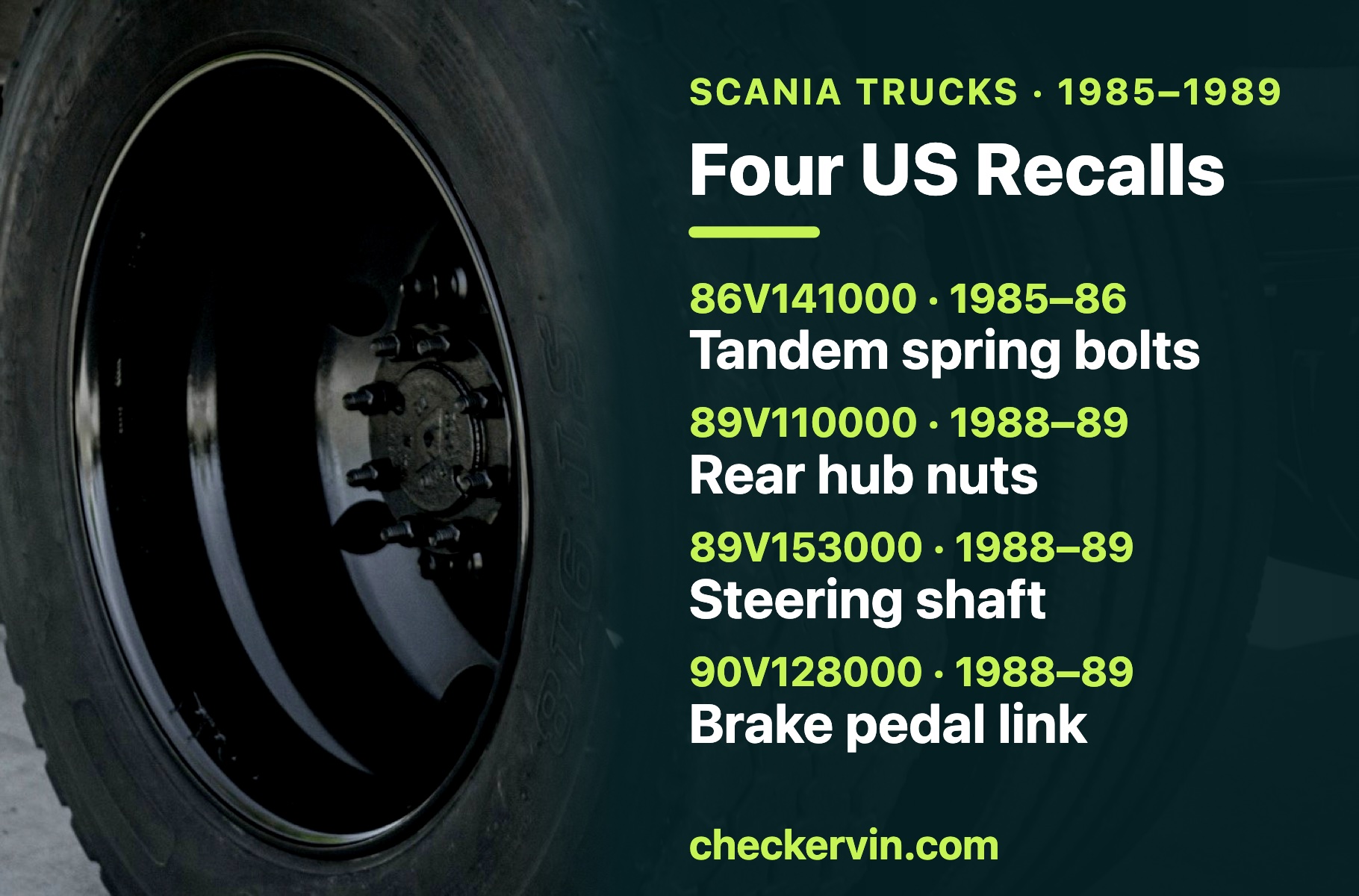
These are the only Scania safety campaigns in NHTSA's recall database, and they give a rare documentary look at the US-market trucks. Each one was filed by Saab Cars USA, Inc.
| Campaign | What it covered |
|---|---|
| 86V141000 · filed October 1986 | 1985–1986 P112, R112, T112 (6x4 tandem trucks). Tandem spring end bearing bolts may lack clamping force; the axle could come loose from the spring. Remedy: replace studs, nuts and bolts on the tandem spring end bearings. Potential units: 68. |
| 89V110000 · filed July 1989 | 1988–1989 P112, R112, T112, 113M, 113MA (AD 80 rear axle). Improperly seated wear washer; under load a hub nut could back off and the wheel come loose. Remedy: adjust bearing clearance so the hub nuts cannot back off. Potential units: 100. |
| 89V153000 · filed September 1989 | 1988–1989 113, P, R and T series with adjustable steering column. Steering column yoke end may be the wrong execution; bearing caps could come loose, risking loss of steering. Remedy: replace the complete steering shaft. Potential units: 204. |
| 90V128000 · filed July 1990 | 1988–1989 113, PRT 4x2, PRT 6x4 (heavy trucks). Retaining clip on the brake/clutch pedal link bolt may loosen; loss of service brake control. Remedy: install a new-design link bolt and split pin. Potential units: 223. |
The four filings list 595 potential units between them. That is not a count of trucks: model years 1988 and 1989 each appear in three campaigns, so one truck can be counted more than once. The largest single campaign lists 223 potential units, which gives a sense of how small the US truck operation was.
Bringing a Scania into the United States
Because no Scania truck is certified to US standards today, every import goes through one of the declarations in 49 CFR 591.5. The ones that matter here:
| Route | What it requires |
|---|---|
| At least 25 years old | 49 U.S.C. 30112(b)(9) exempts a motor vehicle at least 25 years old from the federal safety standards prohibition. This is how most older Scanias arrive. |
| Registered Importer, 591.5(f) | A bond of 150% of the dutiable value, an importer registered under Part 592 (or a contract with one), and an NHTSA determination under Part 593 that the model and model year are eligible. Not available for salvage or reconstructed vehicles. |
| Temporary, nonresident, 591.5(d) | A nonresident with a foreign-registered vehicle, importing for personal use for no more than a year, exporting it again and not selling it. |
| Not a road vehicle, 591.5(a) | A vehicle not manufactured primarily for use on public roads falls outside the safety standards altogether. |
The VIN rules follow the vehicle across the border. Under 565.14(a), an importer has to keep the VIN assigned by the original manufacturer. The substitute “SUBSTITUTE FOR U.S. VIN” plate in 565.14(b) applies only to vehicles of 4,536kg GVWR or less, so it will not appear on a heavy Scania. And 565.11 excludes vehicles imported under 591.5(f), other than by the company that built them, from the format sections of Part 565 — which is why an imported truck's VIN may not behave like a US one in a decoder.
Looking up a Scania outside the US
Outside the United States the route is simpler than any US decoder. Scania publishes a product lookup, SPII (Scania Product Individual Information), that is searched by chassis number. Scania's bodybuilder portal says it returns the complete specification and the certificates the vehicle fulfils.
- Search SPII by chassis number for the factory specification and certificates
- Ask a Scania workshop to run the campaign check — Scania's system needs a unique vehicle entered to do it
- Request the Individual Chassis Specification if you need the frame and equipment detail
- Compare the factory specification with the truck: axle configuration, cab and engine should all match
The factory specification describes the vehicle as it left the plant, often without a body. Scania notes that where the body was supplied from its own factory, the body specification is included too. On most trucks it was not, which brings in a second manufacturer.
Two plates on a bodied Scania
A Scania that left the factory as a chassis cab and was finished as a tipper, a tanker or a box truck has two builders. Scania's pre-delivery inspection checklist for bodybuilders opens with the vehicle identity as a VIN code, and one of its checkpoints is that a manufacturer's plate is fitted to the bodywork. So a correctly finished truck carries Scania's identification and the bodybuilder's plate.
US rules take the same view of who owns the VIN. Under 565.13(a), a vehicle built in more than one stage keeps the VIN assigned by the incomplete vehicle manufacturer, and alterers must use the original manufacturer's VIN. The body adds a plate; it never adds a new VIN.
Scania engines in US equipment: a different number
The Scania name most Americans actually meet is on an engine. Scania's US dealer directory covers industrial and power generation engines and commercial marine engines, and its 24-hour assistance line asks callers to have the engine serial number ready.
That is the number to use for a Scania-powered generator, pump, boat or machine. A VIN belongs to a motor vehicle; an engine in a piece of equipment is identified by its own serial number, and that is what the dealer network looks up.
Buying an imported Scania: the identity checklist
- 1Get the VIN and the chassis number from the seller's papersBoth, in writing, before you travel to see the truck. A seller who only offers one is a seller to press.
- 2Run the chassis number through ScaniaSPII or a Scania workshop gives the factory specification. Check axle configuration, cab and engine against the advert.
- 3Find the numbers on the truckFrame stamping and plates, matched character by character against the papers. Clean the frame first.
- 4Check the body plate on a bodied truckIt names the second manufacturer and points you to the body's own paperwork.
- 5Confirm the import route before payingAge, Registered Importer eligibility, emissions and state title all decide whether the truck can be registered where you need it.
- 6On a 1980s US-market truck, run the recall lookupThe 4 campaigns cover model years 1985 to 1989. Look for physical evidence of each remedy.
For the US heavy-truck makes a free decoder can read in full, see our semi truck VIN decoder.
Where this information comes from
- NHTSA vPIC — Scania manufacturer identifiersThe single identifier on file (1S9098, bus); DecodeWMI and GetModelsForMake confirm the CN112 listing
- NHTSA vPIC — decode a partial YS2 VINReturns error code 7: manufacturer not registered for US sale or importation
- NHTSA products — Scania models by yearChange the year to reproduce; only 1985, 1986, 1988 and 1989 return rows
- NHTSA recall campaign 89V153000Swap in 86V141000, 89V110000 or 90V128000 for the other three campaigns in the table
- 49 CFR Part 565 — VIN requirements565.13(e)–(f) on placement and the windshield rule, 565.14 on imports, 565.15 on six-character identifiers
- 49 CFR 567.4 — certification label locationWhere the federal label goes on a US-market truck
- 49 CFR 591.5 — declarations required for importationThe Registered Importer, temporary and off-road routes
- 49 U.S.C. 30112 — the 25-year exemptionSubsection (b)(9)
- Scania — repair and maintenance information packageThe chassis number as the search key for specification, certificates and campaign checks
- Scania Truck Bodybuilder — terms and abbreviationsICS and ICD defined by chassis serial number
- Scania Truck Bodybuilder — individual chassis drawings in 3DOrdered by chassis serial number or factory order number
- Scania Truck Bodybuilder — SPII individual chassis informationSpecification and certificates searched by chassis number
- Scania — pre-delivery inspection checklist (bodybuilders)Vehicle identity recorded as the VIN code; checkpoint 7, the bodywork manufacturer's plate
- Scania USA — 2023 US and Canada dealer directoryIndustrial and marine engine dealers only; engine serial number for assistance calls
- How we made this pageWritten by the CarCheckerVIN editorial team with AI assistance from NHTSA vPIC and other public records; facts checked November 2026.
Keep reading
Frequently asked questions
Where is the chassis number on a Scania truck?
On the vehicle's papers first: the registration document, the certificate of conformity and Scania's own specification all carry it, and it is the number a Scania workshop asks for. On the truck, heavy vehicles are not held to the windshield-visible rule that applies to cars, so look along the frame rails and for the plates in the cab and door openings. We have not verified a single fixed position across Scania's model range, so match the number on the truck to the papers rather than trusting one spot.
What is the difference between a Scania chassis number and a VIN?
The VIN is the 17-character legal identity a registration authority records. The chassis number is the reference Scania's own systems are built around: its workshop and parts system, its individual chassis drawings and specifications, and its SPII product lookup are all searched by chassis number. Both identify the same truck. Read each off the documents rather than deriving one from the other.
What is the Scania VIN number location on a heavy truck?
There is no dashboard tag requirement to rely on. US rules require the VIN to be readable through the windshield only on trucks of 4,536 kg (10,000 lb) GVWR or less; above that, the VIN only has to sit on a part not designed to be removed, or on a plate permanently fixed to one. Expect it on the frame and on plates in the cab or door area, not behind the glass.
Can I decode a Scania VIN with a free US decoder?
Not a modern truck. Ask NHTSA's vPIC decoder about a VIN beginning YS2 and it returns error code 7: the manufacturer is not registered with NHTSA for sale or importation for US road use. The only Scania identifier on file is a 1980s bus code, so a free US decode cannot spell out a European, Brazilian or other overseas Scania. Use Scania's chassis-number lookup instead.
Were Scania trucks ever sold in the United States?
Briefly. NHTSA's product records list Scania trucks for model years 1985, 1986, 1988, 1989 — the P, R and T series 112 and 113 — and 4 safety recalls were filed on them by Saab Cars USA. Nothing has been listed since 1989, and Scania's current US dealer directory covers industrial and marine engines, not trucks.
Can I import a Scania truck into the United States?
Only through a route in 49 CFR 591.5. A vehicle at least 25 years old is exempt from the federal safety standards under 49 U.S.C. 30112(b)(9). A newer non-conforming vehicle needs a Registered Importer, a bond of 150 percent of dutiable value and an NHTSA eligibility decision for that model and year. Emissions and state titling rules apply on top, so check with the agencies before you buy.
Does my Scania have open US recalls?
Only the 1980s US-market trucks can, because those are the only Scania trucks with US campaigns. The 4 campaigns cover model years 1985 to 1989 and deal with the rear suspension, rear axle hub nuts, the adjustable steering shaft and a brake pedal link. A truck built for another market is outside the US recall system; ask a Scania workshop to run its campaign check on the chassis number.
Check a VIN free
Enter any 17-character VIN to see what the federal database holds for it, with open safety recalls on US-market vehicles. Free, no account.
Run a free VIN check