The short answer
- Can you insure a salvage title car?
- Not for driving while it is still unrepaired salvage in states like Nevada and Texas, because it cannot be registered or driven. Once rebuilt, inspected and retitled, yes, though fewer carriers may write it.
- Is it hard to insure a rebuilt one?
- It can be. Texas's motor vehicle agency says rebuilt vehicles are often denied insurance, and tells buyers to call their agent before they buy.
- What should you do first?
- Get the VIN, confirm the brand on the federal title record, and get a written quote on that exact car before any money changes hands.
No
Driving on an unrepaired salvage title
Nevada and Texas, per their DMVs
65%
Nevada's total-loss line
Repair cost against pre-damage value
72 hrs
Florida title deadline if you keep it
Fla. Stat. § 319.30
12
DOJ-listed NMVTIS sellers for consumers
Where a title brand is confirmed
The short answer
If the title in front of you still says salvage and the car has not been through its state’s rebuild process, the insurance question mostly answers itself. Nevada’s DMV puts it in one line: “You cannot drive or register a vehicle with an orange Salvage Title. It must be rebuilt and inspected first.” Texas requires a sign on any salvage car offered for sale saying it “cannot be operated on a public highway.” A car that cannot be registered or driven has no road policy to buy.
The real question starts at the rebuilt stage. Once the car has been repaired, inspected and issued a rebuilt or reconstructed title, it can be registered and insured, but the carrier is now pricing a car whose repair it did not see. That is where quotes get refused, conditioned or narrowed, and where the paperwork from the rebuild earns its keep. The general split between liability and physical damage cover on a rebuilt car is laid out in what a rebuilt title is; this page is about the order of events and the records behind it.
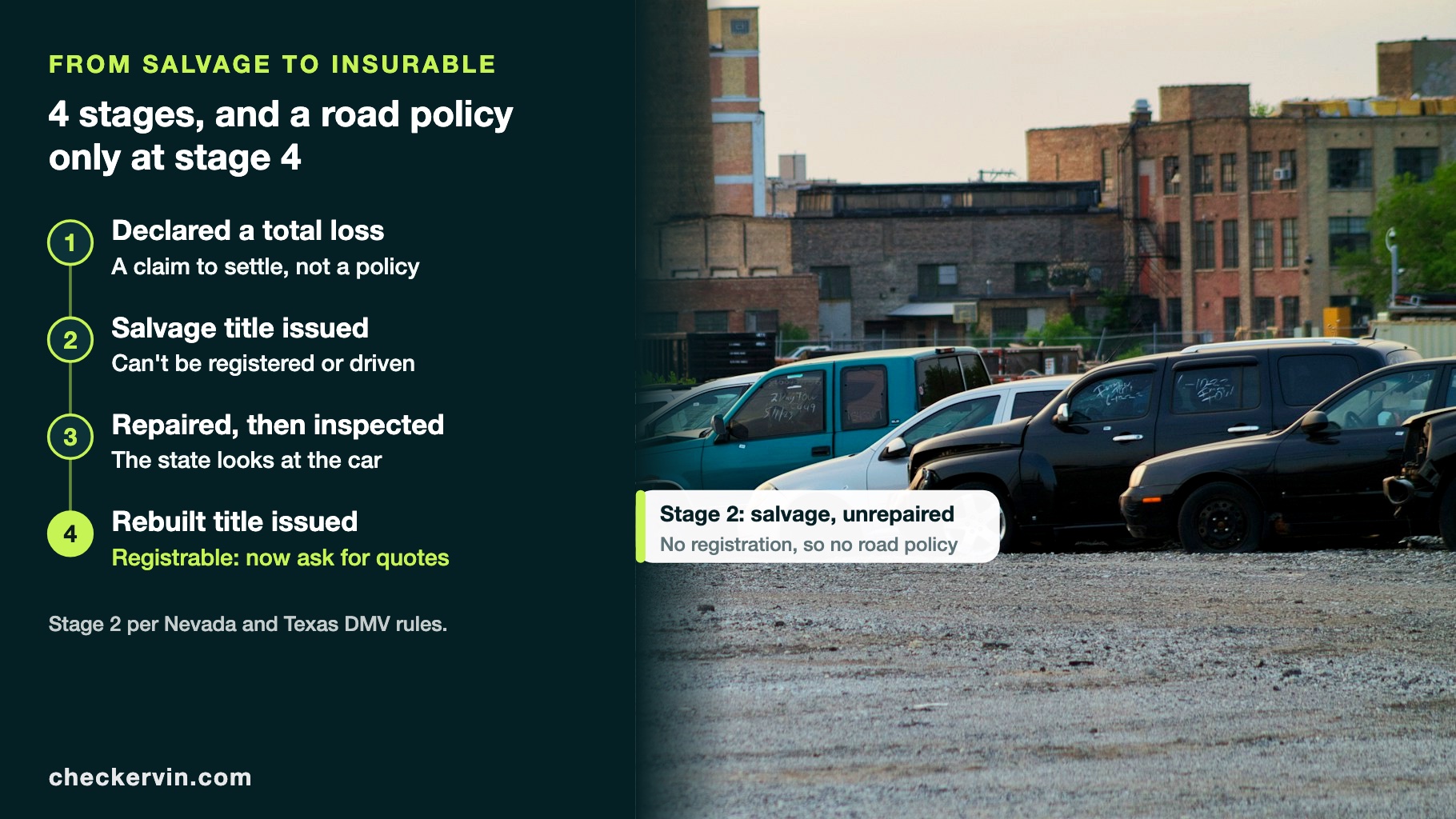
Salvage and rebuilt are two different insurance questions
The search phrase “insurance on salvage title car” covers both stages, which is why answers online seem to contradict each other. One writer says you cannot insure a salvage car; another says plenty of people do. Usually both are right about different cars.
| Where the car is | What the insurance question really is |
|---|---|
| Just totaled, insurer still owns or settling it | A claim question: the settlement, and whether you keep the car |
| Salvage title, not yet repaired | Not registrable or drivable in states like Nevada and Texas, so no road policy |
| Being rebuilt | What a carrier will write, if anything, on a parked car under repair |
| Passed inspection, rebuilt or reconstructed title | A normal quote, but from a smaller pool of willing carriers |
| Rebuilt car later damaged again | A valuation question: what the branded car was worth before the loss |
Read any advice, including ours, against that table. A post saying “my insurer covered my salvage car” almost always means a car that had already been rebuilt and retitled, or a California revived salvage car, which brings its own vocabulary problem.
Why an unrepaired salvage car has nothing to insure on the road
A salvage title is the state’s record that the car was written off. It is a document of ownership for a wreck, not permission to drive one. The two states whose wording we read are blunt about it. Nevada says the orange salvage title cannot be driven or registered and that the car “must be rebuilt and inspected first.” It also bars selling a salvage vehicle to a private person at all: only a licensed rebuilder, wrecker or dealer may buy one there.
Texas makes the same point at the point of sale. Its notice, required under the Texas Administrative Code for any salvage car offered for sale, says the vehicle cannot be operated on a public highway, and that a buyer who wants to register it must go to the county tax office, surrender the salvage title, document the repairs and pay the fees “before the vehicle may be titled and/or registered to operate on the public highway.”
Oregon adds a twist worth knowing. Its DMV says a totaled car must be re-titled even if no repairs are ever done. You may apply for a salvage title only if you do not plan to drive it, and a rebuilt car gets a regular title branded reconstructed, assembled or replica. The salvage document itself never becomes a driving document.
California's confusing word: a road-legal car with a salvage title
California is where most of the online contradiction comes from. There, a car repaired after a total loss is called a revived salvagevehicle. The state’s Bureau of Automotive Repair says that before such a car can be registered and driven again it must pass a vehicle safety systems inspection at a licensed station. Then, in its words, “once all registration requirements are complete, DMV will issue you a salvage title.”
So a Californian who says they insure a car with a salvage title may be describing a car that has already been repaired, inspected and registered: the equivalent of what Texas calls a rebuilt salvage title. When you read a quote, a listing or a forum answer, find out which state’s vocabulary it uses before you draw a conclusion.
The inspection itself is broader than its old brake-and-lamp predecessor. BAR lists:
- Body structure
- Brakes and lights
- Passenger compartment, including seat belts and air bags
- Steering and suspension
- Tires and wheels
- A scan of the on-board diagnostics system
- A check for open safety recalls, which must be resolved first
- A road test
Its list of common failures is a good preview of what an insurer will worry about too: missing or faulty seat belts and air bags, a cracked windshield, a tire pressure warning light left on, and repairs that do not follow the manufacturer’s repair specifications. BAR also notes that some DMV paperwork still refers to brake and light certificates, which it says are no longer required. The DMV’s own reregistration brochure, last revised in October 2019, still lists them, and it adds that California does not recognize out-of-state salvage inspection certificates.
Four states, four routes back to the road
Every state has a route from salvage back to a registrable title, and the route decides what paperwork you will be able to show an insurer at the end. The four we read differ in who looks at the car and when.
| State | Route back to the road, per its own pages |
|---|---|
| Nevada | DMV inspection before repairs for cars 5 model years old or newer, a garage or body shop inspection after, then a final DMV check of the VIN and repairs |
| California | A vehicle safety systems inspection at a licensed station, then DMV registration; a DMV or CHP vehicle inspection; title still branded salvage |
| Texas | Surrender the salvage title at the county tax office with repair information and fees; title branded Rebuilt Salvage; safety and anti-theft inspections |
| Oregon | Re-title even if unrepaired; a rebuilt car gets a regular title branded reconstructed, assembled or replica |
Nevada’s pre-repair inspection is worth noticing. For newer cars, the DMV must document the damage on form VP 209 before anyone starts work, and the page warns that a car fixed without that authorization may not be titled. That record of the damage, made before the repair hid it, is the kind of thing an underwriter would like to see. How these inspections work in other states, and what they do not check, is the subject of our rebuilt title inspection guide.
When a car becomes salvage in the first place
The point at which a damaged car tips into salvage is set by each state, and the definitions are not simply different percentages. They are built differently.
| State | When the car counts as a total loss |
|---|---|
| Nevada | Estimated repair cost over 65% of fair market value before the damage, not counting paint |
| Florida, insured car | When the insurer pays the owner to replace it with one of like kind and quality, or pays on a theft |
| Florida, uninsured car | When repair costs reach 80% or more of the cost of replacing it |
| New York, as a 2000 opinion described it | A Rebuilt Salvage brand for cars 8 model years old or newer when the rebuild costs more than 75% of undamaged value |
Florida’s wording matters for insured owners. For a car with coverage, the trigger is the insurer’s decision to pay a total loss, not a percentage. The statute adds that a car is not a total loss if the insurer and owner agree to repair it instead, unless the actual repair cost to the insurer ends up over 100 percent of replacement.
New York shows the opposite edge. In a 2000 opinion, the state’s Insurance Department considered a car whose collision damage was 60 percent of its actual cash value, below the 75percent branding line, which the insurer had declared a total loss anyway. The department’s answer was that the insurer must still forward the title to the DMV for processing and branding. Salvage is a legal status triggered by events, not a measure of how bad the damage looked. How the record of that event follows the VIN is covered in our salvage title VIN check guide.
If your own car was just totaled and you want to keep it
A large share of people asking about salvage title car insurance are not buyers at all. Their own insurer has just declared their car a total loss, and they are wondering whether to keep it. That is allowed in many places. California’s Bureau of Automotive Repair says that if your insurer declared your vehicle a total loss, “you may choose to keep and repair it,” and warns that repairs can cost more than the car is worth.
Keeping it starts a clock in several states:
- 1The salvage title applicationNevada says an owner who keeps the car, or has no insurance or loan, must apply for the salvage title within 30 days. Florida requires the title to go to the state within 72 hours after the car becomes salvage when the owner keeps it in a total-loss settlement. Oregon gives 30 days to submit the title.
- 2The plates and registrationNevada tells owners to take the plates off as soon as the insurer declares a total loss, and to cancel the registration before canceling the policy, because an active plate with no insurance draws a fine starting at $250.
- 3The settlementAsk the adjuster, in writing, how the settlement changes if you keep the car, and what the retained wreck is valued at. Regulators describe this differently by state, and the figure decides whether keeping it makes sense.
- 4The rebuild and the new titleFrom here the car follows the same route as any salvage vehicle: repairs, the state's inspection, and a branded title. Only then is there something to insure on the road again.
The brand also follows the car when you sell it. Texas lists “Prior Owner Retained” among the brands it uses: a car once branded owner retained carries that history onto the next owner’s title.
The file an insurer wants to see on a rebuilt car
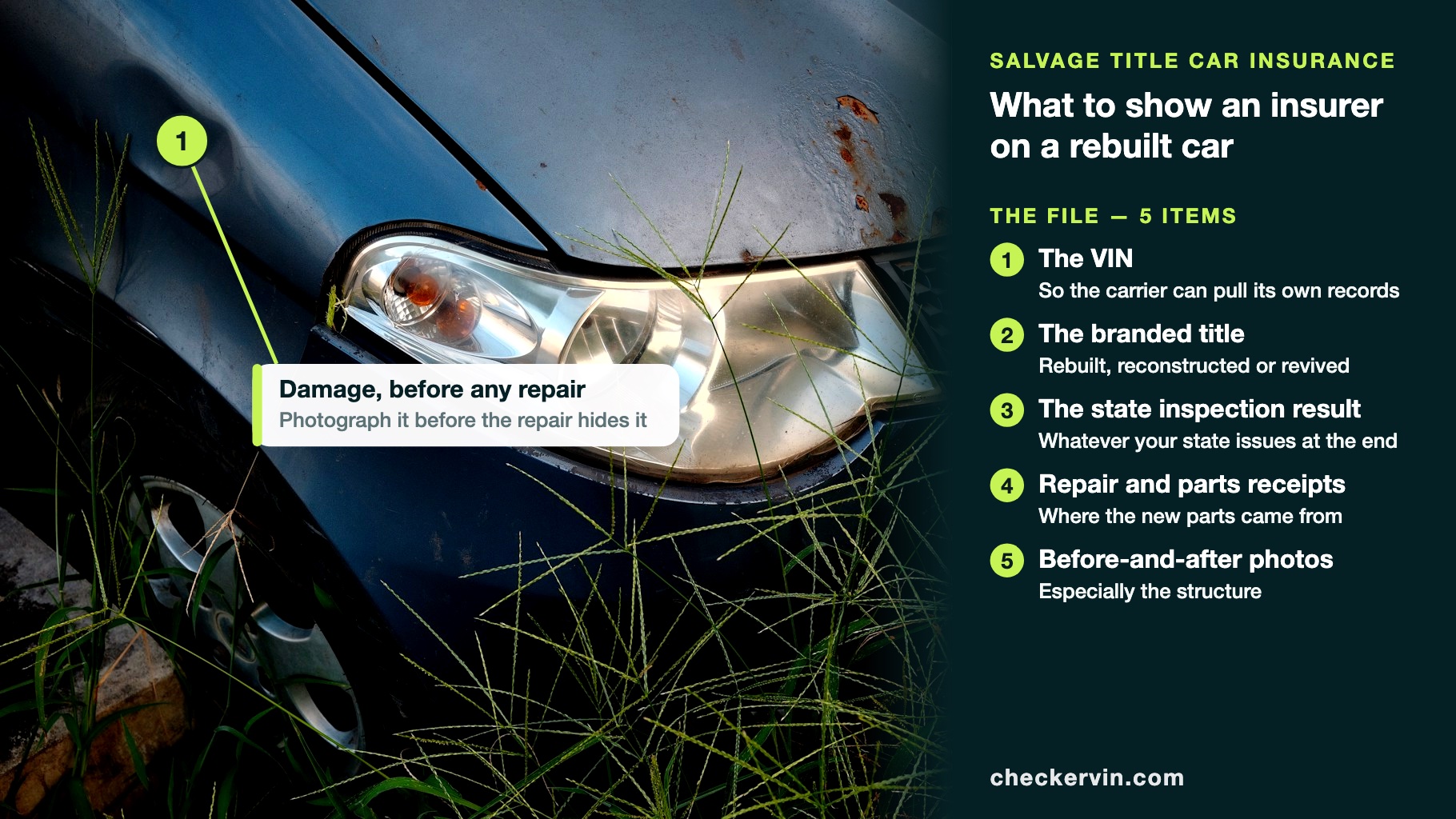
A carrier asked to insure a rebuilt car is being asked to trust a repair it never saw. Anything that shows what was wrong and how it was fixed shortens that leap. Not every carrier asks for all of this, but having it ready means the conversation turns on facts.
- The VIN, so the carrier can pull its own records on the car
- A copy of the rebuilt, reconstructed or revived salvage title showing the brand
- The state's inspection result, such as California's vehicle safety report or Nevada's certificate of inspection
- Repair receipts and bills of sale for parts, which California's DMV asks owners to bring when a CHP inspection is required
- Photos of the damage before repair and of the finished car, especially the structure
- An independent pre-purchase inspection report, if you are buying
The parts receipts do double duty. State rebuild processes, as our inspection guide shows, are largely about where the parts came from, not whether the car is safe. An insurer cares about both, and receipts are the only document that speaks to each.
What to ask before you bind a policy
The general shape of the coverage problem, where liability is easier to buy than cover for the car itself, is set out on our buying a rebuilt car page. What it leaves to you is the conversation with a specific carrier. These are the questions that decide whether a policy is worth having:
- Will you write collision and comprehensive on this VIN, or liability only?
- Do you need photos or an inspection before the policy starts, and who arranges it?
- How would you value this car in a total loss: actual cash value of a branded car, or something else?
- Is an agreed or stated value available, and what documentation would support it?
- Is any pre-existing damage excluded from future claims, and how is that recorded?
- Does the quote change if the rebuild paperwork or inspection report is missing?
- Will the answer still stand at renewal, or is it reviewed each term?
Get the answers by email, not over the phone. The answer you were given before the purchase is the one you will want to quote back if something goes wrong a year later.
What a claim pays later, and the New York rule
The common assumption is that a branded car is paid out at a fixed discount. New York addressed exactly that in 2000. The question put to its Insurance Department was whether an insurer could say it would pay only 50 percent of a car’s value in a total loss because the title read Rebuilt Salvage. The department’s Office of General Counsel answered that an insurer “may not pay a reduced amount in settlement of a vehicle damage claim simply on the basis of the fact that the title to the vehicle is branded as ‘Rebuilt Salvage.’”
The opinion grounds this in valuation. A property damage settlement, it said, is determined on the car’s fair market value “irrespective of the status of the vehicle’s title.” It traced the 50 percent idea to an agent’s misreading of a separate rule in New York’s Insurance Regulation 64, which has insurers withhold at least half of a total-loss payment until the title is handed over. That rule, the opinion said, has no effect on how much is paid.
Salvage or rebuilt: which is worse for insurance?
For insurance purposes, an unrepaired salvage title is worse, and it is not close. In the states we read, it means the car cannot be registered or driven, so there is no ordinary auto policy to buy for it. A rebuilt title means the car has passed whatever its state requires and can be registered, and the remaining problem is finding a willing carrier at a price that makes sense.
For the car itself, the comparison is less tidy. A rebuilt title tells you the repair was finished and the state process completed; it does not tell you the repair was good. Our rebuilt title explainer covers the comparison with a clean title, and the salvage certificate guide covers states that issue a certificate rather than a title for the wrecked stage.
Before you buy a branded car: get the insurance answer first
The Texas Department of Motor Vehicles, in its rebuilt-vehicle buying tips, puts the practical point plainly: “Often rebuilt vehicles are denied insurance. Check with your insurance agent before purchasing the vehicle.” Doing that well takes about four steps.
- 1Get the VIN and check it matchesDecode it and confirm it matches the title, the listing and the plate on the car. A mismatch ends the conversation before insurance comes up.
- 2Confirm the brand on the federal recordThe title in the seller's hand is one state's document. NMVTIS, the federal title system, holds the brand history across states. The Department of Justice lists 12 businesses approved to sell its reports to the public: Bumper, Carsforsale, CarVertical, CheckThatVIN, ClearVin, EpicVin, GoodCar, TitleCheck, VinAudit, VinData, VinReport, Vinsmart.
- 3Check open recallsCalifornia's safety inspection fails a revived salvage car with an open recall, and recall repairs are free at a dealer. Knowing about them up front avoids a failed inspection and a second visit.
- 4Get a written quote on that VINSend the carrier the VIN and the rebuild paperwork, and ask the questions above. Only then agree a price.
If the seller cannot or will not give you the VIN before you pay, that answers a different question. The brand types you might see, and what each means, are covered in what a branded title is.
What CheckerVIN shows today, and what it does not
We do not sell insurance, and we cannot tell you whether a carrier will write a given car. Insurance records are not public either, as our page on insurance lookup by VIN explains. What our free check does give you is the part of the pre-purchase work that comes from public data:
- Factory build and specifications decoded from the VIN
- Factory warranty terms
- Open NHTSA safety recalls
- Photos filed against the VIN
- Market and listing prices
The photos are worth a look on a rebuilt car. Images filed against the VIN, if any exist, can show the car as it looked before the repair, which is useful when you ask a carrier about the damage and when you brief a mechanic.
Decode the VIN and check open recalls free
Decoded from official manufacturer and NHTSA records
What we could not verify, and why no insurers are named
Most pages on this topic name carriers that will or will not insure rebuilt cars, and quote premium differences. We went to the insurers’ own explainer pages to check such claims at the source. In November 2026 those requests were refused, returned errors or hit pages under maintenance, and we did not try to get around that. So this page names no insurer and prints no premium figure. A list of carriers taken from a comparison site is a list of somebody else’s claims about those carriers, and eligibility rules change by state and by year.
Three regulator pages that describe how an owner-retained total loss is settled, from Texas, Washington and the national insurance commissioners’ association, also did not load for us. That is why the settlement point above is written as a question to ask, not as a rule. If you are in a dispute over a total-loss settlement, your state’s insurance department is the place to ask.
Where this information comes from
- Nevada DMV — Salvage VehiclesNo driving or registration on a salvage title; 65% definition; owner's 30-day deadline; VP 209; the $250 fine; retrieved November 26, 2026
- Texas DMV — Rebuilt VehiclesRebuilt Salvage brand, Prior Owner Retained brand, and the advice to check insurance before purchase
- Texas DMV — salvage vehicle sale noticeRequired sign text under Tex. Admin. Code §§ 221.50 and 221.51
- California Bureau of Automotive Repair — Safety systems inspectionsRevived salvage inspection, what it covers, common failures, rebuilder duties, and the salvage title DMV issues afterward
- California DMV — How to Reregister a Salvage (Total Loss) Vehicle (HTVR 13)CHP inspection, receipts and parts bills of sale, air bags, out-of-state inspections not recognized; revised October 2019
- Florida Statutes § 319.30Definition of total loss and the 72-hour title rule when the owner keeps the car
- Oregon DMV — Totaled Vehicles and Title BrandsRe-title even without repairs; Totaled and Reconstructed brands
- New York Insurance Department — OGC Opinion 00-02-13No reduced settlement simply because of a Rebuilt Salvage brand; February 28, 2000
- New York Insurance Department — OGC Opinion 00-02-07A total loss below the 75% line still goes to DMV for branding; February 16, 2000
- NMVTIS — approved data providers (DOJ / BJA)Businesses approved to sell federal title records to consumers; retrieved November 26, 2026
- How we made this pageWritten by the CarCheckerVIN editorial team with AI assistance from the state DMV, statute and insurance-regulator records listed above and the DOJ NMVTIS list; facts checked November 2026.
Keep reading
Frequently asked questions
Is it hard to insure a car with a salvaged title?
While the title still reads salvage and the car has not been rebuilt, there is usually nothing to insure for driving, because states such as Nevada and Texas bar a salvage-titled car from being registered or driven. After repairs, a state inspection and a rebuilt or reconstructed title, it becomes a question of finding a carrier. Texas's motor vehicle agency warns that rebuilt vehicles are often denied insurance and tells buyers to check with their agent before purchase.
Who will insure a salvage title?
For a car still carrying an unrepaired salvage brand, a normal auto policy for road use is not the realistic goal, because the car cannot be registered or driven in states like Nevada and Texas until it is rebuilt and inspected. Once it holds a rebuilt title, ask carriers directly with the VIN, the rebuilt title and the inspection paperwork in hand. We do not name insurers here: their own eligibility pages blocked our requests, so we could not verify any of them.
What is worse, a salvage title or a rebuilt title?
For insurance, an unrepaired salvage title is worse: in most states it means the car cannot be registered or driven at all, so there is no road policy to buy. A rebuilt title means the car was repaired and passed the state's process, and can be registered and insured, though often with fewer carriers willing. California is the odd one out in wording, because a revived salvage car there leaves the process with a title still branded salvage.
Can you get insurance on a salvage title car you are rebuilding?
You can generally insure it once it is rebuilt, inspected and retitled. While it is being repaired it cannot legally be driven in states like Nevada and Texas, so ask a carrier what, if anything, it will write on a parked car being rebuilt. In Nevada, cancel the old registration before you cancel the old policy: the DMV fines an active plate with no insurance, starting at $250.
Does a rebuilt title automatically cut an insurance payout?
Not automatically, at least in New York. A 2000 opinion from the state's Insurance Department said an insurer may not pay a reduced amount simply because the title is branded Rebuilt Salvage, and that a settlement turns on the car's fair market value irrespective of the title. That market value can still be lower for a branded car, so ask the carrier how it would value yours before you buy the policy.
Can I keep my car after the insurance company totals it?
Often, yes. California's Bureau of Automotive Repair says an owner may choose to keep and repair a car the insurer declared a total loss. The car then goes through the salvage process: in Nevada the owner who keeps it must apply for the salvage title within 30 days, and in Florida the title must go to the state within 72 hours. Ask the adjuster in writing how keeping the car changes the settlement.
Know the car before you ask for a quote
Decode any VIN free for the factory build, specifications and open safety recalls. Full vehicle history reports are launching soon.
Run a free VIN check