The short answer
- Do they all start with J?
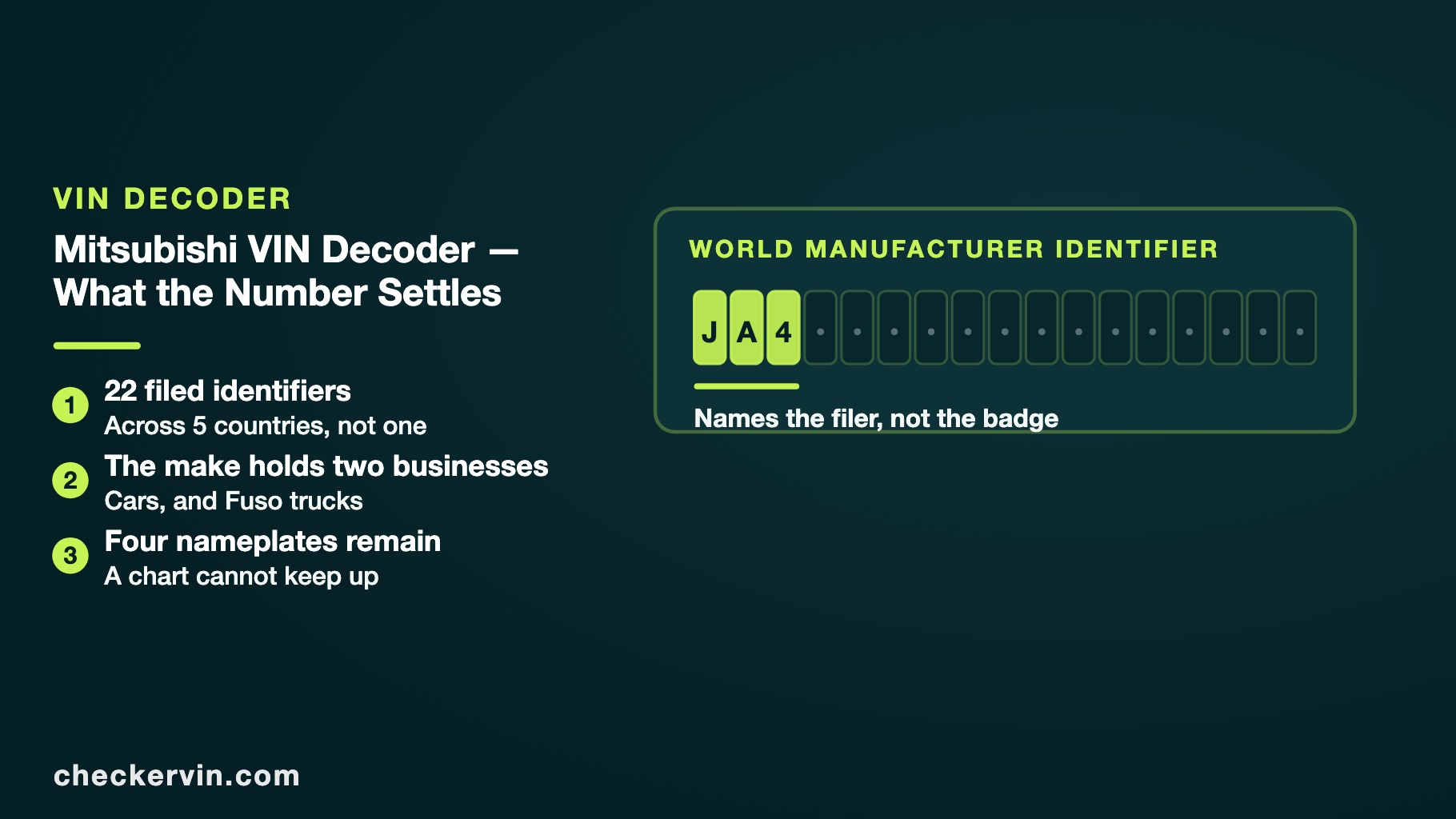
- No. The register holds 22 identifiers across 5 countries — Japan, the US, Thailand, Australia and Portugal.
- Why a truck code?
- Because the make covers Fuso as well as cars. In 2020, 21 of 28 filed models were commercial codes.
- How much does a decode give?
- Make, model, year, plant, body and engine — and nothing about what has happened to the car since.
22
Identifiers filed with NHTSA
Across 5 countries
21 of 28
Filed models that were truck codes in 2020
The make covers two businesses
4
Models filed for 2026
Down from a peak of 28
One make, two businesses — and the decoder shows both
Start here, because it explains most of what confuses people about this marque. The word Mitsubishi, as the federal vehicle database uses it, covers passenger cars and it covers commercial trucks, and the two have almost nothing to do with each other from a buyer’s point of view.
So a decode that comes back with a model name like FE84D has not failed. It has told you that the number belongs to the truck half of the name. That is genuinely useful information if you are looking at a box truck, and thoroughly confusing if you typed in what you believed was a compact car’s number and expected a nameplate.
What the federal database actually files under Mitsubishi
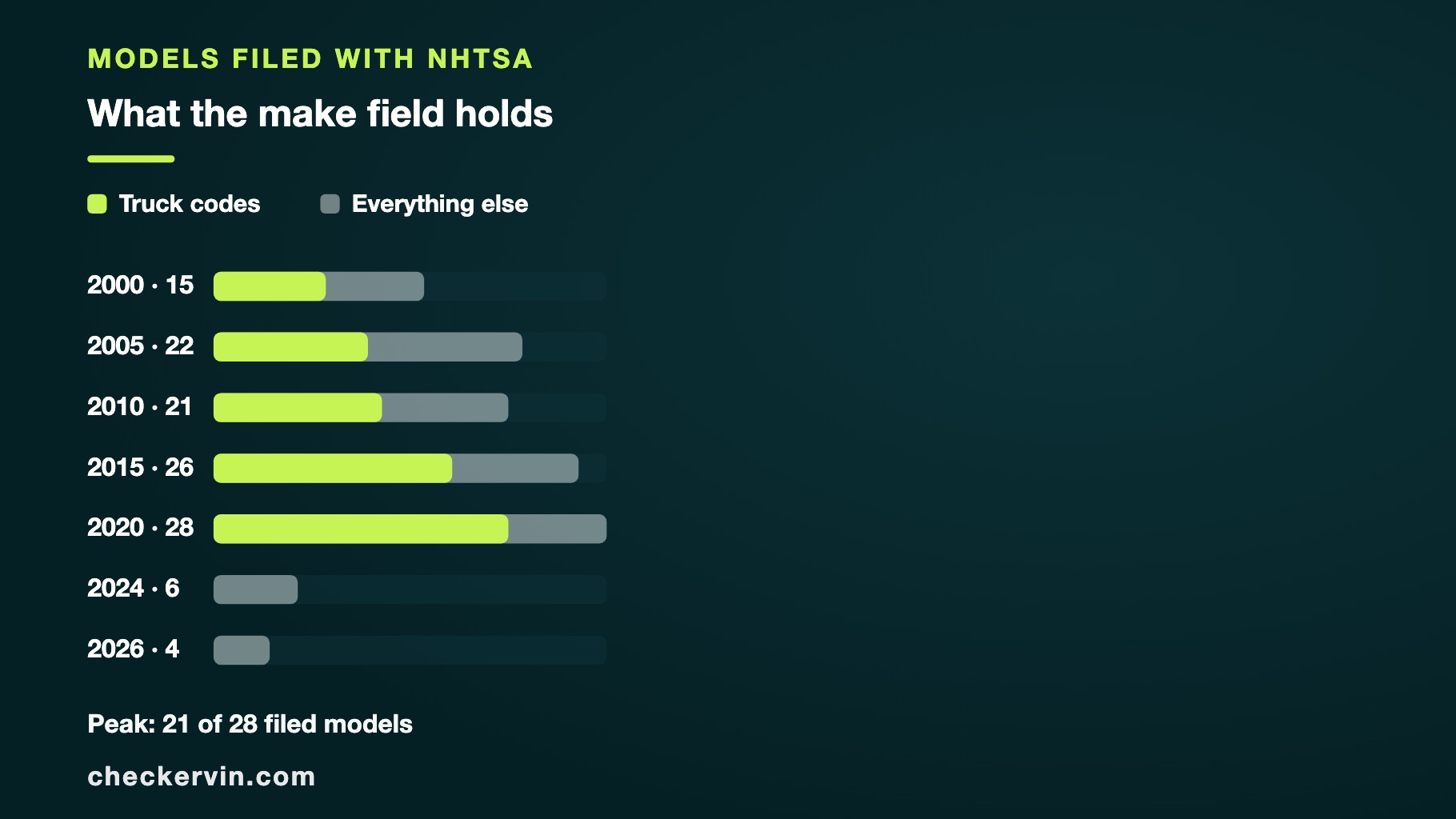
This is countable rather than arguable. Below is the model list NHTSA returns for the Mitsubishi make, by model year, split into the commercial code families — names beginning FE, FG, FH, FK, FM or FT — and everything else.
| Model year | Filed models — total, of which commercial codes |
|---|---|
| 2000 | 15 filed · 8 commercial · 7 other |
| 2005 | 22 filed · 11 commercial · 11 other |
| 2010 | 21 filed · 12 commercial · 9 other |
| 2015 | 26 filed · 17 commercial · 9 other |
| 2020 | 28 filed · 21 commercial · 7 other |
| 2024 | 6 filed · 0 commercial · 6 other |
| 2026 | 4 filed · 0 commercial · 4 other |
The shape is the finding. From 2000 through 2020 the commercial share climbs steadily until, in 2020, 21 of 28 filed models are truck codes. Then it stops: by 2026 the count is 4 models and zerocommercial codes. The truck business did not disappear — it is filed elsewhere, which the identifier register makes visible further down this page.
For anyone decoding an older Mitsubishi, the practical reading is that a model name you do not recognize is far more likely to be a truck than an error.
Down to four nameplates, and what that rules out
The passenger side has narrowed sharply. The current model year returns exactly these:
- Eclipse Cross
- Low Speed Vehicle
- Outlander
- Outlander Sport
Two of those are the same vehicle in two sizes, and one is a low-speed-vehicle entry rather than a car you would shop for. Mirage and Mirage G4 both appear in the 2024 list and are absent after it.
That has a direct decoding consequence. Because the tenth character of a VIN carries the model year, a Mitsubishi number whose tenth character resolves past 2024 cannotbe a Mirage — not as a matter of likelihood but as a matter of what was filed. If a listing claims otherwise, one of the two is wrong, and the number is the one with a federal filing behind it.
Check any VIN free
Decoded from official manufacturer and NHTSA records
The 22 identifiers, read out of the register
The first three characters of a VIN are the world manufacturer identifier, and manufacturers file theirs with NHTSA. Rather than reproduce a chart, here is the register’s own answer for this marque — every row it returns, with the entity and country attached to each.
| Identifier | Filed by, and where |
|---|---|
| JA3 | Mitsubishi Motors Corporation (MMC) · Passenger car · Japan |
| 4A3 | Mitsubishi Motors North America · Passenger car · United States |
| ML3 | Mitsubishi Motors Corporation (MMC) · Passenger car · Thailand |
| 6MM | Mitsubishi Motors Australia Ltd. · Passenger car · Australia |
| MP3 | Mitsubishi Motors (Thailand) Co Ltd · Passenger car · Thailand |
| JP3 | Mitsubishi Motors Corporation (MMC) · Passenger car · Japan |
| 4P3 | Mitsubishi Motors North America · Passenger car · United States |
| JP4 | Mitsubishi Motors Corporation (MMC) · Passenger car · Japan |
| JJ3 | Mitsubishi Motors Corporation (MMC) · Passenger car · Japan |
| JE4 | Mitsubishi Motors Corporation (MMC) · Passenger car · Japan |
| JA4 | Mitsubishi Motors Corporation (MMC) · MPV · Japan |
| 4A4 | Mitsubishi Motors North America · MPV · United States |
| JB4 | Mitsubishi Motors Corporation (MMC) · MPV · Japan |
| JA7 | Mitsubishi Motors Corporation (MMC) · Truck · Japan |
| JW7 | Mitsubishi Motors Corporation (MMC) · Truck · Japan |
| JB7 | Mitsubishi Motors Corporation (MMC) · Truck · Japan |
| JP7 | Mitsubishi Motors Corporation (MMC) · Truck · Japan |
| TYB | Mitsubishi Fuso Truck Europe S.A. · Truck · Portugal |
| JL6 | Mitsubishi Fuso Truck and Bus Corporation · Incomplete vehicle · Japan |
| JLS | Mitsubishi Fuso Truck and Bus Corporation · Incomplete vehicle · Japan |
| JL7 | Mitsubishi Fuso Truck and Bus Corporation · Incomplete vehicle · Japan |
| JW6 | Mitsubishi Motors Corporation (MMC) · Incomplete vehicle · Japan |
22 rows, 4 vehicle types and 5 countries. No printed decoder chart we have seen carries more than a handful of these, which is the whole argument for querying the register instead of memorizing prefixes.
Six companies, five countries
Read the middle column and a second structure appears. These identifiers are not filed by one company. They are filed by 6 distinct legal entities:
- Mitsubishi Motors Corporation (MMC)
- Mitsubishi Motors North America
- Mitsubishi Motors Australia Ltd.
- Mitsubishi Motors (Thailand) Co Ltd
- Mitsubishi Fuso Truck Europe S.A.
- Mitsubishi Fuso Truck and Bus Corporation
That is the answer to the most common assumption about this marque — that a Mitsubishi VIN starts with J. J marks Japan, and ten of the rows do begin with it. But the register also holds identifiers beginning 4 for the United States, M for Thailand, 6 for Australia and T for Portugal.
Why so many of them are Thai
Two of the 22rows are filed in Thailand — one by Mitsubishi Motors Corporation and one by Mitsubishi Motors (Thailand) Co Ltd, which are separate filings by separate entities for the same country.
For a decoding purpose the useful point is narrower than the industrial history. A Thai identifier is not a downgrade, a gray-market signal or an import irregularity. It is a plant location filed with the federal government, and a car carrying one was certified for this market like any other. Where country of build genuinely matters — parts availability, some recall logistics — the plant fields in a decode answer it directly. Our where was my car made page covers how to read those.
The incomplete-vehicle rows, and who they belong to
Four of the identifiers are filed against a vehicle type of incomplete vehicle, and three of those four are filed by Mitsubishi Fuso Truck and Bus Corporation rather than by Mitsubishi Motors.
An incomplete vehicle is one that leaves its manufacturer without a body — a chassis and cab that somebody else finishes as a box truck, a tow truck or a service body. It is a category federal rules treat separately, and it is a second, independent confirmation of the split this page opened with: the truck business has its own corporate name and its own identifiers in the same register.
If you are decoding a commercial Mitsubishi, the completed body is not the manufacturer the VIN names. Our page on the incomplete vehicle document explains what paperwork the second manufacturer is required to produce.
Two identifiers that come back Chrysler
Here is a result worth knowing before it surprises you. Two identifiers commonly associated with Mitsubishi-era cars — JE3 and 4B3— do not appear in Mitsubishi’s register entry at all. Decoded individually, both come back with a manufacturer common name of Chrysler.
We are reporting what the federal decoder returns rather than reconstructing the corporate history behind it. The practical consequence is what matters: if you decode an older car you believe to be a Mitsubishi and the tool names a different company, that is not necessarily an error in the tool. The identifier was filed by whoever filed it, and the register answers accordingly. Our Chrysler VIN decodercovers that marque’s own numbering.
Eight characters is enough for more than you would think
A common situation: you have a listing photograph where the VIN is half legible, or a seller has sent you the first part of the number. The federal decoder accepts an incomplete VIN with a wildcard, and it gives back more than you might expect.
We ran JA4J4UA8*— eight characters and a wildcard, nothing more. Here is what came back:
| Field | Returned for JA4J4UA8* |
|---|---|
| Make | MITSUBISHI |
| Model | Outlander |
| Manufacturer | MITSUBISHI MOTORS CORPORATION (MMC) |
| Vehicle type | MULTIPURPOSE PASSENGER VEHICLE (MPV) |
44 populated fields out of 154, with the response flagged as an incomplete VIN rather than quietly guessing the rest. That behavior is the useful part: it tells you what it knows and marks what it does not, which is the opposite of what a chart does when you feed it a partial number.
What a partial cannot give you is anything downstream of the characters you are missing — the model year in position ten, the plant in position eleven, and the serial. So it is a way to confirm you are looking at the vehicle the advertisement claims, not a substitute for the full number.
What the year character rules out
Position ten of any VIN carries the model year, and on this marque it does more work than usual because the lineup has changed so much. Set the census against it and the number starts eliminating possibilities on its own.
| If position ten resolves to | What the filings allow |
|---|---|
| Roughly 2000 to 2020 | Cars and a growing majority of commercial codes — a truck result is likely, not an error |
| 2024 | Six filed models, including Mirage and Mirage G4 |
| After 2024 | Four filed models — Eclipse Cross, Low Speed Vehicle, Outlander and a low-speed entry. No Mirage |
None of this is a substitute for reading the whole number, and the year character is famously the one people misread. If you want the mechanics of it, including the letters a VIN never uses, how to read a VIN covers the full seventeen positions.
What a free decode returns, and what it does not
Worth being exact, because the phrase “VIN check” is used for two completely different things and only one of them is what a decoder does.
| Question | Answered by a decode? |
|---|---|
| What did the factory build? | Yes — make, model, year, body, engine, plant, vehicle type |
| Which company filed the identifier? | Yes — that is what the register holds |
| Are there open safety recalls? | Yes — campaigns are matched to the VIN |
| Has it been in a collision? | No — that is a history record, not a build record |
| Is the title branded? | No |
| Is the mileage genuine? | No |
The check that costs nothing and is worth the most
Of everything a free decode gives you on a used Mitsubishi, the open-recall result is the one with money attached. A recall remedy is performed at no charge, without regard to how old the car is, how many owners it has had, or whether you were the one who bought it new.
An open campaign on a car you are considering is therefore unfinished free work attached to the vehicle rather than a reason to walk away — though it is a fair question to put to a seller who has had the car for years. Our page on buying a car with an open recall covers how to handle it in a negotiation.
Buying a used Mitsubishi: what the number is good for
Putting the above into an order that costs nothing until the last step.
- 1Decode the number from the car, not the advertisementRead it off the windshield base and the door-opening label, and compare the two. Advertisements carry typos; the vehicle does not.
- 2Check the identifier against the registerIt names the filing entity and the country of build. If the decode names a company you did not expect, that is information rather than a fault.
- 3Read the vehicle typePassenger car, MPV, truck or incomplete vehicle. On this marque that field does real work, and it is the fastest way to know which half of the business you are in.
- 4Check the year character against the lineupThe filings narrow sharply after 2024. A nameplate that does not exist in that model year is a discrepancy worth resolving before anything else.
- 5Run the recallsFree, and the remedy is free. Do it before you discuss price rather than after.
- 6Then buy the historyThe build record cannot tell you about collisions, brands or mileage. That is a separate search and it is the one worth paying for.
Where this information comes from
- NHTSA vPIC — WMIs filed by manufacturerThe 22 identifiers, entities, vehicle types and countries reproduced above
- NHTSA vPIC — models filed by make and model yearSource of the per-year census; change the year in the URL to reproduce it
- NHTSA vPIC — VIN decoding APIThe full and partial decodes used on this page
- 49 CFR Part 565 — Vehicle identification number requirementsThe rule behind the seventeen positions and the manufacturer identifier
Frequently asked questions
How do I decode a Mitsubishi VIN?
Put the whole seventeen characters into a decoder that queries the federal database rather than a static chart. The first three characters are the identifier the manufacturer filed with NHTSA, and for Mitsubishi there are twenty-two of them across five countries and four vehicle types — which is more variation than any printed chart carries. The decode returns the make, the model, the manufacturing entity and the vehicle type directly from that filing.
Why does my Mitsubishi VIN decode to a truck model code?
Because it probably is one. For two decades the majority of the models filed under the Mitsubishi make were commercial codes beginning FE, FG, FK or FM — Fuso trucks — rather than passenger cars. In model year 2020 that was 21 of 28 filed models. A decode returning something like FE84D is not a broken lookup; it is the other half of the business the name covers.
Do Mitsubishi VINs always start with J?
No, and assuming so is the most common error on this marque. J marks Japan, but the register also holds identifiers beginning 4 for the United States, M for Thailand, 6 for Australia and T for Portugal. A Mitsubishi built in Thailand starts ML or MP and is no less a Mitsubishi than one starting JA.
What Mitsubishi models are still sold in the US?
Four nameplates appear in the federal filings for the current model year: Eclipse Cross, Outlander, Outlander Sport, and a low-speed-vehicle entry. Mirage and Mirage G4 are in the 2024 list and gone after it, which means a Mitsubishi VIN reading a later model year in position ten cannot be a Mirage.
Can I decode a partial Mitsubishi VIN?
Partially, and further than most people expect. The federal decoder accepts an incomplete number with a wildcard, and eight characters was enough in our test to return the make, the model, the manufacturing company and the vehicle type — 44 populated fields out of 154. It flags the number as incomplete rather than guessing the rest, which is the honest behavior. It is genuinely useful when you are working from a blurred photograph in a listing.
Is a VIN decode the same as a history check?
No. A decode reads what the manufacturer built into the number and filed with the federal government — make, model, year, plant, body type, engine. It says nothing about what has happened to the car since it left the line: no accidents, no title brands, no odometer record, no theft record. Those live in different systems and are a separate search.
Where is the VIN on a Mitsubishi?
In the same places federal rule requires on any passenger car sold here — visible through the base of the windshield on the driver's side, and on the certification label in the driver's door opening. Check both and compare them character by character, because a mismatch between the two is a signal worth stopping on rather than a clerical curiosity.
Keep reading
Decode a Mitsubishi VIN free
Factory build, specifications and open safety recalls, read straight from the federal database.
Run a free VIN check