The short answer
- Does the MLA cap my car loan?
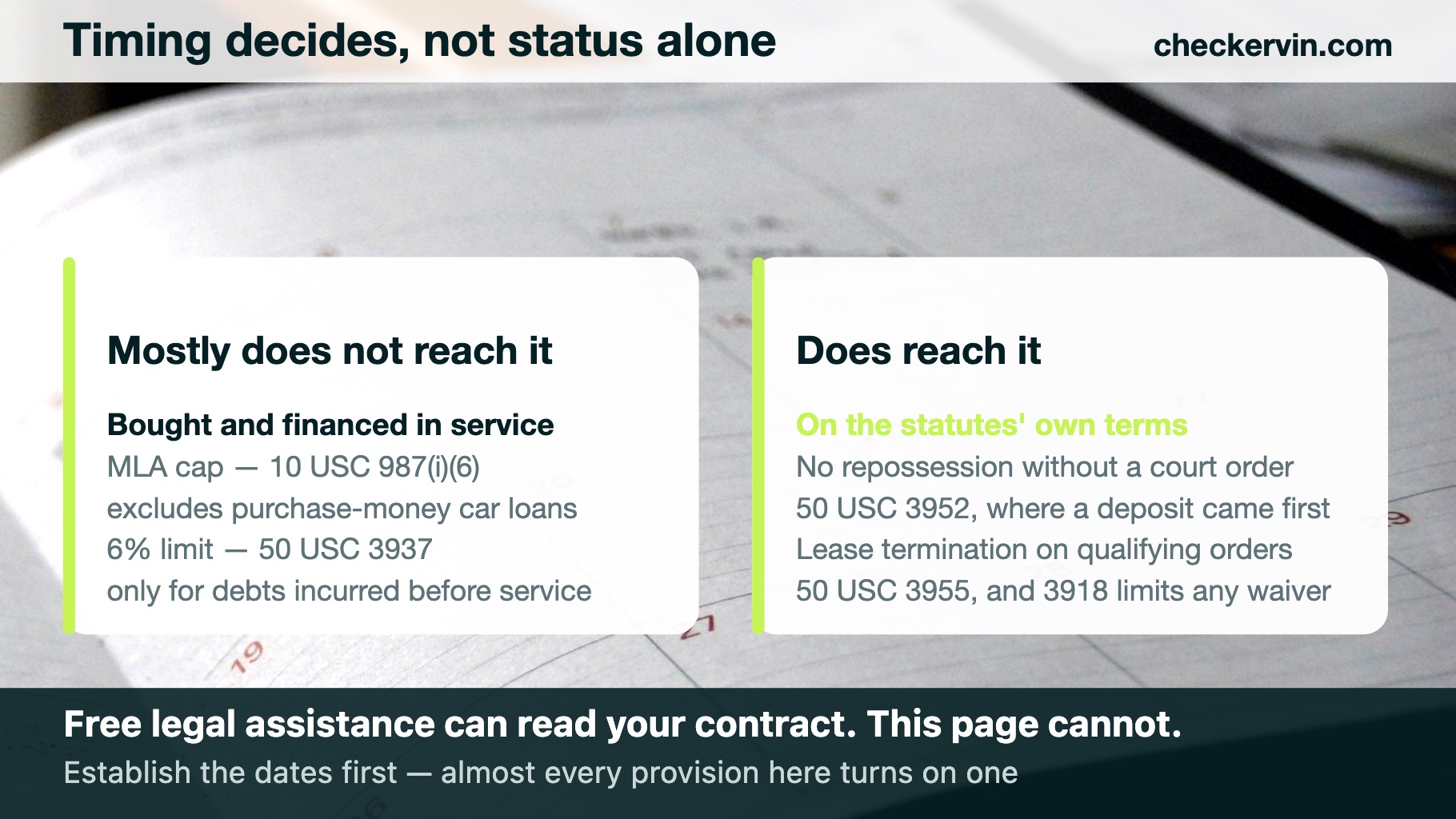
- Generally no. 10 U.S.C. 987 excludes a loan taken to buy a car when it is for that purchase and secured by the car.
- Does the 6 percent cap apply?
- Only to obligations incurred before you entered service. A loan signed while serving is not covered by it.
- So what does protect me?
- Repossession needs a court order where a deposit or installment was paid before service, and qualifying orders can end a vehicle lease.
Excluded
Purchase-money car loans, under the MLA
10 U.S.C. 987(i)(6), in terms
Before
When the 6 percent debt must be incurred
50 U.S.C. 3937 — the date governs
Court order
What repossession requires
50 U.S.C. 3952, and violating it is an offense
Free
Our VIN check, and your legal assistance office
Use both before you sign

The two everybody names, and why they mostly do not apply
Start here, because getting it wrong in this direction is expensive. The two protections most often cited to servicemembers buying cars are the Military Lending Act’s cap on the cost of credit, and the Servicemembers Civil Relief Act’s 6 percent interest limit. Each is real. Neither, read as written, covers the ordinary case of buying and financing a car while you are serving.
| Protection | Why it may not reach your car loan |
|---|---|
| Military Lending Act cap | The Act's definition of consumer credit excludes purchase-money vehicle loans |
| SCRA 6 percent interest limit | It applies to obligations incurred before entering military service |
| SCRA repossession protection | This one does reach cars — with a condition, covered below |
| SCRA vehicle lease termination | This one does too, on qualifying orders |
The Military Lending Act exclusion, in terms
The Act works by defining what counts as consumer credit for its purposes, and then regulating that. The definition is at 10 U.S.C. 987, and it carves two things out expressly.
Consumer credit, the section says, has the meaning provided in regulations prescribed under it, except that such term does not include (A) a residential mortgage, or (B) a loan procured in the course of purchasing a car or other personal property, when that loan is offered for the express purpose of financing the purchase and is secured by the car or personal property procured.
That is an ordinary car loan described exactly: taken to buy the car, and secured by the car. The exclusion is not an oversight or a gap someone forgot to close — it is written into the statute’s own definition.
| Credit | Inside the MLA definition? |
|---|---|
| A loan to buy a car, secured by that car | Excluded by 10 U.S.C. 987(i)(6)(B) |
| A residential mortgage | Excluded by 10 U.S.C. 987(i)(6)(A) |
| Other consumer credit as defined by regulation | Inside, subject to those regulations |
The 6 percent cap, and the date that governs it
The SCRA rate limit is real and it is generous, and its scope is fixed by a single word. Under 50 U.S.C. 3937, an obligation or liability bearing interest above 6 percent per year that is incurred by a servicemember, or by the servicemember and their spouse jointly, before the servicemember enters military service, shall not bear interest above 6 percent.
Before. The provision is a relief measure for debts you brought with you into service, not a rate cap on credit you take out while serving. A car financed at the dealership last month, while you are already in uniform, is not an obligation incurred before you entered service.
| When the obligation was incurred | Reached by 50 U.S.C. 3937? |
|---|---|
| Before entering military service | Yes — that is the provision's subject |
| Jointly with a spouse, before service | Yes — the section names joint obligations |
| While already in military service | No |
The relief also runs for a defined period rather than forever, and the period differs depending on the kind of obligation. That detail is in the section itself, and it is worth reading alongside a legal assistance attorney rather than from a summary, because the answer for a specific debt depends on facts a page cannot see.
The 6 percent cap is not automatic
Here is the part that catches people, and it is the difference between having a right and receiving its benefit. The rate limitation does not apply itself. The servicemember has to ask for it, in a specific way.
Section 3937 sets out how. In order for an obligation to be subject to the interest rate limitation, the servicemember shall provide to the creditor written notice and a copy of the military orders calling the servicemember to military service, along with any orders further extending that service. And there is a deadline attached: the notice is to be provided not later than 180 days after the date of the servicemember’s termination or release from military service.
| What is needed | Why it matters |
|---|---|
| Written notice to the creditor | The relief is claimed, not conferred |
| A copy of the orders calling you to service | The creditor is entitled to see the basis |
| Any orders extending the service period | The section names these specifically |
| Within 180 days of release from service | A deadline that runs after service, not during it |
The section also carries a criminal penalty for the other direction: whoever knowingly violates the rate limitation shall be fined as provided in title 18, imprisoned for not more than one year, or both. That is the second of two criminal provisions on this page, which is unusual density for consumer law.
Repossession requires a court order
This is the provision that genuinely and specifically covers cars, and it names them. Under 50 U.S.C. 3952, after a servicemember enters military service, a contract by the servicemember for the purchase of real or personal property (including a motor vehicle), or for the lease or bailment of such property, may not be rescinded or terminated for a breach of terms occurring before or during that person’s military service, nor may the property be repossessed for such breach without a court order.
Read what that displaces. Repossession of a vehicle in most of the country is ordinarily a self-help remedy: the lender takes the car without going to court at all. This section removes that, in the situation it covers, and puts a judge in the middle.
So the shape of this protection mirrors the 6 percent cap: it is built around obligations that straddle your entry into service. Both provisions are relief for the person whose circumstances changed, rather than general regulation of the car market.
And ignoring it is a crime, not just a breach
Consumer statutes usually end in damages. This one does not stop there. Under the same section, a person who knowingly resumes possession of property in violation of that subsection shall be fined as provided in title 18, or imprisoned for not more than one year, or both.
That is worth knowing for two reasons. It tells you how seriously the provision is meant to be taken, and it tells you that a lender who is properly advised has a strong incentive to go to court rather than send a truck.
It is not, however, something to act on yourself. If a vehicle covered by that section has been repossessed without a court order, the step is a legal assistance attorney, promptly — not a confrontation.
Terminating a motor vehicle lease
Leases have their own provision at 50 U.S.C. 3955, and it covers a lease of a motor vehicle used or intended to be used by a servicemember or their dependents for personal or business transportation. Two routes qualify.
- 1The lease came first, then the serviceWhere the lease is executed by or on behalf of a person who thereafter and during the lease term enters military service under a call or order specifying a period of not less than 180 days — or who enters under a call or order of 180 days or less and, without a break in service, receives orders extending it to not less than 180 days.
- 2The service came first, then the ordersWhere the servicemember executes the lease while in military service and thereafter receives qualifying military orders. One limb covers orders issued in response to a local, national or global emergency, effective for an indefinite period or for a period of not less than 30 days, that prevent the servicemember or their dependents from using the vehicle for personal or business transportation.
The 180-day figure in the first route is the statute’s own, and it is the kind of number worth checking against your actual orders rather than remembering approximately.
How a termination is actually made
The statute specifies the mechanics rather than leaving them to the lessor’s preference. Termination is made by delivery by the lessee of written notice of termination, and a copy of the orders, by the methods the section lists — which include depositing the written notice in the United States mails, and electronic means reasonably calculated to ensure actual receipt.
- Written notice of termination, from the lessee
- A copy of the military orders that qualify it
- Delivered by a method the section recognizes
- Keep proof of what you sent and when you sent it
- Read the section for the effective date rules rather than assuming immediacy
How a waiver has to be done, if it is done at all
A servicemember may waive these rights. The statute says so plainly, and then makes the waiver hard to obtain by accident, which is the interesting part for anyone signing dealership paperwork.
Under 50 U.S.C. 3918, a servicemember may waive any of the rights and protections provided by the chapter. But a waiver applying to the actions the section lists is effective only if it is in writing and is executed as an instrument separate from the obligation or liability to which it applies. And where the waiver permits one of those actions, it is effective only if made pursuant to a written agreement executed during or after the servicemember’s period of military service.
The listed actions include the modification, termination or cancellation of a contract, lease or bailment, and they include repossession. So a clause buried in a finance contract is not the way a servicemember gives up the repossession protection.
| A waiver must be | Which rules out |
|---|---|
| In writing | Anything agreed verbally at the desk |
| A separate instrument from the obligation | A clause inside the finance contract |
| Executed during or after military service | Something signed before you served |
What applies to you as a buyer anyway
Nothing on this page displaces the ordinary consumer protections. Those apply to a servicemember exactly as they apply to anyone else, and in the practical business of buying a car they do more work than the statutes above.
| Protection | What it does |
|---|---|
| The FTC Used Car Rule | The Buyers Guide, and the acts a dealer may not commit whatever box is ticked |
| FCRA notices at the finance desk | What you must be told when your report is used to price you |
| The Credit Practices Rule | The separate notice a cosigner is owed before being obligated |
| Truth in Lending disclosures | What the finance contract itself has to state |
The order of operations is therefore the same for everyone. Check the car, read the Buyers Guide, read the finance paperwork, and use the status-based provisions above only where they actually bite.
Why this market needs the rules at all
It is worth being straightforward about why a body of law exists here. A concentration of young buyers with steady, verifiable pay and limited credit history, arriving in an unfamiliar area on a schedule they do not control, is a commercially attractive audience. The trade around installations reflects that, and the statutes above were written against that background.
That is a statement about incentives rather than an accusation against any dealer. Plenty of them do a straight job. But a buyer who understands why the protections were written is better placed than one who assumes goodwill, and the practical advice that follows is not suspicion — it is reading the paperwork and using the free legal help you already have.
Before you sign
- 1Take the paperwork to legal assistance firstIt is free to those eligible, the attorneys see these contracts constantly, and reviewing a deal before signature is far easier than unwinding one afterward.
- 2Do not rely on a protection you have not checkedThe two most-cited ones may not reach a purchase made during service. Knowing which provision you are actually relying on is the whole point of this page.
- 3Read the Buyers Guide and the finance contractThese apply to you like anyone else and they are where most disputes actually live. Get any promise written onto the form rather than said aloud.
- 4Check the vehicle, freeDecode the VIN for the factory build and specifications, and check open safety recalls, before any of the paperwork matters.
- 5Think about orders before you sign a leaseThe termination provisions are good but conditional. If a move is foreseeable, understand which route would apply to you before rather than after.
If something has already gone wrong
Go to your installation’s legal assistance office. That is not a formality in this answer; it is the correct step, it costs nothing to those eligible, and the statutes above are ones those attorneys apply routinely.
- Gather the contract, the Buyers Guide, and every notice you were handed
- Establish the dates — when the obligation was incurred, and when service began
- Find your orders, because several provisions turn on what they say
- Write down what happened and when, while you remember it
- Do not act on the criminal provision yourself — that is for a lawyer to assess
The dates matter more than anything else in that list. Almost every provision on this page turns on when an obligation arose relative to entry into service, which means an established timeline is the most useful thing you can bring to the conversation.
What this page is not
It is not legal advice. It sets out what four statutory provisions say, and the questions that decide any real case — your dates, your orders, your contract, your state — are exactly the ones a national page cannot answer. You have access to free legal assistance that can, which is a better resource than anything written here.
It also does not cover the whole of either statute. The SCRA and the Military Lending Act are broad, and this page deliberately addresses only the provisions that reach a vehicle purchase or lease.
What we can do is the vehicle half. Our free check returns the factory build, the specifications and open safety recalls from the VIN, at no cost and with no account. It does not return accident, title, odometer or theft history, and it has nothing to say about your contract.
Where this information comes from
- 10 U.S.C. 987 — terms of consumer credit extended to members and dependentsSubsection (i)(6) excludes from consumer credit a loan procured in the course of purchasing a car when it finances that purchase and is secured by the car
- 50 U.S.C. 3937 — interest rate limitationThe 6 percent limit on obligations incurred before the servicemember enters military service
- 50 U.S.C. 3952 — protection under installment contracts for purchase or leaseNo repossession of property including a motor vehicle without a court order; applies where a deposit or installment was paid before service; knowing violation is an offense
- 50 U.S.C. 3955 — termination of residential or motor vehicle leasesThe qualifying routes for terminating a motor vehicle lease, and the written notice and copy of orders that effect it
Keep reading
Frequently asked questions
Does the Military Lending Act cover a car loan?
Generally not. 10 U.S.C. 987 defines consumer credit for the Act and expressly excludes a loan procured in the course of purchasing a car or other personal property, when that loan is offered for the express purpose of financing the purchase and is secured by the car procured. Ordinary purchase-money auto financing therefore sits outside the Act's protections.
Does the 6 percent interest cap apply to my car loan?
Only if you took the loan out before entering military service. 50 U.S.C. 3937 limits interest to 6 percent on an obligation incurred by a servicemember, or jointly with a spouse, before the servicemember enters military service. A loan signed while you are already serving is not covered by it.
Can my car be repossessed while I am serving?
Not without a court order, in the situation the statute covers. Under 50 U.S.C. 3952, after a servicemember enters military service a contract for the purchase of personal property including a motor vehicle may not be rescinded or terminated for a breach occurring before or during service, nor may the property be repossessed for such breach without a court order.
Does that repossession protection cover every car loan?
No, and the limit is specific. The section applies only to a contract for which a deposit or installment was paid by the servicemember before entering military service. A vehicle bought entirely while serving is outside it.
What happens if a lender repossesses anyway?
The statute makes it an offense. A person who knowingly resumes possession of property in violation of that subsection shall be fined as provided in title 18, or imprisoned for not more than one year, or both. It is one of the few consumer provisions with a criminal penalty attached.
Can I get out of a car lease when I get orders?
Often yes. 50 U.S.C. 3955 lets a lessee terminate a motor vehicle lease where the lease was signed before entering service under a call or order of not less than 180 days, or where the lease was signed during service and qualifying orders follow. Termination is made by written notice with a copy of the orders.
Do I have to tell the lender to get the 6 percent rate?
Yes. Section 3937 says that in order for an obligation to be subject to the limitation the servicemember shall provide the creditor with written notice and a copy of the orders calling them to service, together with any orders extending it, and sets a deadline of not later than 180 days after termination or release from service. The relief is claimed, not conferred automatically.
Can a dealer put an SCRA waiver in the finance contract?
Not effectively, for the listed actions. Under 50 U.S.C. 3918 a waiver covering those actions — which include repossession, and the modification, termination or cancellation of a contract or lease — is effective only if it is in writing and executed as an instrument separate from the obligation it applies to, and, where it permits such an action, only under a written agreement executed during or after the period of military service.
Where should I get help with a specific contract?
Your installation's legal assistance office. Advice there is free to those eligible, the attorneys deal with these statutes constantly, and a page on the internet cannot read your paperwork. Go there before you sign if you can, and immediately if something has already gone wrong.
Do the ordinary consumer protections still apply to me?
Yes, all of them. The Buyers Guide rules, the federal notices a credit pull triggers, and the cosigner notice apply to servicemembers exactly as they do to anyone else. The statutes on this page sit on top of those rather than replacing them.
Check the car before the paperwork matters
Decode any 17-character VIN free for the factory build, specifications and open safety recalls. No account required.
Run a free VIN check