The short answer
- Is the paint code in the VIN?
- No. The 17 characters encode manufacturer, model, body, engine, restraint system, model year, plant and a serial number — not color. The paint code is on a separate label attached to the vehicle, and in the factory build record the VIN points to.
- Where do I find it?
- Check the driver's door jamb label first, which is where most manufacturers put it. Then the firewall or strut tower under the hood, the glove box, and the trunk beneath the spare wheel.
- How do I get it if the label is missing?
- A dealer parts department can retrieve it from the factory build record using your VIN. That is the reliable route, and it is why the phrase 'paint code by VIN' works in practice even though the VIN itself carries no color information.
No
The VIN does not encode color
It unlocks the record that does
Door
Where most makes put it
Driver's side jamb label
Two
Codes on many vehicles
Base coat and clear coat
Blend
How shops match aged paint
Not painting to the panel edge
The VIN does not contain your paint code
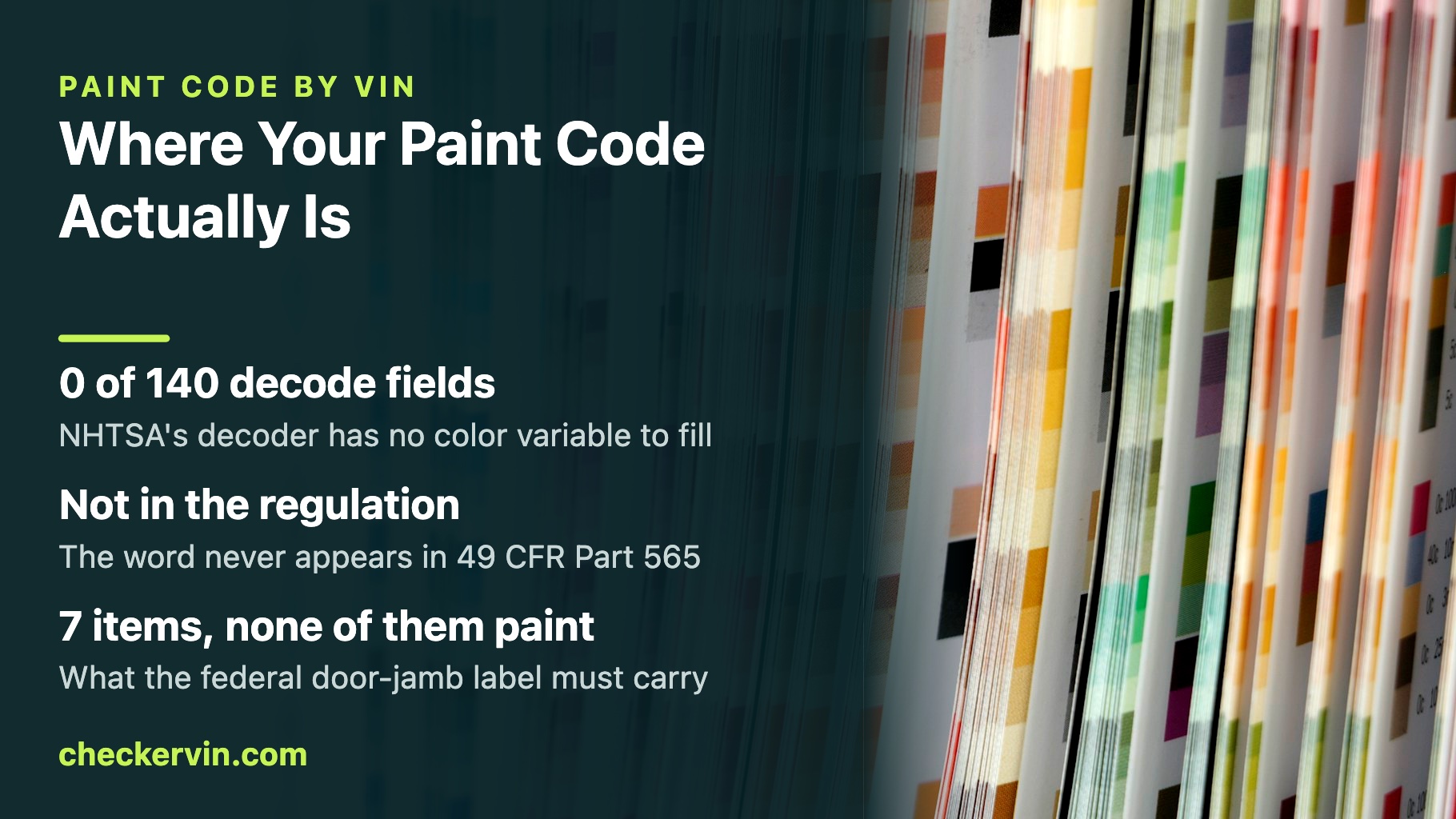
Worth stating plainly, because a lot of effort gets wasted on this. The seventeen characters of a VIN are allocated to manufacturer, vehicle description, a check digit, model year, assembly plant and a sequential serial number. There is no position for color.
What makes “paint code by VIN” a workable phrase is indirect: the VIN identifies the vehicle uniquely, and the manufacturer's build record for that vehicle does contain the color. A dealer, a decoder with build-record access, or the label on the car itself will give you the code. Reading the VIN characters will not.
That is assertable, but it is also provable, and the proof is worth having because every other page on this subject either states it flatly or hedges it. Federal rule sets out what the seventeen characters have to carry. 49 CFR § 565.15(b) requires the descriptor section — positions four through eight — to make a specific list of attributes decipherable, and the regulation prints that list as a table by vehicle type.
| Vehicle type | What the descriptor section must make decipherable |
|---|---|
| Passenger car | Make, line, series, body type, engine type, and all restraint devices and their location |
| Multipurpose passenger vehicle | The same, plus gross vehicle weight rating |
| Truck | Make, model or line, series, chassis, cab type, engine type, brake system, gross vehicle weight rating |
| Motorcycle | Make, type of motorcycle, line, engine type, and net brake horsepower |
Read the rows and notice what is missing from all of them. There is no color entry because there is no requirement to encode one — and the word does not appear anywhere in Part 565 at all. The regulation that governs what a VIN means never mentions paint. A manufacturer is free to spend one of its five discretionary characters on something else entirely, and they do: those five are where model line, body and engine live.
The empirical half agrees. NHTSA’s own decoder returns a fixed schema of 140 variablesfor any VIN you give it — make, model, year, body class, cylinders, displacement, fuel type, drive type, cab type, brake system, air bag locations, plant city, plant state, plant country and so on. Not one of the 140 is a color or paint field. It is not that the value comes back empty; there is no such variable to be empty.
Where the paint code label actually is
- 1The driver's door jambOpen the driver's door and read the label on the frame or the door edge. This is the most common location across the industry, and it is where to look first on almost any vehicle.
- 2Under the hoodThe firewall at the back of the engine bay, the strut towers, or the radiator support at the front. Several European makes favor these positions.
- 3The glove boxSome manufacturers place the full build and option label here, with the paint code among the other codes.
- 4The trunkUnder the trunk floor mat, beneath the spare wheel, or on the underside of the trunk lid.
- 5The center consoleLess common, but some trucks and SUVs place the option label inside the console lid.
Why the location varies by manufacturer at all
There is a reason the next section has to be a list by make rather than one instruction, and it is the same reason the VIN does not carry the code. Nothing requires the paint code to exist in any particular place, or at all.
Compare it with the label people confuse it with. Every vehicle sold here carries a federal certification label under 49 CFR Part 567, and that label’s contents are specified item by item: the manufacturer’s name preceded by “Manufactured By”, the month and year of manufacture, gross vehicle weight rating, gross axle weight ratings, a statement that the vehicle conforms to the applicable federal motor vehicle safety standards, the vehicle identification number, and the type classification. The rule even specifies the lettering height and that it must contrast with its background.
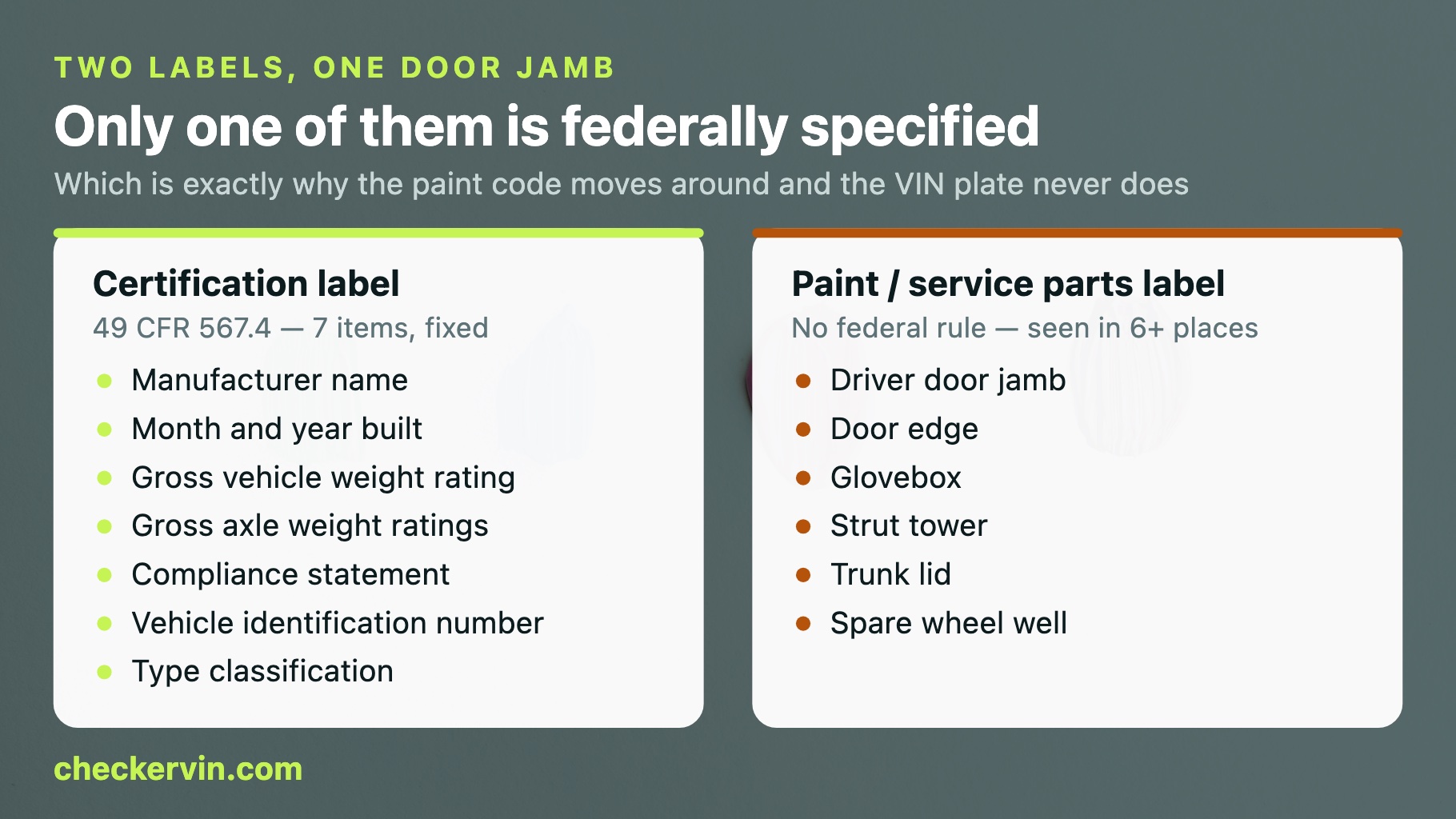
| Label on the door jamb | Who decides what is on it |
|---|---|
| Certification label — Part 567 | Federal rule, item by item, down to lettering height |
| Service parts / paint label | The manufacturer, entirely — no federal content or placement rule |
Paint appears nowhere in that specified list. So the sticker carrying your color code is a manufacturer’s own document, produced for its own dealer network, and it can sit on the door jamb, the door edge, the glovebox, the strut tower, the trunk lid or the spare wheel well depending on who built the car and when. Two vehicles from the same maker a decade apart can carry it in different places, because nothing external ever fixed it.
Typical location by manufacturer
Manufacturers are reasonably consistent within their own ranges. Use this as a starting point rather than a guarantee, since positions do change across generations.
| Make | Where to look |
|---|---|
| Ford, Lincoln | Driver's door jamb label, with the code alongside the exterior paint designation |
| Chevrolet, GMC, Buick, Cadillac | The Service Parts Identification label — glove box, trunk, or console — among the RPO codes |
| Toyota, Lexus | Driver's door jamb, on the line carrying color and trim identifiers |
| Honda, Acura | Driver's door jamb label |
| Jeep, Ram, Chrysler, Dodge | Driver's door jamb, or a label under the hood |
| Nissan, Infiniti | Driver's door jamb, or on the firewall in the engine bay |
| Subaru | Driver's door jamb, or the strut tower under the hood |
| Volkswagen, Audi | Frequently in the trunk — the spare wheel well or the trunk lid underside |
| BMW, Mini | Under the hood, commonly on a strut tower |
| Mercedes-Benz | Under the hood on the radiator support, or the driver's door jamb |
| Hyundai, Kia | Driver's door jamb label |
Reading the code once you find it
Paint codes are short — typically two to four characters, sometimes with a letter prefix — and they sit among a crowd of other codes for trim, axle, plant and options. Knowing which one is the paint code is half the exercise.
- Look for a label heading such as paint, color, EXT PNT, C/TR or an equivalent abbreviation
- The code is usually adjacent to a trim or interior code — do not confuse the two
- Photograph the entire label rather than transcribing one field
- Note any prefix letters; they are part of the code, not decoration
- If two codes appear together, you likely have base coat and clear coat
- Record the model year alongside it, since suppliers ask for both
Base coat and clear coat
Most modern finishes are applied in at least two stages. The base coat carries the pigment and any metallic or pearl effect. The clear coat over it provides gloss, depth and ultraviolet protection.
Where a manufacturer lists a code for each, supply both. Ordering only the base coat leaves you with color and no protection, and the finish will look wrong as well as failing early.
Three-stage finishes — common on pearl whites and some reds — add a translucent mid coat between base and clear. They are considerably harder to match and to apply, and they are worth flagging to a body shop before work is quoted rather than after.
One code, several variants
This is the detail that surprises people who did everything right and still got a mismatch. A single paint code can have multiple factory-approved variant formulas, issued to account for differences between assembly plants, pigment suppliers and production runs.
A competent paint supplier will ask which variant, or will produce a spray-out card — a test panel sprayed with a candidate formula — for you to hold against the vehicle in daylight before committing to a full mix.
Why correct paint still won’t match
The paint code reproduces the color as the factory applied it. Your car has since spent years in sunlight, and the finish has changed — usually subtly, sometimes dramatically on reds and dark blues.
Correctly mixed paint applied to a faded car will therefore look wrong, and it will look wrong in a specific way: fresher and slightly off against its neighbors. This is not a mixing error. It is the difference between the car's original color and its current one.
Body shops solve it by blending — spraying the repaired panel and then feathering the new paint into the adjacent panels so the transition is gradual rather than a hard line at the panel gap. Blending costs more because it involves more panels, and it is the reason a quote for one door sometimes covers three.
Getting the code from the VIN when the label is unreadable
- 1Take the VIN from the vehicleWindshield plate on the driver's side, or the door jamb sticker if that part of it is still legible.
- 2Call a franchise dealer's parts departmentGive them the VIN and ask for the factory paint code. They query the build record directly, and this is the most reliable route available to an owner.
- 3Ask a paint supplierAutomotive paint suppliers hold manufacturer color databases and can often work from the VIN, the model year and the model.
- 4Decode the VIN for the build dataA decode confirms model, year, plant and configuration, which narrows the possible colors and helps a supplier identify the right formula and variant.
- 5Have a body shop match it opticallyA spectrophotometer reads the actual current color of the panel. This is the fallback when no code can be recovered, and it has the advantage of matching the car as it is now.
What a decode does give you, and why a supplier still wants it
Saying the VIN has no color in it invites the wrong conclusion, which is that decoding is pointless here. It is not. The decode is worthless as a source of the code and genuinely useful as a source of everything around the code, and the distinction is what separates a wasted afternoon from a matched panel.
A free federal decode returns the vehicle’s identity and how it was built. On a truck that means make, model, model year, body class, cab type, drive type, engine displacement and configuration, brake system, gross vehicle weight class, restraint locations — and, usefully for paint, the plant. Not just the country: the decoder returns the assembly plant city and state.
| What the decode returns | Why it matters to the person mixing paint |
|---|---|
| Model year | Manufacturers reuse a color name across years with a reformulated mix |
| Make, model, body class | Narrows which codes were offered on that vehicle at all |
| Assembly plant, city and state | Where the body was actually sprayed |
| Vehicle type and cab type | Determines which panels are painted in what material |
That last row is worth expanding, because it is the one people miss. Plastic bumper covers and steel panels take the same color code but not the same product, and a bumper sprayed to the same code can leave the factory a shade off the wing beside it. None of that is a fault, and none of it is recoverable from a code alone.
So the honest sequence runs the other way round from how it is usually described. The code comes off the label or out of the build record. The decode then tells the supplier which vehicle that code is sitting on, which is what lets them pick between variants of it. A code without the vehicle is a starting point; a code with the vehicle is an order.
Ordering touch-up paint
For stone chips and small scratches, a touch-up pen or bottle in the correct code is usually enough, and the work is straightforward if you are patient.
- Supply the paint code and the model year, not the color name
- Order clear coat as well as base coat unless the product is a combined system
- Clean and degrease the area before applying anything
- Build up thin layers rather than filling the chip in one pass
- Let each layer cure fully — this is where most home touch-ups go wrong
- Expect a chip to become much less visible rather than to disappear
Panel repair and respray
Anything beyond a chip is a body shop conversation, and the paint code is the start of it rather than the whole of it. What determines the result is preparation, blending and the shop's skill at matching aged paint.
Worth knowing when buying a used car: a panel resprayed in the correct code but not blended will show as a subtly different shade at a panel gap in daylight. That is one of the more reliable indicators of previous repair, and it is visible to anyone who knows to look along the body line rather than straight at it.
If the label is missing entirely
Labels get painted over during a respray, corrode on older vehicles, or are lost when a door is replaced. Work through the alternatives before assuming the code is unrecoverable.
- Check every other label location for that make — many vehicles carry more than one
- A dealer parts department can retrieve it from the build record with the VIN
- Automotive paint suppliers hold manufacturer databases keyed by VIN and model year
- A body shop can read the current color optically with a spectrophotometer
- On a repainted car the original code may be irrelevant anyway — match what is there now
Why the paint code matters at resale
Original paint carries a premium, particularly on enthusiast vehicles and anything approaching collectible. Being able to state the factory color code, and to show that the car still wears it, is a straightforward way to support the asking price.
From the buyer's side the same information works in reverse. A car whose paint does not match its documented factory code has been resprayed — which may be perfectly innocent, and may equally be the visible half of an accident repair nobody mentioned.
Where this information comes from
Keep reading
Frequently asked questions
Can you get a paint code from a VIN?
Not from the 17 characters themselves — the VIN does not encode color. But the VIN is the key to the factory build record, and that record holds the paint code, which is how a decoder or a dealer parts department can return it for you.
Where is the paint code on a car?
Most commonly on a label inside the driver's door jamb. Depending on the manufacturer it can also be under the hood on the firewall or strut tower, in the glove box, in the trunk under the spare wheel, or on the radiator support.
Why doesn't the new paint match my car?
Usually because the existing paint has faded. A paint code reproduces the factory color as it was when new, not as it looks after years of sun. A body shop resolves this by blending into adjacent panels rather than painting to the edge.
What is the difference between the base coat and clear coat code?
Modern finishes are applied in layers. The base coat carries the color and the clear coat provides gloss and protection. Some manufacturers list a code for each, and supplying both gets you the correct system rather than just the pigment.
Can two cars with the same paint code look different?
Yes. Manufacturers issue variant formulas under a single code to account for differences between plants, suppliers and production runs. A good paint supplier will ask which variant, and a spray-out card is how you confirm before committing.
Start with the VIN
Decode any VIN for the factory build, specifications and open safety recalls — the record your paint code is filed against. Free, no account.
Run a free VIN check