The short answer
- What do they start with?
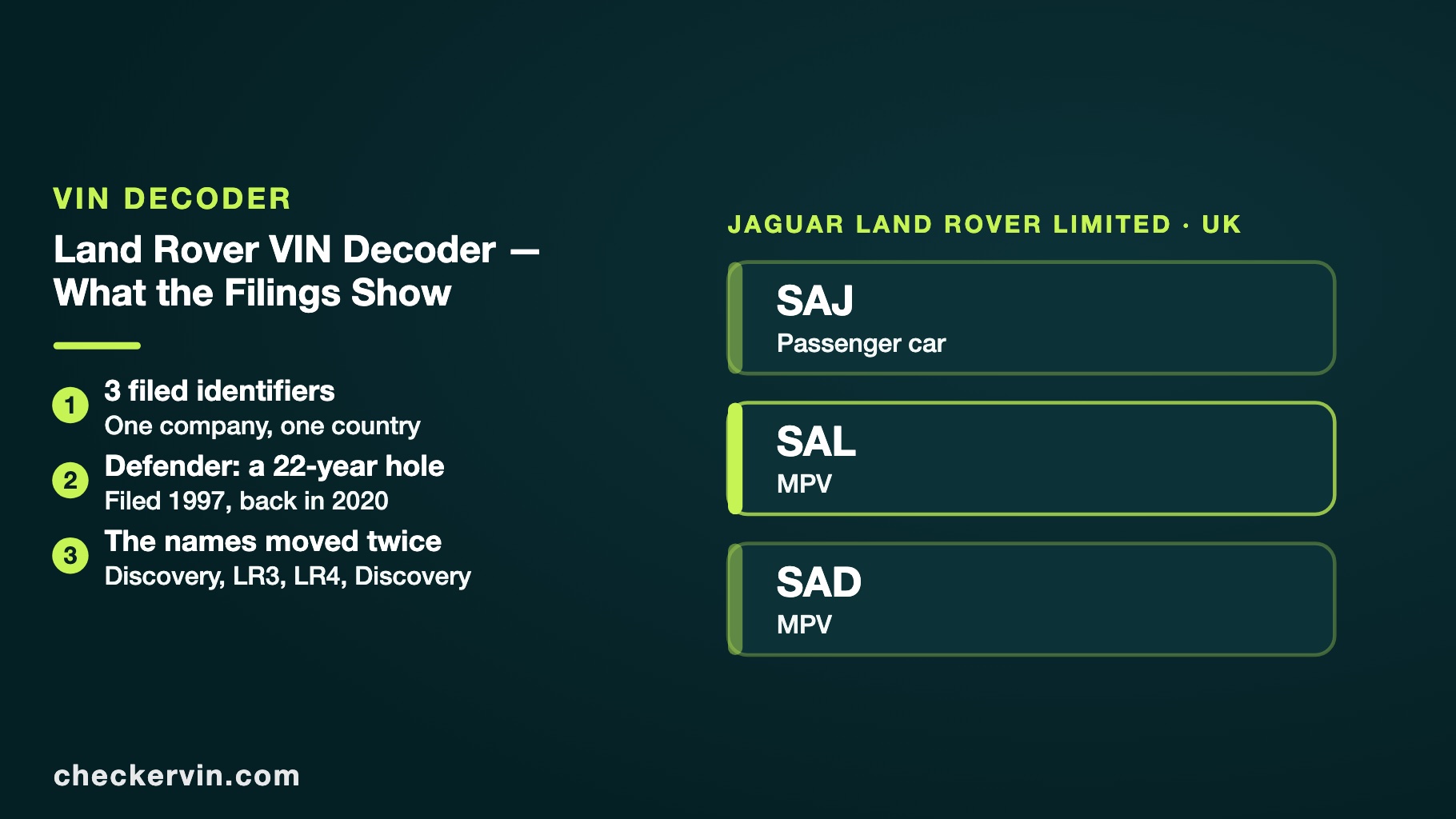
- SAL, SAJ or SAD — 3 identifiers, all filed by Jaguar Land Rover Limited in the United Kingdom.
- Is a Defender legitimate?
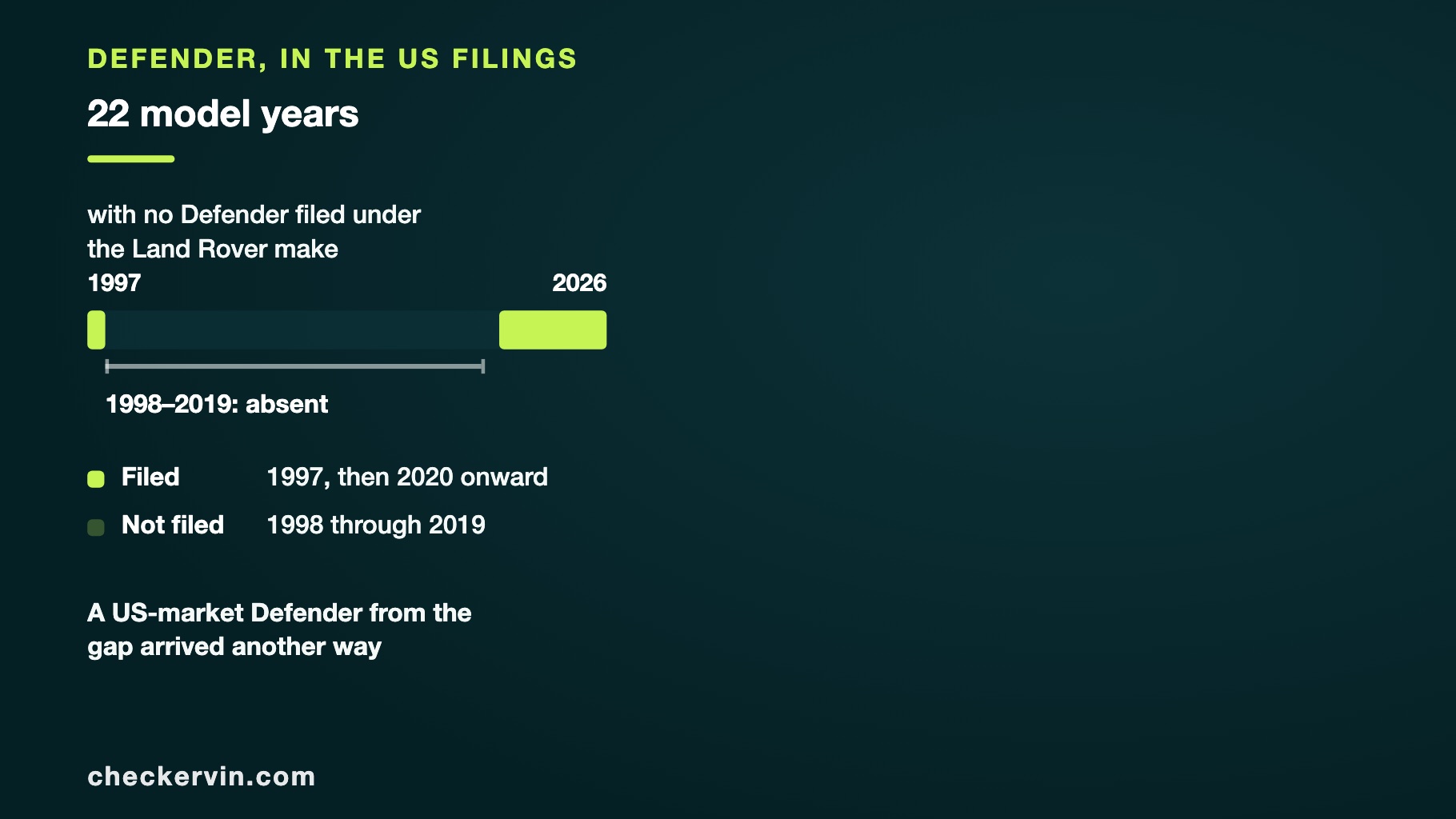
- Filed in 1997, then absent until 2023. Anything in between was not filed here under that name.
- LR4 or Discovery?
- The same line. The name changed twice, so check the model year before calling it a discrepancy.
3
Identifiers filed with NHTSA
All by one company, in one country
25
Model years with no Defender filed
1998 through 2022
3
Names one line has been filed under
Discovery, LR3, LR4 — then Discovery again
Three identifiers, one filer, one country
The first three characters of a VIN are the world manufacturer identifier, filed with NHTSA by whoever builds the vehicle. For this marque the register holds exactly three rows, and they are unusually uniform.
| Identifier | Filed as |
|---|---|
| SAJ | Passenger car · United Kingdom · Jaguar Land Rover Limited |
| SAL | Multipurpose passenger vehicle · United Kingdom · Jaguar Land Rover Limited |
| SAD | Multipurpose passenger vehicle · United Kingdom · Jaguar Land Rover Limited |
That is the whole entry. It is worth setting against a marque like Mitsubishi, whose register holds twenty-two identifiers across five countries and two separate businesses. Land Rover is the opposite shape: the prefix tells you almost nothing you did not already know, and everything that can go wrong on this marque goes wrong further along the number.
Why a Land Rover can decode to Jaguar
Of the three, SAJ causes the most confusion, because it is the identifier most people file mentally under Jaguar. The register puts all three under the same filer, Jaguar Land Rover Limited, and separates them by vehicle type rather than by badge: SAJ is the passenger-car row, SAL and SAD are the multipurpose-passenger-vehicle rows.
So a decode that answers “Jaguar Land Rover Limited” on a Range Rover is correct. What you should check instead is the vehicle type field, which is where the register actually distinguishes between these three rows.
The Defender is missing for 25 model years
This is the finding on this marque with money attached, and it is countable rather than arguable. Asking the federal database which models were filed under Land Rover, year by year, the Defender appears in 1997, is gone by 1998, and does not appear again until 2023.
That does not make such a vehicle illegitimate. It makes it something other than an ordinary US-market car, and the difference matters to a buyer: it will have arrived by a route with its own paperwork, its own conditions, and in some cases its own restrictions on what may lawfully be done with it afterward.
If you are looking at one from those years
The federal decode is the cheapest first test, and it costs nothing. Run the number and read what comes back rather than what the advertisement says.
- 1Decode the VIN and read the model yearIf it resolves inside the gap, the model name that comes back is the thing to look at. A decode that returns nothing useful is itself informative on a vehicle claimed to be a US-market car.
- 2Ask which route it arrived byThere are lawful ones, and each leaves paperwork. A seller who can name the route and show the documents is in a different position from one who cannot.
- 3Read the import rules before you agree a priceThe conditions are federal, they differ by agency, and the well-known version of them is wrong in a way that matters.
We have written the third step up properly, because the popular summary of it clears one agency out of three: the imported car VIN check covers what each of them actually requires. This page is not going to restate it.
Check any VIN free
Decoded from official manufacturer and NHTSA records
The same vehicle, filed under three different names
The second thing that breaks a listing against a decode on this marque is that model names have moved. Two lines have each been filed under three names.
| The chain | The years it was filed that way |
|---|---|
| Discovery → LR3 → LR4 → Discovery | 1997, then 2005, then 2010 and 2015, then 2019 onward |
| Freelander → LR2 → Discovery Sport | 2005, then 2010 and 2015, with 2015 returning both LR2 and Discovery Sport |
Read the second row carefully, because it contains the detail that catches people out: model year 2015 returns both LR2 and Discovery Sport. The change was not a clean cutover between years, so a single model year can legitimately hold the old name and the new one at the same time.
What was actually filed, year by year
Rather than summarize, here is the model list the federal database returns for the Land Rover make in a spread of model years. Everything above is visible in it.
| Model year | Models filed |
|---|---|
| 1997 | Defender, Discovery, Range Rover |
| 1998 | Discovery, Range Rover |
| 2000 | Discovery, Range Rover |
| 2005 | Freelander, LR3, Range Rover |
| 2008 | LR2, LR3, Range Rover, Range Rover Sport |
| 2010 | LR2, LR4, Range Rover, Range Rover Sport |
| 2012 | LR2, LR4, Range Rover, Range Rover Evoque, Range Rover Sport |
| 2015 | Discovery Sport, LR2, LR4, Range Rover, Range Rover Evoque, Range Rover Sport |
| 2019 | Discovery, Discovery Sport, Range Rover, Range Rover Evoque, Range Rover Sport, Range Rover Velar |
| 2020 | Defender, Discovery, Discovery Sport, Range Rover, Range Rover Evoque, Range Rover Sport, Range Rover Velar |
| 2023 | Defender, Discovery, Discovery Sport, Range Rover, Range Rover Evoque, Range Rover Sport, Range Rover Velar |
Three things to notice. Defender in 1997 and not in 1998. The LR names arriving in 2005 and gone again by 2019. And the range widening steadily on the Range Rover side, which the next section counts.
It is also worth seeing how small the filings once were. In 1998 and 2000 the entire Land Rover make is two models. By 2023 it is seven, and the growth is almost all on one side of the range. A decoder chart written at either end of that span is wrong at the other, which is the argument for querying the register on the specific model year in front of you rather than consulting anything printed.
One name became four, and that is why precision matters now
Run the census forward and a second movement appears alongside the renaming. In 1997 exactly 1 filed model carries the Range Rover name. By 2008 it is 2. By 2012 it is 3. From 2019 onward it is 4— Range Rover, Range Rover Sport, Range Rover Evoque and Range Rover Velar, each a separate filing.
That matters for a used buyer in a way the renaming does not. When one filed model wore the name, “Range Rover” in a listing was unambiguous. With four, the word on its own identifies almost nothing — not the size, not the platform, not the price bracket. Sellers who write it that way are not usually being evasive; they are using a name that stopped being specific while nobody was watching.
The same pressure explains why the older names were retired. LR2, LR3 and LR4 were positional labels — a size ladder — and a ladder stops working once the range widens past it. Whatever the commercial reasoning, the effect on the record is that a decade of vehicles carries names that no longer map onto anything currently sold, which is precisely the situation where the model year does the work.
When the model name is a measurement
One more filing quirk worth knowing before it surprises you. The current model year includes these entries alongside Defender:
- 110" WB
- 88" WB
- 90" WB
Those are wheelbase designations filed as model names. A decode that returns a measurement where you expected a nameplate has not failed — it has given you the filing, which on this line is more specific than the nameplate would have been. Once you know to expect it, it is useful: the wheelbase distinguishes body variants that share a name.
Six characters and a wildcard get you further than expected
A common situation on this marque, where listings are often photographed rather than typed: you can read the start of the VIN and not the rest. The federal decoder accepts an incomplete number with a wildcard, and it answers rather than refusing.
We ran SALGS2*— six characters and a wildcard, nothing more:
| Field | Returned for SALGS2* |
|---|---|
| Make | LAND ROVER |
| Model | Range Rover |
| Manufacturer | JAGUAR LAND ROVER LIMITED |
| Vehicle type | MULTIPURPOSE PASSENGER VEHICLE (MPV) |
| Body class | Sport Utility Vehicle [SUV]/Multipurpose Vehicle [MPV] |
26populated fields, with the response flagged as an incomplete VIN rather than quietly guessing the rest. Six characters were enough to establish the make, the model line, the filing company and the body class — which on this marque is often exactly the set of things a listing has got wrong.
What a partial cannot give you is anything downstream of the characters you are missing: the model year in position ten, the plant in position eleven, and the serial. Since the model year is the field that resolves both the renaming and the Defender question, a partial is a way to confirm you are looking at the right family — not a substitute for the whole number.
Reading a listing against the number
Putting the two findings together gives a short procedure for this marque specifically, because the failure modes here are different from most.
| What the listing and the decode disagree about | How to read it |
|---|---|
| Discovery versus LR3 or LR4 | Check the model year. Both names are correct in their own years |
| Freelander versus LR2 versus Discovery Sport | Same line, and 2015 legitimately holds two of the three |
| A Defender in the gap years | Not a naming question. Establish how the vehicle arrived here |
| A model name that is a measurement | A filing convention on the current Defender line, not an error |
| Jaguar Land Rover Limited as the manufacturer | Correct on all three identifiers. Read the vehicle type instead |
What a decode returns, and what it does not
Worth stating plainly, because “VIN check” is used for two different things and a decoder does only one of them.
| Question | Answered by a decode? |
|---|---|
| What did the factory build? | Yes — model, year, body, engine, plant, vehicle type |
| Which company filed the identifier? | Yes |
| Are there open safety recalls? | Yes — campaigns are matched to the VIN |
| Has it been in a collision? | No |
| Is the title branded? | No |
| What has it cost to keep running? | No — no database holds that |
The check that costs nothing and is worth the most
Of everything a free decode gives you on a used Land Rover, the open-recall result is the one attached to money. A recall remedy is performed at no charge regardless of the vehicle’s age, its mileage, how many owners it has had, or whether you were the person who bought it new.
An open campaign is therefore unfinished free work attached to the vehicle rather than a reason to walk away — though it is a fair thing to raise with a seller who has owned the car for years and never had it done. Buying a car with an open recall covers how to handle it in a negotiation.
Buying a used Land Rover: what the number settles
An order that costs nothing until the last step.
- 1Read the VIN off the vehicle, not the advertisementWindshield base and door-opening label, compared character by character. Advertisements carry typos; the car does not.
- 2Check the model year against the nameOn this marque that is the single most productive check, because the names moved twice and a mismatch is usually the calendar rather than a lie.
- 3If it is a Defender, establish the year firstInside 1998 to 2022 the question changes from which trim to how it got here.
- 4Run the recallsFree to check and free to fix. Do it before you discuss price rather than after.
- 5Then buy the historyThe build record says nothing about collisions, brands or mileage. That is a separate search and the one worth paying for.
Where this information comes from
- NHTSA vPIC — WMIs filed by manufacturerThe three identifiers, filer, vehicle types and country reproduced above
- NHTSA vPIC — models filed by make and model yearSource of the census and the Defender gap; change the year in the URL to reproduce it
- NHTSA vPIC — VIN decoding APIThe decoder behind the checks recommended here
- 49 CFR Part 565 — Vehicle identification number requirementsThe rule behind the seventeen positions and the manufacturer identifier
Frequently asked questions
What do Land Rover VINs start with?
SAL for most of them, SAJ for some, and SAD for a third group. All three are filed by Jaguar Land Rover Limited in the United Kingdom, and that is the entire register entry — three identifiers, where a marque like Mitsubishi has twenty-two. The S marks the United Kingdom as the country of the filing.
Why does my Land Rover VIN start with SAJ?
Because SAJ is the passenger-car row of the same manufacturer. People associate it with Jaguar, and that association is reasonable, but the register files SAJ, SAL and SAD to one company. The identifier names the filer, not the badge on the grille, so a decode naming Jaguar Land Rover Limited on a Land Rover is correct rather than confused.
Was the Defender sold in the US?
Not for a long stretch. In the federal model filings the Defender appears in 1997, is gone from 1998, and does not appear again until 2020 — a gap of twenty-two model years. A US-market Defender advertised from within that span was not filed under that name here, which makes it an import, a rebuild, or a mislabeled listing. That is worth establishing from the VIN before any money changes hands.
What is the difference between an LR4 and a Discovery?
For federal filing purposes they are the same line under different names in different years. Discovery is filed in 1997, LR3 in 2005, LR4 in 2010 and 2015, and Discovery again from 2019. So a listing that says Discovery and a decode that says LR4 are not necessarily in conflict — check the model year before treating it as a discrepancy.
Why did my decode return a wheelbase instead of a model?
Because that is what was filed. The current model year includes entries reading 110 inch WB, 90 inch WB and 88 inch WB alongside Defender. A model name that looks like a measurement is a filing convention rather than a broken lookup, and it is specific enough to be useful once you know to expect it.
Does a VIN decode tell me if a Land Rover has been well maintained?
No. A decode reads what the manufacturer built into the number and filed with the federal government — model, year, body, engine, plant. Service history, collisions, title brands and mileage are records about what happened afterward, held in different systems entirely, and none of them are in the number.
Where is the VIN on a Land Rover?
In the places federal rule requires on any vehicle certified for sale here — visible through the base of the windshield on the driver's side, and on the certification label in the driver's door opening. Read both and compare them character by character rather than trusting one, because a disagreement between the two is a signal worth stopping on.
Keep reading
Decode a Land Rover VIN free
Factory build, specifications and open safety recalls, read straight from the federal database.
Run a free VIN check