The short answer
- Is Carsforsale legit?
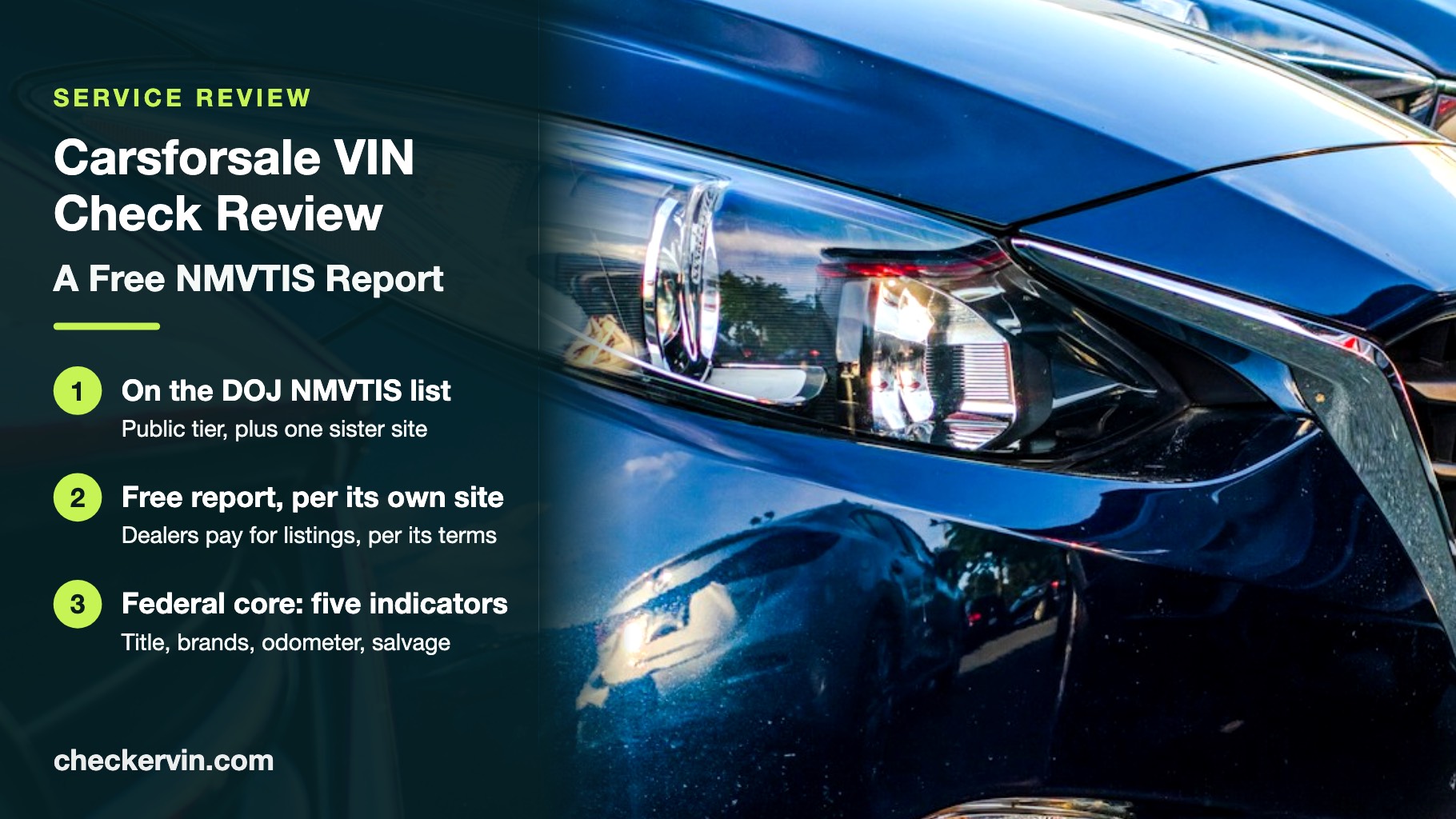
- On the question that matters for a history report, yes: Carsforsale.com is on the Department of Justice list of approved NMVTIS data providers for public and commercial customers.
- What does the VIN check cost?
- Nothing, by its own description. The site is funded by the dealers who pay to list cars on it, according to its terms.
- What will it not tell you?
- Service and repair history, and any crash that never reached an insurer or a title office. The federal record is deliberately short, and no report replaces a mechanic.
Listed
DOJ NMVTIS provider status
Public and commercial customers
Free
Report price, per its own site
Dealers pay to list
2
Data sources it names
NMVTIS and its listing archive
1
Sister site on the DOJ list
VehicleHistoryReport.com
The short verdict
For the narrow job of checking whether a used car carries a title brand, the Carsforsale VIN check is hard to argue with: it comes from an approved NMVTIS provider and the company says it costs nothing. Its report adds something the paid providers mostly do not have, which is a record of how the same car was photographed and priced in earlier listings on its own marketplace.
The limits are the ones built into the federal record, plus a few marketing phrases that promise a little more than the two sources it names can deliver. Read it as a title and listing check, not as a service history, and it is a useful free first step.
Two websites, one approval
Searches for this report arrive under two names, and they lead to the same company. The Department of Justice’s approved-provider page lists Carsforsale.com and, under it, states that an additional website owned by the approved provider sells vehicle history reports that include NMVTIS information: VehicleHistoryReport.com.
Carsforsale’s own report page points the same way: its sample report is a PDF hosted on the VehicleHistoryReport.com domain. So if you have been asking whether VehicleHistoryReport.com is legit, the answer from the federal list is that it sells under Carsforsale’s approval. What we cannot tell you is how it presents or prices its reports, because vehiclehistoryreport.com refused every request we made in November 2026 and we did not try to get round the block.
Is Carsforsale legit? What the record shows
The NMVTIS approved-provider list is the one credential in this market a buyer can verify in seconds. On November 24, 2026, its public tier named 12 businesses:
- Bumper.com
- Carsforsale.com
- Carvertical.com
- Checkthatvin.com
- Clearvin.com
- EpicVin.com
- GoodCar.com
- Titlecheck.us
- Vinaudit.com
- Vindata.com
- VinReport
- Vinsmart.com
The department says the order is alphabetical and implies no preference. It also says, in bold, that consumers cannot receive NMVTIS reports from Carfax, DMVDesk or Experian, which supply that data to dealerships only.
As a business, Carsforsale.com’s terms name the operator as Carsforsale.com, Inc., with a notice address in Sioux Falls, South Dakota, South Dakota law governing disputes and a copyright line running from 1999. Its About page says it began on the lot of a small auto dealership. None of that rates the dealers who list on it; it answers whether the report itself comes from a business entitled to sell the federal record, and it does.
What the Carsforsale VIN check costs, and who pays
The listed providers we have reviewed charge consumers in some form, per report, in bundles or by subscription. Carsforsale says it does not. Its report page calls the report 100% free, says you simply enter a VIN, and answers its own FAQ question on why with a line about safety and value not costing money. We saw no account requirement mentioned on that page.
The money is visible in its terms instead. Carsforsale is a listing marketplace: dealers and paid features are billed under rates published on its dealer site, while private sellers can post up to five listings without a paid subscription, and listings may lapse after 30 days. The terms do not say how the free report is funded, but they do show that the paying customer of this business is the dealer, not the shopper.
That is not a reason for suspicion. It is a reason to understand whose site you are on. A free report on a listing is supplied by the marketplace that also earns from the listing, which is why the federal data in it, rather than anything editorial, is the part to lean on. For what reports cost elsewhere, see what a vehicle history report should cost.
What the Carsforsale history report says it covers
Carsforsale’s report page shows six preview fields, in its own labels:
| Field | What it shows, per the preview |
|---|---|
| Title Info | The title issue date |
| Odometer History | The latest reported reading |
| Junk & Salvage Info | A count of junk and salvage records |
| Insurance Report | A count of insurance records |
| Average Price | A market price figure, not a fee |
| Brand History | Any title brands reported |
Below that, a “What’s Included” list runs through junk and salvage information, insurance information, title history, title brands, online history and odometer information, then a long run of brand names. Its FAQ says the report carries over 70 title disclosures. Grouped, the brand names it lists include:
- Salvage, junk, totaled, parts only and crushed
- Flood, saltwater, fire and hail damage
- Collision and disclosed damage
- Rebuilt, reconstructed and remanufactured
- Recovered theft and salvage stolen
- Former rental, police use, taxi and test vehicle
- Gray market, reissued VIN and VIN replaced
- Warranty returned (often called a lemon buyback)
It says a VIN is all you need, that NMVTIS covers cars, trucks, buses, motorcycles, RVs and truck tractors, and that some commercial vehicles and vehicles older than 1981 may not have reports. On updates it says some reports refresh in real time and others within 24 hours or a few days of a title transaction.
One caution about brand lists in general: a brand appears only where a state applied it. The DOJ notes that one state may brand a damaged car salvage while another does not, because the damage falls below that state’s threshold. Our NMVTIS report guide explains each indicator and how to read an unfamiliar brand.
The federal half and the listing half
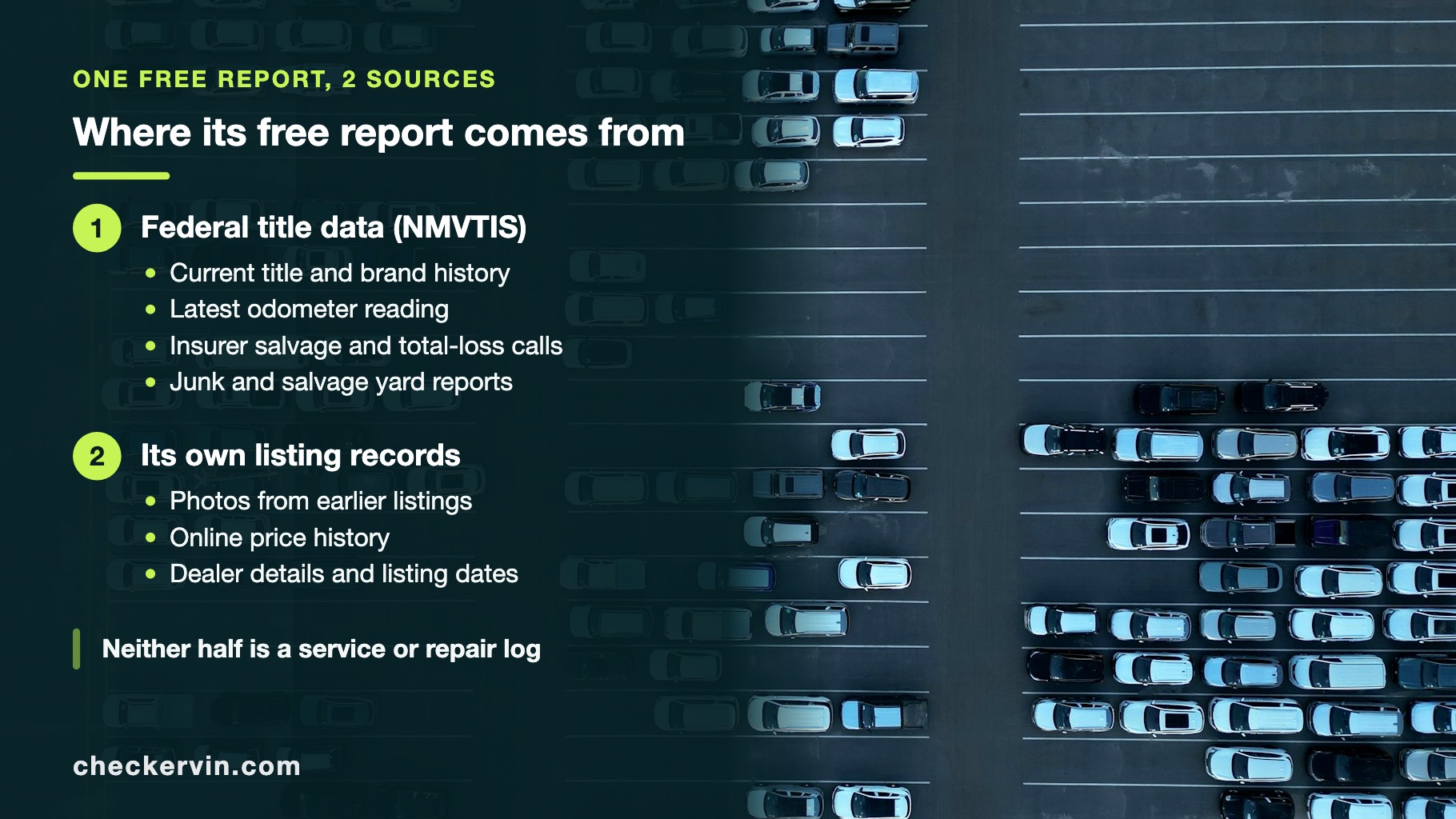
Carsforsale’s FAQ names exactly two sources: NMVTIS, which it describes as a government system created to fight auto theft and fraud, and more than 20 years of its own seller records, which add photos, pricing, dealership details and listing dates. Those two halves deserve to be read differently.
| Report line | Where it comes from, per Carsforsale |
|---|---|
| Title, brands, odometer | NMVTIS, reported by state titling agencies |
| Junk, salvage and insurance records | NMVTIS, reported by yards and insurers |
| Earlier listing photos | Carsforsale's own archive of past listings |
| Online price history | Carsforsale's own archive of past listings |
| Dealer details and listing dates | Carsforsale's own archive of past listings |
| Average price | A market figure shown in the preview; source not stated |
The listing half is genuinely distinctive. Seeing that a car was advertised a year ago with different photos, a different price or a different dealer can expose a hidden repair, a quick flip or a mileage story that does not add up. But it has a built-in blind spot: it only knows about cars that passed through Carsforsale’s own marketplace. A car sold privately elsewhere, or through another site, leaves no trace in that half.
Where the federal record stops
The Department of Justice describes an NMVTIS report as “intentionally concise”: data on five key indicators tied to fraud and theft. Those are information from the current title including brand history, the latest odometer reading, insurer salvage and total-loss determinations, and transfers to junk, salvage or recycling yards, with historical theft data in some cases. Its strength is permanence: once a state brands a vehicle, the brand stays in the federal record, so a move across a state line does not wash it.
The same page is plain about the gaps. It says 87 percent of the U.S. vehicle population is in NMVTIS, that more than half of the states report to it, and that a search can return a false negative such as “no junk or salvage history.” It adds that a total-loss call does not always mean a wreck: a stolen car not recovered within 30 days may be totaled by the insurer and later found in perfect condition. And it encourages buyers to check the actual state title record, since NMVTIS does not hold everything a state records.
None of that is specific to Carsforsale. It applies to every listed provider, which is why a free report and a paid one from the public tier share the same ceiling on the federal half.
Three claims worth reading closely
Carsforsale’s pages are mostly careful, but three phrases go further than the record we could check, and a buyer should know the difference.
| What its pages say | What the public record says |
|---|---|
| Reports match over 96% of U.S. vehicles, from its two sources combined | The DOJ says 87 percent of the U.S. vehicle population is in NMVTIS; the extra coverage would have to come from its listing archive |
| Its About page says reports show accident history | NMVTIS carries brands and insurer total-loss calls, not a crash log; the FAQ names no third, accident-data source |
| Reports are government-backed | The federal part is NMVTIS data sold under a DOJ approval; the listing part is the company's own data |
A listing we opened labeled its report sections Accident History, Previous Photos and Title History. Given the two sources the company names, the accident section can only draw on title brands and insurer records in NMVTIS, or on what earlier listings disclosed. We did not run a report to see how that section is filled, so treat a clean accident line as “nothing reported,” not “never crashed.”
Reports on listings: what that means for a buyer
The listing-site context is the part most reviews skip. On a Carsforsale vehicle page we opened, the report appears twice: a “Get a FREE Vehicle History Report” box described as backed by federal vehicle title data, and a second panel saying the report shows over 70 critical title disclosures backed by government data through NMVTIS, signed “Report Powered by Carsforsale.com & NMVTIS.” Its About page says every vehicle on the site offers one.
That convenience comes with the marketplace’s own terms. Carsforsale’s terms say it merely acts as a conduit for sellers, has no control over the accuracy of what sellers post, makes no representation about the condition of any listed item, and provides site content without warranties. Sellers are responsible for their own listings. The listing we opened also carried a safety-recall note telling buyers to ask the dealer for a recall status update before purchase.
- Run the report on the listing, then check the VIN on the report matches the car and its title
- Read the seller's notes against the brand history; a disclosed branded title should appear in both
- Compare the earlier-listing photos and prices with the current ad
- Check open recalls yourself by VIN rather than relying on the listing
- Treat the report as a screen for the car, not a verdict on the dealer
How it compares with paid NMVTIS providers
On the federal half, a listed provider is a listed provider: the title, brand, odometer and salvage indicators come from the same system. What differs is the wrapper. Some charge per report and add lien or valuation data from other sources, as our VINsmart review sets out. Some sell access by monthly membership and bundle model-level data, as our GoodCar review describes. Carsforsale charges nothing and adds its own listing archive.
| Question | Carsforsale.com |
|---|---|
| Federal title brands and salvage? | Yes, as a listed NMVTIS provider |
| Consumer price? | Free, per its own report page |
| Extra data beyond NMVTIS? | Photos, prices, dealers and dates from its past listings |
| Lien check? | Undisclosed lien appears as a brand name; no separate lien database is named |
| Service records? | Not among the sources it names |
For a buyer, that makes the free report a sensible first pull on any car, listed there or not if its VIN entry accepts it. A paid report earns its price only if it adds a source you actually need. Our Carfax alternatives guide maps which kind of product answers which question.
Carsforsale and CarCheckerVIN, compared fairly
Both are free to start, and they do different jobs. Here is the straight comparison.
| CarCheckerVIN today | Carsforsale.com |
|---|---|
| Price: free, no card field | Price: free, per its report page |
| Factory build and specifications: yes | Factory build and specifications: not listed as a section |
| Factory warranty terms: yes | Factory warranty terms: not listed |
| Open safety recalls: yes | Open safety recalls: not listed as a report section |
| Market and listing prices: yes | Average price and its own listing price history: yes |
| Title brands and salvage: launching soon, not available yet | Title brands and salvage: yes, as a listed NMVTIS provider |
What our free scan returns today:
- Factory build and specifications decoded from the VIN
- Factory warranty terms
- Open NHTSA safety recalls
- Photos filed against the VIN
- Market and listing prices
Decode the build and check open recalls first
Decoded from official manufacturer and NHTSA records
A sensible order of checks
- Decode the VIN free and confirm it matches the listing, the title and the car
- Check open recalls free by VIN; recall repairs are free at a dealer
- Pull a free NMVTIS-based report, such as Carsforsale's, for title brands and salvage
- Run the free NICB VINCheck for theft and insurer total-loss records
- Look up the state's full title record if anything in the report is unclear
- Have an independent mechanic inspect the car, which no database replaces
Run in that order, a buyer can reach the inspection without spending anything on data, and spends the inspection fee only on a car that survived the free checks. Our guide to what a free vehicle history report can give you covers the other free routes.
Who it suits
It suits a shopper already browsing Carsforsale who wants the title record without paying for it, and anyone who values seeing a car’s earlier listings. It suits less well a buyer who needs service records or a detailed accident narrative, because neither is in the sources it names. Whichever report you use, check the provider against the DOJ list first, and see how to choose a VIN check for the rest.
Where this information comes from
- NMVTIS — approved data providers (DOJ / BJA)Lists Carsforsale.com for public and commercial customers, with VehicleHistoryReport.com under it; retrieved November 24, 2026
- NMVTIS — information for consumers (DOJ / BJA)The five indicators, the 87 percent coverage figure, the false-negative warning and the state-differences note
- Carsforsale.com — free vehicle history reportsReport sections, the two data sources, coverage claims and its FAQ; read November 24, 2026
- Carsforsale.com — about usIts statement that every listed vehicle offers a free report
- Carsforsale.com — terms and conditionsOperator name, South Dakota law, the marketplace conduit clause and private-party listing terms; effective May 7, 2026
- NHTSA recall lookupOpen recalls by VIN, free from the regulator
- NICB VINCheckFree theft and total-loss screen
- How we made this pageWritten by the CarCheckerVIN editorial team with AI assistance from the Department of Justice's NMVTIS pages, Carsforsale.com's own pages and other public records; facts checked November 2026. VehicleHistoryReport.com blocked our requests and is not a source.
Keep reading
Frequently asked questions
Is Carsforsale legit?
Carsforsale.com is named on the Department of Justice's list of businesses approved to provide NMVTIS vehicle history reports to both public and commercial customers. Its terms identify the operator as Carsforsale.com, Inc., with a notice address in Sioux Falls, South Dakota. The listing is a statement about access to the federal title record; it is not a rating of any dealer who advertises on the site.
Is the Carsforsale VIN check really free?
Its report page describes the report as 100% free and says you simply enter a VIN. Its answer to why is that safety and value should not cost money. Its terms show that dealers pay for listings and paid features, while private sellers can list up to five vehicles without a subscription. We did not run a report ourselves.
What does a Carsforsale vehicle history report include?
By the company's own account: title information and issue date, the latest odometer reading, junk and salvage records, insurance records, an average price and any title brands, drawn from NMVTIS. It adds photos, price history, dealer details and listing dates from its own records of past listings. It says the report covers over 70 title disclosures.
Is VehicleHistoryReport.com legit?
The Department of Justice lists VehicleHistoryReport.com as an additional website owned by Carsforsale.com that sells vehicle history reports including NMVTIS information. Carsforsale's own report page links its sample report from that domain. The site itself refused our requests, so we cannot describe what it sells beyond that.
Does the Carsforsale report show accident history?
Its About page says its reports show accident history, and a listing labels one section Accident History. The two sources it names are NMVTIS and its own listing records. NMVTIS carries title brands such as collision or disclosed damage and insurer total-loss calls, not a log of every crash, so a minor accident that never reached an insurer or a title office may not appear.
Carsforsale vs Carfax: which should I use?
They are built on different data. Carsforsale's report rests on the federal NMVTIS title record plus its own listing archive. Carfax is built on a private network of service, accident and dealer records, and the Department of Justice states that consumers cannot get NMVTIS reports from Carfax. If your question is whether a title was branded, a listed NMVTIS provider answers it directly.
Can I use the Carsforsale VIN check on a car not listed there?
Its report page says to enter any VIN, while its structured data and About page talk about a report on every listed vehicle. We did not test an unlisted VIN, so we cannot confirm it. It also notes that some commercial vehicles and vehicles older than 1981 may not have reports.
Start with the free layer
Decode any VIN free for the factory build, specifications and open safety recalls. Full vehicle history reports are launching soon.
Run a free VIN check