The short answer
- Which dealer fees are government fees?
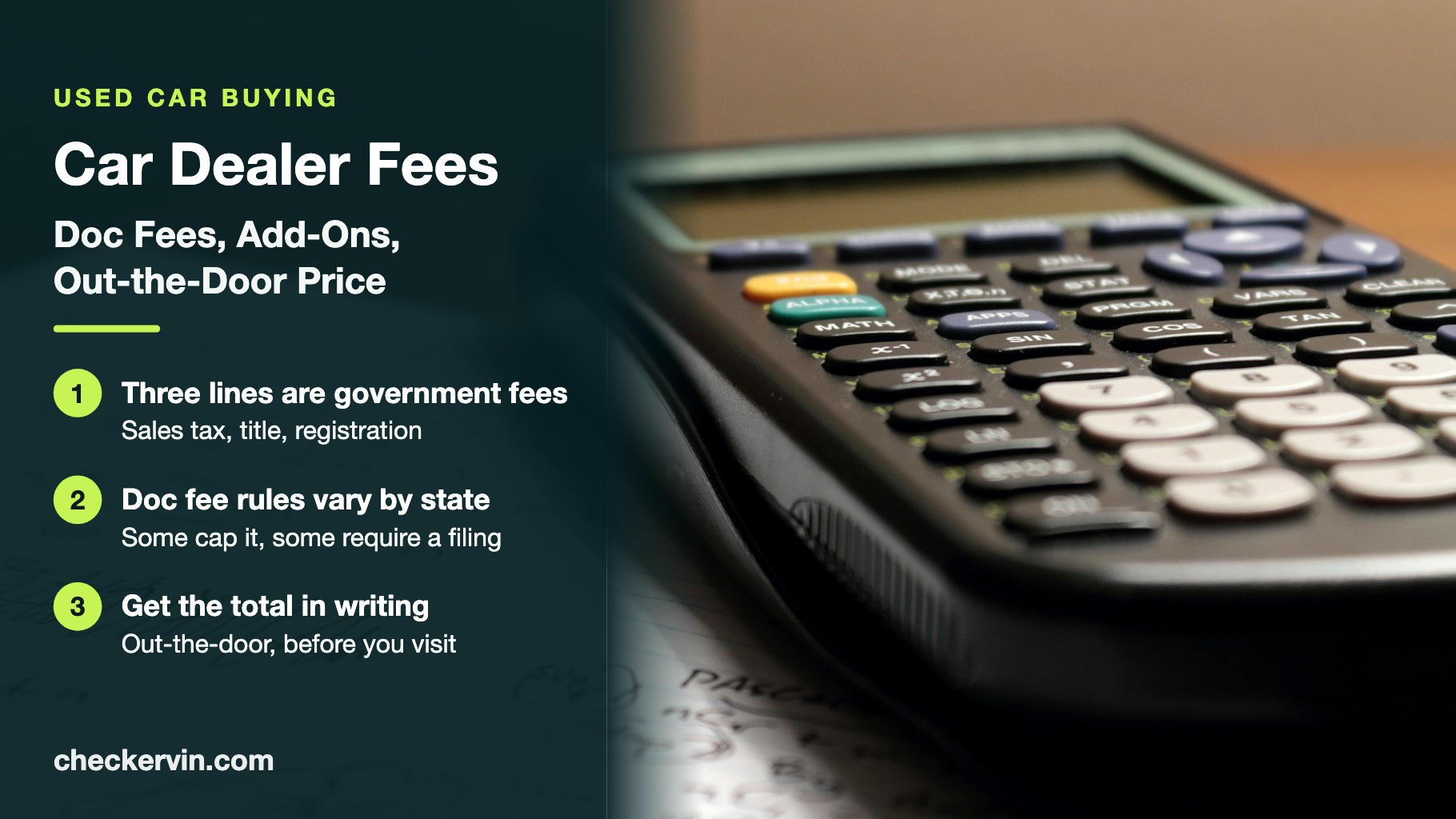
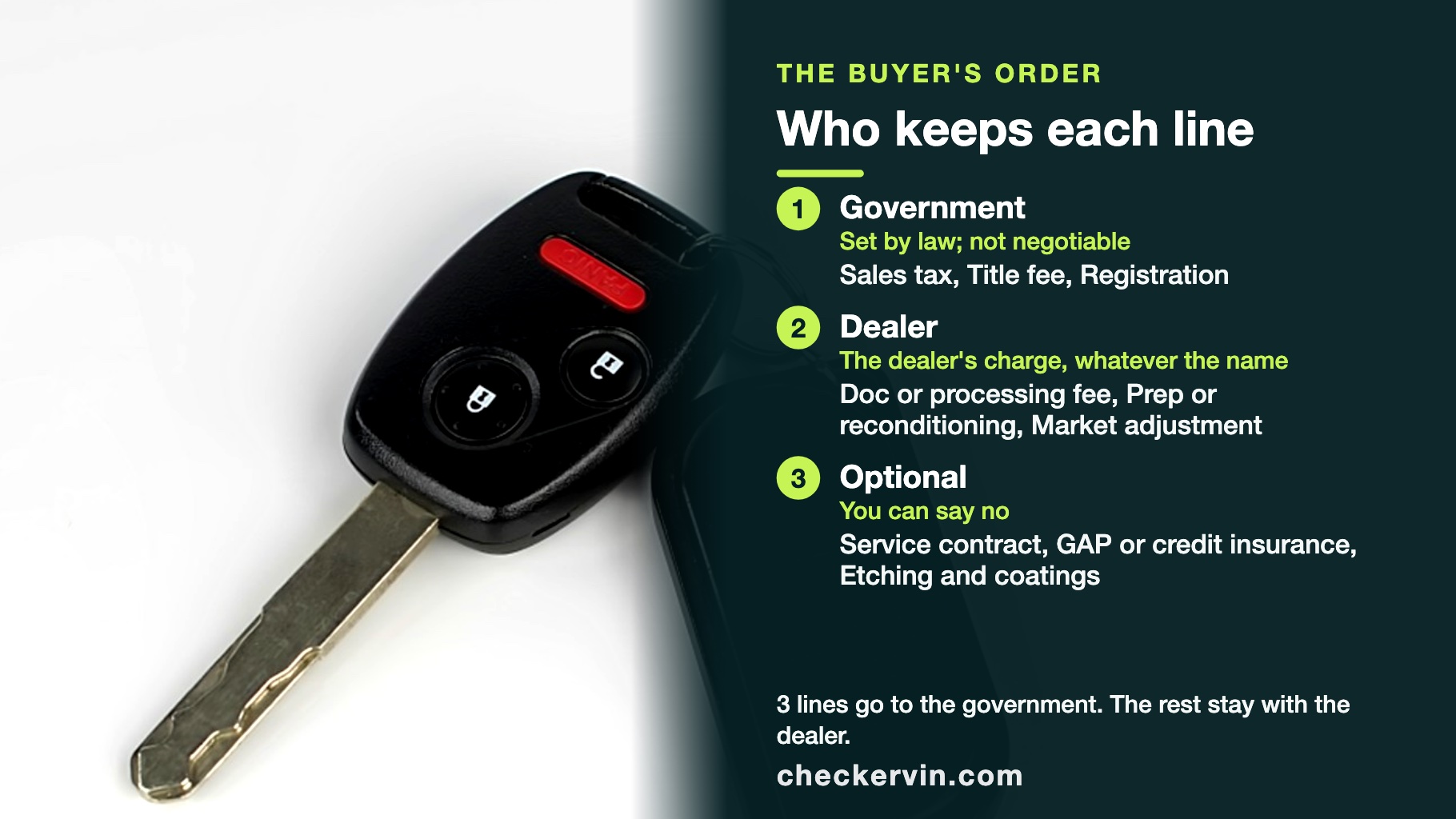
- Sales tax, title and registration. Everything else on the buyer's order, including the doc fee, prep fees and add-ons, is the dealer's charge.
- Is the dealer doc fee capped?
- In some states. California caps it at $85 or $70 depending on the dealer's DMV contract, and New York at $175. Texas requires a filing and cost analysis above $225.
- How do I get the out-the-door price?
- Ask for it in writing, by email, before you visit and before any financing talk. It should include every charge and fee, so anything added later stands out.
3
Government lines
Tax, title, registration
$85
California doc fee cap
$70 without a DMV partner contract
$175
New York doc fee cap
DMV CR-78 (9/26), §78.19
In writing
Out-the-door quote
FTC: before you visit
The short answer
Every buyer’s order has two kinds of charges on it. A short list goes to the government: sales tax, the title fee and registration. Everything else stays with the dealer, whatever it is called. The CFPB says the taxes, title and registration fees set by state and local governments are the parts of a car deal you cannot negotiate. By implication, the rest is open to discussion.
The trouble is that dealer charges are often named to sound official: a “documentary fee,” a “title service fee,” a “processing fee.” Some states regulate those charges closely, cap them, or make dealers print a notice saying they are not government fees. Others leave the amount to the market. And optional add-ons, from service contracts to paint coatings, can arrive pre-printed on the paperwork as if they came with the car.
The way through is simple to describe. Ask for a written out-the-door price before you go in. Sort each line into government, dealer, or optional. Strike what you did not agree to. And check that the VIN printed on the paperwork belongs to the car you drove.
Reading a buyer's order line by line
The buyer’s order, sometimes called a purchase agreement or worksheet, is the dealer’s itemized statement of the deal. If you are financing, the same numbers flow into the retail installment contract, where they become the amount financed. That makes the buyer’s order the best place to catch a fee, because everything after it builds on its totals.
Names vary by state and by dealer, but most lines fall into one of three groups. This is the sorting we use on this page:
| Line item (common names) | Who keeps it |
|---|---|
| Sales tax | Government. Set by the state and often the city or county; the dealer collects it and passes it on |
| Title fee | Government. The state's charge to issue a title in your name |
| Registration and plate fees | Government. Set by the state, sometimes with county or local add-ons |
| Documentary, doc, processing or title-service fee | Dealer. Pays for the paperwork and is profit to the dealer; some states cap it |
| Prep, predelivery, reconditioning, inspection or certification fee | Dealer. Often already part of getting the car ready to sell |
| Market adjustment or added dealer markup | Dealer. Price, not a fee, whatever the label says |
| Service contract, GAP, credit insurance, etching, coatings, tint | Optional add-ons. You can say no, and the price is negotiable |
| Electronic filing or registration-service fee | Dealer or its vendor. Rules vary; California limits when it can be charged |
The three government lines are the only ones a dealer has no say over, and even those are worth checking: the tax should be computed on the right base, and the registration should be for the right vehicle class. Every other line is a dealer decision. Some are legitimate costs of doing business that a dealer is allowed to pass on; some are regulated; and some are optional products that should only be there if you said yes.
Government fees: sales tax, title and registration
These charges are set by law and the dealer is usually just the collector. Rates and methods differ by state, county and sometimes city, so we do not publish a national table. Instead, use your own state’s motor vehicle or revenue agency, which usually has a fee calculator.
Texas is a clear example of how one state words it. The Texas Comptroller sets the motor vehicle sales tax at 6.25 percent of the sales price, minus any trade-in allowance, and says the dealer will collect it from the buyer when you buy from a Texas dealer. That trade-in credit is worth knowing about: in a state that taxes the price after the trade-in, a higher trade-in value lowers the tax line as well as the price.
California splits registration into several named government charges. The California DMV lists a registration fee, a California Highway Patrol fee, a vehicle license fee, a transportation improvement fee and county or district fees, and it publishes calculators for new and used vehicles. If the government lines on your buyer’s order differ noticeably from your state’s calculator, ask the dealer to show how they were worked out.
- Find your state's official fee calculator or fee schedule on the DMV or revenue agency site
- Check whether your state taxes the price before or after the trade-in credit
- Confirm the registration is for the right vehicle type and your county of residence
- If you are buying in another state, read our guide to buying a car out of state before you sign
Buying across a state line changes who collects tax and where you register, which is why that case has its own page: buying a car out of state.
The dealer doc fee: what it pays for
The documentary fee, often shortened to doc fee, is the dealer’s charge for preparing the sale paperwork and, in many states, filing the title and registration for you. It goes by several names: documentation fee, document processing charge, dealer fee, title service fee. Whatever the name, it is the dealer’s money.
The California DMV is blunt about this. Its dealer manual says the document processing charge is not required or collected by the DMV and that it is unlawful to represent it as a governmental fee. New York’s dealer regulations go further and require the dealer to print, on every copy of the invoice, that the charge is optional and “THIS IS NOT A DMV FEE.” Florida requires a printed disclosure on documents with a predelivery service line item, which reads in full:
“This charge represents costs and profit to the dealer for items such as inspecting, cleaning, and adjusting vehicles, and preparing documents related to the sale.”
That Florida wording is a fair description of most doc fees everywhere: part cost, part profit. It does not mean the fee is improper. Paperwork is real work, and many dealers charge the same doc fee on every sale. It does mean the fee is part of the price you are negotiating, not a tax you have to absorb.
State doc fee caps and disclosure rules we verified
There is no federal cap on dealer doc fees. States decide, and they take very different approaches: a hard dollar cap, a filing requirement above a threshold, a disclosure rule, or nothing. These are the four states we checked against official sources on November 26, 2026. Fee rules change, so confirm with your state before relying on a figure.
| State and source | Doc fee rule |
|---|---|
| California (DMV manual §3.030; Vehicle Code §4456.5) | Cap of $85 for a dealer with a DMV private industry partner contract, $70 for other dealers. Not a governmental fee and may not be represented as one |
| New York (DMV CR-78 (9/26), §78.19) | Optional registration or title processing fee capped at $175, plus $5 for special plates. The dealer must actually file the paperwork, print that it is not a DMV fee, and tell you that you may file yourself unless a lien is recorded or the dealer issued plates |
| Texas (OCCC Bulletin B16-5; Fin. Code §348.006) | Since July 11, 2024, a fee of $225 or less needs no filing. Above $225, the dealer must first file a notification and a cost analysis with the OCCC, and may not charge more than the filed amount |
| Florida (Statutes §501.976) | No dollar cap found in this section. A predelivery service line item must carry the printed cost-and-profit disclosure, and an advertised price must include all fees the customer must pay, apart from taxes, tags, registration and title |
Two details are easy to miss. New York’s cap applies to a fee for securing your registration or title, and the regulation says it does not include the DMV’s own registration and title fees or the inspection fee, so those may appear as separate lines. And Texas does not set one statewide number: the $225 figure is the point above which a dealer has to justify its fee to the regulator, so a Texas dealer can lawfully charge more if it has filed for it.
California’s cap nearly changed. A 2025 bill, SB 791, would have let dealers charge more than the current limits. The Governor’s office listed it among the bills he vetoed on October 13, 2025, so the caps above still stand.
Prep, reconditioning and certification fees
The second family of dealer fees covers getting the car ready to sell: dealer prep, predelivery inspection, reconditioning, detailing, certification. On a used car these are worth questioning hard, because the work they describe is normally the reason the car is on the lot at the advertised price.
The FTC’s case against Passport Automotive Group, a dealer group in the Washington, D.C. area, turned on exactly this. In its October 18, 2022 press release, the FTC alleged that Passport advertised cars as certified, reconditioned or inspected at set prices, then added extra certification, reconditioning or inspection fees, falsely presented as mandatory, that added hundreds or thousands of dollars. Passport agreed to pay $3.38 million for refunds, and the order bars it from misrepresenting whether a fee is optional and allows fees only with express, informed consent.
Florida’s advertising rule reaches the same point from another direction. Its statute says an advertised price must include all fees or charges the customer must pay, and names dealer preparation charges among them. Other states have their own advertising rules, but the principle is a good test anywhere: if a fee is truly mandatory, ask why it was not in the advertised price.
- Ask what work a prep or reconditioning fee pays for, and whether it was already done before the car was listed
- On a car advertised as certified or inspected, ask why certification or inspection is charged again
- Compare the buyer's order with the advertisement, and keep a screenshot of the ad
- Treat a market adjustment as part of the price, and negotiate it as price
Dealer add-ons: what you can say no to
Add-ons are products sold alongside the car: service contracts, GAP coverage, credit insurance, maintenance plans, window etching, paint and fabric protection, tint, wheel and tire coverage, alarms. They are where the largest optional sums on a buyer’s order usually sit, and where federal regulators have focused.
The CFPB’s answer on whether you have to buy them is direct: generally, you cannot be required to buy an extended warranty, GAP insurance or credit insurance. If a dealer or lender says a product is required, the CFPB says to ask them to show where your sales contract says so, and that if the contract does not explicitly say it is required, you cannot be required to buy it. A separate CFPB page on negotiating adds that optional add-ons, physical and otherwise, have negotiable prices, and that each one raises both the payment and the total you borrow.
| Add-on | What to know before you agree |
|---|---|
| Service contract (extended warranty) | Optional. Check what the factory warranty still covers first; terms and prices vary |
| GAP coverage | Optional. Your own auto insurer may offer a version, so compare before you buy at the desk |
| Credit insurance | Optional. Pays the loan in set events; generally cannot be made a condition of the loan |
| Etching, coatings, protection packages | Optional. Often pre-printed on the order; the price is negotiable if you want it at all |
| Maintenance plans, tire and wheel coverage | Optional. Compare the price with paying for the same work as you go |
A financed add-on also earns interest for the life of the loan, and many can be canceled later for a partial refund. Our buy here pay here guide covers how those refunds work when a loan ends early, so we do not repeat it here. If you are told an add-on is required and you are turned down when you refuse, the CFPB says you can complain to it, to the FTC, and to your state attorney general.
What FTC enforcement found about junk fees
Three FTC cases show the patterns regulators have alleged. They are allegations and settlements, not findings that every dealer does this, and one of them ended without an order.
| Case | What the FTC said |
|---|---|
| Napleton Auto (April 1, 2022) | With the State of Illinois. The complaint alleged eight dealerships in Illinois, Florida, Pennsylvania and Missouri added junk fees for add-ons such as payment insurance and paint protection, citing a survey in which 83 percent of buyers were charged for add-ons without authorization or through deception. Settled for $10 million |
| Passport Automotive Group (October 18, 2022) | Alleged mandatory-looking certification, reconditioning and inspection fees on cars advertised at set prices, and higher financing costs and fees for Black and Latino buyers. Settled for $3.38 million |
| Asbury Automotive (August 16, 2024) | Administrative complaint over three Texas dealerships, alleging add-ons charged without consent or described as required. The complaint was dismissed on October 5, 2026 (Docket 9436); no finding against the dealer was made |
The Napleton release called its $10 million judgment record-setting for an FTC auto lending case. In its consumer alert about the Asbury complaint, the FTC described buyers signing on electronic devices that showed the terms only at the signature line, so some did not learn of the charges until after they left. Whatever the outcome of that case, the practical lesson is the one the FTC drew: ask for a printed copy and read it before you sign.
How to get a written out-the-door price
The FTC’s consumer guidance on dealer ads gives the sequence. Before you leave home, ask the dealer to confirm the car is on the lot and send the out-the-door price in writing; the FTC says that price should include all charges and fees. Get it for the car you want even before a trade-in appraisal, so you know the final number. Then check that the contract matches what you were sent, and be ready to walk away if it does not.
A short email is enough. Ask for:
- The total out-the-door price for the specific car, identified by its VIN and stock number
- An itemized list: vehicle price, each dealer fee by name and amount, each add-on, sales tax, title and registration
- Confirmation of which add-ons, if any, are already installed, and their prices if you decline them
- The doc fee amount, and confirmation that it is within your state's limit if your state sets one
- How long the quote is valid, and confirmation that the car is on the lot
Asking by VIN matters. It ties the quote to one car, so you cannot be switched to a different unit at a different price, and it gives you the number you need to check the car before you travel. The FTC also warns about advertised deals that turn out to carry eligibility restrictions, such as being a current lessee or in the military; a written, VIN-specific quote surfaces those early.
Why the monthly payment hides fees
Fees are easiest to miss when the conversation is about the payment. A few hundred dollars spread across a multi-year loan barely moves the monthly figure. That is why both the FTC and the CFPB tell buyers to focus on the total cost. The FTC’s 2024 consumer alert says to get the total in writing, including all fees and add-ons, and to shop around for financing because dealer financing often carries higher rates.
The CFPB’s negotiating guide suggests collecting the same four numbers from each dealer or lender early on: the trade-in value, the interest rate, the loan term and the estimated monthly payment. With an outside preapproval in hand, the finance office has less room to blend the price, the fees and the rate into one payment. If the dealer needs to pull your credit to quote a rate, our page on what happens when a dealer runs your credit explains the notices you are owed.
- Settle the out-the-door price before you discuss financing
- Compare the amount financed on the contract with the out-the-door price minus your down payment
- Ask for any line you do not recognize to be explained or removed
- Get a preapproval from a bank or credit union to compare with the dealer's rate
The federal fee rule that never took effect
Many articles about dealer fees still describe the FTC’s Combating Auto Retail Scams Trade Regulation Rule, the CARS Rule, as if it governs today. It does not. On January 27, 2025, the Fifth Circuit (No. 24-60013) granted a petition from two dealer associations and vacated the rule, holding that the FTC had failed to issue an advance notice of proposed rulemaking that its own regulations required, and that the error was not harmless. The FTC then withdrew the rule in a final action published on February 12, 2026 (Federal Register document 2026-02866).
The court did not rule on the substance of the rule, and the withdrawal leaves the FTC’s general authority over unfair and deceptive practices in place. The three cases above were all brought under existing law. For a dealer fee, what applies in November 2026 is the FTC Act, state consumer protection law, and your state’s own doc fee and advertising rules. If your sale was in a dealer’s showroom, there is also no general federal right to cancel afterward; our page on whether you can return a used car explains why.
The VIN on the buyer's order: check it matches, then run it
Every buyer’s order and installment contract lists the vehicle’s VIN. It is the line most buyers never read, and the only one that ties all the money to one specific car. Before you sign, compare it with the VIN on the car itself, at the base of the windshield on the driver’s side and on the label in the driver’s door jamb, and with the Buyers Guide and the title paperwork.
- The VIN on the buyer's order matches the dashboard plate and the door-jamb label
- The year, model, trim and engine decoded from the VIN match the ad and the order
- Open safety recalls are checked by VIN, so you can ask the dealer about them before signing
- The price you agreed is compared with market and listing prices for the same car
- The federal title record comes from a provider on the Department of Justice NMVTIS list (twelve consumer-tier names, read November 26, 2026) for salvage, junk, flood and odometer brands
A mismatch is a reason to stop. A typo can be corrected, but a VIN that belongs to a different car means the fees, the title and the loan are all attached to something other than what you drove.
Decode the VIN on your buyer's order free
Decoded from official manufacturer and NHTSA records
What CheckerVIN shows free today
We do not sell cars, loans or add-ons, and we have no relationship with any dealer. What we do is the free part of the VIN check above. Enter a VIN and you get:
- Factory build and specifications decoded from the VIN
- Factory warranty terms
- Open NHTSA safety recalls
- Photos filed against the VIN
- Market and listing prices
Two items on that list help directly with fees. Market and listing prices tell you whether the vehicle price leaves room for the doc fee and any add-ons you want, and the factory warranty terms tell you how much of the car is still covered before you pay for a service contract.
Before you sign: what you can decline
With the written quote and the buyer’s order side by side, go line by line. This is the short version of everything above.
| Line | What you can do |
|---|---|
| Sales tax, title, registration | Check the math against your state's calculator; you cannot negotiate the rates |
| Doc fee | Check it against your state's cap or filing rule; ask for a matching price cut if it will not come off |
| Prep, reconditioning, certification | Ask what it pays for; question it on a car advertised as ready to sell |
| Market adjustment | Negotiate it as part of the price |
| Service contract, GAP, credit insurance | Decline, or shop it elsewhere; ask to see any clause saying it is required |
| Etching, coatings, protection packages | Decline, or negotiate the price if you want it |
| Anything you did not agree to | Ask for it to be removed before you sign |
If a dealer will not put the out-the-door price in writing, will not remove an add-on you declined, or tells you a dealer fee is a state fee, you have learned something useful before signing. The full order of steps for a used-car purchase is on our guide to buying a used car. Hidden fees can be reported to the FTC at ReportFraud.ftc.gov, and to your state attorney general.
Where this information comes from
- California DMV — Dealer's Document Preparation and Electronic Filing Service Fee (VC §§ 4456.5, 11713.1)Manual §3.030: the $85 and $70 caps and the ban on calling the charge a governmental fee
- Office of the Governor of California — legislative update, October 13, 2025Lists SB 791, Vehicle dealers: document processing charge, among the vetoed bills
- California DMV — Registration feesExample of a state's government fee types and its new and used vehicle fee calculators
- New York DMV — Motor Vehicle Dealers & Transporters Regulations, CR-78 (9/26) (PDF)§78.19: the $175 processing fee cap, the $5 plate fee and the required "not a DMV fee" notice
- Texas OCCC — Documentary Fee Filing Instructions, Bulletin B16-5 (PDF)Rev. July 2, 2024: the $225 filing threshold, effective July 11, 2024
- Texas Comptroller — Motor Vehicle Sales and Use Tax6.25 percent of the sales price minus trade-in; collected by the dealer
- Florida Statutes 2026 — §501.976, Actionable, unfair, or deceptive acts or practicesSubsections (11), (16) and (18): added charges, advertised prices and the predelivery service disclosure
- FTC — Napleton Auto press releaseApril 1, 2022; $10 million settlement over add-on junk fees
- FTC — Passport Automotive Group press releaseOctober 18, 2022; certification, reconditioning and inspection fees; $3.38 million
- FTC — Asbury Automotive Group, Inc., et al., In the Matter ofDocket 9436; complaint dismissed October 5, 2026
- FTC — Car dealerships can't charge you for add-ons you don't wantConsumer alert, August 16, 2024: review the contract, focus on total cost, shop financing
- FTC — Car Dealer Ads and Promotions: Know Before You GoGet the out-the-door price in writing before you visit
- CFPB — Am I required to purchase an extended warranty, GAP or credit insurance to get an auto loan?Last reviewed March 5, 2024
- CFPB — What things can I negotiate when shopping for a car or auto loan?Dealer fees and add-ons negotiable; taxes, title and registration not
- U.S. Court of Appeals, Fifth Circuit — NADA v. FTC, No. 24-60013 (PDF)Filed January 27, 2025; vacates the CARS Rule
- Federal Register — Withdrawal of the CARS Rule (doc. 2026-02866)Published February 12, 2026
- NMVTIS — approved data providers (DOJ / BJA)The consumer-tier list, read November 26, 2026
- NHTSA recall lookupOpen safety recalls by VIN
- How we made this pageWritten by the CarCheckerVIN editorial team with AI assistance from state DMV and regulator records, Florida statutes, FTC and CFPB guidance and enforcement records, court and Federal Register documents and the DOJ NMVTIS list; facts checked November 2026.
Keep reading
Frequently asked questions
What is an out the door price?
It is the total you pay to drive the car away: the vehicle price plus every dealer fee, every add-on, sales tax, title and registration, minus any trade-in or rebate. The FTC tells buyers to get it in writing, ideally by email before visiting the lot, and says it should include all charges and fees.
Is the dealer doc fee negotiable?
The doc fee is a dealer charge, not a government fee, so it is part of the deal like the price. Some states cap it: California at $85 for dealers with a DMV partner contract and $70 for others, New York at $175. Even where a dealer will not drop the fee, you can ask for an equal reduction in the vehicle price, which has the same effect on the out-the-door total.
Which car dealer fees are required by law?
Sales tax, title and registration are set by state and local governments, and the CFPB lists them as the items you cannot negotiate. The doc fee, prep or reconditioning fees, market adjustments and add-ons are the dealer's. California and New York both make it unlawful to describe the doc fee as a government fee.
Can I refuse dealer add ons?
Generally yes. The CFPB says you generally cannot be required to buy an extended warranty, GAP insurance or credit insurance, and that if a dealer says a product is required you should ask them to show you where the contract says so. The FTC has brought cases against dealers that charged for add-ons without consent or claimed they were mandatory.
What fees should not be on a used car buyer's order?
Any add-on you did not agree to, a fee described as a government charge that is really the dealer's, a doc fee above your state's cap, and fees for work the advertised price already covered, such as certification or reconditioning on a car advertised as certified or reconditioned. If you see one, ask for it to be removed before you sign.
Is the FTC CARS Rule in effect?
No. The Fifth Circuit vacated it on January 27, 2025, and the FTC withdrew it in a final rule published February 12, 2026. The FTC Act, state law and state doc fee rules still apply to dealer fees.
Check the car before you pay the fees
Decode any VIN free for the factory build, factory warranty, open safety recalls, photos and market prices. Full vehicle history reports are launching soon.
Run a free VIN check