The short answer
- What is the Cars & Bids buyer fee?
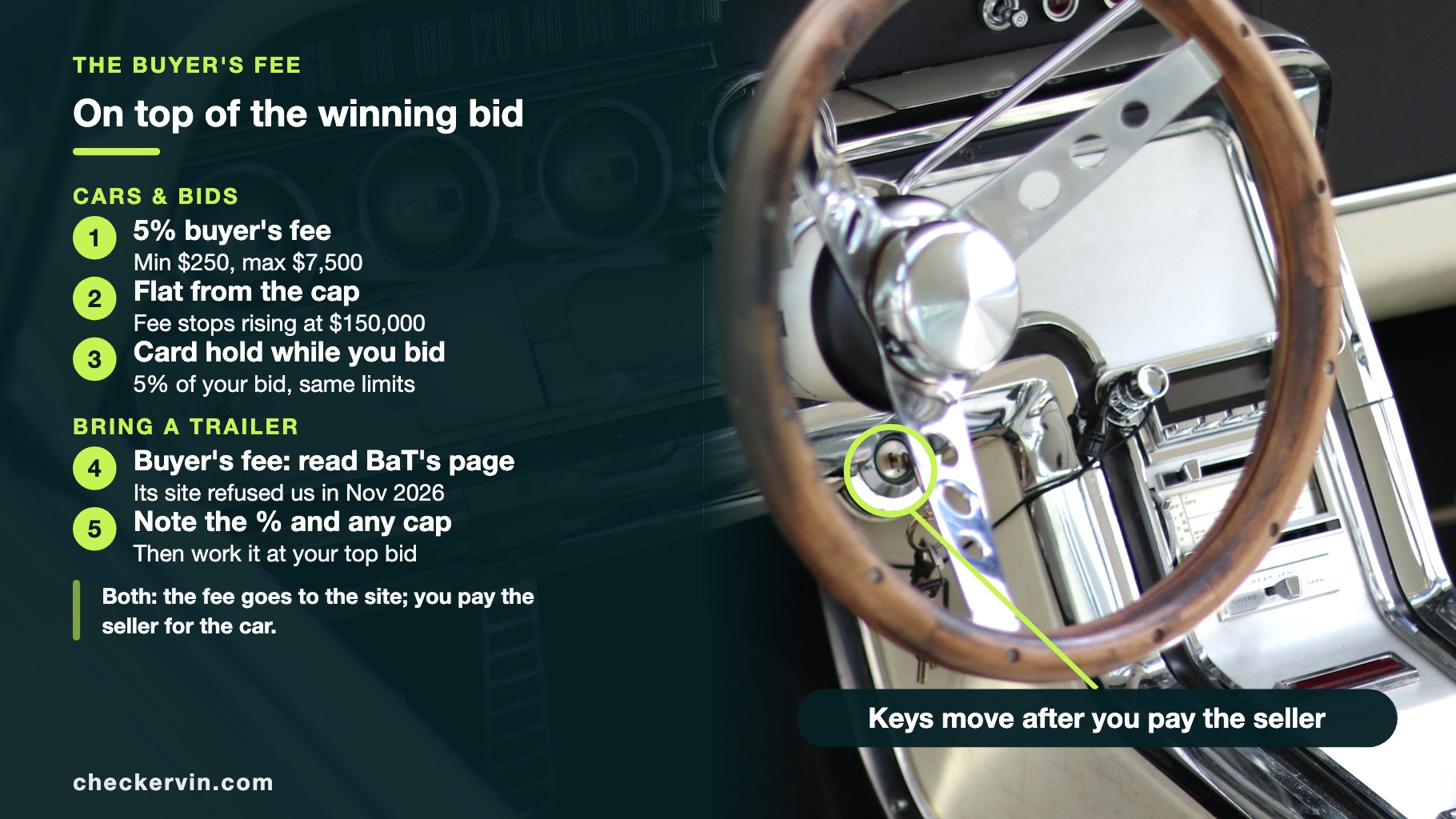
- 5% of the winning bid, with a $250 minimum and a $7,500 maximum, paid to Cars & Bids on top of the price you pay the seller. Listing is free for sellers.
- What is the Bring a Trailer buyer's fee?
- Bring a Trailer's site refused our requests in November 2026, so we do not print a figure. Read its own fee page before bidding and run the numbers the same way.
- Who guarantees the car?
- Nobody but the seller's description. Cars & Bids' terms call it a marketplace only, with the sale contract formed between seller and winning bidder, as-is. Check the VIN, the title record and the car itself before you bid.
5%
Cars & Bids buyer's fee
$250 min, $7,500 max
$150,000
Bid where the cap starts
Fee stays flat above it
7 days
Cars & Bids auction length
1-minute reset on late bids
12
DOJ-listed NMVTIS providers
Selling the title record to the public
Bring a Trailer vs Cars & Bids in short
Both sites sell cars by timed online auction, both pick which cars they list, and both lean on a public comment section where bidders ask the seller questions in the open. Both charge the buyer, not just the seller. The fee is the easy part to compare. The hard part is the same on either site: the car is sold by a private seller, on the seller’s description, and once you win you are committed.
Cars & Bids spells out its terms plainly on pages we could read: a percentage buyer’s fee with a floor and a ceiling, free listing for sellers, a free vehicle history report on every listing, a seven-day auction, hidden reserves, and an optional payment-and-title service run with KeySavvy. Bring a Trailer’s own pages refused our requests in November 2026, so for its fee and terms this page tells you what to look up rather than guessing.
The buyer’s side of the job does not change with the site. Decode the VIN and compare it to the listing, check open recalls, pull the federal title record, and get a pre-purchase inspection before the auction ends. A comment thread can surface a problem; it cannot clear a car.
Cars & Bids buyer fee: a percentage with a floor and a cap
Cars & Bids’ FAQ puts it in one sentence: in addition to the final price paid to the seller, buyers pay a 5% buyer’s fee to Cars & Bids, with a minimum of $250 and a maximum of $7,500. The site’s buying guide repeats the same figures. Here is that rule worked at six bids, as read on November 25, 2026:
| Winning bid | Cars & Bids buyer's fee · share of bid |
|---|---|
| $3,000 | $250 · 8.3% |
| $5,000 | $250 · 5.0% |
| $25,000 | $1,250 · 5.0% |
| $60,000 | $3,000 · 5.0% |
| $150,000 | $7,500 · 5.0% |
| $250,000 | $7,500 · 3.0% |
Two thresholds shape the fee. Below $5,000 the $250 minimum is larger than 5%, so a $3,000 car carries a fee of 8.3% of its price. From $150,000 up, the $7,500 cap applies, and the fee shrinks as a share of the bid: 3.0% on a $250,000 car. Between those two points it is a straight 5%.
The fee goes to Cars & Bids. The seller receives the whole winning bid, and you pay the seller separately, so budget the two as different payments made to different parties on different days.
Bring a Trailer fees: what we could and could not confirm
Searchers ask about Bring a Trailer fees more than any other question on this subject, and we would rather leave a gap than print a number we did not read. On November 25, 2026, bringatrailer.com returned an access-denied response to every page we requested, including its fee and how-it-works pages, and our browser tool would not open the domain at all. Under our rules a fee seen only in a search snippet, a forum or another company’s blog does not go on the page, and plenty of those disagree with each other.
What you should read on Bring a Trailer’s own site before bidding, and write down:
- The Bring a Trailer buyer's fee: its percentage of the winning bid
- Any minimum and maximum on that fee, and the bid where the maximum starts
- Whether motorcycles, parts, memorabilia or other categories carry a different rate
- Whether a card hold or deposit is taken when you register or bid
- What the seller pays to list, and whether any of it depends on the result
With those five answers, work the fee at your target bid exactly as the table above does for Cars & Bids. If the page shows a date or version, note that too; fee schedules on both sites have changed before and will again.
How to compare the two buyer's fees on one car
A percentage alone does not tell you which site is cheaper for a given car. The floor and the cap do most of the work at the ends of the price range, so compare at the price you actually expect to pay.
- 1Pick the bid you expect to win atUse your real ceiling, not the current bid. The fee is set by the final number.
- 2Apply each site's ruleFor Cars & Bids: 5% of that bid, raised to $250 if it falls short, cut to $7,500 if it runs over. For Bring a Trailer: the rule you read on its own fee page.
- 3Add what happens afterTransport, sales tax and registration in your state, and any payment-service fee. Cars & Bids SafePay is $198 for the buyer, plus $99 when a seller's loan has to be paid off, and the two parties may split it.
- 4Then subtract the inspectionA pre-purchase inspection is paid by the buyer on Cars & Bids, per its own FAQ. It costs far less than the fee on most cars and is the only line here that tells you about the car.
A same-car comparison is rare in practice, because each site picks its own listings and a given car appears on one. The useful version of this math is the ceiling: decide what the car is worth to you delivered, subtract the buyer’s fee and the costs after it, and bid no higher than what is left.
Seller fees in brief
A buyer cares about seller fees for one reason: they shape which cars appear and how sellers set reserves. Cars & Bids’ FAQ says listing a car is completely free and sellers receive 100% of the final sale price, with paid extras such as professional photography offered on top. Submitting a car is also free, and Cars & Bids decides whether to accept it.
We could not read Bring a Trailer’s seller terms, so we do not describe its listing fee. If seller pricing matters to you, as it does when you are both buying and selling, check its current page directly.
Who runs each site
Cars & Bids’ own About page says automotive reviewer Doug DeMuro and a team created it for the modern enthusiast, with a focus on cars from the 1980s, 1990s and later. The company named in its copyright line is Cars and Bids LLC. Its FAQ describes what it looks for as anything from traditional sports cars to oddball vehicles and special trucks and SUVs, and notes it does not list every car it is offered.
Bring a Trailer appears among the brands on Hearst’s international licensing site, which describes it as a digital auction platform that curates vehicles submitted by its audience, with a community of users and registered bidders that vets each listing. That is Hearst describing its own brand; it is the only official source on Bring a Trailer’s ownership we could open, so we do not add dates or deal terms to it.
How each site discloses history and condition
Cars & Bids says it provides a vehicle history report for every vehicle it lists, for free, rather than asking sellers to pay for their own. Its pages we read do not name the company that supplies the report, so we do not either. Its buying guide tells bidders to review the listing’s known flaws, the history report, any inspection report, recent maintenance and photos before bidding.
The listing text itself is written by Cars & Bids from what the seller provides, and the seller approves it before it goes live. Its terms of use are direct about what that means: listing content is prepared solely from information, photos, documents and statements supplied or confirmed by the seller; Cars & Bids does not inspect cars or independently verify seller information; and any editorial characterization in a listing is not a warranty or certification.
We could not read how Bring a Trailer handles history reports. Look at the listing itself: if a report is linked, note its provider and date; if none is, budget for one.
Reserve vs no reserve, and how the auction ends
Cars & Bids lets sellers choose a reserve auction, with a hidden minimum price, or a no reserve auction, where the car sells to the high bidder at whatever that bid is. Listings show a No Reserve tag when there is none. Reserves are never published, and buyers are asked not to ask about them during the auction.
| Cars & Bids rule | What it means for a bidder |
|---|---|
| Reserve is hidden | You learn it was met only if the car sells at the close |
| Seller may lower the reserve | Only downward, at any point during the auction |
| Reserve not met | Cars & Bids works with the seller and the high bidder to agree a price; only the high bidder may make that post-auction deal |
| Every auction starts at $0 | With or without a reserve |
| 7-day auction | A bid in the final minute resets the clock to 1 minute, so it ends when bidding stops |
| No proxy bidding | If you are outbid you bid again by hand, and the price jumps straight to your new bid |
Bids rise in steps that grow with the price: $100 from $0, $250 from $15,000, $500 from $50,000, and $1,000 at $200,000 and above. Because there is no proxy bidding, set your ceiling before the final minutes rather than during them.
A no-reserve listing is a commitment by the seller, not a discount for the buyer: the car will sell, and the price is whatever the room pays. We could not read Bring a Trailer’s reserve rules, so check its page for how it marks reserve and no-reserve lots and what happens when a reserve is not met.
Bids are binding: the rule that makes checking first matter
Cars & Bids does not let you retract a bid. Its FAQ says only to bid if you fully intend to buy and have done the due diligence, that the buyer’s fee is not refundable after you win, and that walking away from a won auction can mean forfeiting the fee and permanent removal from the site. If someone else bids from your account, you remain responsible for the purchase.
The card hold is how the fee is secured. When you bid, Cars & Bids places a hold of 5% of your bid on your credit card, within the same $250 floor and $7,500cap as the fee. Lose the auction and the hold is canceled at the close, though Cars & Bids notes your bank may take up to 7 business days to show it released.
So the order matters. Inspection, financing approval, shipping quote and a talk with the seller about timing all come before the first bid. Cars & Bids says payment is expected within one week of the close and that it does not arrange financing, so a loan you have not been approved for is a problem you discover too late.
Payment and escrow: paying the seller safely
On Cars & Bids you pay Cars & Bids only the buyer’s fee. The car itself is paid for between you and the seller, in one of two ways.
| Route | How Cars & Bids describes it |
|---|---|
| SafePay (optional) | Run with KeySavvy, a licensed dealer. Payment is collected from the buyer and paid to the seller when the car is picked up. KeySavvy verifies the seller's ownership, pays off any loan and handles the title. Buyer price: $198, plus $99 if there is a loan; the parties may split it. No cancellation fee. |
| Paying the seller directly | Cars & Bids recommends wire transfer, cashier's check or USDC. The seller should release the car and title only with full payment in hand, and mail a signed title by tracked courier when the sale is remote. |
Cars & Bids calls SafePay similar to escrow but built for vehicle sales, and it is careful about what it does not cover: neither Cars & Bids nor KeySavvy guarantees the car’s condition. What KeySavvy guarantees is the transfer of funds and the ownership and title check. That is worth having on a remote purchase, where title fraud and an unpaid loan are the two ways to pay for a car you never own.
Paying directly is legitimate, but it puts the title work on you. Before money moves, ask for a photo of the title and registration, confirm the name matches the seller, and check for a lien. Our vehicle lien checkguide covers how. We could not read Bring a Trailer’s payment pages; check whether it offers a payment service and what it covers before you assume one.
Who stands behind the car: the seller, as-is
Cars & Bids’ terms of use answer this directly. It is a marketplace only, and the contract for each sale is formed between the seller and the winning bidder. It does not inspect, authenticate or certify any car, and its FAQ says every auction runs on an as-is, where-is basis, with the responsibility on the bidder to inspect the car, consider a pre-purchase inspection and raise concerns with the seller before bidding.
In practice that means your recourse runs to the seller and to what the listing said. That is why the listing matters as a record: save it, its photos and the comment thread on the day the auction ends. Cars & Bids says it keeps all auctions perpetually available, whatever their outcome, but your own copy does not depend on that.
We could not read Bring a Trailer’s terms. Read them before bidding, looking for the same three things: who the contract is between, whether the sale is as-is, and what the site does and does not verify.
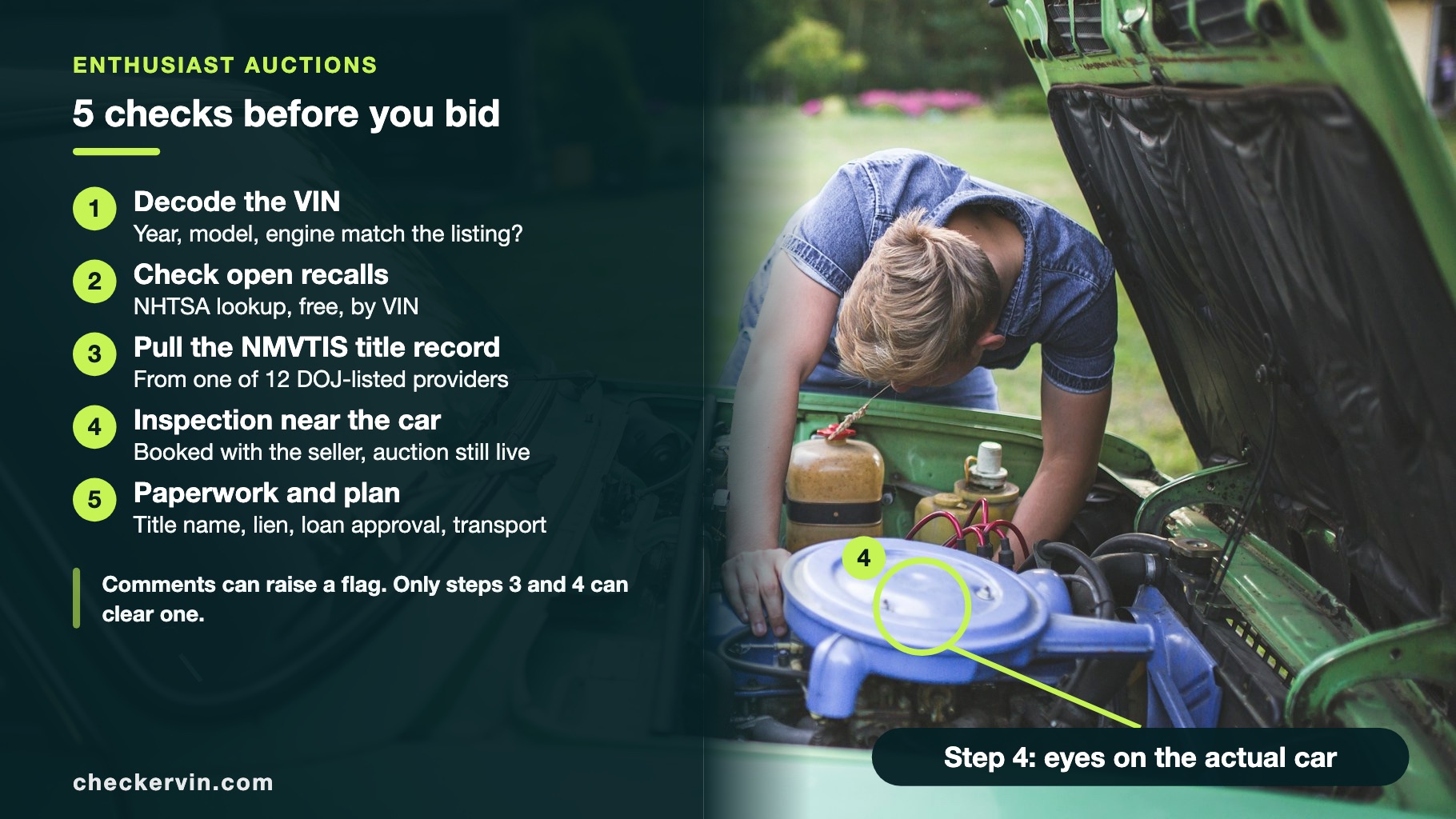
The buyer's checks before you bid on either site
Run these in order. Each one is cheaper than the next, and any of the first three can save you the cost of the fourth.
- 1Decode the VIN and compare it to the listingYear, make, model, body, engine and plant should match what the listing says. A wrong engine code or model year on a car sold on its originality is the cheapest red flag you will ever find.
- 2Check open safety recallsNHTSA's recall lookup lists unrepaired safety campaigns on that VIN. An open recall is fixable for free at a dealer, but you want to know before the car ships.
- 3Pull the federal title recordNMVTIS holds the title brands states applied, insurer total-loss reports and odometer readings. The Department of Justice lists 12 approved providers that sell it to the public. Compare it with the history report in the listing.
- 4Book a pre-purchase inspection near the carCars & Bids suggests a reputable shop in the seller's area or a mobile inspector, at the buyer's cost, arranged through the seller. Do it while the auction is live.
- 5Confirm the paperwork and the planTitle in the seller's name, any lien and how it will be paid off, your financing approval, and a transport quote, all before your first bid.
Decode the listing's VIN free before you bid
Decoded from official manufacturer and NHTSA records
Our pre-purchase inspection guideexplains what an inspector checks and what they cannot see, which matters when the car is a thousand miles away and you are relying on someone else’s eyes.
Older cars: when the VIN will not decode
Both sites list plenty of cars built before the 17-character VIN became standard for the 1981 model year. On those, a modern decoder returns little or nothing, and that is normal, not a warning sign. The checks shift: the numbers on the body, engine and trim tags, whether they agree with each other and with the title, and whether the car is the model it claims to be or a tribute built from a lesser one.
For a car sold on its originality, that comparison is the purchase. Our classic car VIN decoder guide explains which tags matter, how to spot a restamped number, and how states title cars with short or replacement VINs. Ask the seller for clear photos of every tag during the auction, in the comments where other bidders can weigh in.
After the hammer: transport, tax and title
Cars & Bids says transport is always the buyer’s responsibility and suggests getting a quote before bidding; it offers its own shipping service with instant quotes on most listings. Some sellers will store the car briefly or bring it to a loading point, but that is a favor to agree in advance, not a right.
Sales tax and registration are owed in your state when you register the car, including when SafePay handles the payment; Cars & Bids notes that Minnesota buyers pay theirs through KeySavvy. Some states require the seller’s signature on the title to be notarized, and a state can take several weeks to reissue a title after a loan is paid off. Buying across state lines adds its own steps, covered in our buying a car out of state guide.
International buyers can bid on Cars & Bids, but its FAQ puts all export, import, transport and legal costs on the buyer and says to have them arranged before bidding. Bids are in U.S. dollars, including on cars located in Canada.
Which one fits your purchase
For a buyer, the choice is mostly made by the car: each site lists different cars, and the right one is wherever the car you want is for sale. What differs is how much you can learn before bidding from the site’s own pages.
| Question | What we found |
|---|---|
| Buyer's fee published? | Cars & Bids: yes, 5% with $250 min and $7,500 max. Bring a Trailer: not readable by us in November 2026 |
| History report on every listing? | Cars & Bids says yes, free. Bring a Trailer: not confirmed |
| Optional payment and title service? | Cars & Bids SafePay with KeySavvy, $198 buyer price. Bring a Trailer: not confirmed |
| Who stands behind the car? | On Cars & Bids, the seller, as-is, per its terms. Read Bring a Trailer's terms for its wording |
| Can you retract a bid? | Cars & Bids: no. Check Bring a Trailer's rules before bidding |
If you are deciding between two similar cars, one on each site, the gap in buyer’s fees is usually smaller than the gap in condition. Put your inspection money where your bidding money is going.
Where this information comes from
- Cars & Bids — Frequently Asked QuestionsBuyer's fee, card hold, bid increments, reserves, binding bids, payment, SafePay pricing, community rules and seller fees; read November 25, 2026
- Cars & Bids — What's Cars & Bids? (Buying a Car)Free history report on every listing, seven-day auctions, due-diligence steps, finalizing the sale; read November 25, 2026
- Cars & Bids — Terms of UseEffective August 14, 2026: marketplace only, contract between seller and winning bidder, no inspection or verification
- Hearst Magazines International — Bring a TrailerHearst's own description of the Bring a Trailer brand and its community vetting
- NMVTIS — approved data providersThe Department of Justice list of providers that sell the federal title record; read November 25, 2026
- NHTSA — Recalls lookupFree check for open safety recalls by VIN
- How we made this pageWritten by the CarCheckerVIN editorial team with AI assistance from Cars & Bids' own FAQ, buying guide and terms, Hearst's brand page, NHTSA and the Department of Justice NMVTIS list; facts checked November 2026. Bring a Trailer's pages could not be opened, so no Bring a Trailer fee is printed. Every Cars & Bids figure comes from one table in the page's code.
Keep reading
Frequently asked questions
What are the Cars and Bids fees for a buyer?
Cars & Bids charges the winning bidder a 5% buyer's fee on top of the price paid to the seller, with a minimum of $250 and a maximum of $7,500, per its own FAQ as read on November 25, 2026. While you bid it holds 5% of your bid on your credit card, within the same floor and cap. The fee is not refundable once you win. SafePay, its optional payment service, costs the buyer $198 more if you use it.
What are the Bring a Trailer fees?
We could not confirm them. Bring a Trailer's own pages refused our requests in November 2026, and we print fee figures only from a marketplace's own fee page. Before you bid, open Bring a Trailer's How BaT Works and fee pages and note three things: the buyer's fee percentage, any minimum and maximum, and whether a different rate applies to motorcycles, parts or other categories.
Bring a Trailer vs Cars and Bids: which is better for a buyer?
Neither stands behind the car, so the better site is the one listing the car you want, priced right after its buyer's fee. Cars & Bids publishes a fee with a floor and a cap, puts a free history report on every listing, and offers an optional payment and title service. On Bring a Trailer, read its fee and terms pages yourself, because we could not. On both, the checks before bidding are the same.
Is Cars & Bids a safe place to buy a car?
It is a real marketplace with published rules, but its terms are clear that it does not inspect, authenticate or certify cars and does not verify what sellers supply. The contract is between you and the seller, and the car is sold as-is, where-is. Safety comes from your own checks: VIN decode against the listing, open recalls, the NMVTIS title record and a pre-purchase inspection before you bid.
Can I back out after winning a Cars & Bids auction?
No. Its FAQ says bids are binding and cannot be retracted, the buyer's fee is not refundable after you win, and failing to complete a purchase can mean forfeiting the fee and being removed from the site permanently. Do the inspection, financing and shipping planning before your first bid.
Do Bring a Trailer and Cars & Bids listings include a vehicle history report?
Cars & Bids says it provides a vehicle history report for every vehicle it lists, for free; its pages do not name the report's provider. We could not read Bring a Trailer's pages to confirm its practice. Either way, a commercial report is not the same thing as the federal NMVTIS title record, which you can buy from a Department of Justice-listed provider.
Check the car before the comment thread closes
Decode any auction listing's VIN free for the factory build, specifications, warranty and open recalls. No account, no card. Full vehicle history reports are launching soon.
Run a free VIN check
The comment-section vetting model, and its limits
The comment section is the feature both sites are known for. Bidders ask the seller about rust, service records, panel gaps and paint, and the answers sit in public for every bidder to read. Hearst’s description of Bring a Trailer puts the idea plainly: its community vets each listing. Cars & Bids asks sellers to answer questions in the comments and through its private Contact feature, and says active sellers do best.
Cars & Bids’ rules show where the comment model is steered. Comments must stay on the car being sold. Asking the seller about the reserve, calling out the price you think the car will sell for, posting contact details and plugging a business are all moderated. A Reputation Score, built from upvotes on comments and bids, sits beside each username.
Read the thread, and then remember what it is. Commenters see the same photos you do. Nobody in the thread has put the car on a lift, and the seller chooses how to answer. A clean comment section is the absence of a raised flag, not a clean bill of health. Use our used car red flags guide for the signs a walk-around never shows.