The short answer
- Is tire size in the VIN?
- No. The federal table of attributes a VIN must convey covers engine, body, brake system and weight rating, and never mentions tires. NHTSA's own decoder has 144 fields and not one of them is a tire size designation.
- Where is it recorded instead?
- On the Tire and Loading Information placard, which safety rules require on every vehicle rated at or below 10,000 pounds except motorcycles and trailers. It gives the size fitted at first sale under a heading reading size, original tire size or original size.
- Where do I look for it?
- The driver's side B-pillar first — that is the location the rule names before any other. Where the vehicle's construction rules that out, the regulation sets three fallbacks in a fixed order, ending at the surface beside the driver's seat.
10,000 lb
GVWR ceiling for the placard rule
At or below it, the placard is mandatory
Four
Locations the rule permits
In a fixed order of preference
None
Tire size fields in the federal decoder
Out of 144 variables
Original
What the placard records
The size fitted at first sale
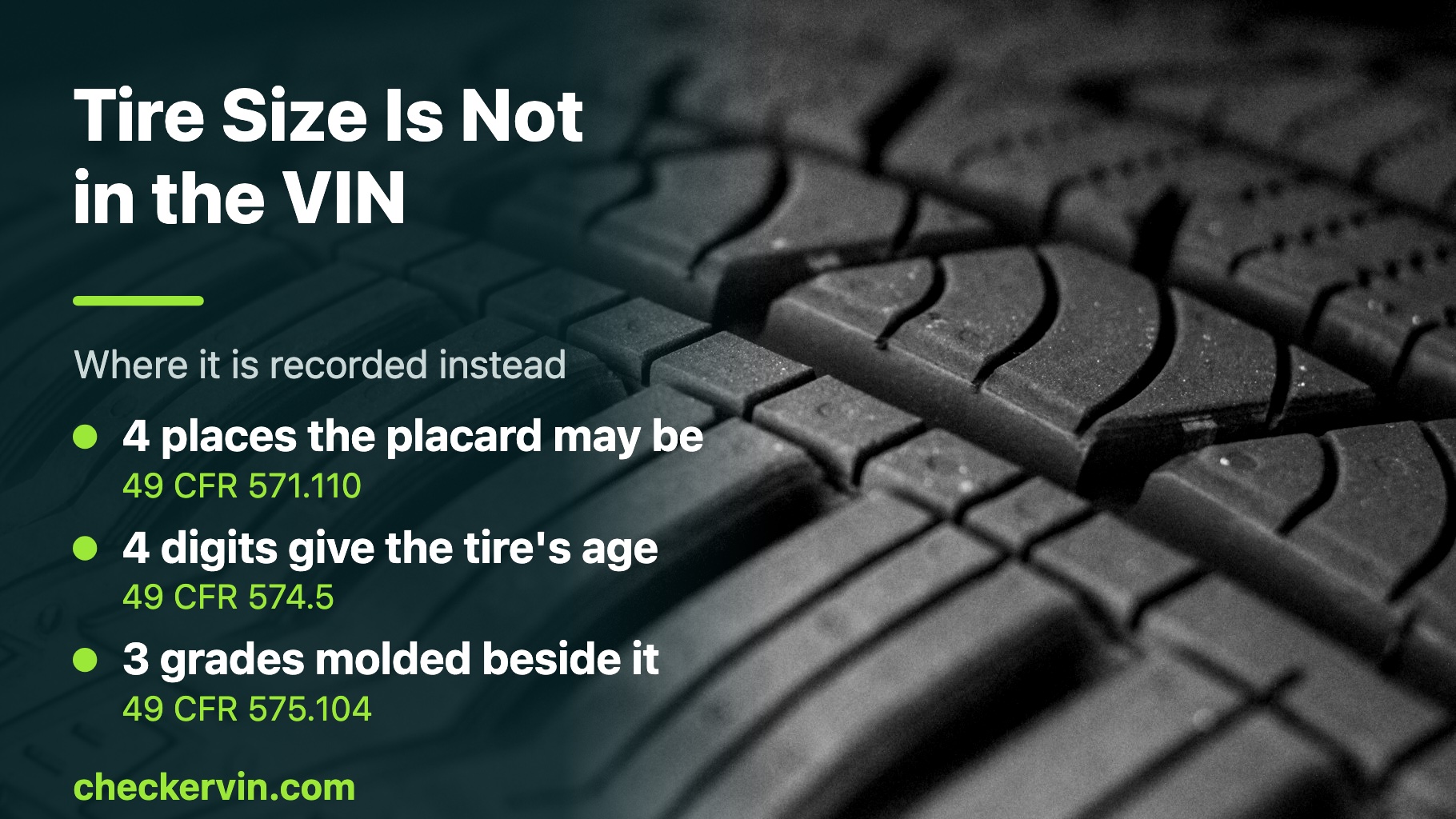
The VIN was never given a tire field
Worth being blunt about, because a good deal of searching goes nowhere on this point. Federal regulation sets out class by class which attributes the middle characters of a VIN must convey. For a passenger car that means line, series, body type, engine type and restraint system. For a truck it adds chassis, cab type, brake system and weight rating. Tires are on none of those lists.
The public decoder run by NHTSA reflects this exactly. It exposes 144 separate variables, and the ones touching wheels and tires are wheel diameter front and rear, the number of wheels, and the type of pressure monitoring system fitted. A size designation is not among them, because there is nothing in the number to read it out of.
The placard the rule does require
Where a VIN says nothing, a different safety standard says a great deal. It applies to vehicles with a gross vehicle weight rating of 4,536 kilograms — 10,000 pounds — or less, excluding motorcycles, and it requires a permanently affixed placard carrying specified information in the English language.
The heading is fixed by the rule: Tire and Loading Information. That phrase is not a manufacturer's choice of wording, which is convenient, because it means the same three words identify the right label on a Honda, a Ram and a Volkswagen.
Trailers and incomplete vehicles are carved out, which is why a utility trailer has no such placard and why a chassis cab delivered for upfitting may carry its tire information differently.
Four permitted locations, in a fixed order
This is the detail that turns a hunt into a two-minute job, and it is the part almost nobody knows: the regulation does not simply say put it somewhere sensible. It names a first choice and then three fallbacks, each conditional on the one before being impossible.
- 1The driver's side B-pillarThe default, and where the overwhelming majority of vehicles carry it. Open the driver's door and look at the upright post between the front and rear doors.
- 2The forward edge of the rear side doorApplies to vehicles with no driver's side B-pillar and two doors on that side opening in opposite directions — the rear-hinged arrangement on some extended cabs and small cars.
- 3The rear edge of the driver's doorUsed where neither of the above allows a placard that is legible, visible and prominent. On the door itself rather than the frame.
- 4The surface beside the driver's seatThe last resort the rule allows: an inward-facing surface next to the driver's seating position, for vehicles where nothing else works.
The consequence of that ordering is practical. If you have opened the driver's door and found nothing on the pillar, you are not looking at a car that hid its placard somewhere creative. You are looking at one of the specific construction cases the rule anticipated, and the next place to check is determined rather than random.
Everything the placard has to carry
Tire size is one entry among several, and the others are worth reading while you are standing there, because together they describe what the vehicle can safely carry.
| Required item | What it tells you |
|---|---|
| Vehicle capacity weight | Phrased as the combined weight of occupants and cargo that should never be exceeded |
| Designated seated capacity | Total occupants, broken down by front and rear seating positions |
| Cold inflation pressure | Manufacturer's recommended figures for front, rear and spare |
| Tire size designation | The size fitted at first purchase, plus the spare |
| The heading itself | Tire and Loading Information, fixed by the regulation |
| Manual reference | A pointer to the owner's manual for additional information |
Note what the size field is defined as: the tires installed at the time of first purchase for purposes other than resale. It is a historical record of how the vehicle left the dealership, not a statement about what is on it today.
Reading the designation once you find it
A size looks like 225/65R17 and decomposes cleanly. The first number is section width in millimeters. The number after the slash is the aspect ratio — sidewall height as a percentage of that width. The letter describes construction, with R meaning radial. The final number is the wheel diameter in inches, which is why that one figure is the only tire-adjacent number a VIN decode tends to know.
Letters before the width matter too. A P prefix marks a passenger tire and LT marks a light truck tire, and the two are not casually interchangeable — load ratings are calculated differently, which is precisely why the rule ties the size designation to the inflation pressures printed beside it.
After the size you will usually find a load index and a speed rating on the tire sidewall itself. Those are properties of the tire rather than the vehicle, so they appear on the rubber, not on the door pillar.
Wheel diameter is not a tire size
This trips people up when a decode returns something that looks close to an answer. A VIN decode may well tell you the vehicle came with seventeen-inch wheels. That single number leaves both of the figures that actually determine fitment unstated.
Two vehicles on identical seventeen-inch wheels can take meaningfully different tires, because width and aspect ratio vary with trim, drivetrain and factory package. Buying on diameter alone is how people end up with tires that rub at full lock or sit visibly wrong in the arch.
The other label, and why it names a tire size too
There is a second federally required label on the vehicle — the certification label — and it carries the gross axle weight ratings. Those ratings are stated together with a tire size designation, because an axle's permitted load depends on what is holding it up.
That pairing is genuinely useful when a vehicle is offered with more than one tire option. The certification label tells you which combination the manufacturer certified, and a mismatch between it and the placard is a signal worth understanding before you buy tires.
It matters most on trucks and vans, where the same body can be sold in several weight ratings and the tires are part of what separates them.
When what is fitted disagrees with the placard
On a used vehicle this is common rather than alarming. Tires get replaced several times over a life, and not every replacement matches the original specification.
The consequence is specific: the inflation pressures on the placard were calculated for the original size, so a different size on the vehicle means those numbers may no longer be the right ones. Anyone changing away from the factory fitment needs pressures worked out for what is actually installed.
- Compare all four sidewalls against each other before comparing them to the placard
- Mixed sizes across an axle is a reason to walk, not a negotiating point
- A larger diameter than original alters indicated speed and odometer accumulation
- Passenger tires on a truck rated for light truck tires reduces the load margin
- Check the spare separately — it is frequently the original size and long expired
- Ask why the size changed if the seller chose it deliberately
Size is only half of what to check
Having found the right size, spend another minute on the tires themselves, because a correctly sized tire can still be the wrong tire to drive on.
Uneven wear across a tread face is worth reading first. Wear concentrated at both shoulders points at chronic underinflation, wear down the middle at overinflation, and wear isolated to one edge at alignment or a worn suspension component. That last one is a bill attached to the car rather than to the tires.
Then there is age, which is invisible in the tread and is the check most buyers skip. Rubber ages on a calendar whether or not the vehicle moves, so a set with deep tread and an old date is a genuinely poor buy — a common situation on low-mileage cars and one sellers rarely raise. That date is molded into the sidewall by federal requirement, and the next section is how to read it.
How old the tires are, from four digits on the sidewall
Tires carry their own federal identifier, quite separate from the vehicle’s VIN and from the placard. Under 49 CFR § 574.5, each new tire manufacturer must conspicuously label one sidewall of each tire by permanently molding into or onto it a Tire Identification Number — a TIN of 13 symbols, in the manner and location the rule specifies.
The part a buyer wants is the end of it. The date code is the final group, and the rule is exact about what those four numerical symbols mean: the first two identify the week of the year and the last two identify the last two digits of the year of manufacture.
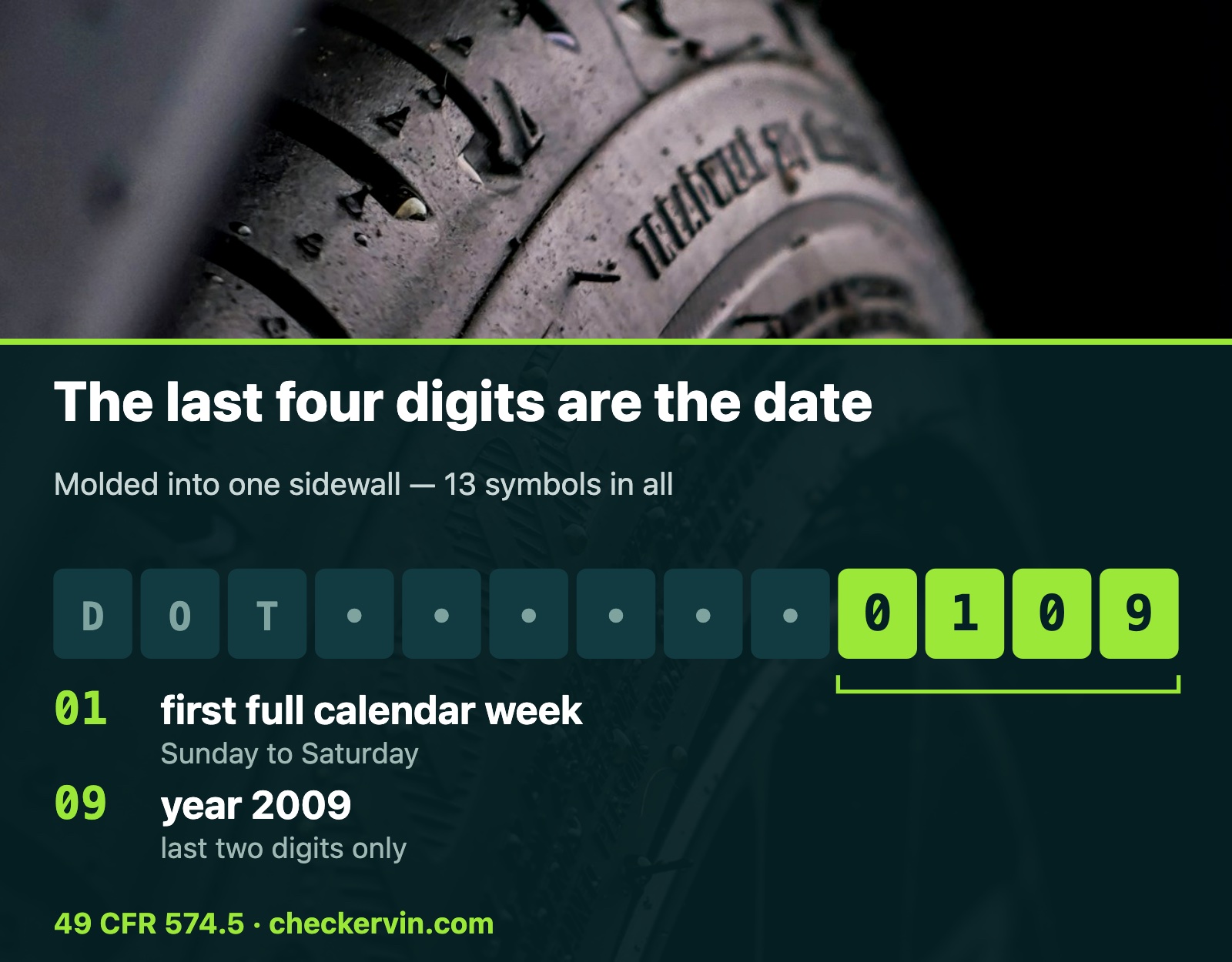
The week numbering is stricter than most explanations suggest. “01” means the first fullcalendar week in the year, “02” the second, and so on — and the calendar week runs Sunday through the following Saturday. The final week of a year may include no more than six days of the following year. The regulation supplies its own worked example: 0109 means the tire was made in the first full calendar week of 2009, the week beginning Sunday, January 4 2009 and ending Saturday, January 10 2009.
Retreads are marked differently and the difference is worth recognizing on a used vehicle. A retreader labels at least one sidewall with a TIN of seven symbols rather than thirteen, and the symbol R is used to identify retreaded tires. A short code beginning with an R is not a damaged marking; it is a different kind of tire, and on a passenger vehicle it is worth a question.
The three grades molded beside the size
There is a second set of markings on a passenger car tire that almost nobody reads, and unlike the size it is a statement about performance rather than dimensions. Under 49 CFR § 575.104, tire manufacturers and brand name owners must provide information indicating the relative performance of passenger car tires in three areas. The regulation states its own purpose plainly: to aid the consumer in making an informed choice in the purchase of passenger car tires.
| The word molded on the sidewall | What follows it, and what it means |
|---|---|
| TREADWEAR | A two or three digit number expressing the tire's grade as a percentage of the NHTSA nominal treadwear value. Grades are expressed in multiples of 20 — 80, 120, 160 and so on |
| TRACTION | AA, A, B or C. A tire is graded C when its adjusted traction coefficient is 0.38 or less on the specified asphalt surface, or 0.26 or less on the specified concrete surface |
| TEMPERATURE | A, B or C, from a test the tire passes only if it finishes a stage with no tread, sidewall, ply, cord, innerliner or bead separation, chunking, broken cords, cracking or open splices |
The treadwear number is the one people misread most, because it looks like a mileage promise and is not. It is a percentage against a nominal value, established by running the candidate tire on a government test course and correcting the projected mileage against course monitoring tires run in the same convoy. A convoy is two or four passenger cars, light trucks or MPVs, each rated at 10,000 pounds GVWR or less, driven within eye range of one another over a course designed to produce wear rates generally representative of public use.
So a grade of 400 does not mean four hundred of anything. It means the tire projected four times the nominal value on that course, in that convoy, after correction — which is a real measurement and a comparative one, not a distance you are owed.
What the grades do not tell you, and which tires have none
The exclusions are as useful as the grades, because they explain the sidewall that carries no grades at all — which buyers routinely read as a marking that has worn off.
- Deep tread tires and winter-type snow tires are outside the grading rule entirely
- Space-saver and temporary use spare tires carry no grades
- Tires with nominal rim diameters of 12 inches or less are excluded
- Limited production tires are excluded — defined as no more than 15,000 of that design and size produced or imported annually
- The rule covers new pneumatic tires for passenger cars, so light truck tires sold outside that scope are a separate question
Two consequences follow for anyone inspecting a used vehicle. A winter tire with no UTQG line is behaving exactly as the regulation intends, and treating its absence as evidence of a counterfeit or a worn marking is a false alarm. And a temporary spare has no grades either — which is a reminder that the spare is a different object from the four tires on the ground, governed by different expectations.
It is also worth being clear about what none of these markings is. The date code is a manufacturing date, not an expiry date; the federal rules quoted here require the date to be stated and do not set a mandatory retirement age. Vehicle and tire manufacturers publish their own replacement guidance, and it varies. The regulation gives you a fact you can read off the tire in ten seconds — how old it is — and leaves the decision where it belongs.
Finding your size, in order
- 1Open the driver's door and read the B-pillarLook for the heading Tire and Loading Information. On most vehicles this is the entire exercise.
- 2Work the fallbacks if the pillar is bareForward edge of the rear side door, then the rear edge of the driver's door, then the surface beside the driver's seat.
- 3Read the sidewalls as a cross-checkThe size on the tire tells you what is fitted now. Where it disagrees with the placard, you have learned something about the vehicle's history.
- 4Decode the VIN for the surrounding specificationModel year, drivetrain, body and wheel diameter, which is what a retailer needs alongside the size to confirm fitment.
- 5Check the certification label on a truck or vanThe axle ratings there are stated with a tire size, which resolves which factory combination the vehicle was certified with.
Where this information comes from
- 49 CFR 571.110 — tire selection and rims (FMVSS No. 110)S4.3 sets the placard's required contents and the four permitted locations in order
- 49 CFR 567.4 — certification label contentRequires gross axle weight ratings stated together with a tire size designation
- 49 CFR Part 574 — tire identification and recordkeeping§ 574.5 on the 13-symbol tire identification number, the four-digit date code, the Sunday-to-Saturday week rule and the retread R symbol
- 49 CFR § 575.104 — uniform tire quality grading standardsTreadwear as a percentage of the NHTSA nominal value, the traction and temperature grades, and the snow, spare, small-rim and limited-production exclusions
- NHTSA vPIC — public VIN decoderReturns wheel diameter and pressure monitoring type, but carries no tire size field
Keep reading
Frequently asked questions
Can you find tire size from a VIN?
Not from the characters themselves — no position in a VIN is allocated to tires. A lookup service can return a size by using the VIN to identify the vehicle and then consulting a fitment database, but that is a second step against separate data, not something read out of the number.
Where is the tire size on my car?
On a placard that federal safety rules require, headed Tire and Loading Information. It lists the size fitted when the vehicle was first sold, together with the recommended cold inflation pressures and the combined weight of occupants and cargo the vehicle can carry.
Why is the placard on the door pillar rather than in the manual?
Because the rule specifies a location where it can be read without moving anything except an outer door. The driver's side B-pillar is the first choice, with three defined fallbacks for vehicles whose construction makes that impossible.
The tires on my car are a different size from the placard. Which is right?
The placard records what the manufacturer fitted at first sale, and the inflation pressures printed on it are calculated for that size. Different tires on the vehicle now means someone changed them, and the pressures on the placard may no longer be the correct figures for what is installed.
How do I tell how old my tires are?
Read the last four digits of the DOT number molded into the sidewall. Under 49 CFR 574.5 the first two identify the week of the year and the last two the year — so 0109 is the first full calendar week of 2009, which is the regulation's own worked example. The rule requires the full identification number on only one sidewall, so if you find nothing, check the inward-facing side before concluding the tire is unmarked.
Decode the VIN, then read the pillar
A free decode gives you the model year, drivetrain and wheel diameter a tire retailer will ask for. The placard on the door pillar supplies the size itself. Between them you have the whole answer.
Run a free VIN check