The short answer
- What does it cost?
- RepairPal lists $692-$1,190 for a Highlander timing job, labeled 'belt.' KBB's year-specific pages range from about $715 to $1,265 depending on year and ZIP.
- Chain or belt?
- Chain on nearly every engine Toyota put in a Highlander. The one real exception is the first-generation Hybrid's V6, sold only for 2006-2010.
- Is it a common failure?
- No. In our federal complaint corpus, ENGINE makes the Highlander's own top five complaint categories in only 8 of 15 model years and never ranks first.
$692–$1,190
RepairPal's general estimate
Published under 'timing belt'
2008–2010
Only Highlander years with a real belt
First-gen Hybrid V6 only
8 of 15
Years ENGINE reaches the top five
2008–2022, federal complaints
Never #1
ENGINE's best rank on this nameplate
Tied for #2 in 2009 & 2013
The numbers, and whose numbers they are
Search this job and the prices cluster in two camps. RepairPal’s general estimator for a Toyota Highlander lists $692 to $1,190 installed, with labor running $331 to $486 of that and parts $360 to $704 — filed under “Timing Belt Replacement.” Kelley Blue Book runs a separate fair-price page for nearly every model year, with figures that vary by ZIP code: about $715 to $823 for a 2020 Highlander, $783 to $1,212 for a 2012, and $1,137 to $1,265 for a 2023 Highlander Hybrid. Every one of those KBB pages is also titled “timing belt replacement,” and on at least one current Highlander page KBB’s own text concedes the contradiction, noting that a car with a timing chain instead of a belt is fortunate because the chain “can actually last the lifetime of your car.”
We publish no price of our own — we decode VINs and pull recall records, not repair quotes — and we did not attempt to independently verify either estimator’s figures by fetching their sites directly. What we can add is the one piece neither page carries: which Highlander years the “belt” label is actually wrong for, and what the federal complaint record says about this nameplate’s engines specifically.
Chain or belt, engine by engine
Toyota put four different engines under a Highlander hood across the years this corpus covers, and three of them never had a belt at all. The exception sat in the very first Highlander Hybrids, and it is the only reason this question has a real answer worth more than one word.
| Highlander engine and years | Timing drive |
|---|---|
| 3.5L 2GR-FE V6 (gas, most of 2008–2022) | Chain |
| 3.3L 3MZ-FE V6 (Hybrid only, 2006–2010) | Belt — the one real exception |
| 3.5L 2GR-FE V6 Hybrid (2011 on) | Chain |
| 2.7L 1AR-FE four-cylinder (2014–2019 base engine) | Chain, listed 'lifetime' by a parts reference |
| 2.5L A25A-FXS four-cylinder Hybrid (2020–2022) | Chain, listed 'lifetime' by the same reference |
That belt lived only on the first-generation Hybrid’s V6, built from the 2006 through 2010 model years. Every gasoline Highlander sold alongside it in those same years already had a chain. Sources disagree on how much that belt actually matters: one Toyota enthusiast technical reference describes the 3.3-liter Hybrid engine as an interference design, where a broken belt can bend valves, while a separate aftermarket parts listing calls the same engine non-interference and suggests a 90,000-mile interval. We read both and could not resolve the conflict from either source alone — which is itself useful information if you own one of these cars: do not assume the lower-risk answer.
Settle a specific car with its VIN rather than its model year alone, because 2008-2010 is exactly the window where gas and Hybrid Highlanders share a model year but not an engine. The timing belt or chain lookup by VIN and the engine size by VIN page both resolve that in under a minute.
What 317 counted engine complaints actually say
Our corpus of federal NHTSA complaints holds 4,258 reports against the 2008–2022 Highlander, gas and Hybrid pooled under one nameplate. NHTSA has no timing-chain category; every engine-related complaint lands under ENGINE, and that category reaches a model year’s own top five most-reported components in only eight of fifteen years. Those eight years add up to 317 counted reports — about 7% of the nameplate’s total complaint volume — and because a year where ENGINE falls below fifth place contributes nothing to that sum, 317 is a floor, not a total. The years below that line are 2010, 2014, 2015, 2016, 2020, 2021, 2022.
Just as telling is where ENGINE ranks in the years it does show up. Its best showing on this nameplate is a tie for second place, in 2009 and 2013— it is never the single most-complained-about system in any Highlander model year, in fifteen years of federal data. Compare that with this nameplate’s own power-train record, where POWER TRAIN ranks first for six straight years running 2017–2022 — a genuinely concentrated pattern this site’s sibling Highlander posts already cover. ENGINE never produces anything close to that shape.
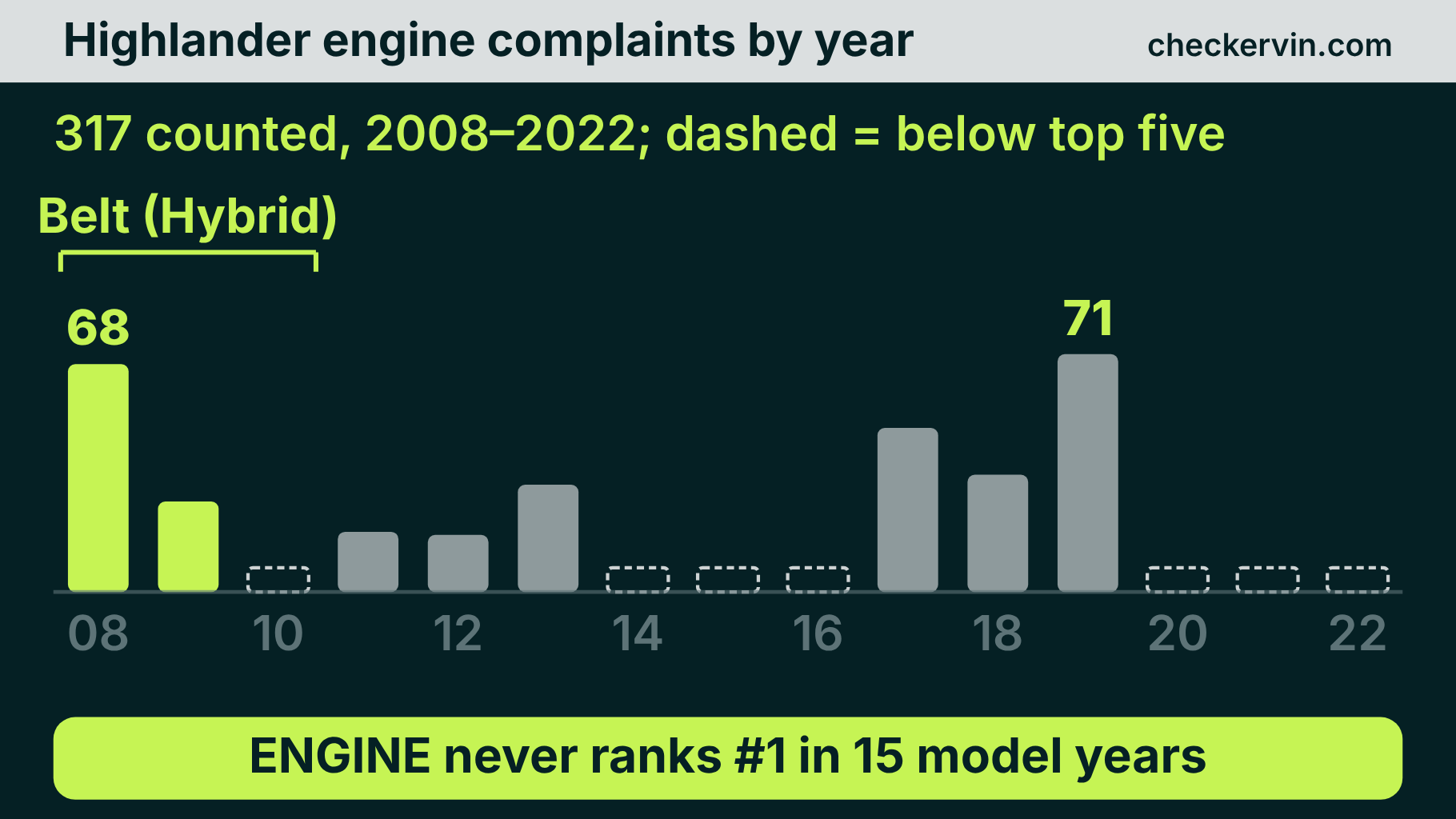
2008–2010: the one era with a genuine belt
Limit the record to the 2008, 2009 and 2010 model years — the only years any US Highlander engine actually used a belt — and the counted ENGINE reports total 95, or 30% of the fifteen-year floor above. We cannot split that figure between the gas 2GR-FE V6 (chain, the large majority of sales in those years) and the first-generation Hybrid’s 3.3-liter V6 (belt): NHTSA’s data pools HIGHLANDER, HIGHLANDER HYBRID and HIGHLANDER HV complaints under one nameplate file, the same limit already stated on this site’s Highlander hybrid-battery post. So this number is an honest upper bound on both engines combined, never a belt-specific count.
That caveat matters more than the number itself. A shopper who finds a KBB page quoting a “Highlander timing belt” price for, say, a 2018 model year is reading a mislabeled chain-engine page. A shopper looking at a genuine 2008-2010 Hybrid is reading about the one car on this entire nameplate where the question is real — and where the record cannot tell you, on its own, whether that specific car’s elevated-for-its-era complaint count has anything to do with the belt at all.
When it really is the chain
On the 3.5-liter 2GR-FE V6 that covers most Highlander model years, a diagnostic trouble code of P0009 points to a timing misalignment on the engine’s second bank. Parts-reference sites most often trace that code to a stretched timing chain or worn tensioner and guides, usually on engines past 100,000 miles, with low or dirty oil named as a cheaper, more common alternate cause worth ruling out first. We found no Toyota technical service bulletin addressing P0009 on this engine specifically.
- A persistent rattle at cold start that does not fade within a second or two
- A check-engine light with a P0009, P0016, P0021 or similar cam/crank correlation code, confirmed on a scan tool
- On a 2008-2010 Hybrid specifically: any history of the belt's inspection or age, since no confirmed interval exists
- Oil seeping from the timing cover, or a known history of low oil level
- A stretched chain confirmed by checking the tensioner plunger's extension through an inspection port
That last check is the one worth paying a shop to do before authorizing a full chain job on a V6. If the tensioner has not fully extended, the chain itself may still be fine and a cheaper fix — a tensioner, a guide, or simply an oil service — may solve the noise.
What the job actually involves, and where the money goes
On the 3.5-liter V6 the chain sits at the front of a longitudinally mounted engine behind a cast cover, with accessory brackets, the crank pulley and usually the water pump bolted over it — reaching it means pulling all of that first. Bruisers’ labor-time guide, which correctly calls this a “Timing Chain, R&R” job rather than a belt job, lists 22.1 standard labor hours for a 2024 Highlander Hybrid’s 2.5-liter engine before tensioner or guide add-ons; the V6 job is a different engine layout but a comparably labor-heavy one. That is the number worth asking a shop to match or explain, not the kit price — on a job this labor-intensive, the chain, guides and tensioner themselves are a modest share of the final bill, and the hours are where two quotes diverge by thousands.
What the recall record covers, and what it doesn't
We could not query NHTSA’s live recall database directly from this session — the connection to nhtsa.gov is blocked here — so this section reports only what our own recall-count column shows per model year, not a fresh pull. Nothing in that column, and nothing in any Toyota document surfaced through web search for this post, names the timing chain, the timing belt or the camshaft gears as the subject of a safety recall. The chain and belt both sit outside the recall system on this nameplate: whatever Toyota has published on either is a technical service bulletin or a parts reference, never a numbered safety campaign.
| Document type | What it means for this repair |
|---|---|
| Safety recall | None found naming the timing chain, belt or camshaft gears on this nameplate |
| Technical service bulletin | None read that applies to the Highlander's timing drive specifically |
| Parts-reference listing (aftermarket) | Source for the chain/belt and 'lifetime' claims above — not a Toyota document |
Running the specific VIN is still worth it for everything else on the car. The Toyota recall lookup by VIN shows every open campaign on a given Highlander, most of which have nothing to do with the engine at all.
Before you authorize the repair
- Confirm the exact engine by VIN — 2008-2010 is the one window where the badge alone will not tell you chain from belt
- Ask for book labor hours and an itemized parts list, then compare quotes on those two lines, not the total
- Have a shop check the tensioner plunger before approving a full chain-and-guide job for a noise alone
- On a 2008-2010 Hybrid, treat the belt as overdue for inspection regardless of mileage — no confirmed interval exists
- Read this nameplate's own complaint record by year before assuming engine trouble explains anything else going on with the car
If you are buying the Highlander, not repairing it
Flip the engine question into a buying checklist. A 2008-2010 Highlander Hybrid is the one car on this entire nameplate where “does it have a belt” is worth asking before you negotiate — every gas Highlander from the same years, and every Highlander of any kind from 2011 on, already has a chain. The Toyota VIN decoder confirms the engine and whether the car is the Hybrid at all.
Beyond the timing drive, the Highlander years-to-avoid breakdown scores every model year against this nameplate’s own median across every complaint category, not just ENGINE — useful context given how thin the engine record actually is next to this nameplate’s power-train and electrical history.
Where this information comes from
- NHTSA — recalls by VINThe federal recall lookup; check a specific Highlander before paying for anything a campaign might already cover.
- RepairPal — Highlander timing estimateThe $692-$1,190 general figure quoted above, published under 'timing belt' regardless of engine.
- Kelley Blue Book — Highlander timing estimateYear-specific fair-price pages, titled 'timing belt' even for chain-driven model years; one page concedes a chain outlasts the car.
- Bruisers — Highlander timing chain labor guideThe 22.1-hour 'Timing Chain, R&R' labor figure for a 2024 Highlander Hybrid, correctly labeled as a chain job.
Keep reading
Frequently asked questions
How much does it cost to replace the timing chain on a Toyota Highlander?
RepairPal's general estimator lists $692 to $1,190 installed, with labor at $331 to $486 of that. Kelley Blue Book's year-specific pages run from about $715-$823 (2020) to $1,137-$1,265 (2023 Hybrid), depending on the model year and ZIP code. Both sites publish those figures under the heading "timing belt replacement" even on model years that are chain-driven. Bruisers' labor guide, which uses the correct chain terminology, lists 22.1 standard labor hours for a 2024 Highlander Hybrid before tensioner or guide add-ons — a useful number for comparing shop quotes, since labor is most of this bill.
Does the Toyota Highlander have a timing belt or a timing chain?
Almost every Highlander on the road has a chain. The 3.5-liter 2GR-FE V6 that powers most gas Highlanders from 2008 on is chain-driven, as is the 2.7-liter 1AR-FE four-cylinder offered from 2014, and the 2.5-liter A25A-FXS hybrid engine from 2020. The one real exception is the first-generation Highlander Hybrid's 3.3-liter V6, sold only for the 2006-2010 model years, which used a timing belt. A 2011 or later Highlander Hybrid has a chain; a 2008-2010 Hybrid has a belt.
How often should the belt be replaced on a 2008-2010 Highlander Hybrid?
We could not find a Toyota-published interval, and the secondary sources disagree on how urgent the question is. One Toyota enthusiast technical reference describes the 3.3-liter Hybrid V6 as an interference engine, meaning a snapped belt can bend valves; a separate aftermarket parts listing calls the same engine non-interference and suggests 90,000 miles. Given the conflict and the engine's age — every one of these cars is now roughly 15-18 years old — the practical answer is to treat the belt as overdue for inspection regardless of a specific mileage, and to get a independent read on interference risk from a shop that has actually opened one.
Is a Toyota Highlander's engine complaint record actually bad?
Not by the nameplate's own standard. In our federal NHTSA corpus covering 2008-2022, the ENGINE category reaches a model year's own top five complaint types in only 8 of 15 years, and even in its best years (2009 and 2013) it only ties for second place — it never ranks first. That is a thinner engine record than several other categories on this same nameplate, which is one reason this post exists: a shopper who searches "Highlander timing chain cost" and lands on a generic price page has no way to tell whether the record backs up the worry.
What does P0009 mean on a Toyota Highlander?
On the 3.5-liter 2GR-FE V6, a P0009 code points to a timing misalignment on the engine's second bank. Parts-reference sites most often attribute it to a stretched timing chain or worn tensioner and guides, usually past 100,000 miles, with low or dirty oil as a secondary cause worth checking first since it is the cheaper possibility. A mechanic can usually confirm a stretched chain by pulling a small inspection cover and checking how far the tensioner's plunger has extended. We found no Toyota technical service bulletin addressing P0009 specifically on this engine.
Confirm the engine before you price the chain
A free CheckerVIN report shows the factory build, engine, specifications and open recalls for any VIN, so you know which Highlander engine — and which era's timing drive — you are actually dealing with.
Run a free VIN check