The short answer
- What does it cost?
- RepairPal lists $297–$355 for Corolla brake pads and $257–$335 for rear shoes, before tax. Rotors and fluid are extra.
- Which years matter?
- 2009–2010: a brake-vacuum recall in cold states, a Smart Stop software campaign, and most of the nameplate's brake defect complaints.
- What changes the bill?
- Whether the rear axle has drums or discs, which depends on year and trim, and on newer cars whether an electric parking brake needs service mode.
$297–$355
RepairPal Corolla brake pad estimate
Retrieved Oct 2026, before tax
$257–$335
RepairPal Corolla brake shoe estimate
The rear job on drum-brake Corollas
8 of 14
Years brake complaints make the top five
2008–2021 Corolla, federal complaints
1
Brake recall, 2008–2021
09V338000, 2009–2010 1.8L, cold states
The numbers, and whose numbers they are
RepairPal publishes the most specific Corolla figures. Its brake pad estimator puts the job at $297 to $355, made up of roughly $122 to $179 in labor and $175 to $176 in parts. Its brake shoe estimator, which is the rear job on a Corolla with drum brakes, comes to $257 to $335, with $164 to $240 of labor and $94 to $95 of parts. Both pages are marked as updated September 3, 2026, and both exclude taxes, fees and your location. RepairPal blocks direct fetches, so we read the figures as its pages were served in search in October 2026.
Kelley Blue Book also prices Corolla brake work by model year, but its numbers move with the ZIP code you enter, and its pages carry a caveat worth remembering when you compare any two quotes: the price shown is for front brakes or rear brakes, not both. A quote that looks twice as high as a published figure is often for two axles.
We sell VIN checks, not brake jobs, and publish no price of our own. The rest of this page is about what moves a Corolla brake bill up or down, and which model years carry something in the federal record you should look at before you pay for a routine pad swap.
Worn pads are maintenance; the complaint record is about defects
Brake pads, shoes and rotors are consumables. Every Corolla wears through them, and nobody files a federal safety complaint because a set of pads reached the wear indicator after normal driving. NHTSA’s service-brakes category records something else: owners reporting that the brakes misbehaved. That means a pedal that sank or went hard, ABS or brake lights, grinding on a nearly new car, brakes that seemed to let go over a bump, or a car that did not stop when the driver says the pedal was down.
So the record cannot tell you how long a Corolla’s pads last, and nothing on this page uses it that way. What it can tell you is which model years drew unusual brake trouble, and whether that trouble was ever traced to a recall or a factory bulletin. That is the part worth knowing before a brake job, because a shop replacing pads on a car with an open brake recall is fixing the wrong thing first.
What 6,096 federal complaints say about Corolla brakes
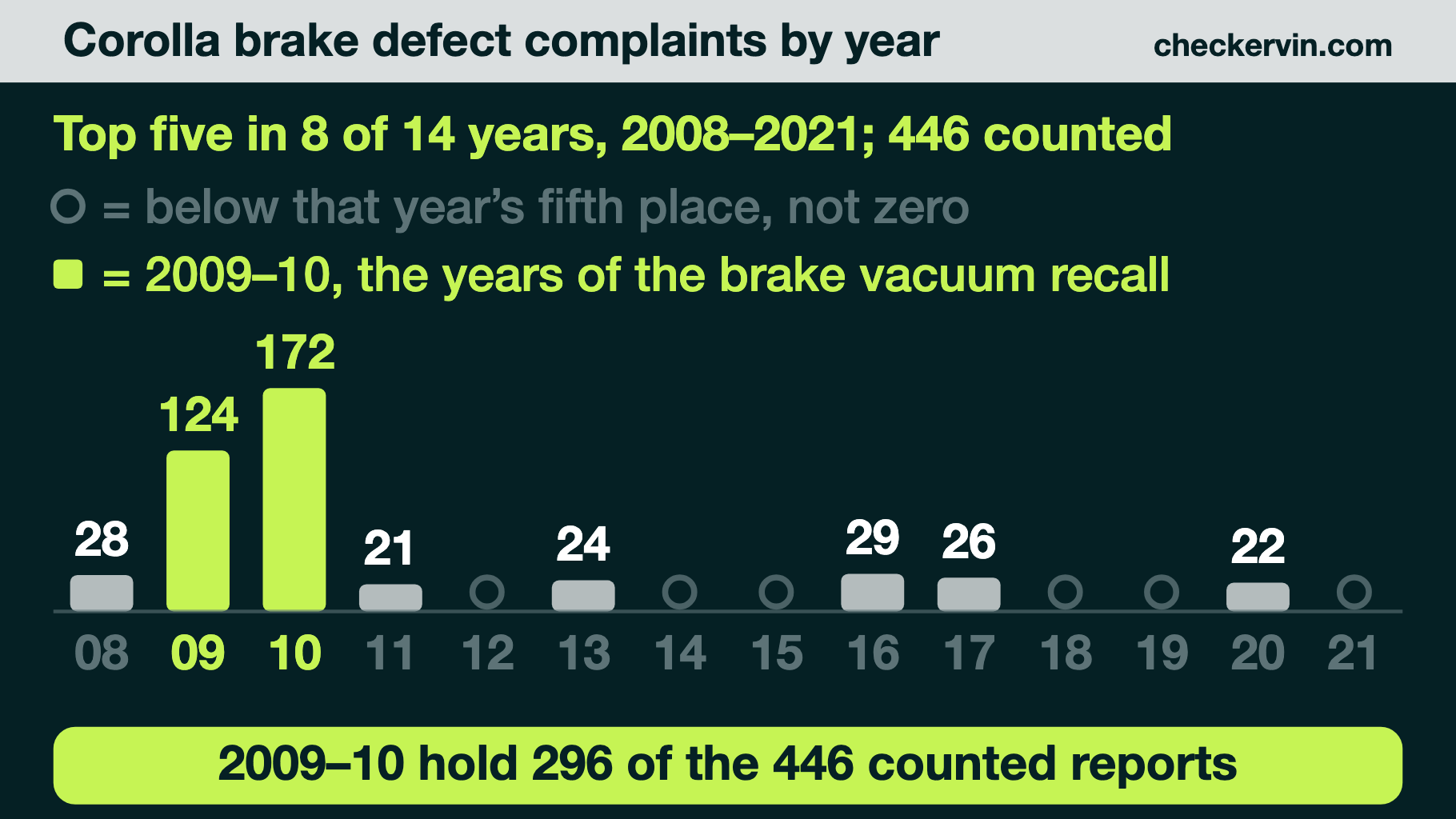
Our corpus holds 6,096 NHTSA owner complaints against the 2008–2021 Corolla, and each model year keeps its five most-reported components. Service brakes make that top five in 8 of 14 model years (2008, 2009, 2010, 2011, 2013, 2016, 2017 and 2020), for at least 446 counted reports. The category never ranks first in any year; its best showing is #2, in 2016. In 2012, 2014, 2015, 2018, 2019 and 2021it ranks below that year’s fifth-place component, which means “below that line,” not zero.
The striking part is how concentrated it is. 2009 and 2010 alone account for 296 of the 446 counted reports, about 66%. The 2010 figure of 172 is roughly 6 times the highest brake count in any later year (29, in 2016). Even in those two years brakes rank #4 both times, behind air bags, steering and vehicle speed controlcomplaints, so the Corolla’s brake story sits inside a much bigger one.
Drums or discs at the back: the line that moves the bill
Every Corolla in this range has disc brakes at the front. The rear is where the cost splits, because a drum-brake rear axle takes shoes and a disc-brake rear axle takes pads, and RepairPal’s two estimates above are priced differently for exactly that reason. The answer depends on the year and the trim.
| Model years | Rear brakes, and how we know |
|---|---|
| 2009–2013 | Drums. Toyota's T-SB-0235-12 supplies improved rear drum brake adjusters for these cars |
| 2011 | Nine-inch rear drums on all models, per Toyota's 2011 Corolla press release |
| 2014 | Rear disc on the S grade, nine-inch drums on the other grades, per Toyota's 2014 release |
| 2015 | Four-wheel discs available with 17-inch wheels, per Toyota's 2015 release |
| 2016–2019 | Mixed by trim; parts catalogs disagree on the LE and SE, so check the car |
| 2020–2021 | Four-wheel discs on the L, SE and XLE in third-party spec listings |
We read Toyota’s bulletin directly. Toyota’s newsroom blocks automated fetches, so the press-release lines are as its pages were served in search, and the 2020 row rests on a third-party spec site. For any single car, the quickest check is to look through the rear wheel: a flat rotor with a caliper is a disc, a closed drum is a drum. Our trim level by VIN lookup tells you the grade the car was built as, which is what the parts counter will ask for.
2009–2010: the one brake recall, and who it reached
We queried NHTSA’s recall database for every Corolla model year from 2008 to 2021. Airbag campaigns dominate the list. Exactly one campaign is filed against the brakes: 09V338000, which Toyota reported in August 2009 and began on September 21, 2009.
It covers 2009–2010 Corollas and Corolla Matrix models, plus 2008–2009 Scion xD, with the 1.8-liter engine, originally sold in or registered in 19 cold-weather states, including Alaska, Colorado, Illinois, Michigan, Minnesota, New York and Wisconsin. NHTSA’s summary describes condensation from crankcase ventilation freezing in extremely low temperatures and blocking the intake-manifold port that supplies the brake booster’s vacuum, which could increase stopping distance. Dealers installed a redesigned intake air connector that moves the vacuum port, at no charge.
Our Toyota recall lookup by VIN shows which campaigns are unrepaired on a specific car. If one turns up on a Corolla you are buying, buying a car with an open recall covers how to handle it.
Why the 2009–2010 record looks so much worse than the car
Reading the 2009 and 2010brake complaints, most were filed during calendar 2010, the months when Toyota’s accelerator-pedal and floor-mat recalls were national news. Many are co-filed with speed control: owners describing a car that would not stop, or seemed to accelerate as they braked. Those sit alongside more ordinary reports, such as the vacuum-port recall notice, ABS lights, a pedal that needed extra effort, grinding from warped front rotors, and brakes that seemed to release over rough pavement.
The acceleration-while-braking reports did not end with the recalls. In September 2014 a petitioner asked NHTSA to investigate “low-speed surging” in 2006–2010 Corollas “in which the brakes fail to stop the vehicle,” and NHTSA opened defect petition DP14-003. It closed in April 2015 with the petition denied: the agency concluded further investigation was unlikely to find a safety defect.
Separately, Toyota’s 2013 economic-loss settlement over unintended acceleration included Smart Stop Technology, an engine-computer update that cuts engine power when the accelerator and brake are pressed together. Toyota’s campaign memo lists roughly 843,300 2009–2010 Corollas, and a September 2016 update converted the campaign, code BST, into a special service campaign with no expiration date. It is not a brake part, and it does not change what a pad job costs, but on a 2009–2010 car it is worth asking a dealer whether it was installed.
Factory bulletins, generation by generation
Bulletins are not recalls: they tell dealers how to fix a known complaint, and coverage is usually limited to the factory warranty. Every Corolla here is past that warranty now, but a bulletin still tells you what the problem was and which part fixed it.
| Bulletin and years | What Toyota told dealers |
|---|---|
| T-SB-0235-12, 2009–2013 | Pedal travel creeping up over time, with no effect on braking; improved rear drum adjusters; 1.4 hours |
| T-TT-0409-16, 2014–2017 | Vibration when braking on cars under 10,000 miles; dealers told not to disassemble and to call Toyota |
| T-SB-0313-17, 2015–2018 | Brake vibration caused by lug nuts torqued wrong; not a warranty repair |
| T-TT-0636-20, through 2021 | Groan or squeak from Toyota Complete Maintenance Care replacement pads; an installation guide |
| T-TT-0732-23, 2020–2022 | Rattle from the brake pedal bracket over rough roads |
The 2009–2013 drum bulletin is the useful one on an older car. It applies to Japan-built Corollas through 2013 and North American-built cars through 2011, each before a production-change VIN, and replaces the rear brake strut kit to restore pedal height. If a car from those years has a long, low pedal but healthy front pads, a drum adjustment or this strut kit may be the fix, not a pad job. Our Toyota VIN decoder reads the plant from the VIN.
The 2014–2018 pair is about vibration, and the lug-nut bulletin is the cheaper lesson: Toyota says a single over- or under-tightened lug nut can cause brake vibration. Before paying for rotors on a 2015–2018 Corolla that started shaking after a tire change, ask for the wheels to be re-torqued in a star pattern. The 2016 model year, where brakes reach #2 with 29 reports, and 2013, at #3 with 24, read as a mix of grinding, vibration and low-speed failure-to-stop reports rather than one repeated fault.
2020–2021: an electric parking brake changes the rear job
Brakes return to the top five in 2020, with 22reports. Several owners of 2020 and 2021 Corollas describe an electric parking brake in their complaints, and Toyota’s T-SB-0078-21 covers a “Parking Brake Malfunction” message with code C059746 on 2021–2022 Corolla and Corolla Hatchback models (its second revision removed the 2020 model year), fixed by reprogramming the skid control computer at 0.8 hours under the 36-month or 36,000-mile basic warranty.
The practical point for a brake job: on an electric parking brake, the rear caliper pistons are driven by motors, and most systems must be put into a maintenance mode, with a scan tool or a set procedure, before the pistons can be pushed back for new pads. Ask whether the shop does that. We have not verified which 2020–2021 trims carry the electric brake, so look for a switch rather than a lever on the console.
A few 2020 brake complaints come from manual-transmission owners, whose clutch draws on the same fluid reservoir as the brakes; they describe a leaking clutch slave cylinder dropping the fluid level. Our brake fluid by VIN page gives the specified fluid for the build, which matters on any brake job that opens the hydraulic system.
Reading a Corolla brake quote
- Which axle the price covers; KBB's own figures are front or rear, not both
- Pads or shoes at the rear, and whether that matches what is actually on the car
- Measured pad and lining thickness at each corner, not just 'needs brakes'
- Whether rotors are being replaced or resurfaced, and the measured rotor thickness
- Genuine Toyota, Toyota Complete Maintenance Care or aftermarket pads, and the warranty on each
- Whether a fluid flush is included, and which fluid is specified
- On a 2020–2021 car, how the shop will retract an electric parking brake
A quote that adds rotors to every pad job deserves a question about the measurement. A quote for rear pads on a Corolla with rear drums is pricing the wrong part. And a vibration quote on a 2015–2018 car that never mentions lug-nut torque has skipped Toyota’s own first step.
ToyotaCare will not cover this on any car in this range. Toyota describes it as covering normal factory scheduled maintenance for 2 years or 25,000 miles, which every 2008–2021 Corolla has outlived; we could not load Toyota’s own list of what it excludes, so we do not quote one. A Toyota warranty check by VIN settles whether any factory coverage remains on a given car.
Front, rear or all four: what a Corolla actually needs
The front brakes do most of the stopping on a front-heavy, front-wheel-drive car like the Corolla, so front pads typically wear first. Brakes are replaced in axle pairs, both sides together, but the two axles run on their own schedules. On the many Corollas with rear drums, shoes often outlast several sets of front pads, which is exactly why a four-wheel quote on one of those cars deserves a second look.
On a Corolla Hybrid, from 2020, the hybrid system recovers energy when slowing, so the friction brakes do less of the work; we have no Toyota figure for how much longer hybrid pads last and will not guess. Our Toyota Corolla years-to-avoid breakdown scores every model year on the whole complaint record, where airbags and steering outrank brakes in most years. If you are pricing other routine work on the same car, the Corolla transmission fluid post covers which Corolla transmissions need that service.
If you are buying the Corolla, not repairing it
A worn set of pads is a small negotiating point on a used Corolla. The things worth checking are the ones a pad job will not fix. On a 2009–2010 car from a cold state, confirm the vacuum-port recall was done and ask about Smart Stop. On a 2009–2013 car, a low or long pedal with good front pads points at the rear drums. On a 2015–2018 car, a shake under braking after recent tire work is worth a torque check before anyone sells you rotors. On a 2020–2021 car, make sure the parking brake engages and releases without a warning message.
Charging trouble on the 2009–2010 cars can light the ABS warning too, because the brake and steering electronics share the 12-volt supply; the Corolla alternator post covers that bulletin. Finally, run the VIN for open recalls, and confirm the trim so you know whether the rear axle takes pads or shoes before you negotiate.
Where this information comes from
- NHTSA recalls API — 2009 Corolla (recall 09V338000)Brake-vacuum port freezing in cold states on 2009–2010 1.8L Corollas; one of fourteen model-year queries, and the only brake campaign across 2008–2021.
- NHTSA investigations — DP14-003, Corolla low-speed surgingPetition on 2006–2010 Corollas whose brakes allegedly failed to stop the car; opened 2014, denied 2015.
- Toyota T-SB-0235-12 Rev2 (NHTSA copy) — Rear brake strut improvementConfirms rear drums on 2009–2013 Corollas; improved adjusters for creeping pedal travel; 1.4 labor hours.
- Toyota SSC BST (NHTSA copy) — Smart Stop Technology reflashSettlement campaign covering 2009–2010 Corollas, converted in 2016 to a campaign with no expiration date.
- Toyota T-SB-0313-17 (NHTSA copy) — Brake vibration and lug nut torqueApplies to 2015–2018 Corollas; one mis-torqued lug nut can cause brake vibration.
- Toyota T-SB-0078-21 Rev2 (NHTSA copy) — Parking brake malfunction message2021–2022 Corolla and Corolla Hatchback; skid control computer reprogram, 0.8 hours, basic warranty.
- RepairPal — Toyota Corolla brake pad replacement estimateThe $297–$355 figure quoted above; RepairPal's brake shoe page gives $257–$335. Both updated September 3, 2026, retrieved October 2026.
Keep reading
Frequently asked questions
How much does a brake job cost on a Toyota Corolla?
RepairPal's Corolla estimates, marked as updated September 3, 2026 and retrieved in October 2026, put a brake pad replacement at $297 to $355 (about $122 to $179 labor, $175 to $176 parts) and a rear brake shoe replacement at $257 to $335, before taxes and fees and without adjusting for location. Kelley Blue Book's Corolla brake pages note that their price is for front or rear brakes, not both. Rotors, calipers or a fluid flush add to either figure.
How much do brakes cost for a 2020 Toyota Corolla?
Start with RepairPal's general Corolla pad range of $297 to $355, then check two things specific to that year. Spec listings show four-wheel disc brakes on the 2020 sedan trims they cover, so a rear job is pads, not shoes. And many 2020–2021 Corollas have an electric parking brake, so ask whether the shop can put it into service mode before pushing the rear pistons back. 2020 is also a year where brake defect complaints made the Corolla's federal top five.
Should I replace all four brake pads on a Corolla at once?
Not by default. Pads are replaced per axle, both sides together, and the front pads do most of the stopping, so they usually wear first. Many Corollas from 2009 to 2019 have drum brakes at the rear, which are serviced on a different schedule from the front discs. Replace the rear only when a measurement says they are worn, and ask the shop for the pad or lining thickness it found at each corner.
Is there a brake recall on the Toyota Corolla?
One, across the 2008–2021 model years. Recall 09V338000 covers 2009–2010 Corollas with the 1.8-liter engine sold or registered in 19 cold-weather states: condensation could freeze and block the brake-vacuum port on the intake manifold, lengthening stopping distances. Dealers fitted a new intake air connector that moves the port, free of charge. Check the car's VIN for whether it was done; no other Corolla recall in those years concerns the brakes.
How long do brakes last on a Toyota Corolla?
There is no fixed mileage, and the federal complaint record cannot answer it, because owners file complaints about defects rather than normal wear. Pad life depends on driving: stop-and-go city use wears pads far faster than highway miles. The reliable approach is to have pad thickness and, on drum cars, shoe lining measured at tire rotations, and to replace them when the shop can show you the measurement.
Know the trim before you price the brakes
A free CheckerVIN report shows the factory build, trim, specifications and open recalls for any VIN, so you know whether you are pricing pads or shoes at the rear, and whether a 2009–2010 car still has its brake recall open.
Run a free VIN check