The short answer
- What does it cost?
- KBB's local ranges run from $4,730-$7,463 (2021 Camry, ZIP 30304) to $8,229-$8,765 (2018 Camry, ZIP 78701), parts and labor included. These are KBB's figures, not ours.
- Which years carry the problem?
- Power train ranks first in the Camry's complaints in 2012, 2013, 2014, 2018 and 2019. The 2012-2014 cars had a Toyota torque-converter extension, and 2018-2019 cars had software bulletins.
- Is it a recall?
- No Camry or Camry Hybrid from 2008 to 2022 has a transmission recall. Toyota's fixes were warranty programs and service bulletins, and most of their clocks have run out.
The prices, and whose they are
Kelley Blue Book publishes a fair repair range for a Camry transmission replacement by model year and ZIP code. For a 2013 Camry in ZIP 44017, outside Cleveland, it lists $4,732 to $5,818. For a 2018 Camry in ZIP 78701, downtown Austin, it lists $8,229 to $8,765. A 2021 Camry in ZIP 30304, Atlanta, comes in at $4,730 to $7,463, and a 2019 Camry Hybrid in ZIP 32250, Jacksonville Beach, at $4,730 to $7,192. Every range includes parts and labor. We read them on November 22, 2026 from the text search engines serve for those pages, because KBB loads its prices in the browser and a direct fetch returned only a placeholder ZIP with no range.
The spread between Austin and Atlanta on cars one model year apart says more about location and dealer labor rates than about the cars. For a sense of the labor itself, Toyota’s own 2021 bulletin T-SB-0008-21 allows a dealer 7.1 hours to remove and replace the automatic transaxle on the 2021 Camrys it covers. That is the warranty flat rate, not a retail quote, and an independent shop may bill a different number of hours. Multiply it by your local shop rate and you have the labor half of a dealer estimate; the unit is the other half.
We sell VIN checks, not repairs, so we publish no price of our own. What we add is the paper trail: which Camry years Toyota itself wrote transmission bulletins for, what those bulletins replaced, and whether any of that coverage is still running.
What 7,586 complaints say about eight model years
Our corpus of federal NHTSA complaints holds 7,586 owner reports against the 2008–2022 Camry, gas and hybrid together. POWER TRAIN, the category that captures transmission and driveline complaints, reaches the five most-reported categories in eight of those fifteen years and ranks first in five: 2012, 2013, 2014, 2018 and 2019. Counting only the years it made the top five, that is 712reports. Treat that number as a minimum. Our data stores each year’s top five, so in the other seven years POWER TRAIN ranked below fifth, which is not the same as zero.
The counted reports split into two clusters. The 2012–2014 cars hold 341 of them (48%), and the 2018–2019 cars hold 316 (44%), so five model years account for 92% of what we counted. 2018 carries the largest single count, 201 reports, or 26% of everything owners filed against that model year. In 2012, power train was 23% of the year’s complaints. The rest are small: 36 in 2015, 12 in 2021 and 7 in 2022.
Complaints are unverified owner reports, not a measured failure rate, and a Camry sells in volumes that produce complaints in every category. The useful question is narrower: in the years owners reported the transmission most, did Toyota document a cause? On this car, it did.
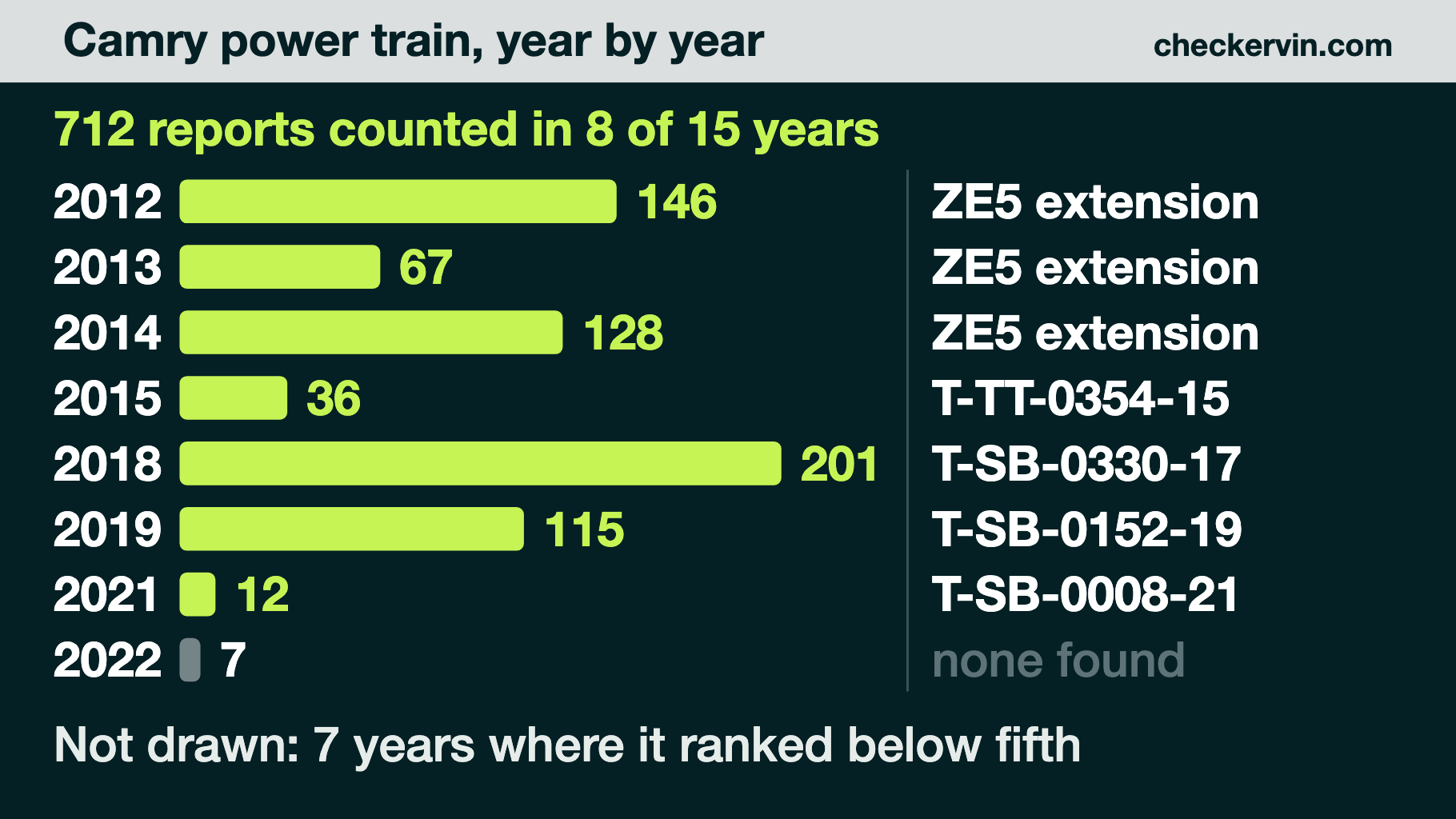
2012-2014: the shudder Toyota put in writing
The 2012–2014 cluster has a named condition behind it. In April 2014, Toyota issued service bulletin T-SB-0034-14 for 2012 through 2014 Camrys with the four-cylinder’s U760 six-speed automatic: a brief, intermittent shudder while driving under light load between about 25 and 50 mph. Toyota traced it to torque converter flex lock-up, the stage where the converter clutch partially engages to save fuel, and changed both the converter and the engine computer’s control logic.
That fall it went further, in two steps, both filed with NHTSA. A Limited Service Campaign, E03, offered a free software update to about 795,000 Camrys whether or not they shuddered; it closed on October 31, 2017. Then Warranty Enhancement Program ZE5 covered the hardware for about 984,000 Camrys built from late July 2011 through late June 2014. If a dealer verified the shudder, ZE5 paid for a new torque converter, extra magnets in the transmission pan and updated software.
| Toyota program | What its documents say |
|---|---|
| T-SB-0034-14 (April 2014) | Repair procedure: new torque converter and ECM logic; 2012-2014 U760 Camry |
| LSC E03 (Oct. 2014) | Free software update, about 795,000 cars; expired October 31, 2017 |
| ZE5 primary coverage | Until April 30, 2016, no mileage limit |
| ZE5 secondary coverage | 8 years from first use or 150,000 miles, whichever first |
The ZE5 letter also states the baseline it was extending: the torque converter was already covered by Toyota’s warranty for 5 years or 60,000 miles. And it says plainly that the condition “will not illuminate a malfunction indicator lamp or set a diagnostic trouble code.” That one sentence matters to anyone pricing a replacement today, as the next section explains.
A shudder is not always a new transmission
Toyota’s own answer to the most common 2012–2014 complaint was a torque converter, not a transmission. The converter bolts between engine and gearbox, and replacing it still means pulling the transmission, so the labor is substantial. But the part is a fraction of a complete unit, and a shop that quotes a full replacement for a light-throttle shudder on one of these cars should be able to say why the converter alone will not do.
The no-trouble-code detail cuts both ways. A shop cannot confirm this shudder by plugging in a scanner and reading a code; it has to drive the car in the 25–50 mph window and feel it. Equally, a clean scan does not prove the transmission is healthy. Ask how the diagnosis was made, and get it in writing before you compare a converter quote with a replacement quote, because they are different jobs at different prices.
The rest of the generation looks different. The 2015 Camry still places power train in its top five, at 36reports, and the only transmission note we found for it is Tech Tip T-TT-0354-15, an oil-pan gasket leak on 2013–2015 U760 cars. In 2016 and 2017, power train falls below fifth. Before the 2012 redesign, it ranked below fifth in all four years on file.
2018-2019: software, not hardware
The 2018 redesign brought an eight-speed automatic. Toyota’s own bulletins call the four-cylinder’s version the UB80E, and the V6 got its own calibrations. Within weeks of launch, Toyota started issuing bulletins. Every service bulletin we read for 2018 and 2019 fixes its condition with engine-computer software rather than parts; the one exception on the list is a tech tip about a leak.
- T-SB-0330-17 (December 2017), 2018 Camry: shift shock from Park to Reverse on first start, or a delay or shock when accelerating again after slowing nearly to a stop. Remedy: reprogram the ECM.
- T-SB-0018-18 (March 2018), 2018 four-cylinder Camry: check-engine light with code P07407E, torque converter clutch actuator stuck on. Remedy: reprogram the ECM.
- T-SB-0152-19 (November 2019, later revised to cover 2018), 2019 Camry: hesitation pulling away from a slow roll at 6 mph or below, right after a 3-to-1 downshift. Remedy: recalibrate the ECM, then a set drive pattern.
- Tech Tip T-TT-0580-19 (November 2019): a transmission side-cover leak on 2018-2020 eight-speed models, listed as under investigation at the time.
Two practical points follow. First, a 2018 or 2019 Camry that shifts harshly or hesitates may need a reprogram, not a transmission; ask whether the applicable bulletin has been done before anyone quotes a unit. Second, Toyota covered those three reprograms under its federal emission warranty, 96 months or 80,000 miles from the in-service date, not the shorter powertrain warranty. That coverage is limited to the condition each bulletin describes, but it is longer than most owners assume.
The software step a cheap swap skips
One more 2018 bulletin is written for the moment you replace the transmission. T-SB-0010-18 tells dealers that some 2018 Camrys need different engine-computer software depending on the transaxle hardware installed, identified by part number or serial number. Put in a unit from one side of Toyota’s production change with software from the other, and the bulletin warns of “a harsh shift or shift flare.”
The bulletin adds that if the mismatch shows up after the original repair, the second round of computer replacement or reprogramming is not covered under warranty. For an owner weighing a salvage-yard unit or a mail-order remanufactured one, that is the risk in plain terms: the transmission can be fine and the car can still shift badly because the software does not match it. The same bulletin lists Toyota’s own remanufactured transaxle part numbers next to new ones, so a factory reman exists as a middle option between a new unit and a used one.
- The replacement unit's part number and serial number, written on the invoice
- Who matches and flashes the engine-computer software, and whether that is in the quote
- Fluid: the type Toyota specifies for that unit (its U760 shudder bulletin lists ATF WS), and the fill level checked
- Core charge on a remanufactured unit, and when it is refunded
- The warranty on the installed job, in months and miles, and whether labor is included
2021: the bulletin that swaps the whole unit
The only Camry bulletin we found whose remedy is a complete transmission is T-SB-0008-21, issued February 2021. It covers some 2021 Camrys with the UA80E eight-speed, identified by two VIN codes (FZ1AK and KZ1AK) and by transmission serial ranges from Aisin’s plant. The symptom is a whine or grind from the transmission, which Toyota attributes to the front carrier assembly pinion shafts. The fix is to remove and replace the automatic transaxle, with a part number in Toyota’s remanufactured format, covered under the powertrain warranty of 60 months or 60,000 miles.
This lines up with a small entry in the complaint record. In 2021, power train ranks fourthamong the Camry’s categories, with 12 of the year’s 165 complaints. That is too few to call a pattern, and the bulletin covers a narrow serial range rather than every 2021 car. If you own one with a transmission whine, though, the serial number on the transaxle settles whether this bulletin applies, and a dealer can check it in minutes.
Which coverage clocks still run in late 2026
Every Toyota term above counts from the car’s first in-service date, not from the bulletin’s date. Here is where each one stands now.
| Camry model years | Coverage status, late 2026 |
|---|---|
| 2012-2014, ZE5 shudder | Ended: 8 years from first use ran out by about 2022-2023 |
| 2012-2017, powertrain 5yr/60k | Ended on every car |
| 2018-2019, software bulletins | 96 months/80,000 miles: late-sold 2019s may have months left |
| 2021, T-SB-0008-21 | Powertrain 60/60: most reach 60 months in 2025-2026 |
| 2022, powertrain 5yr/60k | Still running on cars first sold in 2022 and under 60,000 miles |
Hybrids are a different job
A Camry Hybrid does not have a conventional automatic. Its transaxle, sold as an eCVT, uses electric motor-generators and a planetary power-split gearset in place of a torque converter and stepped gears. None of the bulletins above apply to it, and a quote built for a gas Camry’s automatic is a quote for the wrong part. KBB prices it separately: the 2019 Camry Hybrid range above, $4,730 to $7,192 in ZIP 32250, comes from its own hybrid page.
Our complaint counts pool gas and hybrid Camrys, as NHTSA’s Camry records are combined in our data, so the clusters above include some hybrid reports. The one hybrid driveline recall on record is 17V462000, on 2016 Camry Hybrid and Avalon Hybrid models: the front drive shaft could separate, causing a loss of propulsion. That is a drive shaft, not the transaxle, and dealers replaced affected shafts free. Hybrid-system warranty terms differ from the powertrain warranty; we could not verify them from a Toyota primary source for this page, so confirm them with a dealer by VIN.
Recalls, and the 2013 question
Search results ask whether the 2013 Camry had a transmission recall. It did not. We queried NHTSA’s recall database for every Camry and Camry Hybrid model year from 2008 through 2022 and found no campaign naming the transmission. The 2013 Camry’s two recalls cover the windshield wipers and an air-conditioning drain hose that could clog. Before trusting that empty result, we ran the same query on a vehicle known to have transmission recalls, the 2012 Ford F-150, and it returned three.
The confusion is understandable, because Toyota’s 2014 owner letters about the shudder look like recall notices. They are not. E03 was a Limited Service Campaign and ZE5 a Warranty Enhancement Program: voluntary programs, not safety recalls under federal law. Our guide to service bulletins versus recalls explains why the difference matters. A safety recall stays open on the VIN until the remedy is done; a program like ZE5 ends on a date or a mileage.
Replace, rebuild, or repair one part
Four routes get a Camry moving again, and they differ in price, warranty and what can go wrong.
- New Toyota transaxle from a dealer: the top of KBB's ranges, with Toyota's parts warranty
- Toyota remanufactured transaxle: the factory reman part numbers in T-SB-0010-18 and T-SB-0008-21 show Toyota supplies one
- Independent rebuild or reman: often cheaper; ask for the warranty in months and miles, and who flashes the software
- One-part repair: a torque converter on a 2012-2014 shudder, or a reprogram on a 2018-2019 shift complaint, when the diagnosis supports it
On whether a car is worth the money: an old Camry with a failed transmission is still a Camry, and the rest of the car often has life left. Look up its value for your trim and mileage and set it against the quote. If you plan to keep it, a replacement with a written warranty can make sense. If you plan to sell soon, a car with a fresh, documented transmission sells more easily than one with a known problem.
This page covers replacement. Routine maintenance is a separate question, and our Camry transmission fluid change guide covers the fluid, the intervals and what that service costs.
Before you authorize the replacement
- Decode the VIN to confirm model year, engine and whether it is a hybrid
- Ask a Toyota dealer for the in-service date and any open bulletins or campaigns on that VIN
- On a 2012-2014, ask whether a torque converter alone fixes it; on a 2018-2019, ask whether the bulletin reprogram is done
- On a 2021 with a whine, have the transaxle serial number checked against T-SB-0008-21
- Compare quotes on the same scope: unit type, software, fluid, core and warranty all listed
A Toyota VIN decode confirms the model year and engine, and a transmission lookup by VIN tells you which gearbox the car left the factory with. Checking Toyota warranty coverage by VIN shows whether any clock above still runs, and the Toyota recall lookup clears unrelated open recalls in the same visit. If you are shopping rather than repairing, read which Camry model years draw the most complaints overall before you judge a car on its transmission alone.
Where this information comes from
- NHTSA-hosted Toyota Warranty Enhancement Program ZE5, 2012-2014 Camry (2018 update)Read in full: U760E torque converter shudder, about 984,000 cars, repair parts, coverage to April 30, 2016 then 8 years/150,000 miles, no trouble code.
- NHTSA-hosted Toyota Limited Service Campaign E03 dealer letterSoftware update for about 795,000 2012-2014 Camrys, expired October 31, 2017.
- NHTSA-hosted Toyota T-SB-0010-18, transaxle and ECM software confirmationRead in full: software must match transaxle hardware after a replacement; mismatch causes harsh shifts; second reprogram not covered.
- NHTSA-hosted Toyota T-SB-0330-17, 2018 Camry shift shockECM reprogram for Park-to-Reverse shock and reacceleration delay, covered 96 months/80,000 miles.
- NHTSA-hosted Toyota T-SB-0152-19, 2019 Camry hesitationECM recalibration for hesitation after a 3-to-1 downshift at low speed.
- NHTSA-hosted Toyota T-SB-0008-21, 2021 whine or grindRead in full: transaxle replacement, 7.1 warranty hours, powertrain warranty 60 months/60,000 miles.
- NHTSA recalls API, Camry by model yearQueried for Camry and Camry Hybrid 2008-2022; no transmission campaign, checked against a known-positive vehicle first.
- Kelley Blue Book, 2018 Camry transmission repair and replacementThe $8,229-$8,765 range for ZIP 78701, read from search-served page text on November 22, 2026; the 2013, 2021 and 2019 Hybrid pages were read the same way.
Keep reading
Frequently asked questions
How reliable are Toyota Camry transmissions?
In about half of the Camry's model years, the transmission does not stand out in the federal complaint record at all. In our NHTSA corpus, POWER TRAIN reaches the Camry's five most-reported categories in eight of fifteen model years, and ranks first in 2012, 2013, 2014, 2018 and 2019. Those clusters line up with conditions Toyota documented itself: a torque-converter shudder on 2012-2014 cars and shift-quality software updates on 2018-2019 cars. Complaints are unverified owner reports, not a failure rate, so they tell you which years to check, not how likely your car is to fail.
How much is a transmission for a 2019 Camry?
Kelley Blue Book's fair repair range for a 2019 Camry Hybrid transmission replacement is $4,730 to $7,192 in ZIP 32250 (Jacksonville Beach, Florida), parts and labor included. For a gas Camry of the same generation, KBB's 2018 page lists $8,229 to $8,765 in ZIP 78701 (Austin, Texas). Both are KBB's figures, read from search-served page text on November 22, 2026, and both change with ZIP code. We sell VIN checks, not repairs, and publish no price of our own.
Was there a recall on the transmissions of the 2013 Toyota Camry?
No. NHTSA's recall database lists two campaigns for the 2013 Camry, one for the windshield wipers and one for a clogged air-conditioning drain hose, and no transmission campaign in any Camry year from 2008 through 2022. What 2013 did get was not a recall: a software campaign (LSC E03, closed October 31, 2017) and a warranty extension (ZE5) for a torque-converter shudder on certain 2012-2014 Camrys. ZE5's longest term was 8 years from first use or 150,000 miles, which has ended for practically every 2013 car.
Is it better to replace a transmission or rebuild it?
It depends on what failed, and the Camry gives a clear example. Toyota's own fix for the 2012-2014 shudder replaced the torque converter, added pan magnets and updated software. It did not replace the transmission. If the diagnosis points at one part, a repair can cost far less than a unit. If the case is damaged or debris has spread, a remanufactured unit with a written warranty is usually the safer buy. On 2018 and newer Camrys, either route needs the engine computer software matched to the transmission, per Toyota bulletin T-SB-0010-18.
What is the typical lifespan of a Toyota transmission?
Toyota does not publish a lifespan figure, and we do not invent one. What Toyota does publish is its powertrain warranty: 60 months or 60,000 miles from the in-service date, per its own service bulletins. On 2012-2014 Camrys it stretched coverage for one condition to 8 years or 150,000 miles. Fluid condition, driving pattern and whether the car's open bulletins were done matter more to one car's life than any average.
Confirm the model year before you price the transmission
A free CheckerVIN report shows the factory build, engine, specifications and open recalls for any VIN, so you know which Camry and which transmission you are pricing.
Run a free VIN check