The short answer
- What does it cost?
- Kelley Blue Book's Fair Repair Range runs roughly $289-$426 depending on model year and ZIP code — $289-$388 on the 6-speed cars checked, $361-$426 on a newer 8-speed car.
- Is it the same job every year?
- No. The Camry's gas automatic went from 6 speeds through 2017 to an all-new 8-speed starting in 2018, both using Toyota ATF WS but not necessarily the same interval advice.
- Which years carry the risk?
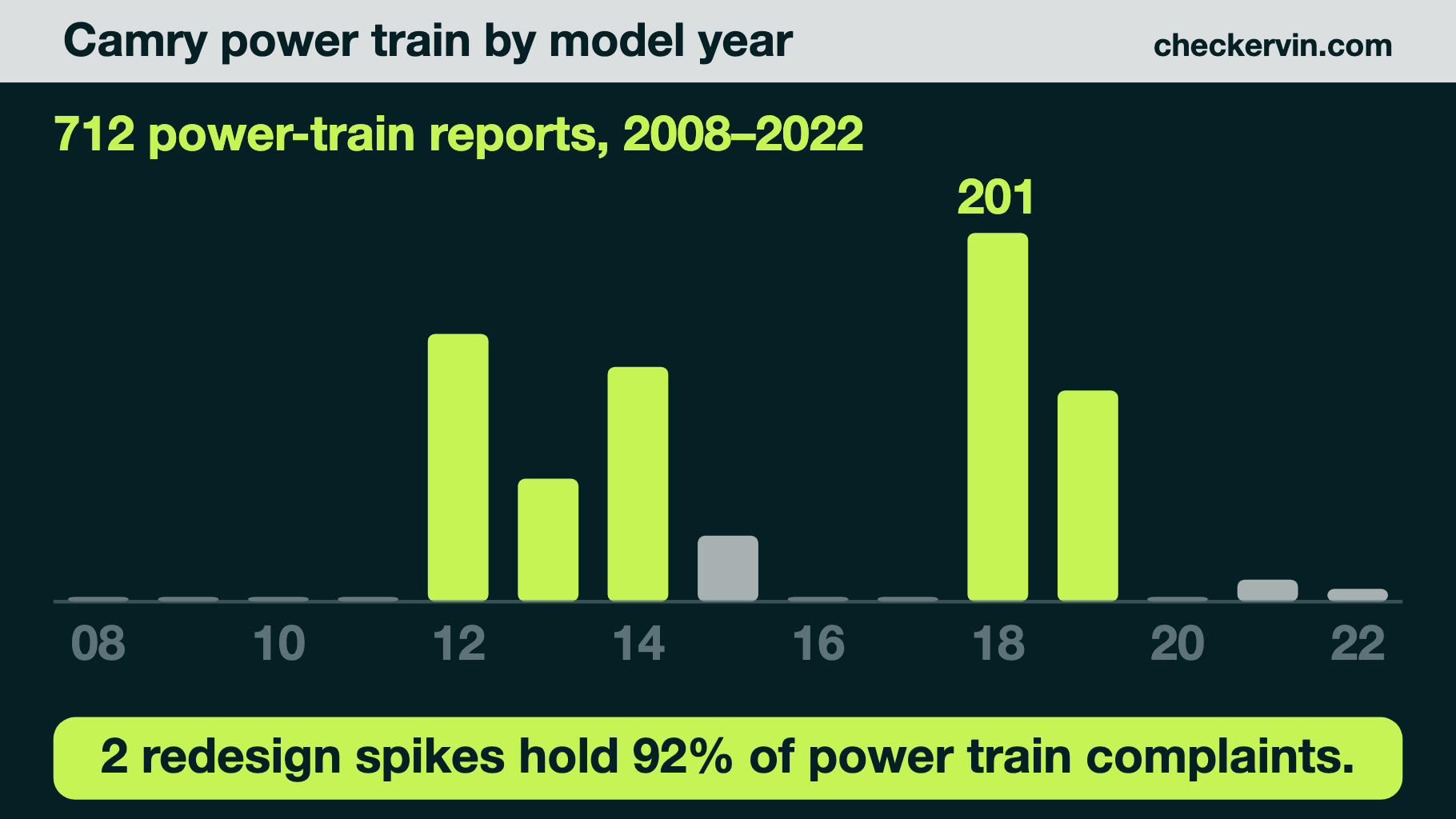
- 2012, 2013, 2014, 2018, 2019 hold every year POWER TRAIN leads this nameplate's own complaint categories — 2012-2013-2014 right after the 2012 redesign, 2018-2019 right after the 2018 one. Toyota documented a torque-converter shudder on the 2012-2014 cars.
The numbers, and whose numbers they are
Kelley Blue Book’s Fair Repair Range, a dealership estimate that varies by ZIP code, lists $292–$388 for a 2011 Camry (Davenport, IA) and $289–$376 for a 2013 Camry (Irving, TX) — both 6-speed cars. A 2021 Camry, with the newer 8-speed, priced higher in the same source at $361–$426 (Miami, FL), and a 2023 Camry Hybrid’s eCVT service priced lower at $312–$367 (Columbus, OH). None of these figures came from us; we sell VIN checks, not repairs, and every dollar figure on this page is attributed to whoever published it.
What those four numbers don’t show on their own is why a 2021 car’s service runs higher than a 2013 car’s. The rest of this page is about that gap, and about what our own complaint record says happened to the Camry’s power train in two specific windows.
Two redesigns, one job title
“Camry transmission fluid change” describes at least two different jobs, not one. Toyota redesigned the Camry twice inside the fifteen model years our corpus covers: a 2012 redesign that kept the gas-model 6-speed automatic largely as it was, and a 2018 redesign, built on Toyota’s TNGA platform, that replaced it on the gas four-cylinder and V6 trims with an all-new eight-speed Direct Shift automatic, per Toyota’s own launch materials and Wards Auto’s coverage of the 2018 car. Toyota’s 2018 service bulletins call the four-cylinder car’s version the UB80E. Hybrid Camrys kept a CVT with simulated six-speed paddle shifting through both redesigns.
A search estimator that quotes one flat number for “Camry transmission fluid change” regardless of model year is quoting across both redesigns as if neither happened.
What 7,586 complaints say about five model years
Our corpus of federal NHTSA complaints holds 7,586 reports against the 2008–2022 Camry. POWER TRAIN is the single most-reported category in our top-five data in exactly 2012, 2013, 2014, 2018, 2019— five of the nameplate’s fifteen model years — and appears anywhere in the top five in three more, 2015, 2021 and 2022, at a smaller share. It does not crack the top five at all in the other seven years on file.
Every one of the five #1 years sits inside the first two or three model years after one of the Camry’s two redesigns in this span: 2012, 2013, 2014 after the 2012 redesign, and 2018 and 2019 after the 2018 one. Inside those windows it runs from 22% to 27% of each year’s own total in the first window (2012: 23%, 2013: 22%, 2014: 27%) and from 26% to 28% in the second (2018: 26%, 2019: 28%). 2018 carries the largest raw count on record, 201 reports. Complaints are unverified owner reports, not a measured failure rate — the honest caveat this site attaches to every figure like it — but two separate spikes, each landing on a redesign’s own first model years, is not noise.
2012-2014: a carried-over gearbox, a documented shudder
Toyota’s 2012 redesign made the Camry the first U.S. Camry sold without a manual transmission option, but the gas-model 6-speed automatic, the U760E, was not new — a contemporary review describes the 2.5-liter’s gearbox as “paired as before with a six-speed automatic.” So this spike is not a new-gearbox story. It does have a documented mechanical cause on Toyota’s side: a brief, intermittent shudder when the torque converter goes into flex lock-up, felt under light throttle at roughly 25–50 mph.
Toyota’s bulletin T-SB-0034-14 (April 30, 2014) covers 2012–2014 Camrys with that transmission. It replaced an earlier bulletin that applied to 2012 cars only, and its repair is a new torque converter, four transmission-pan magnets in place of two, and updated engine-control software. Two programs followed in October 2014. Limited Service Campaign E03 offered a free software update on about 795,000 certain 2012–2014 Camrys and expired October 31, 2017. Warranty Enhancement Program ZE5, covering about 984,000 vehicles, extended coverage for verified shudder repairs to April 30, 2016 with no mileage limit, then to 8 years from first use or 150,000 miles, whichever came first. On a car first sold in 2014, that coverage ended in 2022.
What those documents don’t tell us is how many of the 2012–2014 POWER TRAIN complaints in our corpus are shudder reports. Toyota documented the condition on exactly the three model years where POWER TRAIN leads; it did not publish a count, and we haven’t classified the complaint text by symptom. On a car from these years, a shudder at light throttle is the specific thing to test for, and a dealer’s service history will show whether the T-SB-0034-14 torque converter or the E03 reflash was done.
2018-2019: a genuinely new one
The 2018 redesign replaced the outgoing 6-speed with an all-new eight-speed Direct Shift automatic, Toyota’s first stepped automatic built for the TNGA platform; its bulletins call the four-cylinder version the UB80E. Toyota put out several 2018 Camry bulletins for it in the first months of production. T-SB-0330-17 (December 11, 2017) addresses a shift shock going from Park to Reverse on startup, or a delay or shock when accelerating again after slowing to a near stop. T-SB-0018-18 (March 2, 2018) covers four-cylinder cars that light the check-engine lamp with code P07407E, “Torque Converter Clutch Actuator Stuck On.” Both fixes are a PCM reprogram, and both list UB80E serial-number break points.
A third, T-SB-0010-18 (February 2, 2018, revised in November 2018 and December 2020), is a matching bulletin rather than a repair: it tells technicians replacing a transaxle or PCM, or reprogramming one, to pair the software with transaxle hardware built before or after a production change, because a mismatch “may result in a harsh shift or shift flare.” Read together, the three point to control-software calibration on a new transmission, fixed with reflashes, rather than a parts failure. None of them is a safety recall. For what a full replacement runs when it does come to that, see our Camry transmission replacement cost post.
The open lawsuit, and what it isn't
A separate, currently active class action, Natale, et al. v. Toyota Motor Corp., filed in the U.S. District Court for the Eastern District of New York, alleges that Toyota’s UA80E eight-speed transmission and torque converter — built by Aisin, which the complaint alleges is roughly 25% Toyota-owned — are defective across several Toyota and Lexus models. One named plaintiff, per press coverage of the filing, drives a 2019 Camry. Toyota’s 2018 bulletins call the four-cylinder Camry’s eight-speed the UB80E; we have not read the complaint’s class definition, so we can’t say how it treats that unit.
What the quiet years say
The sevenmodel years where POWER TRAIN never cracks the top five — 2008–2011, 2016–2017 and 2020— sit either before the first redesign, at the settled end of a generation, or two-plus years past the second redesign. After 2019, POWER TRAIN resurfaces only at small, low-ranked counts (2021: rank 4, 12 of 165 complaints, 7%; 2022: rank 5, 7 of 65 complaints, 11%) — too few reports to read as a third spike, and not matched by anything in the 2018 Camry’s own recall list discussed below.
The 2018 model year is the only one in our corpus with a saved, campaign-by-campaign recall breakdown. Of its 8 recorded NHTSA campaigns, none name a POWER TRAIN or TRANSMISSION component — they cover a fuel-delivery hose connection, an oversized engine piston that could stall the car, a brake-booster vacuum hose, and a mislabeled load-capacity sticker. That absence matters: nothing in the one year we can check at this level of detail turns the 2018-2019 complaint concentration into a safety recall. It stayed a bulletin.
The fluid itself
Toyota Genuine ATF WS (World Standard) is the fluid cited across both the 6-speed and 8-speed Camry automatics, per multiple secondary parts and fluid-explainer sources — the owner's manual itself, the one document that would settle this for a specific car, could not be fetched from this environment. One Toyota document does settle it for the 6-speed: the parts table in T-SB-0034-14 calls for ATF WS, 5.6 US quarts (5.3 liters), on 2012–2014 Camrys. ATF WS is described in those sources as not interchangeable with older Toyota Type T-IV, Dexron or Mercon fluid; a mismatch is reported to risk transmission damage, not just a worse fluid.
| Era | Transmission |
|---|---|
| 2007-2011 | 6-speed automatic (pre-redesign) |
| 2012-2017 | 6-speed automatic (U760E), carried over at the 2012 redesign |
| 2018-2024 (gas trims) | 8-speed Direct Shift automatic, new at the 2018 redesign (UB80E on the four-cylinder, per Toyota's 2018 bulletins) |
| Hybrid, both eras | eCVT with simulated multi-speed paddle shifting |
How often it's actually due
Secondary maintenance-schedule aggregators commonly cite a severe-duty drain-and-fill interval around 60,000 miles — towing, heavy loading, or extensive low-speed and stop-and-go driving — with no fixed interval under normal use beyond periodic inspection. That is the kind of figure worth confirming against the actual owner’s manual for a specific VIN’s model year rather than taking from a generic blog post, this one included.
Before you authorize the service
- Confirm the model year by VIN before accepting a quote — the transmission generation and the fluid price both depend on it
- Ask the shop to name the fluid specifically: Toyota Genuine ATF WS, not a generic universal substitute
- If the symptom is a harsh shift or shift shock on a 2018 car, ask whether the PCM reprogram in T-SB-0330-17 (or T-SB-0018-18, for code P07407E) has been done before paying for a fluid change alone; on a 2012-2014 car with a light-throttle shudder, ask about T-SB-0034-14
- Pull the VIN's open recalls before paying for anything a separate campaign might already cover
- Get the quote itemized — fluid brand, quantity and labor — not a single flat "transmission service" line
If you are buying the Camry, not maintaining it
The same record reads as a shopping map. A 2012–2019 Camry that falls inside either post-redesign window should show either a documented transmission service history or a clean test drive with no harsh or hesitant shifts, before its power train is treated as a non-issue. A Toyota VIN decode confirms the exact model year and transmission before you price a service specific to one of these eras, and checking what factory coverage remains by VIN settles whether any of this is still someone else’s responsibility to fix.
On any candidate car, run the recall lookup first, and check which Camry model years show the most complaints overall rather than judging the nameplate by one bad forum thread. The ten model years outside both redesign windows carry a fraction of the power-train complaints in the record, and a documented fluid service is usually cheaper than the negotiation it would take to discount around a car that's missing one.
Where this information comes from
- NHTSA — Camry complaint and recall databaseThe federal record this page's figures and the 2018 recall list are computed from, browsable by model year.
- NHTSA — recalls by VINThe official lookup that settles whether a specific Camry has open safety campaigns.
- Kelley Blue Book — Camry Fair Repair Range (transmission fluid change)Source for the ZIP-dependent dealership price ranges quoted above.
- Toyota pressroom — 2012 Camry introductionToyota's own launch materials for the 2012 redesign.
- Toyota T-SB-0034-14 — Torque Converter Flex Lock-up Shudder (April 30, 2014)2012-2014 Camry with the U760 transmission: shudder at 25-50 mph under light load; new torque converter, pan magnets and ECM (PCM) software. Also lists ATF WS, 5.6 US qt.
- Toyota Limited Service Campaign E03 — dealer letterFree software update for U760E torque-converter shudder on about 795,000 certain 2012-2014 Camrys; expired October 31, 2017.
- Toyota Warranty Enhancement Program ZE5 — dealer letter (October 2014)Extended torque-converter-shudder coverage on about 984,000 certain 2012-2014 Camrys: to April 30, 2016 with no mileage limit, then 8 years from first use or 150,000 miles.
- Toyota ZE5 dealer package — February 15, 2018 updateSame coverage terms; removes the requirement to complete the expired E03 campaign first.
- Toyota T-SB-0330-17 — Shift Shock on Initial Startup or Reacceleration (December 11, 2017)2018 Camry; PCM reprogram; lists UB80E transmission serial break points.
- Toyota T-SB-0010-18 — Transaxle Assembly and ECM (PCM) Software Confirmation (February 2, 2018)2018 Camry, four-cylinder and V6: match PCM software to transaxle hardware; a mismatch may cause a harsh shift or shift flare.
- Toyota T-SB-0018-18 — MIL On, DTC P07407E (March 2, 2018)2018 Camry with the A25A-FKS four-cylinder; torque converter clutch actuator stuck on; PCM reprogram; names the transmission UB80E.
Keep reading
Frequently asked questions
How much does a Toyota Camry transmission fluid change cost?
Kelley Blue Book's Fair Repair Range, which varies by model year and ZIP code, runs roughly $289-$388 on the gas 6-speed cars we checked (2011 and 2013) and $361-$426 on a 2021 with the newer 8-speed. A 2023 Camry Hybrid's eCVT service priced lower, $312-$367, in the same source. None of these are a quote for your car — get one from a local shop against your specific year.
What transmission fluid does the Toyota Camry use?
Toyota Genuine ATF WS (World Standard), used across both the 6-speed automatic and the newer 8-speed Direct Shift automatic, per multiple parts and fluid-explainer sources. It is not interchangeable with older Toyota Type T-IV, Dexron or Mercon fluid — using the wrong fluid is described in repair-procedure summaries as a way to cause transmission damage, not just a worse fluid.
Which Toyota Camry model years have the most power-train complaints?
2012, 2013, 2014, 2018, 2019 — the five of this nameplate's fifteen model years where POWER TRAIN is the single most-reported complaint category in our corpus, computed from src/data/models/toyota-camry.json. Every one of those five years is also one of the first two or three model years after a Camry redesign: 2012-2014 followed the 2012 redesign, 2018-2019 followed the 2018 redesign. For 2012-2014, Toyota documented a torque-converter shudder on the U760E six-speed (bulletin T-SB-0034-14, service campaign E03, warranty program ZE5). 2018 carries the largest raw count, 201 reports (26% of that year's total).
Is there a recall for the Toyota Camry's 8-speed transmission?
Not in the one model year our corpus holds a full recall breakdown for: the 2018 Camry's 8 recorded NHTSA campaigns cover a fuel-line connection, an oversized engine piston, a brake-booster vacuum hose and a mislabeled load rating — none name a power-train or transmission component. Toyota did issue 2018 Camry service bulletins for the new eight-speed, which its bulletins call the UB80E on the four-cylinder: T-SB-0330-17 (shift shock on startup or reacceleration) and T-SB-0018-18 (check-engine light with code P07407E), both fixed with a PCM reprogram, and T-SB-0010-18, which tells technicians to match PCM software to the transaxle hardware because a mismatch “may result in a harsh shift or shift flare.” Those are bulletins, not safety recalls, and a free recall lookup by VIN will not show them.
Is the Toyota 8-speed transmission lawsuit about my Camry?
Possibly, if it's a 2018-or-newer Camry with the 8-speed. Natale v. Toyota Motor Corp., filed in the Eastern District of New York, alleges defects in the UA80E eight-speed transmission and torque converter across several Toyota and Lexus models; one named plaintiff drives a 2019 Camry. Toyota's own 2018 bulletins call the four-cylinder Camry's eight-speed the UB80E, so whether a given car falls inside the alleged class depends on the complaint's definition, which we have not read. That is an allegation in an active case, not a finding, a recall, or a settlement — a different thing from Nissan's actual $277M Rogue CVT settlement, and not something a transmission fluid change by itself resolves either way.
Confirm the year and transmission before you price the service
A free CheckerVIN report shows the factory build, specifications and open recalls for any VIN — confirm what you're actually pricing.
Run a free VIN check