The short answer
- What does it cost?
- KBB's fair repair range runs $4,298-$6,376 for a 2013 Altima (ZIP 47807) and $4,435-$6,417 for a 2017 or 2018. Those are KBB's figures, not ours.
- Will Nissan pay?
- 2013-2018 Altimas got CVT coverage to 84 months/84,000 miles. By late 2026 almost all have aged out. Check the VIN's in-service date at a dealer first.
- Is a new CVT the only fix?
- No. Nissan's bulletins fix many coded Altima CVT faults with software or a valve body, and tell dealers not to sell a full unit for those.
What a replacement costs, and who says so
Kelley Blue Book publishes a fair repair range for an Altima transmission replacement by model year and ZIP code. Its 2013 Altima page, priced for ZIP 47807 in Terre Haute, Indiana, lists $4,298 to $6,376, parts and labor included. Its 2017 page (ZIP 89041, Pahrump, Nevada) and its 2018 page (ZIP 93668, Tranquillity, California) both print $4,435 to $6,417, and break that into roughly $4,182 to $4,486 for parts and $1,783 to $1,931 for labor. We read those on October 26, 2026 from the text search engines serve for KBB’s pages; a direct fetch returned only a placeholder ZIP and no range, because KBB fills in its prices in the browser.
The parts market agrees with KBB’s parts line. Powertrain Products, a remanufactured-transmission seller whose listings we opened directly, prices a remanufactured CVT for a 2014–2018 Altima 2.5L at $5,449, shipped to you uninstalled, with a $1,000 core charge if you do not send the old unit back. Its 2013 2.5L unit and its 2015–2018 3.5L V6 unit are each listed at $4,549. Add a shop’s labor to either and you land inside KBB’s range or above it.
We sell VIN checks, not repairs, so none of these is our price. What the record adds is the part a flat quote skips: Nissan’s own service bulletins replace a whole CVT less often than the search results suggest, and which repair your car needs is a diagnosis, not a model year.
How much of each model year is the CVT
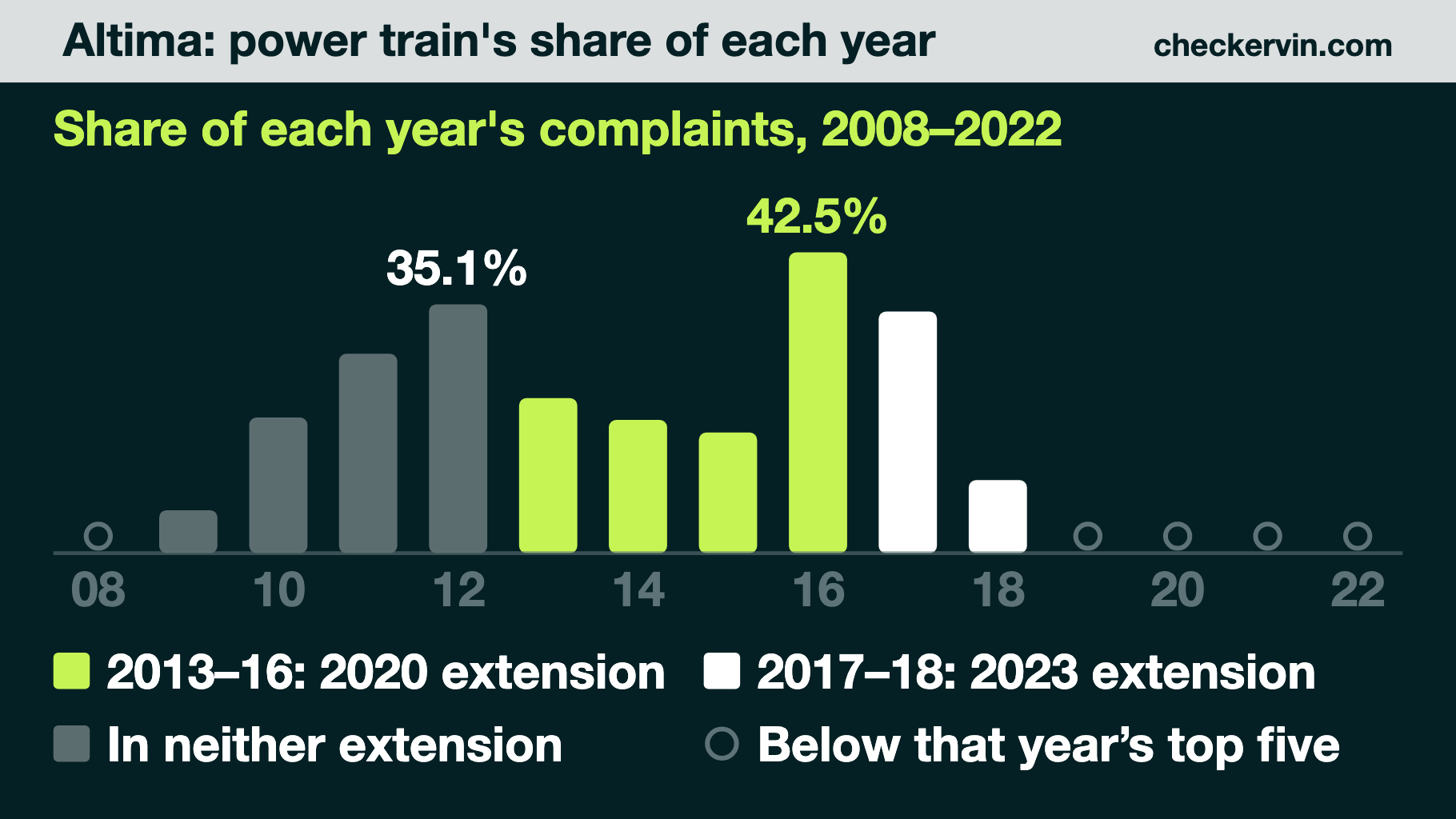
Our corpus of federal NHTSA complaints holds 9,726 owner reports against the 2008–2022 Altima. POWER TRAIN, the category that captures transmission complaints, names 1,655 of them, or 17% of the record. Our post on the maintenance side, Altima CVT fluid service, charts those reports as raw counts by year. Here we divide instead: for each model year, what share of everything owners reported was the power train.
The share view changes which years look worst. By count, 2013 leads with 505 reports, but that year also drew heavy airbag, lighting and other complaints, so the power train is only 21.9% of its record. The year where the transmission dominates is 2016: POWER TRAIN is 42.5% of everything owners filed against it. The category ranks first in four model years, 2011, 2012, 2016, 2017, and in sixof the six fifth-generation L33 years (2013–2018) it outranks ENGINE, which matters when a shop is deciding whether a drivability fault is the engine or the CVT.
The 2013–2018 years Nissan’s two warranty extensions name hold 1,265 power-train complaints, 76.4% of the nameplate’s total. After the 2019 redesign, POWER TRAIN sits below the top five in 4 of 4model years. Our data layer keeps only each year’s five largest categories, so that means “below that year’s fifth”, not zero, and NHTSA’s live 2019 count runs a few reports ahead of ours. Complaints are unverified owner reports, not a failure rate.
The two worst years nobody extended
The chart’s left side is the part most Altima pages leave out. The fourth-generation car’s last years, 2011 and 2012, put POWER TRAIN first among all complaint categories, at 28.2% and 35.1% of their own records. Of the later years, only 2016 and 2017 reach 28.2% or more. Yet neither the 2020 nor the 2023 US extension names any Altima before 2013. The 2009–2012 years together carry 390 power-train complaints, 23.6% of the nameplate’s total.
Those cars use a different, older CVT. Transend’s catalog lists the 2.5-liter cars of that era with the RE0F10A/JF011E unit, the same family as the 2007–2012 Sentra. A secondhand Nissan owner letter describes a 2003–2010 program that doubled CVT coverage to 10 years/120,000 miles; we could not open a primary document for it, and on any car it reached, ten years ran out by 2020. For a 2011 or 2012 Altima in 2026, the honest assumption is that every dollar of a transmission repair is yours, which makes the diagnosis sections below matter more, not less.
The two extensions, in one table
Nissan settled its Altima CVT class actions in two rounds, and each ended in a dealer bulletin filed with NHTSA. We read both. The mechanism is the same one our Sentra transmission replacement post walks through, so here is only what differs for the Altima:
| Altima model years | What Nissan's bulletin says |
|---|---|
| 2013-2016 (L33) | 60/60 to 84/84; activated May 11, 2020; built Mar. 2012 to Aug. 2016 |
| 2017-2018 (L33) | 60/60 to 84/84; activated May 23, 2023; built Oct. 8, 2015 to Aug. 17, 2018 |
| 2009-2012 (L32) | Not named in either bulletin |
| 2019 and newer (L34) | Not named; standard 60/60 powertrain coverage |
Both extensions cover the CVT assembly and internal parts, the valve body, the torque converter, the cooler kit where fitted and reprogramming of the transmission control module. Both bulletins answer “Is this a safety recall?” with no, which is why a recall lookup will never show them. And both warn dealers that some owners opted out of the settlement, which removed the extension from that VIN; the 2020 bulletin says those cars carry the flag “B0033 NO CVT WARRANTY EXT” in Nissan’s system. A used Altima can sit in the right model years and still have no extension at all.
Is any Altima still covered in late 2026?
Both extensions run 84 months from the car’s original in-service date. The last 2013–2016 Altima was built in August 2016, so even a car that waited a year on a lot crossed 84 months by 2024 or 2025. That group is out of coverage on time alone.
The 2017–2018 group is down to stragglers. Production ended August 17, 2018, and a 2018 Altima first sold that fall reached 84 months in late 2025. Counting back 84 months from late October 2026, only a 2018 first put in service in about November 2019 or later could still be inside the window, and only under 84,000 miles. Few leftover cars sat that long, but some did.
Outside coverage, both bulletins give dealers the same instruction: provide an estimate and, if the owner asks for help, consult Nissan’s goodwill guidelines. Asking costs nothing. A partial contribution is possible on a car slightly past the limit, but nothing in the bulletins promises it.
Reimbursement and its caps
Both bulletins say Nissan will reimburse owners who paid for a CVT repair that the extension would have covered, and both add that the amount “may be subject to a cap depending on where the repair was made.” Neither prints the cap. CarComplaints.com’s coverage of the two settlements fills it in: for Gann v. Nissan North America(2013–2016 Altima) and for Martinez v. Nissan North America(2017–2018 Altima), repairs done at a Nissan dealer are reimbursed in full and repairs at other shops up to $5,000. Treat those amounts as reported, since the settlement websites would not load for us.
The deadlines matter more than the caps now. The bulletins set the claim deadline at January 30, 2020 for the earlier group and March 15, 2023 for the later one, or within 30 days of the qualifying repair, whichever came later. A repair paid for while the car was inside 84/84 could have been claimed; a claim for an old repair filed today is almost certainly late. Keep the invoice either way, because a buyer of the car will ask what was done.
When the fix is a valve body or software
The most useful document in this whole file is a one-page Nissan bulletin from May 2020, NPSB/20-590. It tells dealers to offer a full CVT replacement in place of a belt-and-pulley sub-assembly only when the car is at or past 84 months or 84,000 miles, and it says plainly: “Do not recommend CVT unit replacement when the diagnosis is for software updates or control valves.”
The repair bulletin behind it, NTB16-110i, covers 2013–2017 four-cylinder Altimas that set codes P0776 or P0841 or that judder with codes P17F0 or P17F1. For the pressure codes, the technician pulls the valve body and inspects the belt. A good belt means a new valve body and nothing else. A damaged belt means the belt-and-pulley sub-assembly plus the valve body. A coded judder gets a new valve body. Later bulletins apply the same code set to the 2018 Altima (NTB19-076a) and to the redesigned 2019–2020 car (NTB21-083), a reminder that the newer generation is not immune, only less complained about.
- Software first: Nissan's PC490 campaign reprogrammed the CVT on 1,184,100 2013-2016 Altimas for belt slip and code P0776; it was free, took about an hour, and a dealer can tell you whether a VIN ever got it
- Valve body next: replaced alone when the belt passes inspection, by Nissan's own flow chart
- Sub-assembly after that: a new belt, pulleys and side cover, about 65 pounds against roughly 300 for a complete CVT, per the same bulletin
- Complete unit last: when the case or other internals are damaged, or past 84/84 where Nissan favors a full unit over a sub-assembly
Inside Nissan’s network, the 2020 extension bulletin restricts the sub-assembly repair to technicians certified through an instructor-led CVT course. A shop without that training is more likely to quote a complete unit. It may still be the cheaper bill, but ask whether the valve body alone was ruled out, and on what evidence.
Programming and CVT learning are part of the job
A replacement Altima CVT does not simply bolt in. Nissan’s bulletin NTB12-103I says each new CVT or valve body ships with a calibration file, matched to the unit by a QR label, that must be written into the transmission control module. After a valve body swap the car also needs clutch-point learning and select learning; after a full CVT swap, the calibration write and select learning. Skip them and the car can shift harshly or set codes again.
That is the line to look for on a quote. A shop installing a remanufactured unit needs Nissan’s scan tool or an equivalent that can perform the write, and the calibration data for that specific unit. If the estimate does not mention programming, ask who does it and what it costs before the car is on the lift.
New, remanufactured or used
Nissan’s bulletins note that the company itself installs either new or remanufactured CVTs under warranty, depending on supply, and that both contain new internal components; the remanufactured unit reuses the case. Outside Nissan, the choices split by warranty more than by price.
| Altima application | CVT family, per Transend's catalog |
|---|---|
| 2009-2013, 2.5L QR25DE (L32) | RE0F10A / JF011E |
| 2013-2018, 2.5L QR25DE (L33) | RE0F10D / JF016E |
| 2013-2018, 3.5L VQ35DE (L33) | RE0F10E / JF017E |
| 2019 on, 2.5L PR25DD (L34) | RE0F10D / JF016E |
The V6 matters. A 2015 Altima 3.5 uses the same RE0F10E family as the 2013–2019 Pathfinder, which our Pathfinder transmission post covers, and a listing that matches only “2015 Altima” can be the wrong transmission for the car. Remanufacturers differ on terms: Transend lists an 18-month/18,000-mile standard warranty, while Powertrain Products lists three years as standard with longer coverage for an added price. A used unit from a salvage yard is the cheapest part and the biggest unknown, since the donor car’s mileage is usually whatever the seller says.
When it is not worth fixing
On a 2013–2018 Altima, a replacement that KBB prices from about $4,300 is a large share of the car’s value, and on a high-mileage example it can pass it. The arithmetic has three numbers: what the car is worth running, what it is worth with a failed transmission, and the repair. Repair only wins when the first minus the second is larger than the third. Look up the car’s value for its trim and mileage with a VIN-based value check before you sign anything.
Two things move the line. A valve-body or software diagnosis can cut the bill to a fraction of a full unit, which makes almost any running Altima worth fixing. And a transmission that fails with no diagnosis at all is the worst case for selling, because a buyer will price in the full replacement. Paying for a proper diagnosis first is cheap even if you sell the car afterward.
Before you authorize the repair
- Decode the VIN to confirm model year, engine and which CVT family the car has
- Ask a Nissan dealer to read the VIN's CVT coverage, in-service date, opt-out flag and PC490 status
- Get the stored codes and the belt-inspection result in writing: software, valve body, sub-assembly or complete unit
- Compare quotes on the same scope, with calibration write and learning procedures listed
- On a remanufactured unit, ask about the core charge and who honors the warranty if you move
- Pull the VIN's open recalls so one visit clears both
If you are buying the Altima, not repairing it
The share chart works as a shopping map. On a 2016 or 2017 Altima the transmission is a larger part of the record than on almost any other year, and the extension has run out, so service paperwork matters more than the badge. A Nissan VIN decode confirms the engine, which tells you whether you are buying the four-cylinder or V6 CVT. A transmission lookup by VIN settles the transmission itself, and checking what coverage remains by VIN tells you whether any of it is still Nissan’s problem.
Run the Nissan recall check before you negotiate; no recall covers the Altima CVT, but these years carry recalls on other systems. Then read which Altima model years draw the most complaints overall. A receipt for a replaced CVT, valve body or PC490 reprogram is worth more on a 2013–2018 Altima than a clean car wash.
Where this information comes from
- NHTSA — Altima complaint databaseThe federal complaint record this page's shares are computed from, browsable by model year.
- NHTSA-hosted Nissan bulletin MC-10176204 — 2013-2016 Altima CVT warranty extensionRead in full: 84/84 coverage, May 11, 2020 activation, build dates, covered parts, opt-out flag, cap language and claim deadline.
- NHTSA-hosted Nissan bulletin MC-10246457 — 2017-2018 Altima CVT warranty extension, Revision 1Read in full: May 23, 2023 activation, build dates to August 17, 2018, reimbursement deadline and not-a-recall answer.
- NHTSA-hosted Nissan bulletin NPSB/20-590 — CVT repairsThe instruction not to recommend a full CVT for software or control-valve diagnoses.
- NHTSA-hosted Nissan bulletin NTB16-110i — 2013-2017 Altima CVT codesThe valve-body-versus-sub-assembly flow chart and the unit weights quoted above.
- NHTSA-hosted Nissan campaign PC490 — CVT reprogrammingThe 1,184,100-car 2013-2016 Altima software campaign for belt slip and code P0776.
- NHTSA-hosted Nissan bulletin NTB12-103I — CVT/TCM calibration data writeWhy a replacement CVT or valve body needs its calibration file written and learning procedures run.
- NHTSA recalls API — Altima by model yearQueried for 2009-2022; no transmission or power-train campaign, checked against a known-positive vehicle first.
- Kelley Blue Book — 2017 Altima transmission repair and replacementThe $4,435-$6,417 range for ZIP 89041, read from search-served page text on October 26, 2026; the 2013 and 2018 pages were read the same way.
- Powertrain Products — 2014-2018 Altima 2.5L remanufactured transmissionThe $5,449 unit price, $1,000 core charge and three-year standard warranty, opened directly October 26, 2026.
- Transend — remanufactured CVT catalogSource of the Altima CVT family codes and the 18-month/18,000-mile standard warranty, opened directly October 26, 2026.
- CarComplaints.com — 2017-2018 Altima CVT settlementSecondary source for the $5,000 non-dealer reimbursement cap; its 2019 article reports the same cap for the 2013-2016 settlement.
Keep reading
Frequently asked questions
How much does it cost to replace a Nissan Altima transmission?
Kelley Blue Book's fair repair range for a 2013 Altima transmission replacement is $4,298 to $6,376 for ZIP 47807 (Terre Haute, Indiana); its 2017 and 2018 pages both show $4,435 to $6,417, for ZIPs in Nevada and California. Those ranges include parts and labor. They are KBB's figures, read from search-served page text on October 26, 2026, because KBB's pages load prices in the browser. A remanufactured unit alone, before installation, is listed at $5,449 for a 2014-2018 Altima 2.5L at Powertrain Products. We sell VIN checks, not repairs, and price none of this ourselves.
Will Nissan replace my Altima CVT for free?
Only inside coverage. Nissan extended CVT coverage from 60 months/60,000 miles to 84 months/84,000 miles on 2013-2016 Altimas (activated May 11, 2020) and on 2017-2018 Altimas (activated May 23, 2023). Both count from the original in-service date, so by late 2026 essentially every eligible Altima has aged out, apart from a 2018 first sold in about November 2019 or later with low miles. Past that, Nissan's bulletins tell dealers to give an estimate and, if the owner asks for help, to consult goodwill guidelines. That is a request, not an entitlement.
Does every failing Altima CVT need a whole new transmission?
No. Nissan's own repair bulletin for 2013-2017 four-cylinder Altimas with codes P0776 or P0841 has the technician remove the valve body and inspect the belt: if the belt is good, only the valve body is replaced. Judder with codes P17F0 or P17F1 also calls for a new valve body only. A separate 2020 Nissan bulletin tells dealers not to recommend a full CVT replacement when the diagnosis is software or control valves. Ask for the stored codes and the belt-inspection result in writing.
Which Nissan Altima years have the most transmission complaints?
By count, 2013: 505 power-train reports. By share of a year's own complaints, 2016, at 42.5%. Computed from our NHTSA corpus, POWER TRAIN is 1,655 of the Altima's 9,726 complaints (17%), and 76.4% of it sits in the 2013-2018 years Nissan extended. The 2011 and 2012 cars also rank POWER TRAIN first, and neither extension covers them.
Is it worth replacing the transmission in an older Altima?
It depends on the car's value, not the badge. KBB's replacement ranges for 2013-2018 Altimas start above $4,000, so on a high-mileage car the repair can approach or pass what the car is worth with a working transmission. Get the car's value for its trim and mileage, get a written diagnosis that says whether a valve body, a sub-assembly or a full unit is needed, and compare. A cheaper sub-assembly or valve-body repair can change the answer.
Confirm the engine before you price the transmission
A free CheckerVIN report shows the factory build, specifications and open recalls for any VIN, so you know which Altima and which CVT you are pricing.
Run a free VIN check