The short answer
- What does it cost?
- RepairPal: $1,757–$2,018 on a WK2, parts around $1,300 of it. YourMechanic's average is $615. The part you approve drives the gap.
- Does the generation matter?
- Yes. RepairPal's labor for a 2006–2007 WK is $268–$394; for a 2011–2021 WK2 it is $464–$680.
- Is it covered?
- No recall or extension names the radiator. Rule out the fan, hoses and the 3.6L oil cooler before you pay.
$464–$680
WK2 labor, RepairPal
2014, 2016 and 2021 pages
~$1,300
WK2 parts, RepairPal
The larger half of the bill
3.3×
WK2 vs WK engine reports
Per model year, federal record
0
Radiator recalls found
2008–2022, NHTSA
What the estimators say, split into parts and labor
RepairPal publishes a radiator estimate for most Grand Cherokee model years, and the per-year pages break the total into labor and parts. We read them on November 24, 2026. The headline range for the nameplate is $1,631 to $1,823. On the WK2 pages it climbs: the 2014 page shows $1,766 to $1,982, the 2016 page $1,757 to $1,974 and the 2021 page $1,801 to $2,018. All three carry the same labor estimate, $464 to $680, and parts “typically priced around” $1,302, $1,294 and $1,337. Parts, not labor, are most of the bill.
Go back a generation and the split changes. RepairPal’s 2006 and 2007 pages, both first-generation WK years, show labor of $268 to $394 with parts around $1,221 and $1,226. Its 2003 page, a WJ, gives a total of $1,371 to $1,531. The 2022 page drops to $1,472 to $1,655, with labor at $390 to $573 and parts near $1,082. We found no 2008 or 2015 page.
YourMechanic’s Grand Cherokee page tells a different story, a single average of $615 with $363 in parts and $252 in labor. Both sources are surveys and neither is ours. The way to read the gap is the parts line: a figure near $1,300 for the radiator alone suggests factory-part pricing, while $363 points to a much cheaper, likely aftermarket, part. Neither page names a brand. That choice, more than the shop’s hourly rate, is where an owner has room to move.
Read what each total includes before comparing. A radiator job normally covers the radiator, fresh coolant and the labor to drain, fill and bleed the system. It usually does not include hoses, the thermostat, the fan module or any A/C work, and a shop that adds them is pricing a bigger repair rather than overcharging for the same one. Ask for the part brand and number on the written estimate, so two quotes can be compared like for like.
| Generation (RepairPal page) | Labor / parts / total, as listed |
|---|---|
| WJ (2003) | Total $1,371–$1,531; split not shown in what we could read |
| WK (2006, 2007) | Labor $268–$394; parts about $1,221–$1,226 |
| WK2 (2014, 2016, 2021) | Labor $464–$680; parts about $1,294–$1,337; total $1,757–$2,018 |
| 2022 (WK2 or WL) | Labor $390–$573; parts about $1,082; total $1,472–$1,655 |
Which Grand Cherokee you have decides the job
Competing pages quote one number for “the Grand Cherokee.” There are four very different trucks under that name, and the radiator job differs on each.
The WJ(1999–2004) carried the 4.0-liter inline-six or the 4.7-liter V8. ClickMechanic, a UK repair marketplace, books labor at one to two hours on those engines, which suggests a simple job, and quotes independent garages at £201 to £249. The WK(2005–2010) sits partly inside our federal data, which starts with the 2008 model: EPA’s listings for 2008–2010 show a 3.7 V6, 4.7 and 5.7 V8s, the 6.1 SRT8 and, for 2008, a 3.0 diesel.
The WK2(2011–2021) is the volume truck and the one most quotes are about. EPA lists the 3.6 Pentastar V6 and 5.7 Hemi throughout, the 6.4 SRT from 2012, the 3.0 EcoDiesel in 2014–2016 and 2018–2019, and the supercharged 6.2 Trackhawk for 2018–2021. The WLarrived as the three-row Grand Cherokee L for 2021 and as the two-row truck for 2022, with the 3.6, the 5.7 and the 2.0-liter turbo 4xe plug-in hybrid. For 2022, EPA lists both a “Grand Cherokee” and a carry-over “Grand Cherokee WK,” so a 2022 can be either body. A Jeep VIN decode settles which.
What 2,059 engine complaints say, and what they don't
NHTSA has no radiator category. Owners describing a leaking radiator or an overheating engine usually file under ENGINE, which in our corpus holds 2,059 of the Grand Cherokee’s 11,924 complaints from 2008 to 2022, about 17%. ENGINE is in the top five components in 15 of 15 model years, so these are counted figures, not estimates.
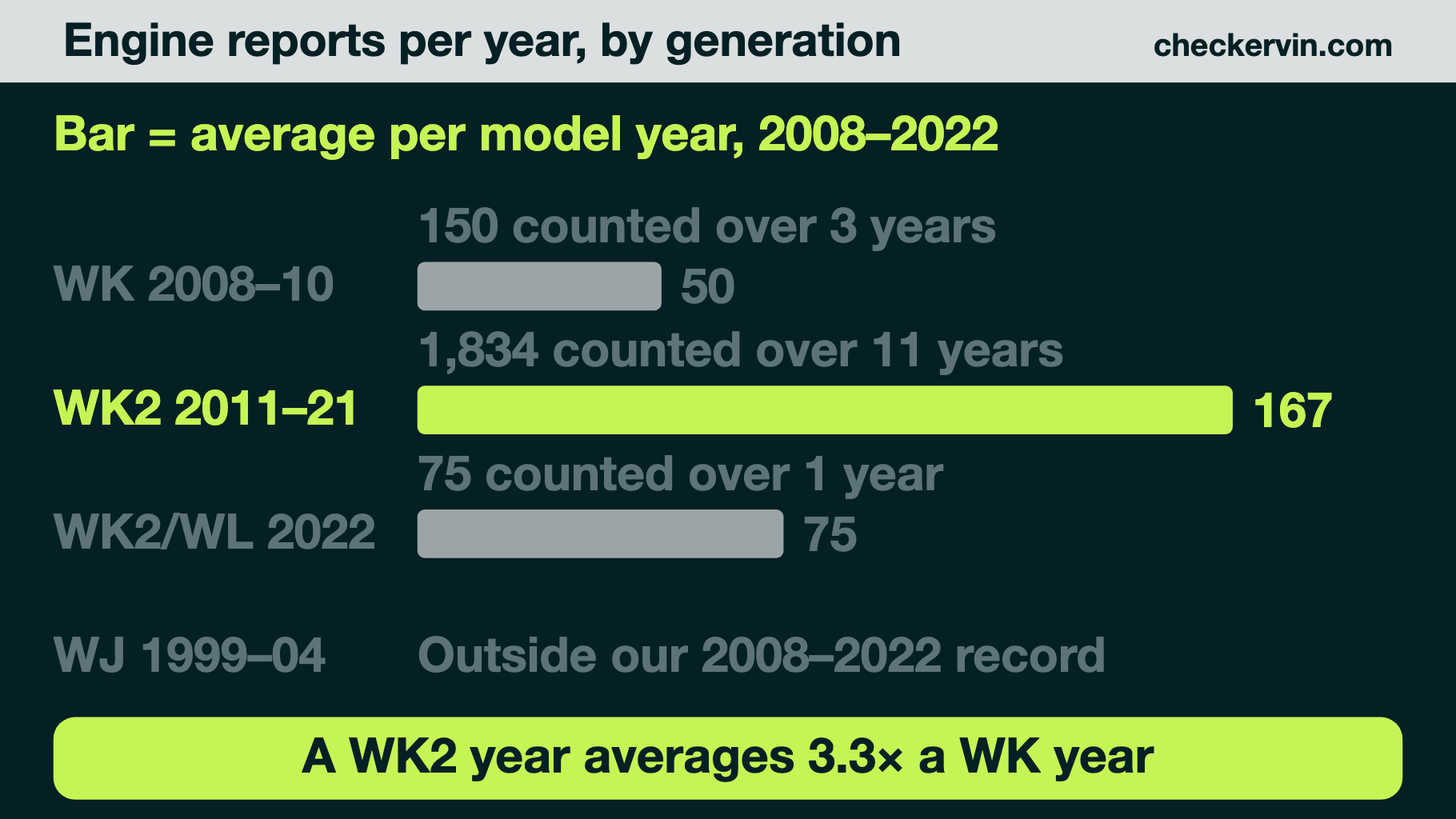
Split by generation, the WK2 stands out. Its 11 model years carry 1,834 engine reports, about 167 per year, peaking with the 2014 model at 409. The three WK years in our data average about 50, so a WK2 year runs about 3.3 times as many. The mixed 2022 year has 75.
We read the narratives behind those numbers. Well under one in ten engine complaints mention coolant, overheating, antifreeze or the radiator, and the radiator by name appears in only a small fraction of those. The most common thread by far is the engine stalling or shutting off while driving; misfires, ticking, oil leaks and engine replacements follow. So the chart below shows where Grand Cherokee engine trouble concentrates by generation; it is not a count of failed radiators, and nobody should read it as one.
The WK2 radiator: what owners report and what Jeep told dealers
The radiator narratives that do exist bunch up in two model years, 2014 and 2015, and they read alike. The leak is often found at a routine visit rather than on the road: a 2015 owner whose dealer found the radiator leaking at the 60,000-mile service, another at under 58,500 miles alongside a power steering leak, another at 85,820 miles during a thermostat code repair. The 2015 owner at 60,000 miles reports paying $1,026.97 at a Michigan Jeep dealer. That is one invoice, not a survey, but it sits between the YourMechanic and RepairPal figures.
Owner reports describe a slow seep found during routine service more often than a sudden burst, which is a reason to have the cooling system pressure-tested before agreeing to a new radiator.
Stellantis did write about the radiator once that we could find. GPOP notice 9003743, dated August 16, 2017 and covering 2017 Grand Cherokees and Durangos (WK and WD), lists two radiator part numbers and tells dealers to call an engineer at FCA’s Auburn Hills offices before replacing one. The revised text adds an instruction: when the radiator is being replaced for damage on its engine side, the fan module is replaced too, and the old fan is shipped back under the same ticket. The notice gives no reason. The engine side of the radiator is the side facing the fan, so the plain reading is that Stellantis wanted those fans back to examine, but that is our inference, not the notice’s words.
Why WK2 labor runs higher than the older trucks
ClickMechanic books the WJ at an hour or two. The WK2 is a bigger job, and RepairPal’s labor line, roughly two-thirds higher than its WK figure, reflects that. As on most modern SUVs, the radiator sits in a stack between the A/C condenser in front and the electric fan module behind, and the automatic transmission’s cooler lines connect at the radiator. A 2011 dealer repair order quoted in one NHTSA complaint describes technicians reattaching transmission cooler lines “at the radiator” after they came loose, which is a reminder that a radiator swap also disturbs the transmission circuit.
The video below takes the front bumper off to get at it, which its creator describes as the method he chose rather than the only one. Either way the job includes draining and refilling coolant, bleeding air out of the system, and checking transmission fluid afterward. If the shop has to disconnect the condenser, recovering and recharging the A/C adds time, so ask whether the quote includes it.
A quote far above the RepairPal range deserves a line-by-line read. It may include a fan module, hoses, a thermostat or A/C work, all of which can be reasonable. If it is a bare radiator at well over $2,000, ask what part is being installed.
Standard duty, heavy duty and the Trackhawk's second circuit
Not every WK2 takes the same radiator: Stellantis’s own documents separate standard-duty and heavier cooling packages. A STAR case from August 2021, S2124000013, filed by NHTSA against the 2021 Grand Cherokee, describes a P0480 cooling-fan code and says the condition is “for NMB (Standard Duty) vehicles only.” NHTSA lists both the WK2 and the new Grand Cherokee L under 2021, and the case does not say which it means, so we cite it only for the point that Jeep builds these trucks with more than one cooling package.
The practical consequence is simple: order by VIN, not by year, so the part matches the package the truck was built with rather than one that merely bolts in.
The 2018–2021 Trackhawk’s supercharged 6.2-liter V8 cools its compressed intake air as well, so a “radiator” quote on a Trackhawk should say exactly which heat exchanger it covers. The SRT’s 6.4 and the Hemi use their own radiators too, and none of the estimators above breaks its figures out by engine.
The cooling fan often belongs on the same bill
An engine that overheats with a full radiator is often a fan problem, and the narratives show it: a 2015 Pentastar owner who ran hot from a failed electric fan and a thermostat housing, a 2011 owner whose fan lost power because the fuse box module failed. Two Stellantis documents address the fan directly. STAR case S2208000064, from March 2022 and filed against the 2021 Grand Cherokee, traces a P0480 fan code to a ground wire not fully welded to its eyelet at ground G908A, behind the passenger headlight, and recommends spot-soldering it. And GPOP notice 9004540, from May 2022 for the 2022 Grand Cherokee 4xe, tells dealers to command the fan at 50% duty cycle with the scan tool before replacing the fan module.
Both point the same way. A fan code is not automatically a new fan, and a fan problem is not a radiator problem. If the radiator is replaced for damage on the fan side, as on the 2017 trucks above, expect the conversation to include the fan module.
Coolant loss that isn't the radiator
Several owners describe paying for a radiator and still losing coolant. One 2015 owner’s dealer replaced the radiator; the leak continued, and a later diagnosis named the oil cooler. Another 2016 owner says a cracked plastic oil filter assembly pumped at least three quarts of oil into the radiator. On the 3.6L, parts sellers list that housing as an oil filter and cooler assembly, and our Grand Cherokee water pump post walks through the Stellantis documents on that housing and on the plastic thermostat housing. Oil in the coolant bottle points there first, not at the radiator.
Hoses and clamps fail on their own: a 2009 owner lost all coolant when the barb on a plastic upper hose elbow broke, and a 2014 owner traced a leak to a corroded lower hose clamp. RepairPal lists Grand Cherokee radiator hose replacement at $428 to $462. Coolant that vanishes with no visible leak can be internal. The diesel’s EGR cooler is under recall, and the WL’s engines have their own block-porosity notices; a May 2026 STAR case for the 2026 Grand Cherokee says coolant loss from block porosity is under engineering investigation. Our head gasket post covers the internal cases.
What the recall record covers
We queried NHTSA’s recall database for every Grand Cherokee year from 2008 through 2022, and the counts matched our corpus; the 2014model returned the same campaigns our data records. No campaign names the radiator, a cooling fan or a coolant hose. The one coolant recall is 20V699, for the EGR cooler on 2014–2019 EcoDiesel models. We also found no Stellantis warranty extension on Grand Cherokee radiators. Our search of Stellantis’s dealer communications covered every year except 2014, whose list NHTSA’s system failed to return, so 2014 remains unchecked on that one point. The Jeep recall lookup by VIN shows what is still open on a specific vehicle.
Before you authorize the radiator
- Confirm the generation and engine by VIN; a 2022 can be a WK2 or a WL
- Ask for a pressure test with dye and a photo of the leak at the radiator
- Check the coolant bottle for oil; on a 3.6L that points at the oil cooler housing
- Ask whether the part is factory or aftermarket, and whether it matches a standard- or heavy-duty package
- Ask whether the quote includes the fan module, hoses, thermostat or A/C work
- Refill with the coolant the factory specified for that engine
The second and fourth items matter most. The leak test guards against paying for the wrong part, and the parts question is where the difference between a $615 job and a $2,000 job lives. A coolant type lookup by VIN shows which coolant the factory specified for the refill.
If you are buying a Grand Cherokee, not repairing one
The same record works as a shopping checklist, and it differs by generation. On a 2014 or 2015 WK2, the two years where radiator narratives bunch up, look at the radiator’s side tanks with a flashlight for dried coolant crust, check the coolant level with the engine cold, and ask whether the radiator has been replaced. A receipt showing a replacement at 60,000 to 90,000 miles is not a red flag; it may mean the common repair is already done.
On a 2017, ask whether a radiator replacement came with a fan module, since that is the pairing Stellantis told its dealers to make. On a Trackhawk, have both the main radiator and the low-temperature circuit checked, because a seller’s “new radiator” may cover only one. On a 2014–2019 EcoDiesel, confirm that recall 20V699 has been done before blaming any coolant loss on the radiator. And on a 2022, decode the VIN first, because the carry-over WK2 and the new WL share a model year and nothing else under the hood.
A pre-purchase inspection with a cooling-system pressure test costs a fraction of any radiator figure on this page. The Grand Cherokee years-to-avoid page covers the rest of the record, where electrical complaints lead 11 of the 15 model years we hold.
Where this information comes from
- Stellantis GPOP 9003743 (NHTSA copy) — 2017 WK/WD radiatorCall engineering before replacing; replace the fan module too when the radiator is damaged on its engine side.
- Stellantis STAR S2208000064 (NHTSA copy) — P0480 fan groundFiled against the 2021 Grand Cherokee: fan code from a poorly welded ground eyelet; spot solder it.
- Stellantis STAR S2124000013 (NHTSA copy) — P0480, standard dutyShows the fan condition applies to standard-duty vehicles only, evidence of more than one cooling package.
- Stellantis GPOP 9004540 (NHTSA copy) — 2022 4xe fan moduleTest the fan at 50% duty cycle before replacing the module.
- Stellantis STAR S2609000007 (NHTSA copy) — 2026 WL coolant lossBlock porosity causing external coolant loss is under engineering investigation.
- NHTSA recalls and complaints databaseRecall query for 2008–2022: no radiator, fan or hose campaign; complaint narratives read for every year.
- EPA fueleconomy.gov — Grand Cherokee engine listingsEngines by model year, the SRT and Trackhawk, and the two 2022 Grand Cherokee bodies.
- RepairPal — Jeep Grand Cherokee radiator replacement estimatesNameplate and per-year ranges with labor and parts, read November 24, 2026 via search text.
- YourMechanic — Grand Cherokee radiator replacementAverage $615, parts $363, labor $252, read November 24, 2026 via search text.
- ClickMechanic — Grand Cherokee radiator replacement (UK)WJ-era 4.0 and 4.7 labor booked at one to two hours; prices in pounds.
Keep reading
Frequently asked questions
How much does it cost to replace a radiator on a Jeep Grand Cherokee?
RepairPal's Grand Cherokee page puts radiator replacement at $1,631 to $1,823, and its WK2 model-year pages run $1,757 to $2,018, with labor at $464 to $680 and parts around $1,294 to $1,337 (retrieved November 2026). YourMechanic lists a much lower average of $615, with $363 in parts and $252 in labor. The gap is mostly the radiator itself: RepairPal's parts figures suggest factory-part pricing, so the brand of radiator you approve moves the bill more than the labor does.
How much is a new radiator for a 2015 Grand Cherokee?
RepairPal had no 2015 page we could find, but its 2014 and 2016 pages bracket it: parts around $1,294 to $1,302, and $1,757 to $1,982 for the whole job. One 2015 owner told NHTSA a Michigan Jeep dealer charged $1,026.97 to replace a leaking radiator at 60,000 miles. A 2015 can carry a standard-duty or heavy-duty cooling package, so order the part by VIN rather than by year alone.
What is the most common problem with a Grand Cherokee?
In the federal complaint record, electrical faults. ELECTRICAL SYSTEM is the top complaint category in 11 of the 15 Grand Cherokee model years from 2008 to 2022. ENGINE reaches the top five in 15 of 15 years, with 2,059 reports counted, but only a small minority of those engine narratives mention coolant, overheating or the radiator. A radiator leak is a real and recurring repair, not the vehicle's leading complaint.
Is there a recall or extended warranty on the Grand Cherokee radiator?
Not that we could find. We queried NHTSA's recall database for every model year from 2008 through 2022, and no campaign names the radiator, cooling fan or hoses. The only coolant-related recall is 20V699, for the EGR cooler on 2014-2019 Grand Cherokees with the 3.0L EcoDiesel. A 2017 Stellantis dealer notice told technicians to call an engineer before replacing a 2017 Grand Cherokee or Durango radiator, but it is a dealer instruction, not an owner warranty.
Could my Grand Cherokee's coolant leak be something other than the radiator?
Yes, and some are cheaper. Owners report dealers replacing a radiator only for the leak to continue until the 3.6L oil cooler housing was found to be the cause. Hoses and clamps fail too: RepairPal lists radiator hose replacement at $428 to $462. A dead electric cooling fan causes overheating without any leak, and Stellantis has dealer documents on fan faults caused by a poorly attached ground wire. Ask for a pressure test with dye before approving a radiator.
Order the right radiator the first time
A free CheckerVIN report shows the factory build, engine, specifications and open recalls for any VIN, so you know which generation and package the shop is quoting.
Run a free VIN check