The short answer
- What does it cost?
- On a 2017-2022 1.5T or 2020-2022 hybrid CR-V with a failed head gasket, possibly nothing: Honda's 2026 extension covers a new head or short block when warpage is found.
- What does the record say?
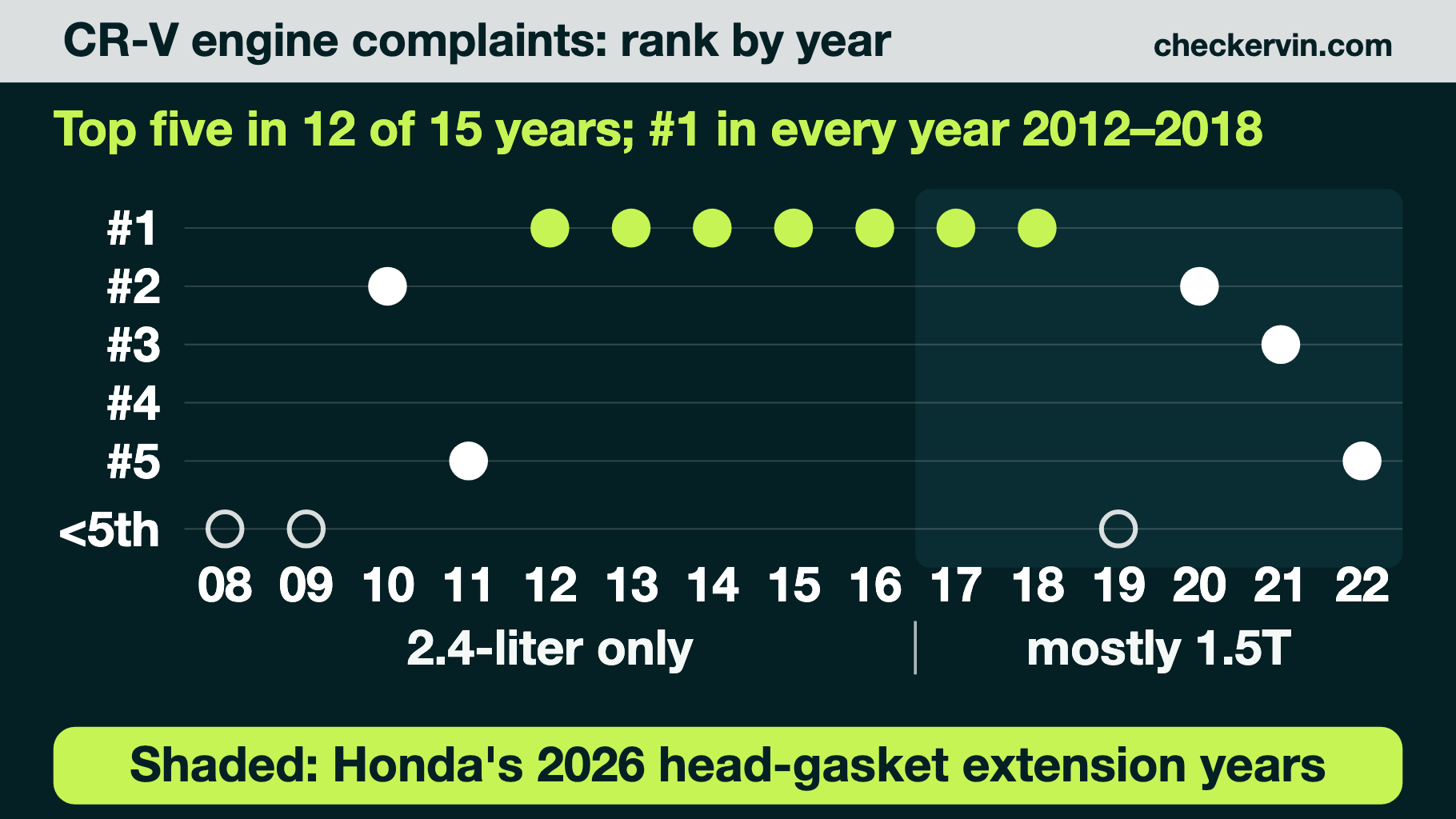
- ENGINE is in the CR-V's top five complaint categories in 12 of 15 model years and first in every year 2012-2018.
- What should I do first?
- Ask a Honda dealer to check the VIN for the head-gasket campaign and any open recalls before you price a used or rebuilt engine anywhere.
12 of 15
Model years with ENGINE in the top five
2012–2018
Every year ENGINE ranked first
10 yr / 150k
Honda's 2026 head-gasket coverage
May 31, 2027
2017 1.5T coverage end, any mileage
The price, and why we print none
Search this question and you get an Australian repair marketplace, two forum threads quoting what one owner paid, and estimator pages for a blower motor. None of them prices a US CR-V engine. We looked for an estimator or seller figure we could open and confirm on November 22, 2026. RepairPal publishes estimates for CR-V gasket and oil-pan jobs but not a full engine. One search summary credited a remanufactured 1.5-liter turbo price to an online engine seller, but the seller’s page refused two direct requests, so the number stays unprinted. We sell VIN checks, not repairs, and quote no price of our own.
The one cost figure we can stand behind comes from Honda. Its service bulletin 26-016, issued September 25, 2026, books the head-gasket job on a 2017–2022 CR-V at 13.2 labor hours, a head-and-gasket job at 13.7, and a gasket plus new short block at 15.1 hours front-wheel drive or 15.5 all-wheel drive. Replacing the head, the short block and the gasket together runs 15.2 or 15.6. Multiply by a local shop rate and you have the labor half of a quote. For most owners of those model years, though, the more useful fact in that bulletin is the heading on its first page: it is a warranty extension.
Where ENGINE ranks, year by year
Our NHTSA corpus holds 11,098 owner complaints against the 2008–2022CR-V, with the CR-V Hybrid pooled in from 2020. ENGINE appears among a model year’s five most-reported categories in 12 of those 15 years, and it ranks first in every year from 2012 through 2018. Summing only the years where it makes the top five gives 2,033 ENGINE reports counted, a minimum rather than a total, because a year where ENGINE ranks sixth adds nothing to that sum.
The category is broad. It takes every engine-related report, from an oil leak or a rattle to a misfire light, so it is the outer limit of how often owners blamed the engine, never a count of engines that had to be replaced. Read it as a map of where to look. On this nameplate, two different stories sit inside it. The 2.4-liter cars from 2012 to 2016 lead with ENGINE every year, 720 reports counted, peaking at 243 in 2015, 36.2% of that year’s complaints. Then the 1.5-liter turbo era opens with the two largest ENGINE years on record, 531 in 2017 and 530 in 2018.
After that the category falls away. In 2019ENGINE drops below the year’s fifth-place category, which caps it at 120 reports or fewer. For 2020 through 2022 it returns at ranks 2, 3 and 5, never more than 15.8% of a year’s complaints. Across the six model years Honda’s 2026 extension names, 1,223 ENGINE reports are counted, most of them from 2017 and 2018. That does not make 2017–2018 head-gasket years; the narratives from those two years mostly describe gasoline-smelling oil, which is a different failure with a different, now-expired remedy.
Which engine the CR-V has
The engine decides which Honda documents apply, so settle it before anything else. The EPA’s fuel-economy records list the CR-V’s gasoline engines like this:
| Model years | Engine, per EPA records |
|---|---|
| 2008-2014 | 2.4-liter four-cylinder, 5-speed automatic |
| 2015-2016 | 2.4-liter four-cylinder with direct injection, CVT |
| 2017-2019 | 2.4-liter four (LX) or 1.5-liter turbo four, CVT |
| 2020-2022 | 1.5-liter turbo four, CVT; CR-V Hybrid with a 2.0-liter four |
The split years are the trap. A 2018 CR-V LX and a 2018 CR-V EX look alike in a listing, but only the EX’s 1.5-liter turbo is named in the oil-dilution program and in the head-gasket bulletin titles. A parts listing that matches on “2018 CR-V” alone is not a match either. An engine lookup by VIN settles it in a minute.
The 2026 head-gasket extension, read in full
On August 26, 2026, American Honda told its dealers it was extending coverage on the cylinder head gasket for certain 2018–2026 Accords, 2016–2026 Civics, 2017–2026 CR-Vs and 2020–2026 CR-V Hybrids. The stated condition: the gasket’s effectiveness may be reduced, which can cause overheating, coolant loss, misfires and misfire codes P0300 through P0304. Coverage runs 10 years from the original date of purchase or 150,000 miles, whichever comes first, and Honda added a six-month grace period from the date of notification for cars already too old to qualify. Customer letters were due to start in early October 2026.
The CR-V bulletin, 26-016, is the part that turns a gasket campaign into an engine story. Its corrective action is to replace the head gasket if coolant is leaking into the combustion chamber and, if the cylinder head or engine block is warped, to replace the head, the short block, or both. Honda sent dealers a warpage inspection kit for the job. Version 3 of the bulletin also adds a line that matters to anyone buying a rebuilt CR-V: the extension applies regardless of whether the vehicle has been declared a total loss, sold for salvage or given a branded title under any state’s law.
- 26-016: 2017-2022 CR-V, 1.5-liter turbo per Honda's bulletin list, 10 years or 150,000 miles
- 26-018: 2020-2022 CR-V Hybrid, same terms per Honda's dealer message
- 26-098: 2017 CR-V 1.5L Turbo, covered until May 31, 2027 regardless of time in service or mileage
- 26-017 and 26-019: the 2023-2026 CR-V and CR-V Hybrid, newer than the years our data covers
There is a gate. The dealer pressure-tests the cooling system, pulls the spark plugs and looks into each cylinder with a borescope. If no coolant is entering a cylinder, the bulletin says it does not apply and the car goes back to normal diagnosis. A new head or short block also needs approval from Honda’s Repair Verification Team before the work starts. So the extension pays for one specific failure, proven one specific way, and not for every engine that stops running.
Where each model year stands on the clock
A ten-year term counts from the day the car was first sold, so by late 2026 the earliest cars are already near the end of it.
| CR-V | Head-gasket coverage, late 2026 |
|---|---|
| 2017 1.5T | Until May 31, 2027 at any mileage (26-098) |
| 2018-2019 1.5T | 10 years from first sale or 150,000 miles; ends 2027-2029 |
| 2020-2022 1.5T | 10 years from first sale or 150,000 miles; ends 2029-2032 |
| 2020-2022 Hybrid | Same terms under 26-018 |
| 2017-2019 LX 2.4L | Not named in Honda's bulletin titles; ask for an iN VIN check |
| 2008-2016 | Not covered by this extension |
Mileage can close the window before the calendar does. A high-mileage 2019 that crossed 150,000 miles last year is outside 26-016 even though it is well inside ten years, and only the 2017 bulletin waives mileage. Honda’s documents direct dealers to confirm eligibility with an iN VIN status inquiry, which reads the in-service date and campaign status off Honda’s own system. That check, not the model year on the registration, is the answer.
2017–2018 oil dilution, in Honda’s words
The 2017–2018 complaint spike has its own documents, and they were never an engine-replacement program. On October 22, 2018, Honda announced a product update for 2017–2018 CR-Vs with the 1.5-liter turbo sold in five cold-weather states: Maine, Minnesota, North Dakota, South Dakota and Wisconsin. The problem it described: on very short trips in extreme cold, fuel could dilute the oil, raise the oil level and cause misfires. The repair was software, an oil change and, on some cars, a new A/C control unit. Outside those states, dealers were told to diagnose normally and provide the update under warranty if they confirmed the problem.
On April 5, 2019, Honda followed with a warranty extension for 2016–2018 Civics and 2017–2018 CR-Vs. It covered the camshafts and rocker arm assemblies, raising their coverage from 5 years/60,000 miles to 6 years with unlimited mileage from the original sale date. Honda’s own note to dealers said the majority of vehicles would need only a software update. Six years from a 2018 sale ran out for almost every car by 2024 or 2025, so that coverage is now history. The CR-V timing-chain post covers why that spike is not a chain problem; here the point is narrower. If a 2017–2018 CR-V needs an engine today, the oil-dilution paperwork will not pay for it, and the 2026 head-gasket bulletin pays only if a borescope finds coolant in a cylinder.
The 2.4-liter years: bulletins, not blocks
The one older CR-V engine program Honda did run was on the 2010–2011 cars. NHTSA’s summaries of Honda bulletin 12-089 describe a warning light for high oil consumption and deposits forming on the oil control rings, and an extension of coverage on the pistons and piston rings to 8 years from purchase or 125,000 miles. Eight years from a 2011 sale ended in 2019. Note one contrast with 2026: Honda’s 2019 version of that bulletin excluded any car ever declared a total loss or given a branded title, and the 2026 head-gasket bulletin expressly includes them.
The 2012–2016 cars lead their complaint lists with ENGINE every year, yet Honda never extended engine coverage on them. The bulletins NHTSA holds for those years describe noises and vibrations with part-level fixes. For 2012–2014, Honda’s bulletins replace the variable valve timing actuator when the engine rattles for about two seconds on a cold start. For 2015–2016, a 2019 bulletin addresses a cold-start knock from a worn check valve in the cam chain tensioner.
The 2015 model year has a fuller paper trail. Service bulletin 15-046, revised nine times through September 2018, treats vibration felt through the driver’s seat with new mounts and cushions, engine software and a tailgate damper kit. It applies to every 2015 CR-V and to no 2016. Owners sued, and the case settled in January 2018; Honda’s 2019 settlement reminder to dealers says the mount fix fell under the 5-year/60,000-mile powertrain warranty and the software fixes under the 8-year/80,000-mile emissions warranty. Both have run out. None of it involved replacing an engine, which is a useful thing to know if a shop diagnoses a 2015’s vibration as a failing motor.
Engine recalls by year
NHTSA’s recall database lists two CR-V campaigns filed under ENGINE between 2008 and 2022, both on the 2015–2016 cars. We queried every model year, CR-V and CR-V Hybrid, after confirming the same query returns engine recalls on a vehicle known to have them.
| Campaign | What NHTSA's record says |
|---|---|
| 15V121000 (2015) | CR-Vs built Sept. 9, 2014 to Feb. 6, 2015 may have improperly torqued connecting-rod bolts; dealers replace the short block free |
| 17V305000 (2015-2016) | CR-Vs that received a replacement engine that may have the wrong pistons; dealers inspect and replace parts free |
| 23V858000 (2013-2022) | Fuel pump inside the tank may fail; filed under fuel system, but it can stall a healthy engine |
The first one is the clearest case of Honda paying for a CR-V short block outright, and it reaches only cars built in a five-month window. The fuel-pump campaign is the one to rule out before anyone condemns an engine for stalling or refusing to start: it spans almost every CR-V year in our data and the 2020 Hybrid. A Honda recall check by VIN shows whether either is still open on a specific car.
When the bill is yours
Outside every campaign, follow the escalation Honda wrote for its own technicians, because it is also a sensible way to read a quote. Their flow confirms coolant in a cylinder first, then checks the block for cracks and warpage, then the head, and only replaces what the measurements condemn: a gasket alone, a head and gasket, a short block, or both. A complete engine from a salvage yard or a remanufacturer sits beyond all of that, and it makes sense when the damage goes past the block and head, such as a spun bearing or a seized engine.
- Head gasket only: the smallest job, 13.2 hours on Honda's clock for a 1.5T
- Cylinder head and gasket: adds the head and injector seals, 13.7 hours
- Short block: block, pistons and crank, keeping your head and accessories, 15.1-15.5 hours
- Used complete engine: lowest parts price, least known about its history
- Remanufactured complete engine: rebuilt with new wear parts and a written warranty; ask its length and who honors it
Two lines hide in short-block and complete-engine quotes. Honda’s bulletin calls for CVT fluid when the short block comes out, because the transmission is drained to separate it, and for a wheel alignment after the subframe work. A quote that leaves those off is not finished. On a turbo car, ask whether the turbo gaskets, oil feed filter and coolant are included; Honda’s gasket-only parts list runs to about thirty items.
Before you authorize an engine
- Decode the VIN to confirm the model year and whether it is the 2.4-liter, the 1.5-liter turbo or the hybrid
- Ask a Honda dealer for an iN VIN status inquiry on the head-gasket campaign (26-016, 26-018 or 26-098)
- If the car overheats, loses coolant or misfires, ask for the bulletin's borescope inspection before any teardown elsewhere
- Rule out the open fuel-pump recall before condemning an engine for stalling
- Get the diagnosis in writing: gasket, head, short block or complete engine, and what ruled out the smaller jobs
- Compare the repair with the car's value for its trim and mileage
If you are buying the CR-V, not repairing it
A 2017–2022 turbo CR-V with a history of overheating is a different purchase now than it was in July 2026. The head-gasket extension follows the car, not the owner, and Honda wrote it to cover salvage and branded-title cars too, so a rebuilt CR-V can still qualify. Run a Honda VIN decode to confirm the engine, then ask the seller for service records showing whether the campaign has been done. If it has, the car may already have a new head or short block from Honda.
Read which CR-V model years draw the most complaints across every category, not only ENGINE, and use a warranty check by VIN to see what factory coverage is left. If the car carries a branded title, our guide to the salvage certificate explains what that brand does and does not tell you.
Where this information comes from
- NHTSA-hosted Honda dealer message — 2016-2026 multi-model cylinder head gasket warranty extension (Aug. 26, 2026)Read in full: 10 years/150,000 miles, six-month grace period, the list of CR-V bulletins 26-016, 26-018 and 26-098.
- NHTSA-hosted Honda Service Bulletin 26-016 — 2017-22 CR-V cylinder head gasket (Version 3)Read in full: corrective action up to short block, branded-title clause, flat-rate hours, borescope gate.
- NHTSA-hosted Honda Service Bulletin 26-098 — 2017 CR-V 1.5T, expires May 31, 2027Source of the any-mileage coverage to May 31, 2027 for the 2017 1.5-liter turbo.
- NHTSA-hosted Honda dealer message — 2017-18 CR-V oil dilution warranty extension (Apr. 5, 2019)Camshafts and rocker arms to 6 years/unlimited miles; most cars needed only software.
- NHTSA-hosted Honda dealer message — 2017-18 CR-V oil dilution product update (Oct. 22, 2018)Names the five cold-weather states and the software and oil-change repair.
- NHTSA-hosted Honda Service Bulletin 12-089 — 2010-11 CR-V piston and piston-ring warranty extension8 years/125,000 miles; terms taken from NHTSA's summary of the bulletin, including the branded-title exclusion.
- NHTSA-hosted Honda Service Bulletin 15-046 — 2015 CR-V vibrationApplies to every 2015 CR-V; mounts, software and a tailgate damper, no engine replacement.
- NHTSA recalls API — CR-V by model yearQueried for every CR-V and CR-V Hybrid year 2008-2022 after a known-positive check; source of 15V121000 and 17V305000.
- EPA fueleconomy.gov web service — CR-V engine options by model yearQueried for every year 2008-2022; this 2017 query shows the 2.4-liter and 1.5-liter turbo offered side by side.
Keep reading
Frequently asked questions
How much does it cost to replace a Honda CR-V engine?
On a 2017-2022 CR-V with the 1.5-liter turbo or a 2020-2022 CR-V Hybrid, it may cost nothing: Honda's August 26, 2026 warranty extension covers head-gasket failures for 10 years from original purchase or 150,000 miles, and its bulletin authorizes a new cylinder head and short block when the inspection finds warpage. Honda books that job at 13.2 to 15.6 labor hours. Outside that coverage the bill depends on whether the car needs a gasket, a head, a short block or a complete used or remanufactured engine. We could not verify a published CR-V engine price from an estimator or seller, so we print none.
Which CR-V year should you stay away from for engine problems?
By engine complaints, the 2012-2018 run: ENGINE is the single most-reported category in every one of those model years, computed from our NHTSA corpus. 2017 and 2018 carry the most, 531 and 530 reports, and those are the oil-dilution years. 2019 drops ENGINE out of its top five entirely. Complaints are owner reports, not failure rates, so read them as a map of what to check rather than a verdict, and see our CR-V years-to-avoid page for every category.
How long do Honda CR-V engines last?
No public dataset measures CR-V engine life, and we will not invent a mileage. What can be stated is what Honda itself stands behind: 5 years or 60,000 miles of powertrain coverage on these model years, and, since August 2026, 10 years or 150,000 miles on the head-gasket condition for 2017-2022 1.5-liter turbo and 2020-2022 hybrid CR-Vs. On a 2010 or 2011 CR-V, Honda once extended piston and piston-ring coverage to 8 years or 125,000 miles over oil consumption; that has expired, so on those cars today the maintenance record and an oil-consumption check matter more than the model year.
Does the Honda head gasket warranty extension cover a 2017 CR-V?
Yes, under its own bulletin. Service Bulletin 26-098 covers the 2017 CR-V 1.5L Turbo until May 31, 2027, regardless of time in service or mileage, and the broader bulletin 26-016 covers 2017-2022 CR-Vs for 10 years from original purchase or 150,000 miles. The dealer must find coolant entering a cylinder with a borescope before the bulletin applies, and it applies even to cars with a salvage or branded title. A Honda dealer can confirm eligibility by VIN.
Is it worth replacing the engine in a CR-V?
Check the free routes before you decide. On a 2017-2022 1.5T or 2020-2022 hybrid with coolant loss, overheating or misfires, ask a Honda dealer to run the head-gasket inspection first, because the fix may be Honda's bill. If the car is outside every extension, compare the quote with the car's market value for its trim and mileage, and get the diagnosis written down: Honda's own bulletin escalates from gasket to head to short block only as the inspection finds damage, so a complete-engine quote should say why the cheaper steps were ruled out.
Know which CR-V engine you are pricing
A free CheckerVIN report shows the factory build, engine, specifications and open recalls for any VIN, so the head-gasket question starts from the right car.
Run a free VIN check