The short answer
- What does it cost?
- For a 2006-2011 1.8-liter: a new Honda short block listed at $2,298.12 plus a $700 core, and 12.6 hours of labor on Honda's own clock. A 1.5-liter turbo with a failed head gasket may cost you nothing.
- What does the record say?
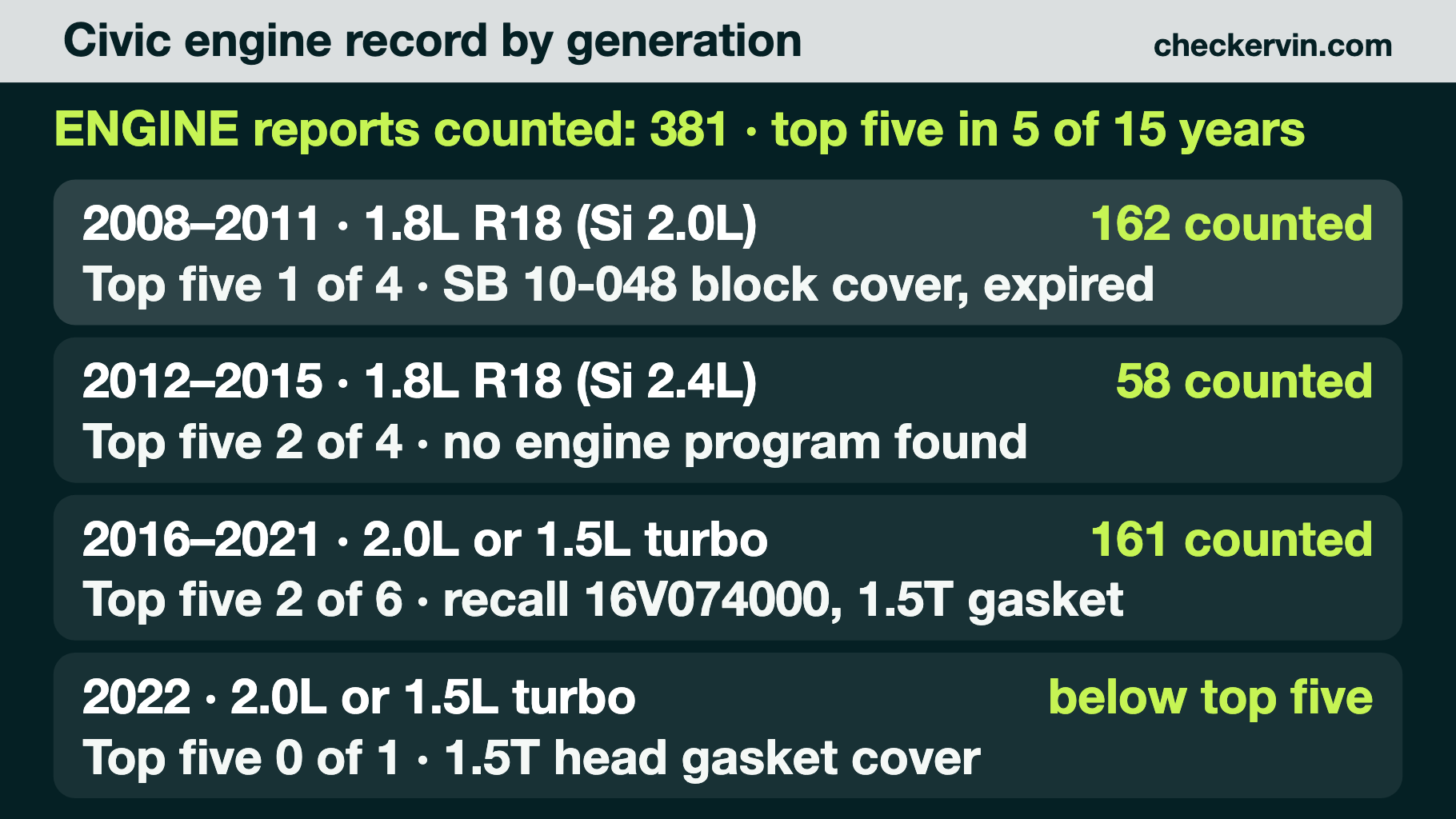
- ENGINE is in the Civic's top five complaint categories in 5 of 15 model years (2008, 2014, 2015, 2016, 2017), and 2008 carries the most, 162 reports.
- What should I do first?
- Decode the VIN to confirm the engine, then ask a Honda dealer whether a recall or warranty extension is open before you price a used engine.
5 of 15
Model years with ENGINE in the top five
12.6 hr
Honda's flat rate for an R18 block swap
$2,298
New Honda R18 short block, listed Nov. 23, 2026
14.7 hr
Honda's 1.5T gasket + short block time
The figures we could open
The search results for this question price engines in euros and shekels, quote an Australian Facebook group, and fall back on RepairPal question pages from 2011 and 2015. None of them splits a Civic engine by generation, and none says what a US owner pays for a new, remanufactured or used unit. We tried to open a US price for each on November 23, 2026. Most parts sellers refused automated requests, so the list is short, and we print nothing we could not read ourselves. We sell VIN checks, not engines or repairs.
| What | Figure and where it comes from |
|---|---|
| New Honda short block, 2006-2011 1.8L | $2,298.12 plus $700 core charge; MSRP $3,081.55 (HondaPartsNow, part 10002-RNA-A50, Nov. 23, 2026) |
| Labor, R18 block swap | 12.6 hours, engine and transmission removed together (Honda SB 10-048) |
| Labor, 1.5T gasket + short block | 14.7 hours (Honda SB 26-008, 2016-2021 Civic CVT) |
| What owners say they paid | $4,257 for a replacement motor (2008 Civic) and $8,194.56 at a dealer (2016 turbo), per NHTSA complaints |
The two owner figures are what people wrote to NHTSA, not invoices we saw, and they describe different jobs: a 2008 owner who replaced a cracked engine after buying the car used, and a 2016 turbo owner whose engine failed after a head-gasket breach and was replaced at a Honda dealer. The gap between them is roughly the gap between an independent shop with a used engine and a dealer with new parts. Your quote will sit somewhere on that line, and the rest of this page is about where.
Where ENGINE shows up, 2008–2022
Our NHTSA corpus holds 7,598 owner complaints against the 2008–2022Civic. ENGINE makes a model year’s five most-reported categories in only 5 of those 15 years: 2008, 2014, 2015, 2016, 2017. Summing those years gives 381 ENGINE reports counted. That is a floor, because a year where ENGINE ranks sixth adds nothing to the sum, and it is an outer limit on engine trouble, because the category takes every engine-related report from a leak to a stall. It is not a count of engines that were replaced.
2008 stands apart: 162 ENGINE reports, 16.4% of that year’s complaints, and the narratives are mostly cracked blocks. The 2012–2015 cars add 58 counted, but read 2014 (24) and 2015 (34) with care: several of their engine-tagged narratives describe transmission faults that owners filed under the engine. The 2016–2021 body adds 161, all of it from 2016 (95) and 2017 (66); in the other 4 years of that body ENGINE sits below fifth place, at most 70 reports in any one of them. 2022 has it below fifth as well, capped at 43.
Which engine the Civic has
Part numbers, labor hours and Honda programs all follow the engine, so settle it first. Displacements below are from EPA fuel-economy records; engine codes are from Haynes’s Civic generation table, and Honda’s own block bulletin names the R18A1.
| Model years | Engine |
|---|---|
| 2001-2005 | 1.7-liter four (D17 family); Si hatchback 2.0-liter (K20A3) |
| 2006-2011 | 1.8-liter four (R18A1/A2); Si 2.0-liter (K20Z3) |
| 2012-2015 | 1.8-liter four (R18Z1/Z4); Si 2.4-liter (K24Z7) |
| 2016-2021 | 2.0-liter four (K20C2) or 1.5-liter turbo (L15B7); 2017-2020 Si 1.5-liter turbo |
| 2022 | 2.0-liter four or 1.5-liter turbo |
The 2016–2021 split is where quotes go wrong. Trims divide between the 2.0-liter and the turbo, two cars of the same year can look identical in a listing, and they share no short block. Honda’s own turbo bulletin warns that ordering the wrong block can leave the alternator not fitting, and splits even the 1.5-liter blocks by engine serial number. An engine size check by VIN settles the displacement in a minute; the serial is stamped on the block.
The swap on Honda’s clock
Honda publishes the time it pays its own dealers, and two of its bulletins amount to engine swaps. They are the closest thing to a neutral labor figure for this job. On the 2006–2009 1.8-liter, service bulletin 10-048 allows 12.6 hours to replace the engine block. Its procedure removes the engine and transmission as one assembly, splits them on the bench, moves the head, oil pump and ignition coils to the new short block, and reinstalls the lot. That is a block swap, and a used complete engine saves only part of it, since most of the hours are in getting the assembly out and back.
On the 2016–2021 1.5-liter turbo with a CVT, bulletin 26-008 allows 14.7hours for a head gasket and new short block, including a wheel alignment, and calls for fresh CVT fluid whenever the short block is replaced. Shop rates vary too much by region for us to multiply these out, so do it with your shop’s posted hourly rate. A quote far above that product should list what else it includes. One far below it usually means a used engine and a shorter parts list.
Used, JDM, remanufactured or new
A new Honda short block is the most documented option. Honda prints a part number for it, ships it with a factory parts warranty, and its own technicians install the same part under campaign. For the 2006–2011 1.8-liter that part is 10002-RNA-A50, which supersedes the two original block numbers. HondaPartsNow listed it new at $2,298.12 on November 23, 2026, plus a $700 core charge. We could not open a current price for the 2.0-liter or 1.5-liter turbo blocks, so we print none.
A remanufactured engine is rebuilt with new wear parts and sold with a written warranty from the rebuilder, not from Honda. We could not open a current remanufactured R18 listing ourselves, so we print no price for one. Ask any rebuilder how long the warranty runs, whether it pays labor on a second swap, and who honors it if the shop that installed it closes.
Used and imported Japanese-market engines are the cheapest parts route and the hardest to judge. Their mileage is the seller’s word. On a 2006–2009 car there is a specific trap: a used US engine from a 2006–2009 Civic can carry the same original block Honda extended coverage on, unless that car already had its block replaced. If you go this way, get the seller’s warranty in writing and ask which sensors and housings the shop will move over from your old engine.
The 2006–2011 cars today
The 2008–2011 cars carry 162 ENGINE reports counted, all from 2008, the only year of that run where ENGINE reaches the top five. Our Civic water pump post tells the cracked-block story and why many of those owners were first quoted a pump. For an engine bill, what matters now is that the coverage is over. Honda’s 10-year, any-mileage extension ran from each car’s original purchase, so the last eligible cars aged out around 2019 or 2020, and NHTSA complaints from later years include owners turned away for exactly that reason.
The bulletin is still useful to an owner paying out of pocket. It names the block a shop should install, gives the hours Honda considers fair, and lists the parts a complete job replaces: head gasket kit, oil pump O-rings, an oil seal, coolant, transmission fluid and set rings. A quote that is much cheaper than 12.6hours plus that parts list should say what it leaves out. Honda’s procedure also has the technician check the ignition coils for heat damage from the overheating, which is easy to skip.
2016–2022: what Honda may pay for
Two Honda programs reach inside the newer engines. The first is recall 16V074000: 2016 Civics with the 2.0-liter built between September 22, 2015 and February 3, 2016 may have pistons assembled without a wrist-pin circlip, or with one not seated. Honda’s dealer message put the population at about 34,000 cars. Its bulletin 16-017 has the dealer pull the oil pan and inspect each piston with a borescope, 2.5hours on Honda’s clock, then replace the pistons and, in what the bulletin calls rare cases where a pin has damaged the block, the whole short block. That is free under the recall. A Honda recall check shows whether it is still open on a given 2016.
The second is the August 2026 head-gasket extension on the 1.5-liter turbo, which our Civic head gasket post covers bulletin by bulletin. The part that matters here: bulletin 26-008 covers 2016–2021 CVT cars for 10 years from purchase or 150,000 miles, includes salvage and branded-title cars, and authorizes a new short block when the inspection finds the block warped. So on a turbo Civic with coolant loss or misfires, a used engine bought before the dealer’s borescope check may be money spent on a repair Honda would have made. The owner who reported an $8,194.56 dealer engine in September 2025 paid before the extension existed; the bulletin we read does not describe reimbursement, so ask Honda directly with the repair order.
The 2016–2018 oil-dilution story belongs to this body too, but it was never an engine-replacement program. Honda’s December 2018 product update for turbo Civics sold in 21 cold-weather states was software plus, at first, a new A/C control unit, and its April 2019 extension moved camshafts and rocker arms from 5 years/60,000 miles to 6 years with unlimited miles, noting that most cars would need only software. Six years from a 2018 sale has run out for almost every car. The CR-V engine replacement post walks through the same documents for the CR-V.
The 2001–2005 Civic
Google’s related questions ask about the 2004 Civic, and that is the car we can say least about. Our complaint data begins with the 2008 model year, so there is no ENGINE figure here for the D17-era cars. NHTSA’s recall list for the 2004 Civic runs to fifteen campaigns and none is filed under the engine or power train. We could not open a Honda price for a D17 short block either.
What decides the job on a car this old is arithmetic, not engineering. Any engine plus a day of labor can exceed the market value of a twenty-year-old Civic, so get the quote itemized, price a comparable running car, and compare the two before authorizing anything. If the current engine still runs, a compression and leak test costs far less than a swap and tells you whether you need one.
Before you authorize an engine
- Decode the VIN to confirm the model year, trim and engine size
- On a 2016, ask a Honda dealer whether recall 16V074000 is open
- On a 2016-2022 1.5-liter turbo with coolant loss or misfires, ask for Honda's head-gasket borescope inspection first
- Get the quote to say short block, long block or complete engine, new, rebuilt or used
- Compare the labor with Honda's flat rate: 12.6 hours for an R18 block, 14.7 for a 1.5T gasket and short block
- Ask whether seals, coolant, transmission fluid and an alignment are included
- Get any used or rebuilt engine's warranty in writing, including who pays labor if it fails
- Compare the total with the car's value for its trim and mileage
Buying a Civic with a replaced engine
A replaced engine is not a bad sign on its own, but it moves the questions from the car to the paperwork. Ask for the repair order: it should name the engine source, the shop, the mileage at the swap and the warranty. A 2006–2009 car with a Honda block under bulletin 10-048 will show it in Honda’s campaign history, which a dealer can read off the VIN. A turbo car with a short block under the 2026 extension will too.
Run a Honda VIN decode to confirm the engine the car left the factory with, and check which Civic model years draw the most complaints in every category, not only ENGINE. A warranty check by VIN shows what factory coverage is left. If the car has a branded title, note that Honda’s 2026 turbo bulletin still applies to it, while the older block extension never did.
Where this information comes from
- NHTSA-hosted Honda Service Bulletin 10-048 — Warranty Extension: Engine Block (Version 7, July 19, 2017)Read in full: 2006-2009 Civic, 10 years/no mileage limit, branded-title exclusion, block part number, 12.6-hour flat rate, engine-and-transmission removal.
- NHTSA-hosted Honda Service Bulletin 16-017 — Safety Recall: Piston Pin Snap Ring Inspection2016 Civic 2.0L: 2.5-hour inspection, piston replacement, short block in rare cases.
- NHTSA recalls API — 2016 Honda CivicSource of 16V074000 and its build dates; also queried for 2004 and 2006-2009 with no engine campaign returned.
- NHTSA-hosted Honda Service Bulletin 26-008 — 2016-21 Civic (CVT) Cylinder Head Gasket (Version 3)10 years/150,000 miles, branded titles included, short block when warpage is found, 14.7-hour flat rate.
- NHTSA-hosted Honda dealer message — 2016-18 Civic oil dilution product update (Dec. 21, 2018)21 cold-weather states; ECU and TCU software and A/C control unit.
- NHTSA-hosted Honda dealer message — 2016-18 Civic and 2017-18 CR-V oil dilution warranty extension (Apr. 5, 2019)Camshafts and rocker arms from 5 years/60,000 miles to 6 years/unlimited miles.
- EPA fueleconomy.gov web service — Civic engine options by model yearQueried for 2001-2022; this 2016 query shows the 1.5-liter turbo and 2.0-liter offered side by side.
- Haynes — Honda Civic generations and engine codesSource of the D17, R18, K20, K24, L15B7 and K20C2 codes by generation.
- HondaPartsNow — Honda 10002-RNA-A50 short blockNew Honda 1.8L short block for 2006-2011 Civic: $2,298.12, $700 core, retrieved Nov. 23, 2026.
Keep reading
Frequently asked questions
How much does it cost to replace a Honda Civic engine?
It depends on the engine and on who pays. On a 2006-2011 1.8-liter Civic, a new Honda short block (part 10002-RNA-A50) was listed online at $2,298.12 plus a $700 core charge on November 23, 2026, and Honda's own bulletin books 12.6 labor hours to swap the block with the engine and transmission out of the car. A used or imported engine costs less in parts and comes with less known history. On a 2016-2022 1.5-liter turbo with coolant in a cylinder, Honda's 2026 head-gasket extension can pay for a short block, so check the VIN before buying anything.
How long do Civic engines last?
No public dataset measures Civic engine life, and we will not invent a mileage. What Honda itself stood behind: 5 years or 60,000 miles of powertrain coverage on the 2016-2018 cars, stretched to 6 years with unlimited miles for camshafts and rocker arms over oil dilution; 10 years from purchase, any mileage, on 2006-2009 engine blocks; and since 2026, 10 years or 150,000 miles on 1.5-liter turbo head gaskets. On a used Civic, the oil-change record and a cooling-system check tell you more than the model year.
How much does it cost to replace the engine in a 2004 Honda Civic?
We could not open a price we would stand behind for a 2004 engine. The 2004 Civic uses a 1.7-liter four in most trims and a 2.0-liter in the Si hatchback, per EPA records, and Haynes lists the 1.7 as the D17 family. Our complaint data starts in 2008, and NHTSA lists no engine recall for the 2004 Civic. At this age the engine price matters less than the car's value: a used D17 plus labor can exceed what the whole car is worth, so get the quote in writing and compare.
Does Honda still cover cracked engine blocks on 2006-2009 Civics?
Not under the original extension. Honda Service Bulletin 10-048 covered the engine block on 2006-2008 and early 2009 Civics for 10 years from the original purchase date with no mileage limit, so the last eligible cars ran out around 2019 or 2020. The bulletin also excluded any car ever declared a total loss or given a branded title. If a block cracks now, the repair is the owner's bill, though Honda's bulletin does describe ordering the same block for customer-pay and goodwill repairs.
Is a used or JDM engine a good replacement for a Civic?
It is the cheapest route and the least documented. A used engine's mileage and maintenance usually cannot be verified, and on 2006-2009 1.8-liter cars a used US engine may carry the same original block Honda extended coverage on, unless it was already replaced. An imported Japanese-market engine avoids that history question but brings its own: ask for the seller's warranty in writing, what accessories transfer from your old engine, and whether the price includes the parts Honda's own procedures replace, such as seals and fluids.
Know which Civic engine you are pricing
A free CheckerVIN report shows the factory build, engine, specifications and open recalls for any VIN, so the quote starts from the right engine.
Run a free VIN check