The short answer
- What does it cost?
- RepairPal lists $271–$328 for Civic brake pads and $304–$391 for rear shoes, before tax. Rotors, calipers and fluid are extra.
- Which years matter?
- 2009–2011 for fast pad wear and a class settlement; 2016–2017 for the electric parking brake recall and bulletin; 2020–2021 for a brake booster recall.
- What changes the bill?
- Drums or discs at the back on 2008–2015 cars, and on 2016 and later cars whether the shop can put the electric parking brake into maintenance mode.
$271–$328
RepairPal Civic brake pad estimate
Retrieved Oct 2026, before tax
$304–$391
RepairPal Civic brake shoe estimate
The rear job on drum-brake Civics
8 of 15
Years brake complaints make the top five
2008–2022 Civic, federal complaints
2
Brake recalls, 2008–2022
16V725000 (2016) and 23V458000 (2020–21)
What a Civic brake job costs, and whose figures these are
RepairPal’s Civic estimator puts a brake pad replacement at $271 to $328: roughly $122 to $179 for labor and about $149 for parts. Its brake shoe estimator, which is the rear job on a Civic with drum brakes, gives $304 to $391, with $187 to $275 of labor and about $117 of parts. The pad page is marked as updated September 3, 2026. Both ranges leave out taxes, fees and your location. RepairPal refuses automated fetches, so these are the figures as its pages were served in search in October 2026. Its year-by-year pages vary; the 2023 Civic pad estimate, for example, is $191 to $242.
Kelley Blue Book prices Civic brake work by ZIP code and model year, and it attaches a caveat that is worth keeping in mind with any quote: the figure is for front brakes or rear brakes, not both. A shop quote that looks double a published number is often pricing two axles.
We don’t sell brake work and publish no price of our own. What we can add is the part no estimator shows: which Civic years carry a recall, a factory bulletin or a run of owner complaints about the brakes, and which hardware the car has at the back.
A worn pad is maintenance; a complaint is about a defect
Pads, shoes and rotors are consumables, and every Civic eats through them. Nobody reports a set of pads reaching the wear indicator to the federal government. What owners do report, under NHTSA’s service-brakes heading, is brakes that behave wrongly: a pedal that sinks or goes stiff, warning lights for the ABS or stability system, a parking brake that will not set or will not release, grinding on a car a few months old, or pads that are gone in a fraction of the expected distance.
So the counts below are not a measure of pad life. They show where Civic owners thought something was broken, and they are worth reading before a routine pad job because the fix for a defect is often a recall, a software update or a different part, not another set of pads.
What 7,501 federal complaints say about Civic brakes
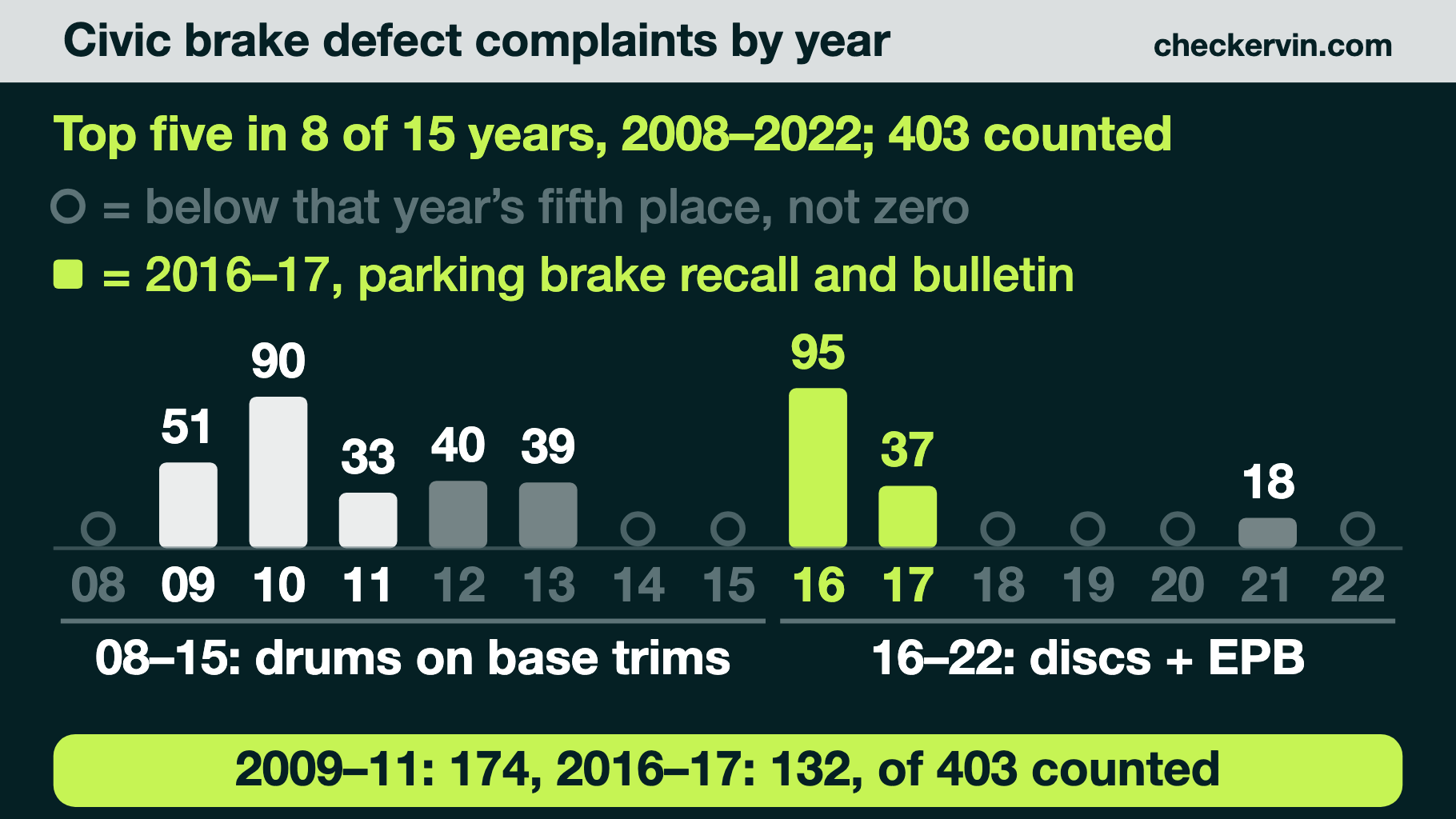
Our corpus holds 7,501 NHTSA owner complaints against the 2008–2022Civic, with each model year’s five most-reported components. Service brakes reach that top five in 8 of 15 years, for at least 403 counted reports. The category never ranks first; its best is #2, in 2009, 2010 and 2011. In 2008, 2014, 2015, 2018, 2019, 2020 and 2022it sits below that year’s fifth-place component, which means below the line, not zero.
The counted reports fall into two clusters. 2009–2011, the last three years of the 2006–2011 generation, hold 174 of them, about 43%. 2016–2017, the first two years of the electric parking brake, hold 132, about 33%. Together that is 76% of the total from five model years. The single biggest year is 2016, with 95, yet even there brakes rank only #4, behind steering, unknown or other and electrical system complaints.
We checked these figures against NHTSA’s live complaint database in October 2026. The live service-brakes counts for the top-five years match ours or differ by one, and every below-the-line year is still below its fifth place, so the picture holds.
Drums, discs and the 2016 line: what is at the back of your Civic
Every Civic here has disc brakes at the front. The rear is where the job changes, and the change is sharp at 2016. Before that, Honda put drums on the cheaper trims and discs on the better-equipped ones. From 2016 every trim has rear discs, and the parking brake moved from a hand lever to a switch that drives motors in the rear calipers.
| Model year and trim | Rear brakes, per Honda |
|---|---|
| 2008 DX, LX sedan | Drums, 7.9 inches |
| 2008 Hybrid and GX | Drums, 8.7 inches |
| 2008 EX, EX-L and Si | Solid discs, 10.2 inches |
| 2012 DX, LX sedan | Drums, 7.9 inches; EX and EX-L have discs |
| 2014 LX, HF sedan | Drums, 7.9 inches; EX and EX-L have discs |
| 2016 all trims | Four-wheel discs, electric parking brake, Automatic Brake Hold |
| 2022 LX, Sport, EX, Touring | Solid rear discs, electric parking brake on all four |
Those rows come from Honda’s own specification sheets and its 2016 Civic press kit, which calls four-wheel discs on every trim “a first for Civic.” We did not read the sheets for every year in between, or for the coupe and the 2012–2015 Si, so treat any year not listed as “check the car.” Looking through the rear wheel settles it: a caliper on a flat rotor is a disc, a closed drum is a drum. Our trim level by VIN lookup tells you which grade the car was built as, which is what the parts counter asks for.
2009–2011: owners wearing out pads far too early
Brakes rank #2 in all three of these years, behind only air bags. 2010 carries 90 reports on its own. The narratives are unusual for a brake record because so few describe a single frightening failure. Instead, owners describe replacing pads and rotors at low mileage, then replacing them again; outer pads worn to the backing plate while the inner pad on the same wheel is nearly new; grinding that arrived with no warning; and repeat bills at the same shop. Most of these were filed between 2011 and 2014, after the cars had a few years of driving on them.
That pattern ended in court rather than in a recall. Bursor & Fisher, the law firm that brought the case, says it filed a class action in the U.S. District Court for the Eastern District of California because “the brake pads on Honda Civic vehicles from 2006 through 2011 wore out prematurely,” and that class members were reimbursed for as much as 100% of what they paid to replace the pads. Its write-up is dated June 2015, and Consumer Action’s settlement listing gave a claim deadline of March 31, 2015, so that money is long gone.
We found no Honda service bulletin on pad wear for these years in NHTSA’s file and no recall. The practical lesson for a current owner is narrower. Uneven inner and outer wear on one wheel points at a caliper whose slide pins or piston are sticking, and new pads alone will not fix that. Ask the shop to say which pad on which wheel was thinnest.
2012–2013: warning lights more than worn pads
The ninth-generation Civic’s brake record is smaller: 79 counted reports across 2012 and 2013, with brakes at #5 in 2012 and #3 in 2013. The tone changes too. Fewer owners write about pads, and more describe the ABS, stability-assist and brake warning lights coming on together, often with a dealer diagnosis of a failed VSA modulator, the pump and valve unit behind the ABS, and in a few recent complaints a replacement part on backorder.
Honda did open one brake inquiry on the 2013 car. In June 2013 it asked dealers to hold any 2013 Civic sedan, other than the Si, that came in within six months of sale with a first complaint of front brake grinding, squeaking or squealing, so its engineers could inspect it before anyone repaired it. The message contains no fix, and we found no follow-up bulletin. A squeal on one of these cars today is far more likely to be ordinary pad wear than a factory problem.
The lights are the expensive part. A modulator is a hydraulic and electronic unit that has to be bled and programmed after fitting; it is not a brake-pad job, and a pad quote will not mention it. If the dash shows ABS, VSA and brake lights together, get the codes read before anyone sells you pads.
2016–2017: the electric parking brake arrives, with a recall
2016 is the Civic’s worst year for brake complaints in our data, with 95 counted, and 2017 adds 37. Many of the 2016 narratives are about the new parking brake: warning messages, a brake that did not set, Automatic Brake Hold behaving unexpectedly, and owners quoting the recall notice.
Recall 16V725000 is the reason. In October 2016 Honda announced it would update the software on about 350,000 2016 Civic coupes and sedans because the stability system’s control unit could stop the electric parking brake from applying if the driver set it immediately after switching the ignition off. Honda said the “BRAKE” light would blink for 15 seconds when that happened, and that a car left out of Park could roll away. The issue came to light through warranty claims for the brake warning light. The update is free at any Honda dealer.
A second fix followed in January 2017. Honda Service Bulletin 17-007 covers 2016 and 2017 Civic coupes and sedans, but not the hatchback, showing a blinking or steady brake light and an “Electric Parking Brake Problem” message with code U3000-49. The cause, Honda says, is software inside the VSA modulator-control unit; the fix is a reflash plus sensor recalibration, at 0.4 hours under the normal warranty. That warranty has expired on every car this old, so on a used 2016 or 2017 with that message, ask a Honda dealer whether both the recall and the bulletin update were done before anything is replaced.
Why rear pads on a 2016-or-newer Civic need a scan tool
On a car with a hand-lever parking brake, a mechanic pushes the rear caliper piston back with a clamp or wind-back tool and fits new pads. On a Civic with an electric parking brake, a motor on each rear caliper drives the piston, and it has to be backed off electronically first. Blue Print, a supplier of Honda-fit brake pads, warned its customers in 2025 that rear brakes on these Civics can fail after a pad change if the procedure is skipped, that the caliper piston can over-extend, and that the car may log left or right parking-brake actuator fault codes. Its guidance is to put the system into Brake Pad Maintenance mode with a diagnostic tool before the caliper comes off, and to take it out only after everything is reassembled.
Many shops have a scan tool that does this; a basic code reader of the kind a home mechanic owns usually will not. It is a reasonable question to ask when you book the job, and a reasonable explanation for a rear pad quote on a 2016 or newer car running a little above a front one.
The rear calipers on the current generation have their own open question. In March 2026 Honda asked dealers to hold automatic 2022–2023 Civic LX, Sport, EX, EX-L and Touring models logging a left-rear parking-brake actuator circuit fault, with brake, lane-keeping and cruise-control warnings, so it could collect the parts. It excluded cars that already had a left rear brake assembly replaced. The message names no cause and no fix. If your 2022–2023 shows those warnings, a Honda dealer should see it before an independent shop starts swapping parts.
2020–2021: a brake booster recall worth checking first
The second brake recall in our range is not about pads at all. Recall 23V458000, filed in June 2023, covers certain 2020–2021 Civics alongside Ridgeline, Passport, Pilot and Acura MDX models, 124,077 vehicles in all. NHTSA’s summary says the fastener joining the brake booster to the master cylinder may have been assembled incorrectly, letting the master cylinder separate and causing a loss of brake function. Dealers inspect and repair it free, and owner letters went out in August 2023.
Two years before that recall, in June 2021, Honda had asked its dealers to report 2020–2021 Civics with long brake pedal travel “almost reaching the floor.” Honda does not connect the two documents, and neither do we, but a soft or sinking pedal on one of these cars is a reason to look up the VIN before ordering pads. Brakes reach #4 in 2021, with 18 reports; in 2018, 2019, 2020 and 2022 they stay below the line. The quickest check is our Honda recall check.
Reading a Civic brake quote
- Which axle the price covers; KBB's own figures are front or rear, not both
- Pads or shoes at the rear, and whether that matches the trim and model year
- Measured pad thickness at each wheel, inner and outer, not just 'needs brakes'
- On a 2016 or newer car, how the shop retracts the electric parking brake
- Whether rotors are being replaced or resurfaced, and the measured thickness
- Whether the caliper slide pins are cleaned and lubricated as part of the job
- Genuine Honda or aftermarket pads, and the warranty on each
- Whether a fluid flush is included, and which fluid is specified
A rear-pad quote on a 2014 LX is pricing a part the car may not have. A rotor on every axle at every pad change deserves a question about the measurement. And on a Civic that keeps eating its front pads, a quote that never mentions the slides is treating the symptom. Our brake fluid by VIN page gives the fluid specified for the build, which matters on any job that opens the hydraulics, including a caliper or a modulator.
If you are buying the Civic, not fixing it
Worn pads are a small bargaining point on a used Civic. The checks that matter are the ones a pad job will not fix. On a 2009–2011 car, look at the inner and outer pad on each front wheel; very uneven wear says a caliper needs attention. On a 2012–2015 car, make sure the ABS and VSA lights go out after start-up. On a 2016–2017 car, set and release the parking brake a few times, including straight after switching off, and confirm the recall was done. On a 2020–2021 car, check the pedal is firm and the booster recall is closed.
A Civic that flashes several warning lights at once is not always a brake problem; a weak 12-volt supply can do it, and the Civic alternator post covers how that shows up on these cars, while the Civic starter post handles the no-crank side. For the whole record by model year, airbags and steering included, see our Honda Civic years-to-avoid breakdown. If you are weighing a Civic against its obvious rival, the Corolla brake postruns the same analysis on Toyota’s record. And if the car is new enough that factory coverage might remain, a Honda warranty check by VIN settles it.
Where this information comes from
- NHTSA recalls API — 2016 Civic (recall 16V725000)Electric parking brake may not engage if applied right after the ignition is turned off; software update. One of fifteen model-year queries, 2008–2022.
- NHTSA recalls API — 2021 Civic (recall 23V458000)Booster-to-master-cylinder fastener on 2020–2021 Civics; the only other brake-component campaign in the range.
- American Honda statement on the 2016 Civic EPB recall (NHTSA copy)About 350,000 2016 Civic coupes and sedans; blinking BRAKE light; discovered through warranty claims.
- Honda Service Bulletin 17-007 (NHTSA copy) — EPB problem message, DTC U3000-492016–2017 Civic except 5-door; VSA modulator-control unit software update, 0.4 hours.
- Honda iN message (NHTSA copy) — 2013 Civic front brake noiseJune 2013 request to inspect new 2013 sedans with front brake grinding or squeal; no fix stated.
- Honda iN message (NHTSA copy) — 2020–2021 Civic long brake pedal travelJune 2021 request for cars with a pedal almost reaching the floor.
- Honda iN message (NHTSA copy) — 2022–2023 Civic EPB harness codesMarch 2026 parts request for left-rear parking-brake actuator circuit faults.
- Honda — 2016 Civic Sedan press kit, chassisFour-wheel disc brakes on all trims, standard electric parking brake and Automatic Brake Hold.
- RepairPal — Honda Civic brake pad replacement estimateThe $271–$328 figure, updated September 3, 2026; the brake shoe page gives $304–$391. Retrieved October 2026.
Keep reading
Frequently asked questions
How much does it cost to replace brake pads on a Honda Civic?
RepairPal's Civic estimate, marked as updated September 3, 2026 and retrieved in October 2026, puts a brake pad replacement at $271 to $328, with about $122 to $179 of labor and roughly $149 of parts, before taxes and fees and without adjusting for location. Its rear brake shoe estimate for drum-brake Civics is $304 to $391. Kelley Blue Book notes that its brake prices cover front or rear brakes, not both, so a quote for both axles will run higher. Rotors, calipers and a fluid flush are extra.
Does the Honda Civic have rear drum brakes?
Some do. Honda's specification sheets list rear drums on the 2008 DX, LX, Hybrid and GX sedans, the 2012 DX and LX, and the 2014 LX and HF, with rear discs on the EX and EX-L of those years and on the 2008 Si. From the 2016 model year Honda says every Civic trim has four-wheel disc brakes. On a 2006 to 2015 car, check the trim or look through the rear wheel before buying parts.
Do you need a scan tool to replace rear brake pads on a 2016 or newer Civic?
In practice, yes. Every 2016 and later Civic has an electric parking brake built into the rear calipers. Blue Print, a parts supplier, warns that on these cars the system should be put into Brake Pad Maintenance mode with a diagnostic tool before the caliper comes off, and that skipping it can over-extend the piston and set parking-brake actuator fault codes. Ask the shop how it handles the electric parking brake before the job starts.
Is there a brake recall on the Honda Civic?
Two, across the 2008–2022 model years. Recall 16V725000 updated the electric parking brake software on about 350,000 2016 Civic coupes and sedans, because the brake could fail to set if applied right after the ignition was switched off. Recall 23V458000 covers some 2020–2021 Civics whose brake master cylinder could separate from the booster; dealers inspect and repair it free. Check the VIN for either before paying for brake work.
How long do brake pads last on a Honda Civic?
Honda does not publish a fixed mileage, and the federal complaint record cannot answer it, because owners file complaints about defects rather than normal wear. Pad life depends heavily on traffic and driving style. The reliable approach is to have the pad thickness measured at each tire rotation. If a Civic is wearing through pads unusually fast, ask the shop to check the caliper slides and pistons before fitting another set.
Know which Civic you have before you price the brakes
A free CheckerVIN report shows the factory build, trim, specifications and open recalls for any VIN, so you know whether the rear axle takes shoes or pads, and whether a 2016 or 2020–2021 Civic still has a brake recall open.
Run a free VIN check