The short answer
- What does it cost?
- About $200: RepairPal lists $193–$223, KBB $224–$293 depending on shop type — attributed figures, and the fluid itself is most of the bill.
- Is it worth doing?
- It is the cheapest insurance in the book — a $200 service protecting a four-figure component, on the manufacturer's own schedule.
- Will it hurt an older car?
- The record says the fear is misplaced: power train cracks a year's top-five complaints in only 2 of 15 modern Accord years. Healthy unit, correct fluid — change it.
The numbers, and whose numbers they are
RepairPal prices an Accord transmission fluid change at $193 to $223, with labor only $64 to $94 of it. Kelley Blue Book’s estimator lands close by: $224 to $263 at a dealer, $249 to $293 at an independent, parts $101 to $118. Both retrieved September 2026 and quoted with attribution — we sell VIN checks, not service, and publish no price of our own.
Notice what the split implies. When parts are half the bill and the parts are the manufacturer’s own fluid, the usual dealer-versus-independent gap nearly closes — KBB’s own ranges put the dealer belowthe independent here. This is the rare service where the dealership’s quote deserves a look, because nobody discounts Honda fluid like the counter that stocks it by the drum.
What the money buys — and what Honda actually does
The service Honda schedules is a drain-and-fill: open the drain plug, let gravity take the old fluid, refill with the specified fluid, check the level hot. Several quarts of Honda’s own ATF, a crush washer, and modest labor. What it is not — on Honda’s procedure — is a pressurized machine flush, and that distinction matters when comparing quotes, because a flush is a different service at a different price with a different risk conversation attached.
The specification does the heavy lifting: Honda calls for its own fluids — DW-1 for the conventional automatics, its CVT fluid for the belt-drive cars — and the owner’s manual for the specific year is the tie-breaker on any invoice. A bargain quote with a universal fluid on the parts line is not the same service at a better price; it is a different service wearing the same name.
The myth, taken seriously instead of repeated
The question Google itself attaches to this query — “why do mechanics say not to change transmission fluid?” — deserves a real answer. The folklore holds that fresh fluid strips friction material that an old transmission depends on, so a high-mileage change kills it. The kernel of truth: a transmission already wearing out can fail shortly after any service, and the last person to touch it gets the blame. Survivorship does the rest — nobody posts a forum thread when a fluid change is followed by 80,000 uneventful miles.
The operative distinction is the unit’s condition before the drain plug moves. Shifting normally: fresh correct fluid is maintenance, scheduled by the manufacturer itself. Already slipping, flaring or hunting: no fluid decides that outcome, and the honest spend is a diagnosis, not a service. The myth survives by collapsing those two cars into one story.
What 9,607 complaints say about the fear
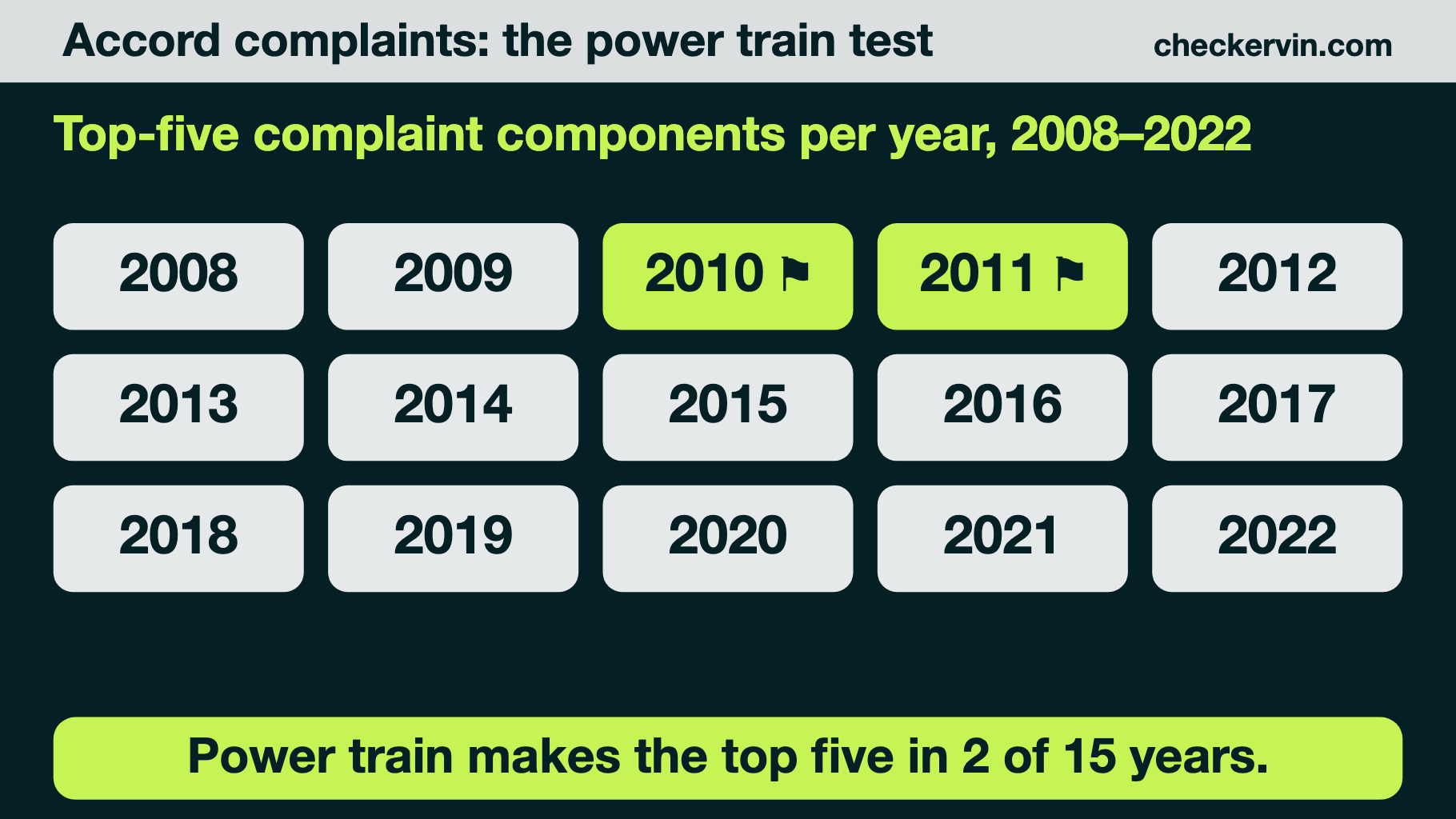
Here is the figure no page on this SERP carries. Our corpus of federal NHTSA complaints holds 9,607 reports against the 2008–2022 Accord. In each model year, the database surfaces the five components owners complained about most — and the power train makes that top five in exactly 2 of 15 years (2010 and 2011). Thirteen model years of Accords generated their complaint noise somewhere else entirely.
Complaints are unverified reports, not failure rates — the caveat this site attaches to every such figure. But the shape is the point: the transmission anxiety attached to this $200 service was earned by Accord generations that predate this entire dataset. The modern record describes a component that mostly behaves, which is precisely the condition under which scheduled fluid is cheap insurance rather than a gamble.
When the Accord asks for it
Modern Accords schedule this service themselves. Honda’s Maintenance Minder monitors operating conditions and posts the transmission-fluid code when the fluid’s duty is done — under normal driving that lands broadly in the 60,000-to-90,000 mile window, and meaningfully earlier with towing, mountain commutes or rideshare duty. The dashboard request outranks any generic interval, including the one in this sentence, and the owner’s manual for the specific year settles ties.
The corollary for the “too late” crowd: if the minder was ignored for 40,000 miles, the right response is still the service, not despair. Fluid does not know how overdue it is; it knows whether the unit it lubricates is healthy, and that question is answered by how the car shifts today.
CVT against conventional — same query, two services
One Accord phrase, two transmissions. The four-cylinder cars from 2013 on run a continuously variable transmission; the V6s of the same era and everything earlier run conventional automatics. The fluids are not interchangeable, the intervals differ, and the CVT is the less forgiving of the two about specification — which makes “which transmission is in this car” the first question of any quote, answered in seconds by a Honda VIN decode.
The price conversation barely moves — both services live in the same couple-hundred-dollar territory — but the parts line should read differently, and an invoice that names the wrong fluid family for the transmission in the car is the clearest possible signal to take the job elsewhere.
Where the money goes
This is the inverse of the labor-heavy jobs we have covered in this series — the Equinox’s timing chain buries hours behind the front of the engine; the Accord’s fluid change is minutes of labor wrapped around a parts line. The fluid is the product. That is why the spread between estimators is barely a hundred dollars, why dealers compete well, and why the cheapest quote usually differs on fluid choice rather than cleverness.
It is also why doing it twice is not tragic. A drain-and-fill swaps only what gravity surrenders — roughly a third to half of the system’s fluid — so high-mileage cars sometimes get two changes a short interval apart to step the fluid fresh. That is a legitimate approach, priced as two modest services, not evidence anyone is padding the bill.
Before you authorize the service
- Confirm which transmission the car has — CVT and conventional take different fluids
- Check the invoice names Honda's specified fluid, not a universal substitute
- Drain-and-fill is the scheduled service; treat a machine flush as a separate conversation
- If the car already shifts badly, buy a diagnosis before any fluid
- Pull the VIN's open recalls while you are at it — the lookup is free
If you are buying the Accord, not maintaining it
The service history question writes itself: on a car past the minder’s window, ask when the transmission fluid was done and expect a line item naming a Honda fluid. The answer prices in minutes of risk, not thousands — this is a $200 catch-up, not a timing chain — but like every skipped interval it reports on how the whole schedule was treated.
Then let the record vote. Our Accord years-to-avoid breakdown scores each model year against the nameplate’s own median from the same corpus this page computes from — the loud Accord years are loud about other systems, and knowing which years those are is worth more than any single service receipt. Finish with the warranty check by VIN to see what factory coverage survives on the specific car.
Where this information comes from
- NHTSA — Accord complaint databaseThe federal complaint record this page's top-five presence figures are computed from.
- RepairPal — Accord fluid change estimateThe $193–$223 figure and labor split quoted above, retrieved September 2026.
- KBB — Accord fluid change estimateThe dealer and independent ranges with the parts line quoted above.
- NHTSA — recalls by VINThe official lookup for open campaigns on the specific car in front of you.
Keep reading
Frequently asked questions
How much does a Honda Accord transmission fluid change cost?
RepairPal lists $193 to $223, with labor only $64 to $94 of it. KBB's estimator runs $224 to $263 at a dealer and $249 to $293 independent, with parts at $101 to $118. Their figures, quoted with attribution. The parts line is mostly the fluid itself — Honda's own ATF, several quarts of it — which is why this is one of the few services where the dealer's quote is genuinely competitive.
How often does an Accord need a transmission fluid change?
Let the car call it: Honda's Maintenance Minder requests the service by monitoring conditions rather than a fixed date, and under normal driving that lands broadly in the 60,000–90,000-mile window, sooner with towing or hard use. The owner's manual for the specific year outranks any generic interval — including this one — and the invoice should name the fluid the manual names.
Is 100,000 miles too late to change transmission fluid?
No — on a transmission that shifts normally, fresh fluid at 100,000 miles is still maintenance, not risk. The scare stories conflate two situations: fluid changed on a healthy unit, which is routine, and fluid changed on a transmission already slipping, where the service gets blamed for a failure that was underway. If it currently shifts fine, change it; if it is already misbehaving, diagnose first and spend the money on the diagnosis.
Why do some mechanics say not to change old transmission fluid?
It is failure-attribution folklore with a kernel of truth. Worn clutch material suspended in old fluid can mask wear on a dying transmission, and a service performed weeks before an inevitable failure looks like a cause. On Hondas the risk is compounded only by using the wrong fluid — the specification matters more than the calendar. A drain-and-fill with the correct Honda fluid on a healthy unit is what the manufacturer itself schedules.
Do Accord transmissions have a bad record?
Not in the current file. Across 9,607 federal complaints on the 2008–2022 Accord, the power train makes a model year's top-five complaint components in just 2 of 15 years — the reputation that phrase carries dates to generations before this data begins. Check the specific year you are considering, but the modern record reads quiet.
Two hundred dollars of insurance, priced against the record
A free CheckerVIN report shows the factory build, specifications and open recalls for any VIN — and the transmission in the car, which decides the fluid before any quote does.
Run a free VIN check