The short answer
- What does it cost?
- RepairPal lists $904–$1,092 for a 2021 Malibu and $989–$1,231 on its 2017 Las Vegas page. Neither names the engine.
- Why does the engine matter?
- The 2.4L's pump is turned by the chain drive and needs a GM holding tool. The 2016-and-later turbos also have an electric auxiliary pump.
- Is there a recall?
- No. No Malibu recall from 2008 to 2022 names the pump, and NHTSA lists no GM special coverage for it.
1,604
Engine complaints counted
2008–2022, a minimum
11 of 15
Years engine is top five
Others below fifth
0
Recalls naming the pump
Malibu 2008–2022
$904+
RepairPal, 2021 Malibu
Low end of its range
The numbers, and whose numbers they are
We do not repair cars or sell parts, so every price here belongs to the site that published it. RepairPal’s page for a 2021 Malibu puts a water pump replacement at $904 to $1,092, made up of $403 to $591 in labor and about $501 in parts. Its 2017 Malibu page for Las Vegas runs $989 to $1,231, with $517 to $759 of labor and $472 of parts. RepairPal says its figures leave out taxes, fees and related repairs.
Kelley Blue Book was no help without a ZIP code. Its 2014 Malibu page showed “No Pricing Data Available” and fell back on a general answer that a water pump costs $375 to $787 including parts and labor. That range is generic boilerplate, not a Malibu estimate, and it is far below both RepairPal figures.
The more important gap is one none of these pages fills: they do not say which engine they priced. A 2021 Malibu could have a 1.5-liter or a 2.0-liter turbo. A 2017 could also be a hybrid. A 2012 could be a four-cylinder whose pump is driven from inside the engine, or a V6. Before comparing any quote with these numbers, find out which of those engines you are paying to work on.
We looked for GM’s own labor time for a Malibu pump job, the figure a dealer would claim under warranty, and did not find one in the bulletins NHTSA hosts. The Cruze has one because GM extended coverage on its pump; the Malibu never got that treatment. So the labor line on a quote has nothing official to be checked against. Ask the shop how many hours it assumes and what it has to remove to reach the pump on your engine, then compare two quotes on the same terms.
Three generations, three different pump jobs
The federal fuel economy records list these engines for the Malibu by model year. We checked GM’s own service documents for how each one drives its water pump, and the table says plainly where we could not confirm it.
| Model years and engines (EPA) | Water pump: what we could verify |
|---|---|
| 2008–2012: 2.4L four (also 2008–2010 Hybrid) | Turned by the engine’s chain drive; GM requires a sprocket holding tool (PIP3535C) |
| 2008–2010: 3.5L V6; 2008–2012: 3.6L V6 | Drive not confirmed from a GM document; ask the shop |
| 2013–2014 Malibu eAssist: 2.4L | Same 2.4L chain-driven layout (PIP3535C covers it) |
| 2013–2015 and 2016 Limited: 2.5L; 2013–2015: 2.0L turbo | Drive not confirmed; GM studied a pump squeal on these engines (PIE0385) |
| 2016–2022: 1.5L turbo and 2.0L turbo | Electric auxiliary pump on 2016–2018 cars (18-NA-015); parts sellers list a belt pulley for the 1.5L main pump |
| 2016–2019 Malibu Hybrid: 1.8L | Exhaust heat exchanger is a known internal coolant leak (PIP5465A) |
Two things follow. First, a quote for one Malibu says little about another, even of the same model year. Second, “the water pump” on a 2016–2018 turbo can mean two different parts: the main engine-driven pump and the small electric auxiliary pump that keeps coolant flowing when start-stop shuts the engine off. Ask which one the shop means. An engine lookup by VIN settles the engine before you call anyone.
The 2.4L: a pump on the timing chain
The 2.4-liter Ecotec is the engine most 2008–2012 Malibus carry, and its pump is the awkward one. GM’s bulletin PIP3535C names 2004–2014 Malibus with the 2.2L and 2.4L Ecotec engines, including the eAssist. It refers to a water pump chain and a water pump sprocket: the pump is turned from the engine’s chain drive, and a technician replacing it is supposed to hold that sprocket with a dedicated tool, J43651, while the pump is out.
Skipping the tool has a specific consequence, according to GM. The balance shaft chain tensioner can ratchet out, leaving the balance shaft chain too tight, and the engine then whines from the front. The fix is resetting or replacing that tensioner, which means going back into the front of the engine. A shop that has done this job often will own the tool; a shop that has not may improvise.
That overlap is why many shops quote the pump and chain together on this engine. Chain wear on these Malibus is its own subject, with its own costs and symptoms, and our Malibu timing chain cost guide covers it. The point for a pump quote is narrower: know whether you are paying for a pump alone or for a pump plus chain work, and get the hours written down either way.
What 10,242 complaints say about the Malibu
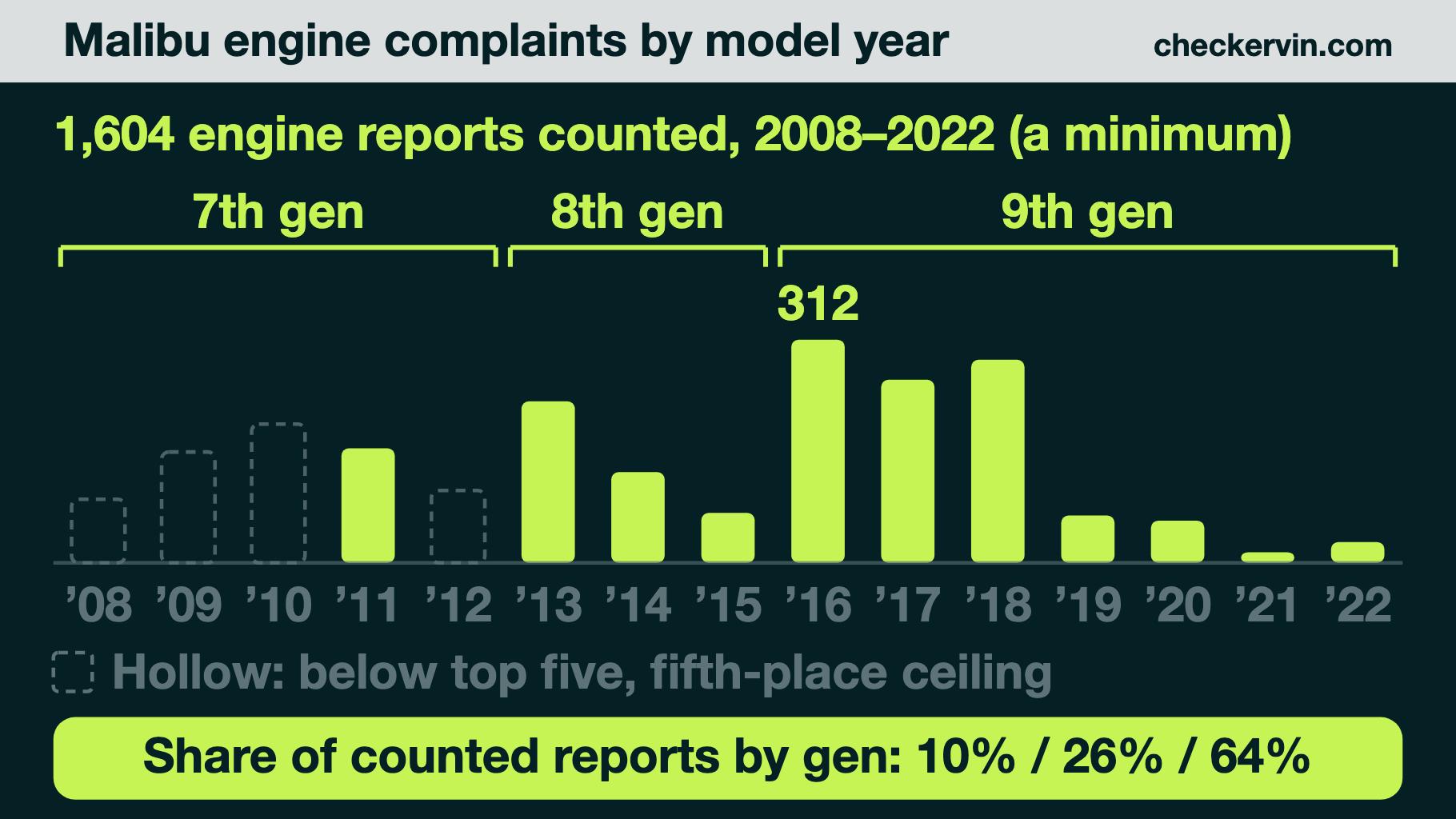
Our corpus of federal NHTSA complaints holds 10,242 reports against the 2008–2022Malibu. ENGINE reaches that year’s top five components in 11 of the 15 model years, and those years account for 1,604 engine complaints. That is a minimum: in 2008, 2009, 2010 and 2012 ENGINE fell below the fifth most-reported component, so its count for those years is unknown but no higher than the fifth-place figure.
ENGINE is the single most-reported component every year from 2014–2018 and again in 2020. The peak is 2016, with 312 engine reports. By generation, the counted engine complaints split 10% to the 2008–2012 cars, 26% to 2013–2015 and 64% to 2016–2022. The first figure is the softest, since 4 of those five years are below-fifth gaps. The 2016 row also blends two cars: the redesigned Malibu and the carryover 2016 Malibu Limited with the old 2.5L. Our record pools every name NHTSA files the Malibu under, Limited and Hybrid included, so each bar holds all of them.
The record also holds one figure closer to the pump than ENGINE. For 2022, a separate component called ENGINE AND ENGINE COOLING reached the top five with 10 reports, out of 99 complaints that year. We report it alongside ENGINE rather than adding the two together, because a single complaint can name both.
What the record does not prove
NHTSA has no water pump category. ENGINE covers every engine complaint, from every engine Chevrolet put in the Malibu that year, so the bars hold stalling, warning lights, oil leaks and everything else alongside coolant loss. They are an upper bound on cooling trouble, never a count of pump failures, and complaints are unverified owner reports, not a measured failure rate.
Reading the narratives makes the gap obvious. We searched the engine complaints for 2011, 2013, 2014, 2016, 2017, 2018, 2020 and 2022 for cooling terms. In the 2016–2018 files, which carry the tallest bars, owners mostly describe an “engine power reduced” message, check-engine lights and stalling. Coolant and overheating barely appear, and the water pump almost never. Engine reports make up about 37% of all complaints for those three years, against about 27% for 2013–2015, so the redesign era is engine-heavy, just not pump-heavy.
The 2013file reads differently. Overheating warnings show up more often, alongside a handful of owners who say a dealer diagnosed or replaced the water pump. That fits the bulletin record below: GM’s documents for the 2013 car describe overheating from a blocked water outlet, not a failed pump. From 2019 on, engine complaints average about 42 a year in our data. The Chevrolet Malibu years-to-avoid page breaks the rest of the record down by year.
When the coolant loss is not the pump
GM’s service bulletins for the Malibu say more about coolant trouble that is not the pump than about the pump itself. Read together, they are a list of what to rule out before buying one.
| GM bulletin and the cars it names | What it says |
|---|---|
| PIC5764B (2013, 2.0T / 2.5L) and PIP5300 (2013–2015) | Overheating and poor heat at idle from plastic flashing or debris in the water outlet at the back of the head, or a leftover black plug in the heater hose |
| 17-NA-120 (2016–2017, 1.5L turbo) | A broken radiator bracket lets the radiator shift until the lower hose rubs the A/C compressor pulley and leaks |
| PIP5465A (2016–2018 Hybrid, 1.8L) | Coolant loss with exhaust smoke from an internal leak in the exhaust heat exchanger |
| 25-NA-052 (all GM, 2000–2025) | Oil in the coolant on a healthy engine may be a leaking engine oil cooler |
The second row is worth knowing on a 2016–2017 1.5L car. A leak low at the front of the engine, near the belts, looks like a pump. GM’s bulletin says to check the radiator brackets first, and to replace only the brackets that broke plus the damaged hose. At least one owner complaint we read for 2016 describes exactly that: a hole worn in the lower hose by a belt-driven pulley.
That repair is not trivial either. GM’s bulletin books 2.0 hours to replace the upper radiator bracket, another 2.5 hours for the lower one and 0.7 hour for the outlet hose, because the radiator has to come partly out. But it is a different bill from a pump, and a new pump on a car with a broken bracket leaves the hose rubbing the same pulley.
The hybrid row has its own trap. GM warns in bulletin 15-06-123-001C that stop-leak additives clog the small passages in the 2016–2017 Malibu Hybrid’s cooling circuits, and that cleaning up afterward can mean a new heater core, thermostat or even the high-voltage battery. On any Malibu, but on a hybrid most of all, a bottle of sealer is not a cheap alternative to a diagnosis.
Squeals, whines and gurgles
Noise is the other way Malibu owners end up quoted for a pump, and GM documented three different ones.
| Noise | What GM said |
|---|---|
| High-pitch squeal from the pump, 2013–2017 2.0T / 2.5L | PIE0385: engineering collected data in 2016–2017, then closed the request and sent technicians back to standard diagnosis |
| Whine from the front after pump or chain work, 2.4L | PIP3535C: balance shaft tensioner ratcheted out, often from skipping the sprocket tool |
| Gurgle or water rush behind the dash at Auto Stop, 2016–2018 turbos | 18-NA-015: air in the system; the electric auxiliary pump moves coolant past it at the heater core |
Only the first is the pump making noise, and GM’s bulletin series on it ended without a published field fix. The second is damage done during a previous pump job. The third is not a failing pump at all: GM’s procedure for cars built before June 15, 2018 is to fill the surge tank 5 mm above the cold mark and bleed the air, booked at half an hour, plus an hour if the system has to be drained and refilled. If a shop hears that gurgle and quotes a pump, ask whether it bled the system first.
Is there a recall or special coverage on the Malibu pump?
No. We queried NHTSA’s recall records for every Malibu model year from 2008 through 2022, and no campaign names the water pump, coolant or overheating. To make sure the search could find one, we ran the same query for a car with a known water pump recall, a 2012 BMW 328i, and it came back positive.
Special coverage is a separate question, because GM has extended pump coverage on other cars. NHTSA’s list of GM communications for the 2012 Cruze includes Special Coverage 14371 for its 1.4L water pump. The same lists for every Malibu year from 2008 to 2022 contain no water pump coverage. The Malibu bulletins above are repair guidance only, and our TSB versus recall page explains why they pay nothing on their own. Open recalls on other systems are still worth clearing while the car is in the shop, and the Chevrolet recall check shows them by VIN.
Can you keep driving it?
- “AC Off” or “High Engine Temperature” message on the cluster
- Temperature gauge climbing, especially at idle or low speed
- Surge tank dropping again within days of a top-up
- Steam or a coolant puddle at the front of the engine
- White smoke from the exhaust with coolant loss (hybrid)
The first two are reasons to pull over and shut the engine off; GM’s overheating bulletins list exactly those messages. The rest call for a diagnosis soon, with a jug of the correct coolant in the trunk meanwhile. Steam alone is not always a leak: GM bulletin 19-NA-104 says vapor from the grille after rain or a car wash can be normal on 2014–2022 GM cars. A puddle under the car, or a level that keeps falling, is not normal.
Before you authorize the repair, or buy the car
- Confirm the engine by VIN; the pump job differs between the 2.4L, the V6s, the 2.5L and the turbos
- On a 2.4L, ask whether the shop has GM's sprocket holding tool and whether chain work is included
- On a 2016–2018 turbo, ask whether the quote is for the main pump or the electric auxiliary pump
- Ask for a pressure test with the leak point written on the invoice
- Refill with the coolant the engine was built for
GM’s bulletin 18-NA-015 lists Dex-Cool for the 2016–2018 turbos, and a coolant type lookup by VIN confirms it for a specific Malibu. For a shopper, a receipt that names the leak source and the part replaced is better evidence than a clean engine bay, which may only mean the car was washed. A Chevrolet VIN decode confirms the engine and trim before you compare repair history against it.
Where this information comes from
- GM PIP3535C — Whine Noise From Timing Chain Area (NHTSA)December 2017. Names 2004–2014 Malibu 2.2L/2.4L engines and the water pump sprocket holding tool.
- GM 18-NA-015 — Gurgle or Water Rush Noise from Dash Area Upon a Stop (NHTSA)November 2019. 2016–2018 Malibu 1.5L/2.0L; the auxiliary water pump, the fill level and the labor times.
- GM 17-NA-120 — Diagnostic Tip for Coolant Leak, Steam from Under Hood (NHTSA)April 2017. 2016–2017 Malibu 1.5L radiator bracket and lower hose contacting the A/C pulley.
- GM PIP5300 — Engine Overheating, Poor Heater Performance (NHTSA)June 2015. 2013–2015 Malibu 2.0L/2.5L water outlet debris and heater hose plug.
- GM PIE0385B — High Pitch Squeal Noise from Water Pump (NHTSA)March 2017. 2013–2017 Malibu LTG/LCV; ends GM's data request on the squeal.
- GM PIP5465A — Exhaust Heat Exchanger Coolant Leak (NHTSA)February 2018. 2016–2018 Malibu Hybrid 1.8L coolant loss with exhaust smoke.
- NHTSA — recalls by vehicle and VINOur 2008–2022 Malibu query found no campaign naming the water pump, coolant or overheating.
- EPA and DOE — fueleconomy.gov vehicle recordsThe per-year Malibu engine listings behind the engine table.
Keep reading
Frequently asked questions
How much does it cost to replace the water pump on a Chevy Malibu?
RepairPal's estimate for a 2021 Malibu is $904 to $1,092, with $403 to $591 of labor and about $501 in parts. Its 2017 Malibu page for Las Vegas lists $989 to $1,231. Kelley Blue Book's Malibu pages fall back on a generic water pump figure of $375 to $787 when no ZIP code is entered, which is not specific to the Malibu. None of these figures says which engine it assumes, and on a Malibu the engine changes the job.
Is there a recall or warranty extension on the Malibu water pump?
No. We checked NHTSA's recall records for every Malibu model year from 2008 through 2022 and none names the water pump, coolant or overheating. The manufacturer communications NHTSA lists for the Malibu show no special coverage for the pump either, unlike the Cruze, whose 1.4L pump got a 10-year coverage. GM did publish bulletins on Malibu cooling problems, but a bulletin is repair guidance, not free repair.
Is it difficult to replace the water pump on a Malibu?
It depends on the engine. On the 2.4-liter Ecotec used through 2012 and in the 2013–2014 eAssist, the pump is turned by the engine's chain drive, and GM warns that replacing it without a special sprocket holding tool can throw the balance shaft chain out of adjustment and cause a whine. Parts sellers list a belt pulley for the 1.5-liter turbo used from 2016, which points to a simpler front-of-engine job. Ask the shop which engine its quote assumes.
Why does my Malibu make a gurgling noise from the dash when it stops?
On 2016–2018 Malibus with the 1.5L or 2.0L turbo, GM traced that noise to air left in the cooling system. When the engine shuts off at an Auto Stop, an auxiliary electric water pump keeps coolant moving, and air trapped at the heater core makes the gurgle. GM bulletin 18-NA-015 fixes it by filling the surge tank slightly above the cold mark and bleeding the air. A low surge tank is worth finding the cause of, but the noise alone does not mean the pump is failing.
Can I drive my Malibu with a leaking water pump?
Only short distances while the temperature gauge and coolant level stay normal. If the dash shows an AC Off or High Engine Temperature message, or the gauge climbs, stop the engine. GM's bulletins on Malibu overheating list those messages as the symptoms technicians see. Topping up the surge tank buys time to get a pressure test, not weeks of commuting.
Confirm the engine before you price the pump
A free CheckerVIN report shows the factory build, engine, specifications and open recalls for any VIN, so you know which Malibu pump job and which GM bulletins apply before you pay.
Run a free VIN check