The short answer
- What does it cost?
- KBB's fair repair range is $7,493-$7,989 for a 2019 Malibu near Naples, Florida and $6,154-$6,614 for a 2020 near Leominster, Massachusetts. KBB's figures, not ours.
- Does it need a whole transmission?
- Often not first. GM tells dealers to replace the CVT's valve body before the assembly, and its #1 power-train complaint year is mostly a shifter switch.
- Will GM pay?
- Only inside the 5-year/60,000-mile powertrain coverage. We found no Malibu transmission warranty extension, so most 2019-2021 cars are now on the owner.
What a replacement is quoted at
Kelley Blue Book publishes a fair repair range for Malibu transmission replacement by model year and location. For a 2019 Malibu near Naples, Florida it lists $7,493 to $7,989, parts and labor included. For a 2020 Malibu near Leominster, Massachusetts it lists $6,154 to $6,614. Those are KBB’s numbers, read on November 22, 2026 from the text search engines serve for those two pages. KBB fills in its prices in the browser, and when we opened the pages directly they showed a placeholder ZIP of 00000 and no range at all, so the location attached to each figure is whatever KBB printed for it.
GM’s own paperwork adds one hard number on the labor side. When a small batch of 2018 Malibus left the plant with a six-speed missing an internal cup plug, GM’s customer satisfaction program allowed its dealers 7.6 hours to replace the transmission. That is GM’s allowance for one engine and one gearbox, not a rule for every Malibu, but it explains why labor is a large slice of any quote. We publish no price of our own. What we can add is the part an estimate leaves out: which Malibu you have, what failed inside it, and whether anyone else should be paying.
What the complaint record shows, and what it does not
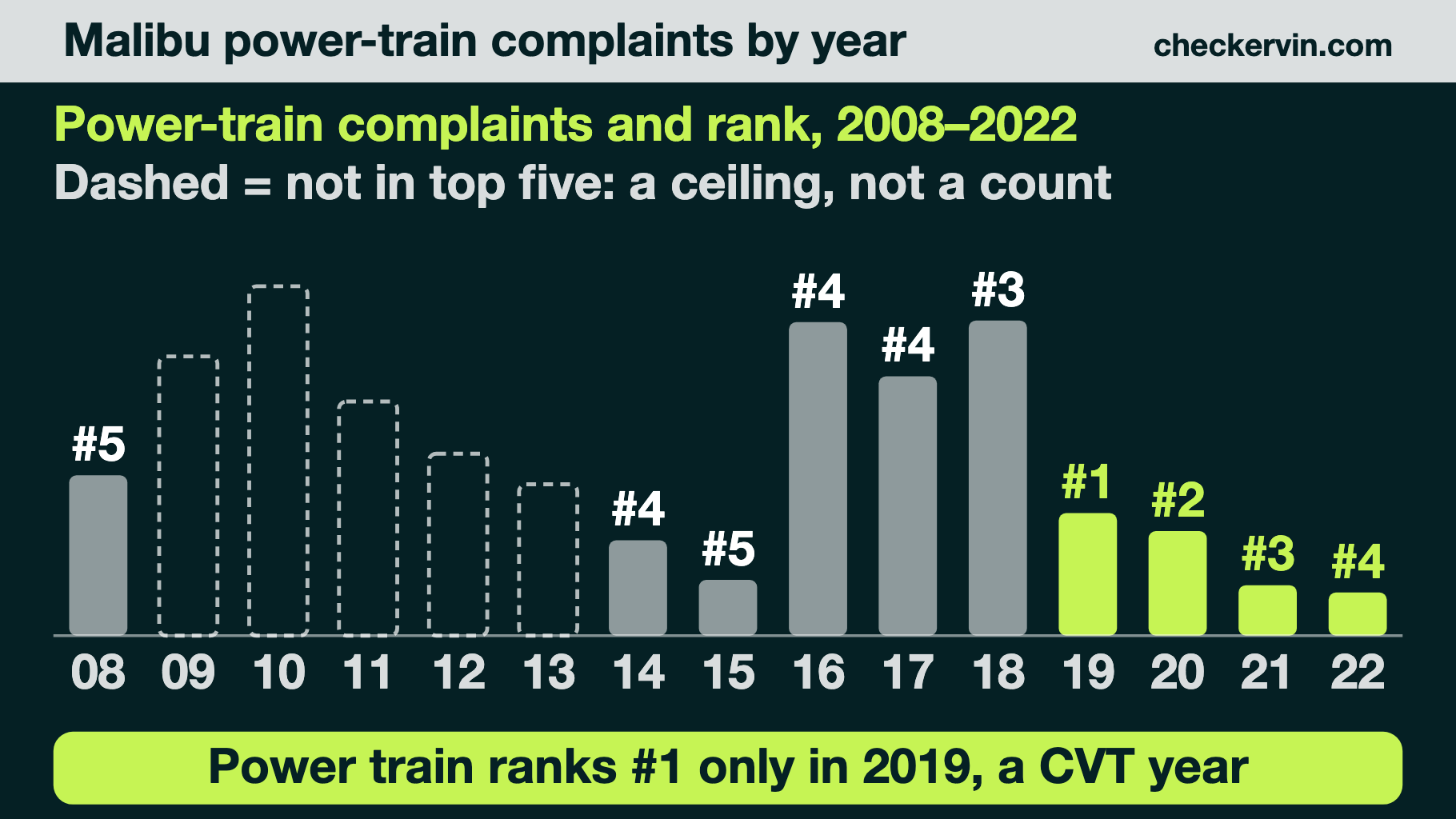
Our corpus of federal NHTSA complaints holds 10,242 owner reports against the 2008–2022Malibu. POWER TRAIN, the category that catches transmission complaints along with shifters, axles and the rest of the driveline, reaches a model year’s top five in 10 of those 15 years. Where it does, we can count it, and the counted reports add up to at least 844. In 2009–2013it never makes the top five, which means it sat below each year’s fifth-place category, not that owners reported nothing.
The years with the most reports are the ones just after the 2016 redesign. 2016, 2017, 2018 together hold 493 counted power-train complaints, with 2018 the highest at 175. Those cars sold in larger numbers and have had longer to collect complaints. The CVT years from 2019 on add 178 more, but rank higher on a smaller record: power train is #1 to #4 in every one of them. 2019 is the only model year in the whole record where it is the single most-reported category, at 68 reports, 34.9% of that year’s complaints, and 2020 follows at #2.
Two cautions travel with every one of those figures. Complaints are unverified owner reports, not a failure rate. And because POWER TRAIN is wider than the transmission, a count is a ceiling on transmission complaints, never a measure of how many transmissions failed. That second point turns out to matter a great deal in 2019.
Five drive units since the 2016 redesign
“Malibu transmission” is not one part. Since the 2016 redesign alone, a Malibu could leave the factory with any of four gearboxes depending on its engine and year, plus a separate hybrid drive unit. GM’s bulletins name them by family and option code, and press coverage of each launch fills in which engine got which:
| Malibu, years and engine | Transmission |
|---|---|
| 2016-2018, 1.5L turbo | Six-speed automatic (GM 6T family, RPO MNH on 2018) |
| 2016, 2.0L turbo | Eight-speed automatic (press-reported) |
| 2017 on, 2.0L turbo | 9T50 nine-speed automatic (RPO M3E) |
| 2019 on, 1.5L turbo | VT40 continuously variable (CVT, RPO MRG) |
| 2016-2019 Hybrid, 1.8L | 5ET50 two-motor hybrid drive unit (RPO MKE) |
The split matters for price and for diagnosis. A 2019 LT with the 1.5-liter and a 2019 Premier with the 2.0-liter share a model year and a body, yet one has a chain-and-pulley CVT and the other a nine-speed with clutch packs, and the bulletins below apply to only one of them. The hybrid sits outside GM’s normal assembly-swap policy altogether, which exempts transmissions that contain high-voltage drive motors. The engine is in the VIN, and the factory option codes on the build sheet name the exact unit.
The #1 year is mostly a shifter, not a gearbox
We read the 2019Malibu’s power-train complaints on NHTSA’s complaint database. The single largest thread is not slipping or a dead transmission. It is a “Shift to Park” message that appears with the lever already in Park, so the car will not shut off or lock, and owners wiggle the shifter or restart the car until it clears. Real transmission complaints are there too, including lost forward drive, slipping, CVT hesitation and the P2714 code, but the category’s first-place finish leans heavily on a part in the center console.
GM’s bulletin 19-NA-206 describes that exact fault on 2016–2019 Malibus built before April 2, 2019. Its stated cause is the park switch inside the shifter assembly failing to tell the body control module that the car is in Park. The fix is a new park switch and shifter harness plus a jumper harness, and the labor allowance for a Malibu is 0.8 hours. It is billed under GM’s bumper-to-bumper coverage, not powertrain, which tells you how GM classifies it: a shifter repair, not a transmission one.
What GM tells its technicians to check on the CVT
The VT40 CVT in the 1.5-liter Malibu from 2019 on is the unit most often behind a real replacement quote on a late Malibu, and GM has published a clear order of operations for it. Bulletin 24-NA-009, revised in March 2024 and covering the 2019–2024 Malibu, addresses loss of forward gear, slipping and a check-engine light with code P2714. GM names three possible causes: a clutch regulator valve sticking in the valve body, damage to the forward clutch piston, or wear in the primary pulley bearing bore that damages the case.
The repair path climbs in cost one step at a time. With the fluid level verified hot, the technician replaces the valve body first and re-checks. If the code returns with slipping or no forward motion, the transmission comes out and is opened. Worn forward clutches and a damaged piston get the forward clutch parts replaced. Only if the pump shows that the primary pulley bearing has spun in its bore does the bulletin say the transmission “will need to be replaced.”
A second bulletin, 20-NA-120, decides the other big CVT question. When certain codes have been set and the car driven more than about 30 miles, or the fluid is found a liter or more low, the technician runs a borescope through the fill cap to look at the drive chain and pulleys. Clean surfaces mean the CVT can be repaired for the underlying fault. Slip marks on the chain pins or grooving on the pulleys mean it “should be replaced, not repaired.” And a 2025 GM preliminary bulletin on 2019–2025 Malibus with no drive or reverse points to a broken transmission chain and asks dealers to open a technical case with GM before repairing one.
GM's own repair-or-replace rule
GM also tells its U.S. dealers how to choose between repairing and replacing any engine or transmission it pays for. Its warranty bulletin 20-NA-138 says dealers “are to perform the most cost economical repair,” recommends a cost comparison worksheet, and requires the job card to record verified symptoms, the cause of failure and any codes. Replacing a whole assembly when a repair would cost less needs GM pre-approval.
That is a policy for GM’s money, not yours, but it hands an owner paying out of pocket a fair standard. A shop that quotes a complete transmission should be able to say, in writing, what failed and why a valve body, a clutch pack or a solenoid would not fix it. On the CVT, the honest answer may well be a spun pulley bearing or a slipped chain, which GM itself treats as replacement territory. The point is to hear that answer before you sign.
Who pays: the five-year clock
Chevrolet’s owner warranty page puts typical powertrain coverage at 5 years or 60,000 miles, whichever comes first, and bumper-to-bumper coverage at 3 years or 36,000 miles. Both run from the car’s original in-service date. GM’s CVT bulletins list their repair codes under powertrain coverage, and the shifter bulletin under bumper-to-bumper, so the date the car was first sold decides who pays for each.
By late 2026, a 2019 or 2020 Malibu sold new in its model year is past five years, and most 2021s are at or near the line. A 2022 sold new in 2022 may still have powertrain coverage into 2027 if it is under 60,000 miles. Malibu production continued after the last model year in our complaint data, and GM’s CVT bulletins name cars through 2024 and 2025, so a late Malibu is the one most worth checking before you pay anyone.
What we did not find matters as much. We searched every GM communication NHTSA lists for the 2019 Malibu, several hundred items, for a transmission warranty extension or special coverage and found none. The same search on the 2018 Malibu does surface a GM customer satisfaction program, so the method finds programs where they exist. Unlike some rivals’ CVTs, the Malibu’s has no extended coverage to fall back on once the standard warranty ends. Asking a dealer about goodwill help costs nothing, but nothing we read obliges GM to grant it, so treat it as a request, not an entitlement.
The recalls, and the one transmission GM swapped for free
We queried NHTSA’s recall database for every Malibu model year from 2016 through 2022 and filtered for power-train and transmission campaigns, after confirming the same filter finds the 2014 Malibu’s shift-cable recall. Only the 2018 Malibu returns one: 20V668000, covering start/stop accumulator endcaps that may be missing bolts, which can leak transmission fluid and lead to a loss of propulsion. Dealers inspect the accumulator and replace it if bolts are missing. It is a recall to clear, not a replacement program.
The 2018 car is also the subject of the one Malibu transmission swap GM ran as a program. Customer Satisfaction Program 18277 covered 2018 Malibus with the six-speed that were built without a transmission case cup plug, which can starve the unit of lubrication and wear it out early. GM’s remedy was a new transmission at no charge, and its dealer notice put the U.S. population at about 76 cars. The program ended September 30, 2020. If you are pricing a replacement for a 2018 Malibu, ask a dealer whether the VIN was one of them and whether the work was done; it is a short question with a useful answer about the unit in the car.
Rebuilt, remanufactured, used, or repaired in the car
Once a replacement is truly needed, the price depends on which of four routes you take, and they come with very different paperwork.
- New or remanufactured from GM, installed by a dealer: the top of KBB's range, and the route GM's own bulletins use
- Remanufactured from an independent supplier: often cheaper, with the supplier's own warranty terms and usually a refundable core charge
- Rebuilt by a local transmission shop: your own case with new wear parts, priced by the shop and warrantied by the shop
- Used from a salvage yard: the lowest parts price and the least information, because the donor's mileage is whatever the seller says
Is it cheaper to rebuild or replace? On the conventional six-, eight- and nine-speed automatics, a rebuild is a common route, and many independent shops will quote one. On the CVT, the answer hinges on the failure. A sticking valve body or worn forward clutch is a repair GM itself performs inside the case. Chain or pulley damage is the case GM’s own bulletin says to replace, and a rebuild that reuses damaged pulleys is not a bargain. GM’s 2016 bulletin on the nine-speed also warns that a replacement unit’s solenoid valves must be characterized by programming after installation or the car may shift poorly, so a quote that leaves programming off may be pricing a car that will not shift right.
Is it worth replacing the transmission?
The real decision is often whether to put a $6,000-to-$8,000 job into a car whose market value is in the same neighborhood. Look up the value for your trim and mileage before deciding, and compare three numbers: the repair, the car’s value with a working transmission, and what it would fetch as-is with a failed one.
Three facts push the answer toward repairing. A diagnosis that stops at a valve body or clutch pack can cut the bill well below a complete unit. A car still inside powertrain coverage costs you nothing but time. And a replacement with a written warranty makes the car easier to keep and to sell. Without any of those, selling a high-mileage Malibu with a failed transmission at a project-car discount can beat paying the full quote.
Before you authorize the repair
- Decode the VIN to confirm the engine, which tells you whether the car has the CVT, a six-, eight- or nine-speed, or the hybrid unit
- If the complaint is a Shift to Park message, ask for the shifter park-switch check in bulletin 19-NA-206 before anything else
- On a 2019-or-newer 1.5-liter, ask whether the valve body step in 24-NA-009 and the chain-and-pulley borescope check in 20-NA-120 were done
- Ask a Chevrolet dealer to read the VIN's in-service date and remaining powertrain coverage
- Get every quote on the same scope: new, remanufactured, rebuilt or used, with fluid, programming and core charge listed
- Pull the VIN's open recalls; on a 2018, that includes the accumulator recall 20V668000
A Chevrolet VIN decode confirms the model year and engine, and a transmission lookup by VIN narrows the gearbox; the GM build sheet carries the option codes, such as MRG for the CVT, that name the exact unit. Checking what Chevrolet coverage remains by VIN tells you whether any of this is still GM’s bill, and the Chevrolet recall check clears the recall question in the same sitting. If you are shopping rather than repairing, read which Malibu model years draw the most complaints overall, since engine and electrical complaints outnumber power train in most years.
Where this information comes from
- NHTSA — Malibu complaint databaseThe federal complaint record this page's figures are computed from, and where we read the 2019 power-train narratives.
- NHTSA-hosted GM bulletin 24-NA-009 — VT40 CVT loss of forward gear, P2714Read in full: 2019-2024 Malibu; valve body first, then forward clutch, transmission only for a spun primary pulley bearing.
- NHTSA-hosted GM bulletin 20-NA-120 — CVT chain and pulley inspectionRead in full: borescope check; slip marks or grooving mean replace, not repair.
- NHTSA-hosted GM bulletin 19-NA-206 — intermittent Shift to Park messageRead in full: 2016-2019 Malibu built before April 2, 2019; shifter park switch; 0.8 hr under bumper-to-bumper coverage.
- NHTSA-hosted GM bulletin 20-NA-138 — engine and transmission assembly replacement policyRead in full: dealers perform the most cost-economical repair; hybrid drive units exempt.
- NHTSA-hosted GM Customer Satisfaction Program 18277 — 2018 Malibu six-speed cup plugRead in full: transmission replaced free through September 30, 2020; 7.6-hour Malibu labor allowance.
- NHTSA recalls API — Malibu by model yearQueried for 2016-2022 after a 2014 known-positive; only 2018 returns a power-train recall, 20V668000.
- Kelley Blue Book — 2019 Malibu transmission repair and replacementThe $7,493-$7,989 Naples, Florida range, read from search-served page text on November 22, 2026.
- Kelley Blue Book — 2020 Malibu transmission repair and replacementThe $6,154-$6,614 Leominster, Massachusetts range, read the same way on the same date.
- Chevrolet — owner warranty coverageSource of the 5-year/60,000-mile powertrain and 3-year/36,000-mile bumper-to-bumper terms.
Keep reading
Frequently asked questions
How much does a 2020 Chevy Malibu transmission cost?
Kelley Blue Book's fair repair range for replacing the transmission in a 2020 Malibu is $6,154 to $6,614 near Leominster, Massachusetts, parts and labor included. Its 2019 page shows $7,493 to $7,989 near Naples, Florida. Both are KBB's figures for the locations it printed, read from search-served page text on November 22, 2026, because KBB loads its prices in the browser and a direct fetch returned no range. We sell VIN checks, not repairs, and price none of this ourselves.
Is it cheaper to rebuild or replace a Malibu transmission?
It depends on what failed, and GM's own bulletins show how often the answer is neither. On the 2019-and-newer CVT, GM bulletin 24-NA-009 tells dealers to replace the valve body first for a P2714 slipping or no-forward-gear complaint, then disassemble and replace the forward clutch parts if needed, and to replace the whole transmission only if the primary pulley bearing has spun in its bore. A separate bulletin, 20-NA-120, says a CVT whose chain or pulleys show slip damage should be replaced, not repaired. Ask which of those the shop found.
Is it worth replacing the transmission in a Malibu?
Compare the quote with what the car is worth running and what it would sell for with a failed transmission. KBB's 2019-2020 ranges sit between about $6,000 and $8,000, which on an older, higher-mileage Malibu can approach the car's value. A cheaper sub-assembly repair, a car still inside GM's 5-year/60,000-mile powertrain coverage, or a replacement that carries a written warranty all tilt the answer toward fixing it.
Which Chevy Malibu years have the most transmission complaints?
In our NHTSA corpus the power-train category reaches the Malibu's five most-reported categories in 10 of its 15 model years, with the most reports counted in 2018 (175). It ranks first only in 2019, the first year of the CVT, at 68 reports, 34.9% of that year's complaints. Reading those 2019 reports, the largest single thread is a Shift to Park message caused by the shifter, not a transmission failure. Power train covers more than the transmission, so treat every count as an upper bound.
Is there a recall on the Chevy Malibu transmission?
Not a broad one for the 2016-2022 car. We queried NHTSA's recall database for every Malibu model year from 2016 through 2022, after confirming the same query finds the 2014 Malibu's shift-cable recall, 14V092000. Only the 2018 Malibu returns a power-train recall, 20V668000, for start/stop accumulator endcap bolts that may be missing. A separate GM Customer Satisfaction Program, 18277, replaced transmissions on a small number of 2018 Malibus built without a case cup plug, and it ended September 30, 2020. Check the specific VIN for open recalls on other systems.
Confirm the transmission before you price the replacement
A free CheckerVIN report shows the factory build, specifications and open recalls for any VIN, so you know which Malibu and which transmission you are pricing.
Run a free VIN check