The short answer
- What does it cost?
- RepairPal puts a 2018 Cruze turbo replacement at $1,179–$1,541. GM books 2.4 hours of labor on a 2011–2016 1.4L.
- Is there a recall or GM coverage?
- No safety recall or special coverage names the Cruze turbo. A 2016 emission recall fixed one oil feed fitting on certain LE2 cars.
- What should happen first?
- GM's boost control test, and a check of the PCV valve and oil feed pipe. GM's bulletins list several faults that get blamed on the turbo and are not.
$1,179+
2018 Cruze turbo estimate
RepairPal, read Nov 2026
2.4 h
GM labor time
2011–2016 1.4L, incl. coolant fill
211
Engine reports per model year
2011–2015 Cruze
35
Engine reports per model year
2017–2019 Cruze
The numbers, and whose numbers they are
We decode VINs. We do not fix cars or sell turbochargers, so every dollar figure here belongs to whoever published it. For this job there are not many. The most specific is RepairPal’s estimator for a 2018 Chevrolet Cruze, which gives an average cost of $1,179 to $1,541 for a turbocharger assembly replacement. Its page blocked our direct request, so we read that figure from the page’s own text as it appeared in a live search in November 2026. We found no matching RepairPal page for the 2011–2017 Cruze, and no Kelley Blue Book turbo price for any year.
The same RepairPal Cruze listing prices a turbocharger intercooler tube replacement at $414 to $485. That line matters more than it looks. A split boost hose or intercooler tube causes the same loss of power and the same underboost code as a failing turbo, and it costs a fraction as much. Several sites publish Cruze turbo prices without saying where they came from; we left those out.
Treat the RepairPal range as a starting point for a second-generation car at an independent shop. A dealer, a genuine GM turbo, or a car that needs the oil feed pipe, exhaust gaskets and coolant pipe seals replaced at the same visit will land above it.
What GM's own labor time says about the job
GM publishes the hours it pays dealers for warranty work, and those hours are the most neutral guide to how big a job is. In its bulletin PIP5495A for the 2011–2016 Cruze with the 1.4L turbo (engine codes LUJ and LUV), GM lists “Turbocharger Replacement and Coolant System Fill” at 2.4 hours for the Cruze. The same bulletin adds 0.3 hour for a boost control test it wants done before any turbo is replaced.
The coolant fill is in the name because this turbo is water-cooled. Coolant pipes run to the turbo center section alongside the oil feed and return pipes, so the job means draining coolant, taking off the exhaust manifold heat shield, disconnecting the oil and coolant lines along with the exhaust and intake connections, then refilling and bleeding the cooling system afterward. A shop’s quote should list which of those seals and gaskets it is replacing. The video below shows the full job on a first-generation car.
Which Cruze has which turbo
“Cruze turbo” covers two different gasoline engines, two diesels, and one engine with no turbo at all. GM’s bulletins are written per engine code, so this is the first thing to settle.
| Model years | Engine and turbo |
|---|---|
| 2011–2015, 2016 Cruze Limited | 1.4L turbo, RPO LUJ or LUV (first generation) |
| 2011–2015, 2016 Cruze Limited | 1.8L, naturally aspirated: no turbo to replace |
| 2014–2015 | 2.0L turbodiesel, RPO LUZ |
| 2016 Cruze, 2017–2019 | 1.4L turbo, RPO LE2 (second generation) |
| 2017–2019 | 1.6L turbodiesel, RPO LH7 |
That split explains the search terms. A 2014 Cruze is most likely a 1.4L LUV or a 1.8L, and only the first has a turbo. A 2017 Cruze is almost always the LE2. The two 1.4L engines share a displacement and very little else in the bulletin record. An engine lookup by VIN settles it in seconds, and a Chevrolet VIN decode adds the trim and build plant. Our Cruze timing belt guide explains how the eighth VIN character maps to these engines.
What gets blamed on the turbo
GM inspects every warranty turbo returned from the 2011–2016 1.4L, and enough of them came back with nothing wrong that GM wrote a bulletin about it. PIP5495A tells technicians, in a list, when not to replace a turbo that has set code P0299 (engine underboost):
- Cracks at the wastegate valve port, which GM calls normal and harmless to performance
- A broken wastegate solenoid valve port or a bent actuator port: replace that part, not the turbo
- A missing wastegate actuator clip: a clip, sold separately
- A broken bypass valve cover port, or water or oil inside the valve
- Restricted intake: a dirty filter, collapsed or twisted ducts, even animal nesting
- Ice in the charge air cooler or boost sensor in cold weather
GM’s test before replacing is specific. Clear the codes, warm the engine, make three full-throttle runs from a stop through the first upshift, and compare actual against desired boost on the scan tool. Replace the turbo only if the gap is more than 20 kPa, about 2.9 psi. GM wants screenshots of that graph attached to the warranty claim. You can ask a shop for the same evidence.
The bulletin is just as blunt about coolant. It calls the turbo “highly unlikely” to be the source of coolant getting into the intake or exhaust, because it has no moving coolant seals. A coolant leak at the turbo means the coolant pipes and their connections. Our Cruze head gasket guide covers what to test when coolant is going missing inside the engine.
Oil in the turbo: the PCV link GM spells out
Oil in the intake ducts or smoke from the tailpipe often gets diagnosed as a leaking turbo seal. GM says otherwise. PIP5495A calls an internal turbo oil leak “very unlikely” unless the shaft between the turbine and compressor wheels has broken, and it sends technicians who find oil at the turbo inlet, where the PCV bypass hose enters, to a separate bulletin: PIP5197.
PIP5197 is about the PCV valve, which on the first-generation 1.4L is built into the camshaft cover. Its symptom list reads like a turbo complaint: oil consumption, blue smoke, a whistle, and code P0299 alongside lean and misfire codes P0171 and P0300. The fix GM describes is a new cam cover if the PCV port leaks oil or vacuum, a crankcase pressure test, and in the worst case a cylinder leakage test for a broken piston ring land, which is an engine job and not a turbo job at all.
GM ran two special coverages for that cracked PCV diaphragm, one for 2011–2014 Cruzes and one for 2015–2016; our head gasket guide covers the first in detail. The practical point here is the order of operations: a cam cover is a far smaller bill than a turbo, and replacing a turbo while a failed PCV valve keeps pushing oil into the intake leaves the original fault in place.
Wastegate wear on the 1.4L, and the LE2 rattle
The first-generation turbo’s known mechanical weak point is the wastegate linkage. GM’s PIP5023, from May 2012, describes P0299 on 2011–2012 Cruzes at roughly 15,000 miles or more from a worn actuator pivot pin that lets the wastegate open when it should stay shut. GM gave a measurement: about 0.3 to 0.4 mm of play is normal, failures usually showed around 0.8 mm, and excessive play meant a new turbo assembly. A December 2014 follow-up, PI1366, widened the models to 2011–2015 and reframed it as lost wastegate preload, checked by wiggling the lever with the heat shield off.
By 2017, PIP5495A said the preload problem shows up only on 2011 and 2012 cars still running their original turbos, because a redesigned actuator gives 5 mm more travel. That matters on a used early Cruze: a 2011 or 2012 with a turbo already replaced may have the newer part.
The LE2 has its own sound. GM’s PIP5418, from August 2016 and revised in November 2017, covers a rattle off idle from the wastegate actuator rod on 2016–2017 Cruzes with the LE2. It told technicians to check the turbo mounting bolt torque, confirm the noise by pressing on the rod, and then “do not replace any components at this time” because GM was reviewing options. We found no later Cruze bulletin closing that out. A rattle alone is not a reason to buy a turbo.
Oil feed lines, coking, and the repeat failure
The other first-generation pattern is oil starvation. GM’s PI0851, first issued in November 2012 and revised as PI0851B in February 2016 for 2011–2015 Cruzes and the 2016 Cruze Limited, says that whenever the turbo is removed or replaced, the oil feed pipe must be checked for restriction and replaced if restricted. “Do not attempt to clean the pipe assembly,” it adds. An oil leak at the return pipe can be the clue, because heat from an underfed turbo damages that pipe.
The cause GM names is oil coking: oil cooking into carbon in the feed pipe after a hot shutdown. For 2011 and 2012 cars, GM released an engine computer calibration that runs the cooling fans briefly after the key is off, so the turbo cools faster. If a 2011 or 2012 Cruze is in for a turbo, ask whether that calibration is installed, and do not be surprised by fans running after shutdown once it is.
The second-generation engine had a feed-line issue of a different kind. GM’s emission recall 16008, from October 2016, covered certain 2016 Cruzes with the LE2 whose turbo oil feed pipe fitting may not have been tightened to spec, risking an oil leak, low oil pressure and a check-engine light. Dealers replaced the fitting, a 0.8-hour job. It is an emissions campaign, so it does not appear in NHTSA’s safety recall list.
What 3,721 complaints say, and what they don't
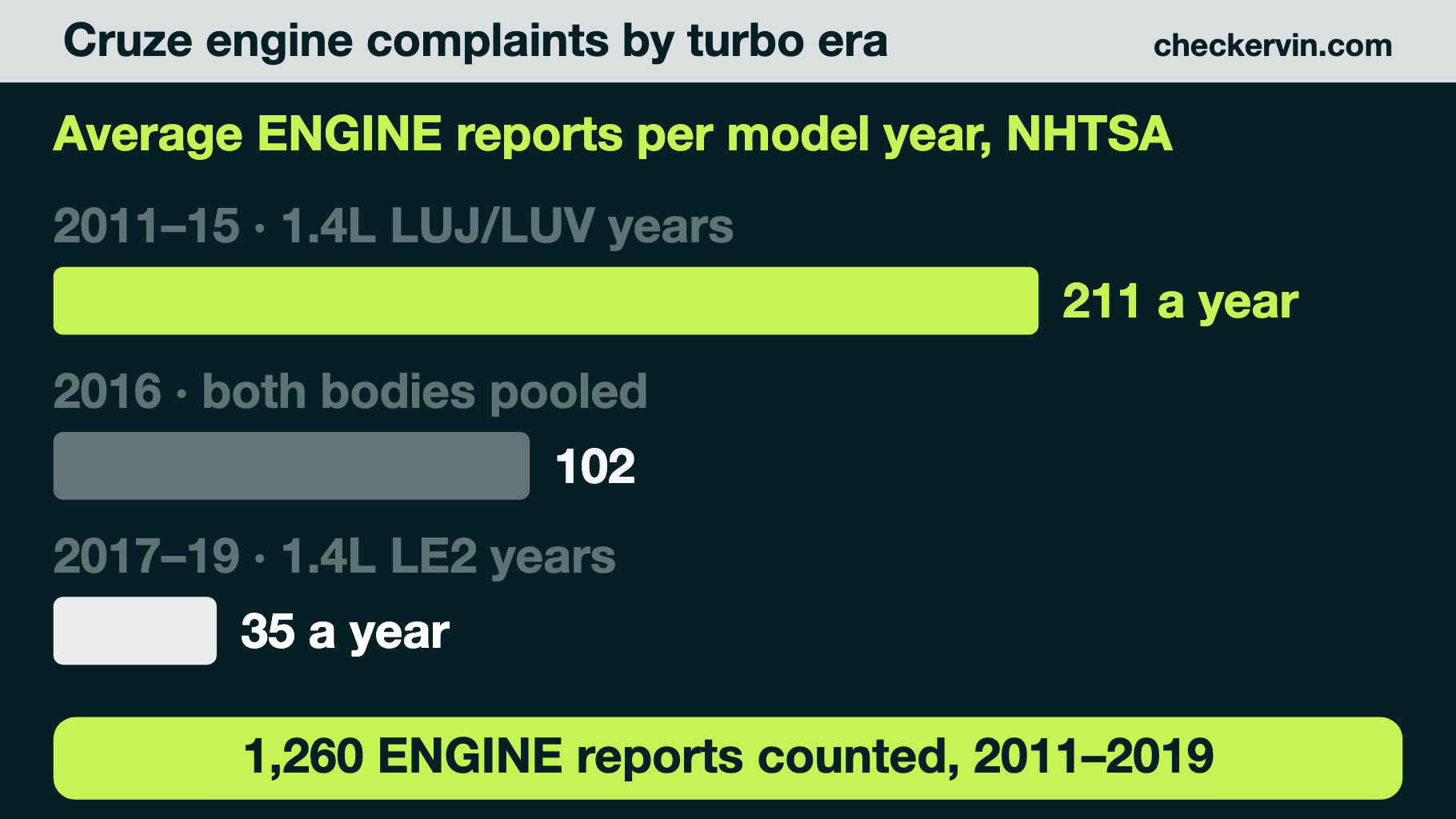
Our corpus of federal NHTSA complaints holds 3,721 reports against the 2011–2019 Cruze. ENGINE is in the top five components in 9 of 9 model years, and we count 1,260 engine reports across them, peaking at 268 for the 2012 car. The chart groups them by which turbo engine was on sale. The 2011–2015 years, when the LUJ/LUV was the turbo engine, average 211 engine reports per model year. The 2017–2019 LE2 years average 35, roughly a 6-to-1 drop. The pooled 2016 row, which mixes the old-body Cruze Limited with the new car, sits between at 102.
That drop is not a clean verdict on the LE2. Older cars have had more years and miles to fail and to be complained about, the first-generation 1.4L was on sale for more model years, and the 2019 row rests on only 23 complaints in all. The early years also include the 1.8L and the 2.0L diesel under the same ENGINE heading.
NHTSA has no turbocharger category, so we read the engine narratives themselves. In the 2011–2016 files, words for coolant trouble (coolant, thermostat, water outlet, water pump, overheating) turn up far more often than the word “turbo,” and PCV or cam-cover words a little less often than turbo. In the 2017–2019 files, coolant and PCV words nearly vanish, and the engine stories shift toward pistons, misfires and stalling. Turbo stories exist in every generation, including owners who replaced two or three, and several who believe GM recalled the turbo. It did not, as the next section shows. The share of engine complaints that are truly turbo failures cannot be read from this data; it is a minority of what owners filed under ENGINE.
Is there a recall or special coverage on the Cruze turbo?
No. We queried NHTSA’s recall database for every Cruze model year from 2011 through 2019. The campaign counts matched our own data year for year, and none names the turbocharger, its oil lines or the PCV system. Our search did match the word “turbo” in two campaigns that mention the 1.4L turbo engine for unrelated brake-assist and front half-shaft defects, which shows it would have found a turbo campaign. The nearest engine-bay recall is 12V288 for 2011–2012 Cruzes, about spilled oil collecting in the engine shield near hot exhaust parts.
We then searched the summaries of every GM bulletin, program and special coverage NHTSA lists for those years. None of the special coverages names the turbo; the same search found GM’s water pump and cam cover coverages, so it was capable of finding one. The only turbo-system field actions are emission recall 16008 above and Service Update N222372590 from December 2022, which added a thermal wrap to the wastegate regulator valve on 2016–2019 Cruzes to stop icing at 0°F or colder. That update expires with each car’s new-vehicle warranty, which by age has run out on nearly every Cruze. Check any VIN with the Chevrolet recall check, and ask anyone who says a turbo is “covered by a recall” for the campaign number.
Can you keep driving a Cruze with a bad turbo?
It depends on how the turbo is failing. A wastegate that will not hold boost mostly costs power: the car sets P0299, may limit output, and feels flat merging onto a highway. That is a reason to book a diagnosis soon, not usually a reason for a tow. These signs are different and mean park it:
- Blue or white smoke from the exhaust, or oil dripping at the tailpipe
- Oil level dropping fast between checks, or an oil pressure warning
- A grinding, scraping or siren-like whine that rises with boost
- A burning oil smell from under the hood
A turbo starved of oil or breaking apart can send fragments into the intake or exhaust, and oil on hot exhaust parts can catch fire. Several owners in the NHTSA files describe a failed turbo followed by a clogged catalytic converter, which turns one repair into two. Keep the oil full, let the engine idle briefly after hard driving before shutting it off, and use the oil GM specifies.
Before you pay for a turbo, or buy the car
- Confirm the engine code from the VIN: LUJ/LUV, LE2, 1.8L or diesel
- Ask for the boost test result: desired versus actual boost, and the gap
- Ask whether the PCV valve in the cam cover and the boost hoses were checked
- Make sure the quote includes a new oil feed pipe, not a cleaned one
- Ask which gaskets, seals and coolant are included, and whether the part is GM or aftermarket
- On a 2011 or 2012, ask whether the fan-run calibration is installed
If you are buying a used Cruze, a receipt for a turbo is more reassuring when it names the oil feed pipe and a cam cover or PCV check. Our Cruze water pump guide covers the cooling-system leaks that make up much of the early engine record.
Where this information comes from
- GM PIP5495A — Check Engine Light On With P0299 Or P0234 (NHTSA)2011–2016 Cruze 1.4L: when not to replace a turbo, the boost control test, the PCV and coolant notes, and 2.4 hours for turbo replacement.
- GM PIP5197L — Oil Consumption, Blue Smoke, P0171/P0300/P0299 (NHTSA)The PCV valve built into the 1.4L cam cover, and the tests that separate it from turbo and piston faults.
- GM PI0851B — Turbocharger Oil Feed and Return Line Inspection (NHTSA)Replace a restricted oil feed pipe, do not clean it; the 2011–2012 fan-run calibration against oil coking.
- GM PI1366 — P0299 Loss of Turbocharger Boost (NHTSA)Wastegate preload on the 2011–2015 Cruze 1.4L, and the wiggle test GM uses before replacing the turbo.
- GM PIP5418A — Rattle Noise From Engine Area While Driving (NHTSA)2016–2017 Cruze LE2 wastegate rod rattle; GM told dealers not to replace parts while it reviewed options.
- GM Emission Recall 16008 — Engine Oil Pipe Leak (NHTSA)Certain 2016 Cruze LE2: turbo oil feed pipe fitting replaced, 0.8 hour.
- NHTSA — recalls by vehicle and VINOur 2011–2019 Cruze query found no safety recall naming the turbocharger.
- RepairPal — 2018 Chevrolet Cruze turbocharger assembly replacement cost$1,179 to $1,541, read from the page's text in live search, November 2026 (direct fetch blocked).
Keep reading
Frequently asked questions
How much does it cost to replace a turbo on a Chevy Cruze?
RepairPal's estimator puts a 2018 Chevrolet Cruze turbocharger assembly replacement at $1,179 to $1,541, which we read in November 2026. We found no RepairPal or Kelley Blue Book Cruze turbo figure for other model years. GM's own warranty labor time for replacing the turbo on a 2011–2016 Cruze 1.4L, including the coolant fill, is 2.4 hours. Oil feed pipes, gaskets and a coolant refill add to the parts line.
Is there a recall on the Chevy Cruze turbo?
No. We checked NHTSA's recall list for every Cruze model year from 2011 through 2019, and no safety recall names the turbocharger. GM's special coverages for the Cruze do not name it either. The closest items are an October 2016 emission recall, 16008, that tightened the turbo oil feed pipe fitting on certain 2016 Cruzes with the LE2 engine, and a 2022 service update for cold-weather icing tied to the new-vehicle warranty.
Can you drive a Cruze with a bad turbo?
Usually for a short distance, carefully. A wastegate fault that sets code P0299 mostly costs power. Stop driving if you see blue or white smoke, smell burning oil, the oil level is dropping fast, or you hear a grinding or siren noise from the turbo. A turbo starved of oil can shed debris into the engine and exhaust, and leaking oil near hot exhaust parts is a fire risk.
Is the 1.4L turbo a good engine?
It is a mixed record. GM published a long run of bulletins for the 2011–2016 1.4L turbo covering wastegate wear, oil feed pipes and the PCV valve in the cam cover, and owners filed many engine complaints in those years. The second-generation LE2 drew far fewer engine complaints per model year, though those cars are younger and were on sale for fewer years. Maintenance, especially oil changes and cool-down habits, matters on either one.
Why does my Cruze turbo keep failing?
On the 2011–2016 1.4L, GM's bulletins point to three repeat causes: a restricted oil feed pipe left in place when the turbo was changed, oil reaching the turbo inlet from a failed PCV valve in the cam cover, and a misdiagnosis in the first place. GM tells technicians to replace the oil feed pipe, not clean it, and to check the PCV system before blaming the turbo for oil.
Confirm the engine before you price the turbo
A free CheckerVIN report shows the factory build, engine, specifications and open recalls for any VIN, so you know which GM turbo bulletins apply to that Cruze before anyone orders a part.
Run a free VIN check