The short answer
- What is a temporary tag?
- A short-lived permit — usually paper — that lets you drive a newly bought vehicle legally while the title and permanent plates are being processed. It is issued under state law, by a dealer or by the state motor vehicle agency.
- How long does it last?
- There is no single answer, and anyone who gives you one is describing their own state. Durations run from a handful of working days to a couple of months depending on where the vehicle is being registered.
- What is the mistake people make?
- Treating the tag's expiry as the only deadline. A separate clock governs how long you have to transfer the title into your name, it is usually longer, and missing it produces penalties that the tag has nothing to do with.
0
Times "temporary tag" appears in the CFR
Every title searched
50
Different answers
It is state law, end to end
2
Deadlines running at once
Tag expiry and title transfer
Free
VIN decode while you wait
Federal build and recall data
The short answer
A temporary tag is permission to drive, granted for a short window, while the permanent paperwork catches up. It is not a title, it is not proof of ownership, and it is not registration in the ordinary sense — it is a stopgap that exists because titling a vehicle takes longer than buying one.
Two things follow from that, and they explain most of the confusion around the topic. The first is that the tag is about the vehicle being driven, not about who owns it. The second is that because it is a creature of state law, there is no national standard to appeal to — which is why one article says sixty days, another says seven, and both are right about their own state.

Why there is no national rule, checked rather than assumed
It would be reasonable to assume that something this universal has a federal definition somewhere. We went looking for one in the Code of Federal Regulations, and searched by phrase rather than by impression.
| Phrase searched | Occurrences found |
|---|---|
| "temporary tag" — every title of the CFR | none at all |
| "temporary license plate" — every title of the CFR | none at all |
| "drive-out tag" — every title of the CFR | none at all |
| "temporary registration" — Title 49, the vehicle title | none at all |
4 phrases, nothing returned for any of them. The phrase temporary registration does occur elsewhere in the CFR — twenty-five times across all titles — but not once in Title 49, the title that governs motor vehicles.
This is not a gap in the law. Registering vehicles has always been a state function, so the tag that bridges the registration gap is defined fifty times over, by fifty legislatures, with no obligation to agree with each other. Every practical question below therefore has the same beginning to its answer: it depends where the vehicle is being registered.
Dealer sale and private sale are different problems
The single biggest determinant of how much work this is for you is who sold you the car.
| Where you bought it | How the tag usually reaches you |
|---|---|
| Franchise or independent dealer | The dealer issues it as part of the transaction. Dealers hold stocks of tags and are the party the state holds responsible for issuing them correctly |
| Private seller, same state | You obtain it yourself from the state motor vehicle agency or its online service, with proof of ownership and insurance |
| Private seller, another state | Hardest case. You may need a tag to get the vehicle home and a different process to register it where you live |
| Auction | Varies sharply. Some auctions are treated as dealers for this purpose and some are not |
The private-sale case is where people get caught out, because nothing at the moment of sale prompts them. A dealer hands you a tag; a private seller hands you keys and a signed title and drives away. Our guide to private seller versus dealer covers the wider differences in what protection you get.
The two clocks people confuse, and the expensive one
If you take one thing from this page, take this. After a purchase, two separate deadlines start running, and they are not the same deadline.
| The clock | What it actually governs |
|---|---|
| The temporary tag window | How long you may legally operate the vehicle on the road before permanent plates are on it |
| The title transfer deadline | How long you have to put the title into your name before late penalties, and sometimes tax penalties, begin accruing |
They are set by different provisions, they usually run for different lengths, and satisfying one does nothing for the other. It is entirely possible to hold a valid temporary tag and simultaneously be late on your title transfer, accruing a penalty, while feeling completely covered because the thing in the back window has not expired.
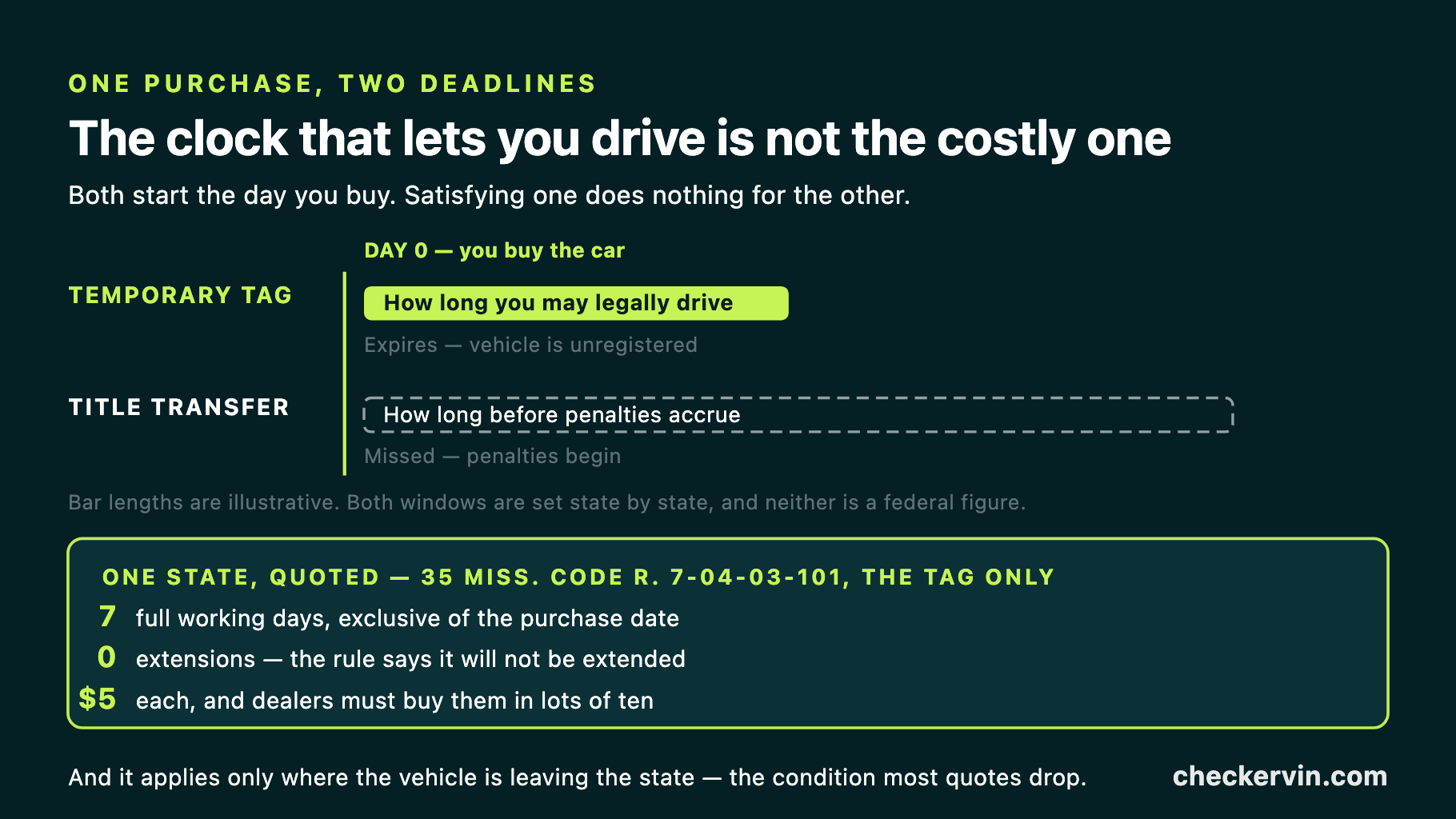
One state, read properly
Mississippi is worth working through in full, because it is the state most often quoted on this topic and it is also the one most often quoted wrongly. The rule is 35 Miss. Code R. 7-04-03-101, made under Miss. Code Ann. § 27-19-40(2), and it says more than the number people repeat from it.
| What the rule provides | The text it comes from |
|---|---|
| Who may use one | A temporary tag may be used where the vehicle was sold by a dealer or auction to a nonresident, or to a Mississippi resident who may temporarily exit the state before obtaining a Mississippi tag |
| How long it lasts | Valid for seven full working days, exclusive of the date of purchase, after the date the vehicle is purchased |
| Whether it can be extended | The seven-day period will not be extended |
| Who may not use one | It is unlawful for a dealer, or an employee of a dealer, to operate a vehicle in inventory on a temporary tag |
| What it costs | Five dollars, and dealers must buy them in lots of ten |
Read the first row again, because it is the part that gets dropped every time this rule is quoted. Mississippi's temporary tag is not a general-purpose grace period for anyone who buys a car in Mississippi. It is aimed at a vehicle that is about to leave the state — a nonresident buyer, or a resident heading out before they can get a Mississippi plate. Quoting the seven days without that condition turns a narrow permit into a promise the state never made.
That is the shape of this whole subject in one example. The number is the easy part to copy and the eligibility condition is the part that decides whether the number applies to you at all.
A second state, and a completely different shape
Mississippi resolves to one narrow permit. Texas resolves to five, and they are not interchangeable — which is the clearest possible demonstration that “how long is a temporary tag” has no general answer. These are read from the Texas Department of Motor Vehicles' own temporary permits page.
| The Texas permit | What it actually is |
|---|---|
| Vehicle Transit Permit | Five calendar days, starting the day it is printed, valid for one trip between the origin and destination named on it. No fee. This is the one for a private purchase where the seller keeps the plates |
| One-Trip Permit | Fifteen calendar days, one trip only between the origin and destination shown on the receipt, one of which must be in Texas |
| 30-Day Permit | Thirty calendar days, and it may be bought up to sixty calendar days before it takes effect. Requires Form VTR-66 together with proof of insurance and proof of a passing vehicle inspection |
| 72-Hour and 144-Hour Permits | Commercial. For laden trucks, truck-tractors, trailers, semitrailers and motor buses, and a valid USDOT number is required |
Now look at what that does to the search. Somebody typing “temporary tag Texas” after buying a car privately is usually picturing the thirty-day one — and the thirty-day permit wants a form, an insurance document and a passing inspection. The permit that actually fits their situation is free, takes five days, and covers a single journey to their county tax office. Those are not variations on a theme; they are different products for different problems.
Texas has its own quirks beyond the permits — plates leave with the seller, and the state's annual safety inspection ended in 2025. Our Texas license plate guide covers both, and the transit permit from the plate side.
What you need to get one
The specifics vary, but the underlying logic does not: the state wants to know the vehicle exists, that you own it, and that it is insured.
- 1Proof that you own itA signed-over title is the strongest form. A bill of sale is usually required alongside it and is sometimes accepted on its own where a title is delayed. Keep both with you until the permanent registration arrives.
- 2Proof of insurance on that specific vehicleCoverage has to name the vehicle, which means the VIN. Insurers can usually add it same-day, and doing it before you drive away is the sequence that keeps you covered rather than merely tagged.
- 3The VIN itself, read off the carTake it from the windshield plate and confirm it against the driver's door jamb label rather than copying it from the advert. A VIN that differs between those two places is a problem to resolve before any paperwork is filed.
- 4Identification and paymentA driver's license and a fee, which is usually small. Mississippi's is five dollars; other states differ, and some charge nothing to a buyer because the cost sits with the dealer.
- 5The odometer reading at saleFederal law requires a written odometer disclosure on transfer for most vehicles, and states fold it into the transfer paperwork. Record the number at the moment of sale rather than reconstructing it later.
How long they last, and why we will not print a table of fifty
You will find pages that list a duration for every state. Treat them with caution, and here is the honest reason we are not publishing one.
Temporary tag rules sit in state administrative codes that are amended quietly and often — the Mississippi rule above was amended three times between 2018 and the end of 2024. A fifty-row table is a promise to keep fifty state administrative codes current, and a table that is ninety percent right is worse than no table at all, because you cannot tell which rows are the wrong ten percent.
- Durations are commonly expressed in working days in some states and calendar days in others, which changes the real length considerably
- Some states date the period from the sale, others from the date the tag is issued
- Some permit a second tag or an extension, and some state expressly that they do not
- Dealer-issued and buyer-obtained tags sometimes run for different lengths in the same state
- Eligibility conditions can narrow a rule to a subset of buyers, as Mississippi's does
The reliable move is to read the rule for the state where the vehicle will be registered, which is not always the state where you bought it. Our state pages are a reasonable starting point for what each state expects of a buyer, and the state motor vehicle agency itself is the authority for the tag.
When the tag expires and the plates have not arrived
This is common and it is not automatically your fault — processing backlogs are real. It is still your problem, because the consequence attaches to the vehicle on the road rather than to whoever caused the delay.
Driving on an expired temporary tag is driving unregistered. That is citable in every state, and the secondary consequence is the one people miss: an insurer handling a claim may take an interest in whether the vehicle was legally on the road, and an unregistered vehicle is a weaker position to argue from than a registered one.
Ask the issuing agency before it lapses rather than after. Where a second tag is available, it is generally available to someone whose first has not yet expired and much harder to obtain for someone already driving on a dead one.
If the delay is on the dealer's side, escalate in writing rather than by phone. A dealer that has taken your money and not filed your title paperwork is the party creating the exposure, and a dated written record of when you asked is what turns a disagreement about who caused the lapse into a matter of fact. Most state motor vehicle agencies also have a complaints route for dealer titling failures, which is worth knowing exists before you need it.
Four things a temporary tag is not
Most of the trouble on this topic comes from the tag being asked to do jobs it was never issued to do. It is a narrow permission, and it is worth being precise about what falls outside it.
| People treat it as | What it actually is |
|---|---|
| Proof that you own the car | It is not. Ownership transfers with the title. A tag can sit on a vehicle whose title was never signed over, which is precisely how title jumping stays invisible |
| Registration | It is a stopgap that stands in for registration for a set period. Once it lapses the vehicle is unregistered, not lightly registered |
| Evidence the car is insured | Separate systems. Most states require insurance to issue a tag, but the tag itself proves nothing about a policy still being in force a month later |
| A grace period for the title paperwork | The clock that governs the paperwork is a different one, usually longer, with its own penalties. Satisfying the tag does nothing for it |
The first row is the one worth carrying. A seller who is comfortable handing over a vehicle with a tag on it and a vague answer about the title has arranged things so that you can drive the car without ever becoming its recorded owner — which is convenient for exactly one of the two people in that transaction.
Paper tag fraud, and why it matters to a buyer
Temporary tags are paper, printed rather than stamped, and issued in volume. That makes them the softest document in the vehicle chain, and there is a real trade in fraudulent ones — tags printed to order, or issued through a dealer license used as a supply of legitimate-looking paper.
For an honest buyer this matters in two directions. A vehicle wearing a fraudulent tag attracts exactly the attention you do not want, and a seller who supplies one is telling you something about the rest of the transaction. The people who use them are often the same people avoiding the title system altogether.
- A tag issued by a dealer should tie to a real dealer, verifiable through the state licensing agency
- A tag with no issue date, no expiry date, or a handwritten one is not a document, it is a decoration
- A seller offering to supply a tag for a private-party sale is offering something private sellers cannot ordinarily issue
- Being handed a tag but not a signed title is the wrong way round — the title is the thing that transfers ownership
The underlying pattern here is the one behind curbstoning and title jumping: keeping a vehicle moving without a record being created. A temporary tag is what that looks like from the outside.
Buying across state lines
Cross-border purchases are where the two-clock problem and the fifty-rules problem meet, because the state that lets you drive the car away is often not the state that will eventually register it.
The practical questions are ordered: can you legally drive it out of the selling state, can you legally drive it in the state you are crossing into, and what does your home state require to title it once it arrives. Those are three different answers and the Mississippi rule above shows why — its temporary tag is written specifically around a vehicle that is leaving.
Our guide to buying a car out of state covers the titling and tax side of the same trip.
One planning point that saves people a second journey: decide before you travel whether you are driving the vehicle home or transporting it. A tag that is valid for the drive out is not automatically valid for a week of errands once you arrive, and some of the narrower permits — Mississippi's among them — are written around the journey rather than around the buyer. If the vehicle is going onto a trailer, the tag question largely disappears and is replaced by whether the trailer itself is legal, which is a different check entirely.
What to settle while the tag is still valid
The temporary tag period is the most useful window you will get, and most buyers waste it waiting. It is the last stretch during which problems are cheap to act on, because the title is not yet in your name and the transaction is still fresh.
- Confirm the VIN on the windshield matches the door jamb label and the title you were given
- Run the VIN for open safety recalls, which are repaired at no cost by the manufacturer regardless of how many owners the vehicle has had
- Confirm the odometer reading you were given matches what is written on the transfer paperwork
- Get insurance recorded against the VIN rather than against a description of the car
- Start the title transfer immediately rather than at the end of the window, because the penalty clock is the one that costs money
Our free decode returns what the vehicle was built as — model year, body class, engine, drivetrain, plant — together with recall information for that model year, from federal data. It does not return accident, title-brand or odometer history, and nothing here should be read as a promise that it does.
Where this information comes from
- eCFR — full-text search of the Code of Federal RegulationsWhere the phrase searches on this page were run, with a control query
- 35 Miss. Code R. 7-04-03-101 — in-transit and temporary dealer tagsThe Mississippi rule quoted above, made under Miss. Code Ann. 27-19-40(2)
- TxDMV — temporary permitsThe five Texas permits, their durations and what each one requires
- NHTSA recall lookupFree open-recall check by VIN, repaired at no cost by the manufacturer
- NHTSA vPIC — public VIN decoderFederal build data behind a free decode, no account required
Keep reading
Frequently asked questions
How long is a temporary tag good for?
It depends entirely on the state, and the range is wide — some states measure it in working days and others in months. There is no national figure because there is no national rule: temporary tags are created by state law, and the phrase does not appear anywhere in the Code of Federal Regulations.
Can I get a temporary tag when I buy from a private seller?
In many states yes, but you usually have to obtain it yourself rather than receive it at the sale. A dealer issues tags as part of the transaction; a private seller has nothing to issue. Expect to visit the state motor vehicle agency or its online service with proof of ownership and insurance.
What happens if my temporary tag expires before the plates arrive?
You are driving unregistered, which is a citable offense in every state and can also void insurance coverage in a dispute. Some states allow a second tag or an extension and some expressly do not, so the safe move is to ask the issuing agency before it lapses rather than after.
Is the temporary tag deadline the same as the title transfer deadline?
No, and confusing them is the most expensive mistake on this topic. The tag governs how long you may legally drive; the transfer deadline governs how long you have to put the title in your name before penalties accrue. They are set by different provisions, they run for different lengths, and missing the second one costs money even if the first is still valid.
Can I check a car's history before the temporary tag runs out?
Yes, and it is worth doing immediately. A free VIN decode returns what the vehicle was built as and any open safety recalls against it, using federal data. Problems found while the paperwork is still in progress are far easier to act on than problems found after the title is in your name.