The short answer
- Where is the number on a Polaris?
- Stamped on the frame — commonly the left side toward the front on side-by-sides, and on the frame near the steering head on ATVs. A certification label carries the same number along with the build date. The engine carries its own separate serial.
- Where do I check Polaris recalls?
- The Consumer Product Safety Commission, not NHTSA. Off-highway vehicles are regulated as consumer products rather than motor vehicles, so their recalls are published by the CPSC.
- What should I check before buying one used?
- The frame number against whatever paperwork exists, a free theft lookup, the CPSC recall list, and your own state's rules on titling and registering off-highway vehicles.
CPSC
Where off-road recalls live
Not NHTSA
Frame
Where the number is stamped
Engine has its own serial
Varies
Whether your state titles it
Check before you buy
High
Powersports theft rates
Run the free check
What a Polaris lookup gives you
Where a machine carries a standard 17-character VIN, a decode returns the usual build data. Off-highway-only machines file less, and some carry identification numbers that public vehicle decoders do not read at all — which is normal rather than a problem.
- Manufacturer and model year
- Model line and configuration where filed
- Engine information where the machine carries a road-legal VIN
- The number your registration or title is issued against, where your state issues one
- A basis for running the free theft check
- The number a Polaris dealer needs to look up parts and service history
Polaris runs its own lookup, and it is the one to use first
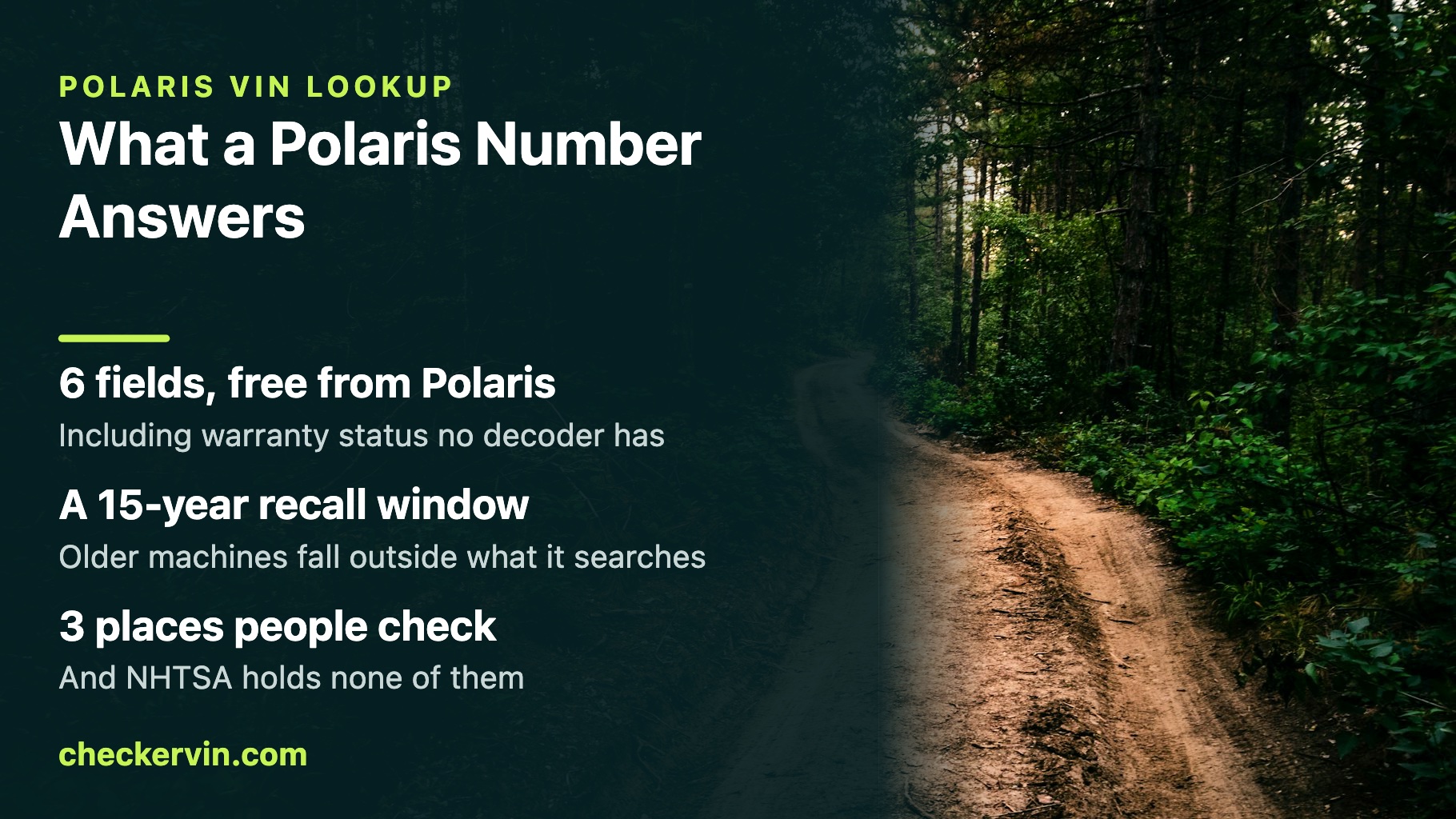
Worth saying before anything else, because it saves people money: Polaris publishes a free VIN search for its own machines, and for most of what an owner wants it is better than any third-party decoder. It is the manufacturer reading its own build record rather than a service inferring from the characters.
What it returns is specific, and two of the fields are things no general VIN decoder can produce at all.
| What the factory search returns | Why it matters on a used machine |
|---|---|
| Model year and model number | The exact configuration, not the marketing name a listing used |
| Engine serial number | The second number on the machine, so you can check it against the cases |
| Factory warranty | Whether any original coverage is still running |
| Extended Service Contract | Whether a purchased contract exists and stands |
| Guides and manuals | The correct documents for that specific build |
| Product recalls and safety bulletins | Incomplete safety work against that machine |
Factory warranty and Extended Service Contract status are the two that matter most on a used purchase, and they are the two nobody else has. A seller telling you a machine is still in warranty is making a claim; the factory search is the thing that settles it before money changes hands, and it costs nothing to ask. A decoder reads the number; only the manufacturer knows what agreements are attached to that machine and whether they are still live.
The other exclusion is worth knowing if the machine came from outside the country. Polaris states that the search does not cover international vehicles, so a unit built for another market and imported later can return nothing at all — not a clean result, but no result. On an imported machine the dealer route below is the one that works.
That distinction is the whole reason this page does not simply end here. Powersports machines last a long time and change hands often, and a fifteen-year-old Sportsman is an ordinary used purchase rather than an antique. For anything approaching that age the factory tool is the first check and not the last one, which is what the sections below are for.
Where the number is on each type
- 1Side-by-sides — RZR, Ranger, GeneralStamped on the frame, most often on the left side toward the front of the chassis, or on a frame rail beneath the driver's side. You may need to look under the machine.
- 2ATVs — Sportsman and similarOn the frame near the steering head, or on a frame tube under the front bodywork. Turn the bars and look on the right side of the neck.
- 3SnowmobilesOn the tunnel or the frame near the front, and on a label under the hood or seat.
- 4The certification labelCarries the identification number, the build date and often the model designation. Usually near the stamping, and easier to read.
- 5The engineA separate serial stamped on the cases. Not the machine's identity, and it will not decode as a VIN.
VIN, PIN and engine number: three different things
| Number | What it is |
|---|---|
| VIN | A 17-character vehicle identification number, carried by machines built to road-legal standards. Decodes in standard databases. |
| PIN | A product identification number used on some off-highway equipment. A different format, and not readable by road-vehicle decoders. |
| Engine serial | Identifies the engine as a component. Separate from the machine's identity, and frequently different after a rebuild or swap. |
Establish which one you are looking at before concluding that a number “does not work.” A PIN entered into a VIN decoder will fail every time, and that failure says nothing about the machine.
Polaris settles the distinction from its own side, which is the useful confirmation here. Its factory search takes the machine’s identification number and returns the engine serial numberas a separate field — not as part of the identity you typed in, but as another fact about the vehicle. The manufacturer treats them as two records because they are two records.
That is also the cheapest fraud check available on a used Polaris, and it takes a minute. Run the identification number through the factory search, read the engine serial it returns, then walk to the machine and read the number stamped on the cases. If those disagree, the engine in front of you is not the one the factory recorded against that chassis. That is not automatically a problem — engines get rebuilt and swapped, and on a machine with any age it is unremarkable — but it is something the seller should be able to explain rather than something you discover afterwards.
What Polaris actually makes
Polaris covers a broader range than most people realize, and the rules differ across it. A road-legal motorcycle from the group is regulated quite differently from a side-by-side.
| Line | What it is |
|---|---|
| RZR | Sport side-by-sides, built for recreational off-road performance. |
| Ranger | Utility side-by-sides, aimed at work, farm and property use. |
| General | Crossover side-by-sides positioned between sport and utility. |
| Sportsman | The ATV line — straddle-seat, handlebar-steered quads. |
| Snowmobiles | The winter line, identified similarly to other off-highway machines. |
| Indian Motorcycle | Road-legal motorcycles, which carry standard motorcycle VINs and fall under NHTSA. |
| Slingshot | A three-wheeled road vehicle, registered and regulated differently again by state. |
BRP’s range raises the same questions from the other side — Can-Am VIN decoder covers why a three-wheeler is federally a motorcycle while the side-by-sides are not.
Recalls come from the CPSC, not NHTSA
This is the most consequential thing on the page, and it is where people who apply car habits to powersports go wrong.
Off-highway vehicles — ATVs, side-by-sides, snowmobiles — are regulated as consumer products by the Consumer Product Safety Commission rather than as motor vehicles by NHTSA. Their recalls are published by the CPSC.
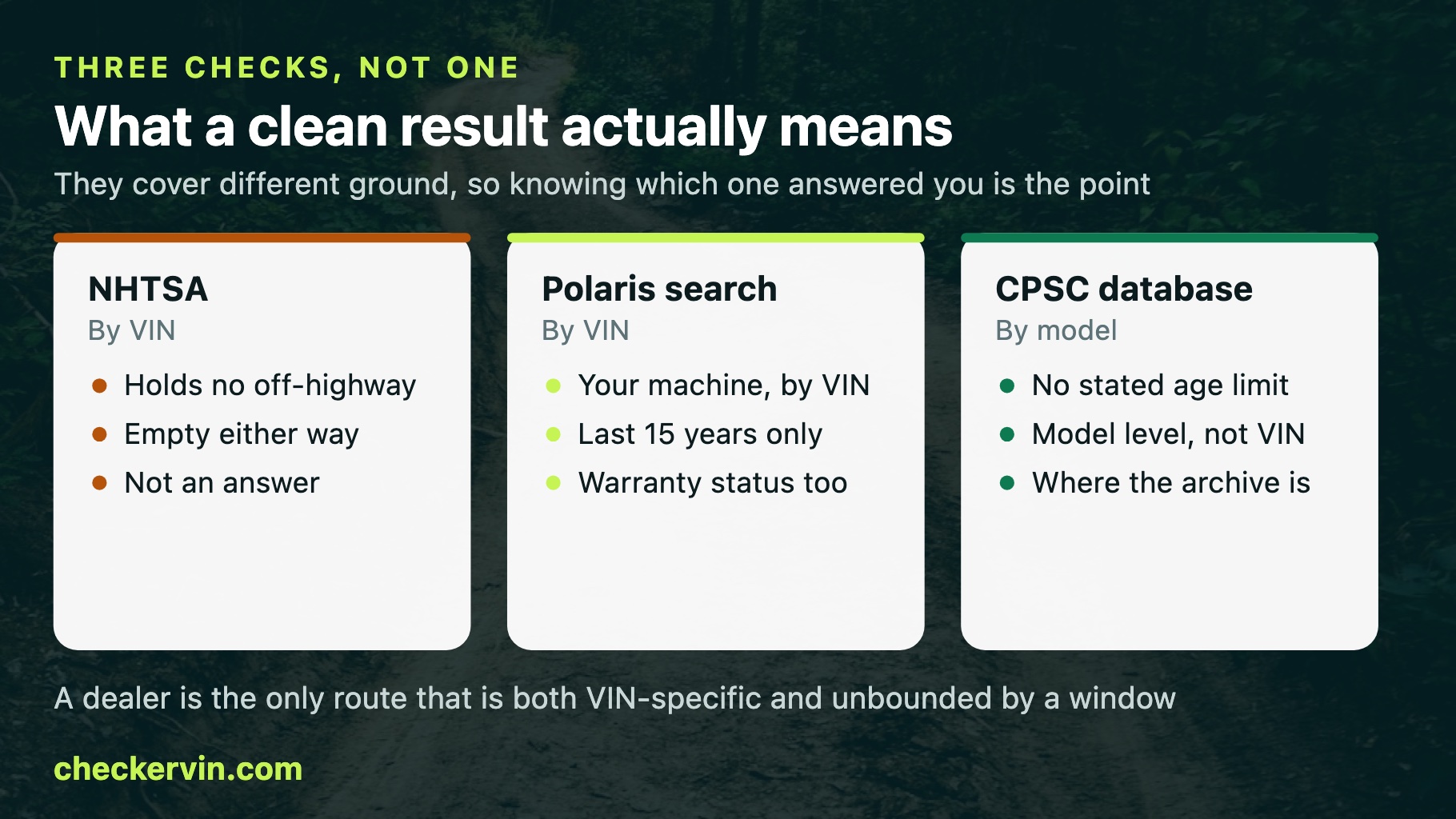
There are therefore three places a Polaris recall can be established, and they do not cover the same ground. Knowing which one answered you is the difference between a checked machine and a machine you assume is checked.
| Where you looked | What a clean result there actually means |
|---|---|
| NHTSA by VIN | Nothing at all for an off-highway machine — the agency does not hold them |
| Polaris VIN search | No incomplete recall in the last 15 calendar years, by the maker's own statement |
| CPSC recall database | No published recall for that model, with no 15-year horizon on the archive |
Read the middle row against the bottom one. The factory tool is VIN-specific, which is its advantage: it tells you whether this machine still has work outstanding rather than whether the model was ever recalled. The CPSC listing is model-level and has no stated age cut-off, which is its advantage on older equipment. Neither replaces the other, and the gap between them is exactly where a fifteen-year-old machine with an unrepaired campaign would sit.
- Search the CPSC recall database by manufacturer and model
- Check the Polaris owner site, which publishes its own safety notices
- Call a Polaris dealer with the identification number for outstanding campaigns
- Ask whether any recall work was performed by a previous owner, and for proof
- Do not treat an empty NHTSA search as an answer for an off-highway machine
Off-road titling varies enormously by state
Some states title off-highway vehicles the way they title cars. Some issue a registration or an OHV decal without a title. Some do neither, treating the machine as personal property evidenced by a bill of sale.
The practical consequence for a buyer is significant: “there is no title” may be entirely normal or may be a serious problem, and which one depends on your state rather than the seller's.
- Check your own state's rules before agreeing to buy, not after
- Get a detailed bill of sale with the identification number, date and both parties' details
- Ask for the original purchase paperwork or dealer invoice where it exists
- Confirm what your state requires to register the machine in your name
- Where your state does title them, do not buy without one
- Ask about any lien, since financed machines are common
Powersports theft, and why the check is worth a minute
Off-road machines are attractive targets. They are valuable, easy to load onto a trailer, often stored outbuildings rather than garages, and frequently unregistered — which makes them harder to trace.
Add a private-sale market that runs largely on cash and thin paperwork, and the free theft check becomes the highest-value minute you will spend on the purchase.
- Run the free NICB lookup against the identification number before money moves
- Confirm the frame stamping matches whatever paperwork exists
- Confirm the seller's name matches that paperwork
- Inspect the frame around the stamping for grinding, filing or fresh paint
- Be cautious of a machine with no documentation at a notably low price
- Photograph the number and the machine for your own records after purchase
Snowmobiles
Snowmobiles follow the same pattern as other off-highway machines: identification stamped on the frame or tunnel, a certification label, CPSC rather than NHTSA for recalls, and state-by-state registration rules.
One extra consideration applies. Snowmobiles are seasonal, and a machine that has sat from spring to autumn each year has its own wear profile — fuel system deposits, perished rubber, battery condition — that has little to do with the hours on the clock.
Modified machines
Powersports modification culture is at least as active as the automotive one, and a used RZR or Sportsman has a good chance of having been altered. The decode gives the factory baseline; the rest is inspection.
- Suspension and lift changes, and whether geometry was corrected
- Oversized tires, which stress the drivetrain and change gearing
- Clutch and gearing changes, which affect belt life
- Exhaust and fuel mapping, which may affect emissions compliance where it applies
- Roll cage or bumper changes, and whether they were competently fabricated
- Evidence of hard use — bent A-arms, damaged skid plates, cracked mounts
Buying a used Polaris: the checklist
- 1Get a photo of the frame stamping before you travelA seller unwilling to send one has answered a question you had not asked yet.
- 2Run the free theft checkBefore money moves. On powersports this is the single highest-value check available.
- 3Check the CPSC for recallsNot NHTSA. This is the step nearly everyone skips.
- 4Confirm your state's titling rulesEstablish what paperwork you need to register it in your name, before you hand over cash.
- 5Read the hour meter as well as any mileageOn off-road machines hours tell you more about engine wear than distance does.
- 6Inspect underneath thoroughlySkid plates, A-arms, CV boots, frame welds and mounting points. This is where hard use shows.
- 7Check the belt and clutch on a side-by-sideBelt condition is a fast indicator of how the machine has been driven and maintained.
What the number will not tell you
- How hard the machine has been ridden, which matters more than age
- Rollovers and impacts, which frequently generate no insurance record at all
- Hours on the engine, unless you read the meter
- Maintenance history — belts, oil, valve service
- Modifications and whether they were competently done
- Whether any lien exists, in states that do not title off-highway vehicles
That second point is the one to sit with. An off-road machine can be rolled repeatedly without any of it appearing in a record anywhere, because there is no claim, no police report and often no title to brand. Inspection is not a supplement to the paperwork here — it is the primary source.
Where this information comes from
- Polaris — vehicles VIN searchThe manufacturer's own free lookup: model year and number, engine serial, factory warranty, Extended Service Contract, manuals and recalls — and its stated 15-calendar-year recall window
- CPSC — recalls for off-highway vehiclesWhere ATV, side-by-side and snowmobile recalls are published
- NICB VINCheckFree theft lookup from participating insurers
- NHTSA vPIC — public VIN decoderFor road-legal machines carrying standard 17-character VINs
Keep reading
Frequently asked questions
Where is the VIN on a Polaris RZR or Ranger?
On side-by-sides the identification number is usually stamped on the frame, commonly on the left side near the front of the chassis or under the driver's side. There is also a certification label carrying the number and the build date. The engine has its own separate serial.
Do Polaris off-road vehicles have 17-character VINs?
Machines built for road-legal use carry standard 17-character VINs. Purely off-road vehicles may carry a product identification number in a different format. Check the certification label to see which your machine has.
Why doesn't NHTSA show recalls for my ATV?
Because off-highway vehicles fall under the Consumer Product Safety Commission rather than NHTSA. ATV, side-by-side and snowmobile recalls are published by the CPSC, so an NHTSA-only search will show nothing even when a recall exists.
Do I need a title for a Polaris side-by-side?
It depends entirely on your state. Some states title off-highway vehicles, some register them without a title, and some do neither. Check what applies where you will register it rather than where it is being sold.
How do I check if a Polaris is stolen?
Run the identification number through the free NICB theft lookup, and confirm the frame stamping matches whatever paperwork the seller has. Powersports machines are stolen frequently, and many are sold privately with thin documentation.
Check before you load it on the trailer
Decode any 17-character VIN free for the factory build, specifications and open safety recalls. No account required.
Run a free VIN check