The short answer
- What is Visor?
- A car search and market-pricing tool. It aggregates dealer listings and tracks what happens to them over time — price changes, days on the market, how fast the specification is selling.
- Is it a history report?
- No. Its History tab is the history of the listing, not of the vehicle. No accident, title-brand, odometer or theft records.
- Is it worth using?
- For working out whether an advertised price is a real price, yes — the price-change trail is the most useful thing on it. For establishing what happened to the car, no. Different question.
Listings
What the VIN keys into
Not a records database
Price trail
The standout feature
Every change, dated, with mileage
Buyer-funded
Its stated model
A paid tier instead of dealer leads
Free
Our decode and recall check
No account needed
What Visor actually is
Visor is an independent car-search site. It gathers dealer listings, presents them without the deal-rating badges and lead-capture forms that most listing sites are built around, and adds a layer of market analysis on top — what the same specification is selling for, how long these cars sit, how a particular listing’s price has moved since it appeared.
It positions itself explicitly against the incumbents on business model rather than on features, saying it does not sell personal information as leads and does not run dealer ads, and that a paid tier is what allows it to be funded by buyers instead. Whatever you make of that as marketing, it is a coherent position and it shows in the product: there is no form standing between you and a listing.
It is run by a small team — the site describes itself as started by two brothers and publishes a direct email address, a changelog and a public roadmap. That is a different kind of operation from the data conglomerates the vehicle-history market is made of, and it explains both the responsiveness and the scope.
Why the name sends people to the wrong expectation
Three things point the same way and all three are misleading if you do not already know the category.
| What you see | What it actually means |
|---|---|
| A .vin domain | The VIN is used as a lookup key, not as an index into records |
| Paste a VIN, get a page | That page is the car's for-sale listing, not its past |
| A tab labeled History | The listing's price and seller history, not the vehicle's |
Every listing on the site lives at an address ending in the vehicle’s VIN. That is a perfectly reasonable design — the VIN is the only globally unique handle a car has, so it is the obvious primary key — and it is exactly why a search for the site’s name draws a large number of people who are actually looking for a history report.
What a VIN actually returns on Visor
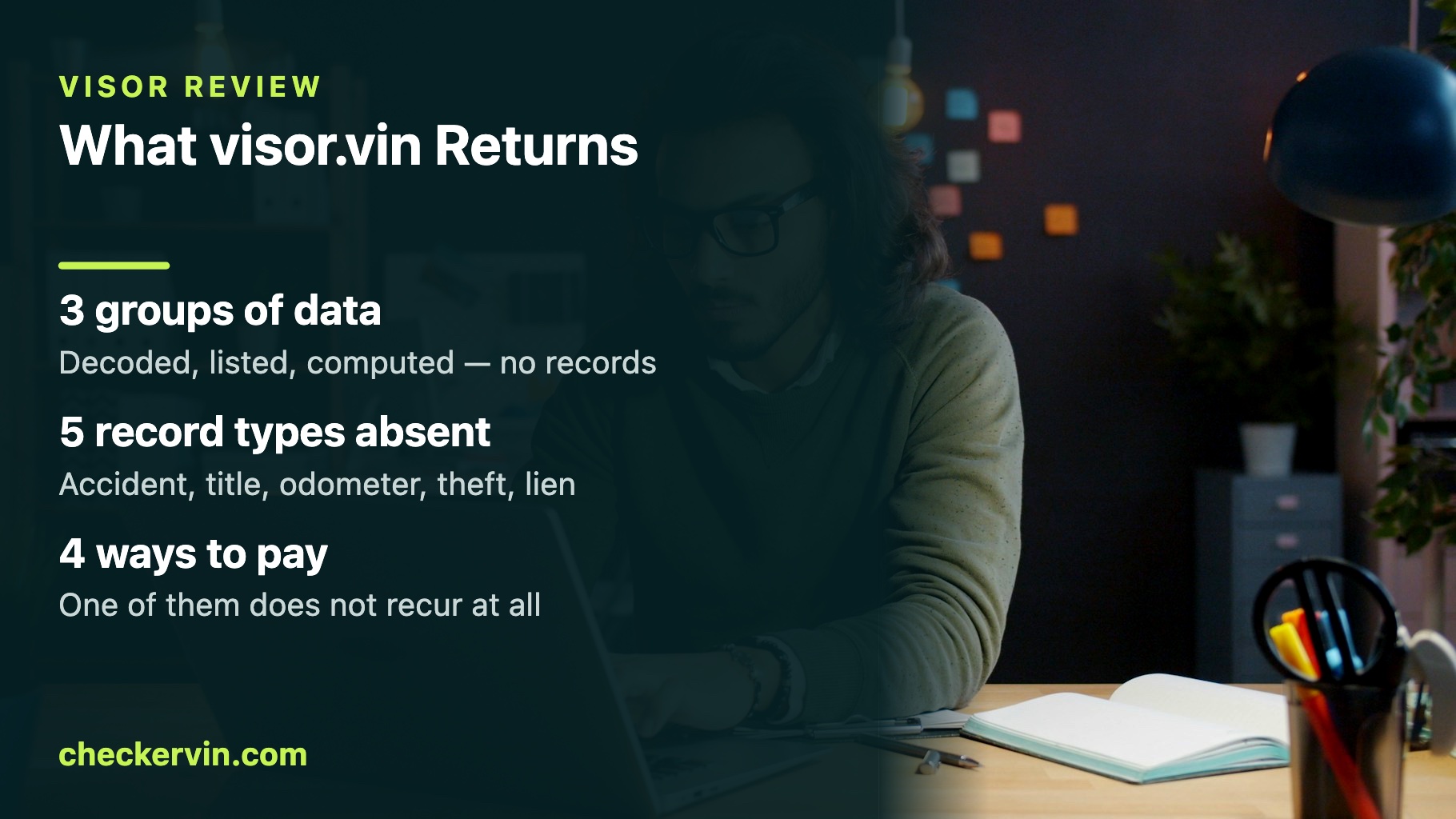
We put a VIN into it and read the resulting page field by field. What comes back divides cleanly into three groups, and the division is the whole story.
| Group | What is in it |
|---|---|
| Decoded from the VIN | Year, make, model, trim, engine, drivetrain, fuel type, assembly plant |
| From the listing | Price, mileage, colors, dealer, stock number, photos, days advertised |
| Computed by Visor | Every price change with its date, market velocity, days-to-sell versus average |
The first group is the part any VIN decoder returns, including ours, free. The second is what the dealer published. The third is the actual product — the thing you cannot get by looking at the listing yourself — and it is good.
What is absent from all three groups is any record about the vehicle’s past: no accidents, no title brands, no odometer history, no theft check, no lien status. Some fields are gated behind an account rather than absent — warranty status showed as login-required on the listing we read — but the categories above are simply not part of what the tool holds.
Listing history and vehicle history are not the same thing
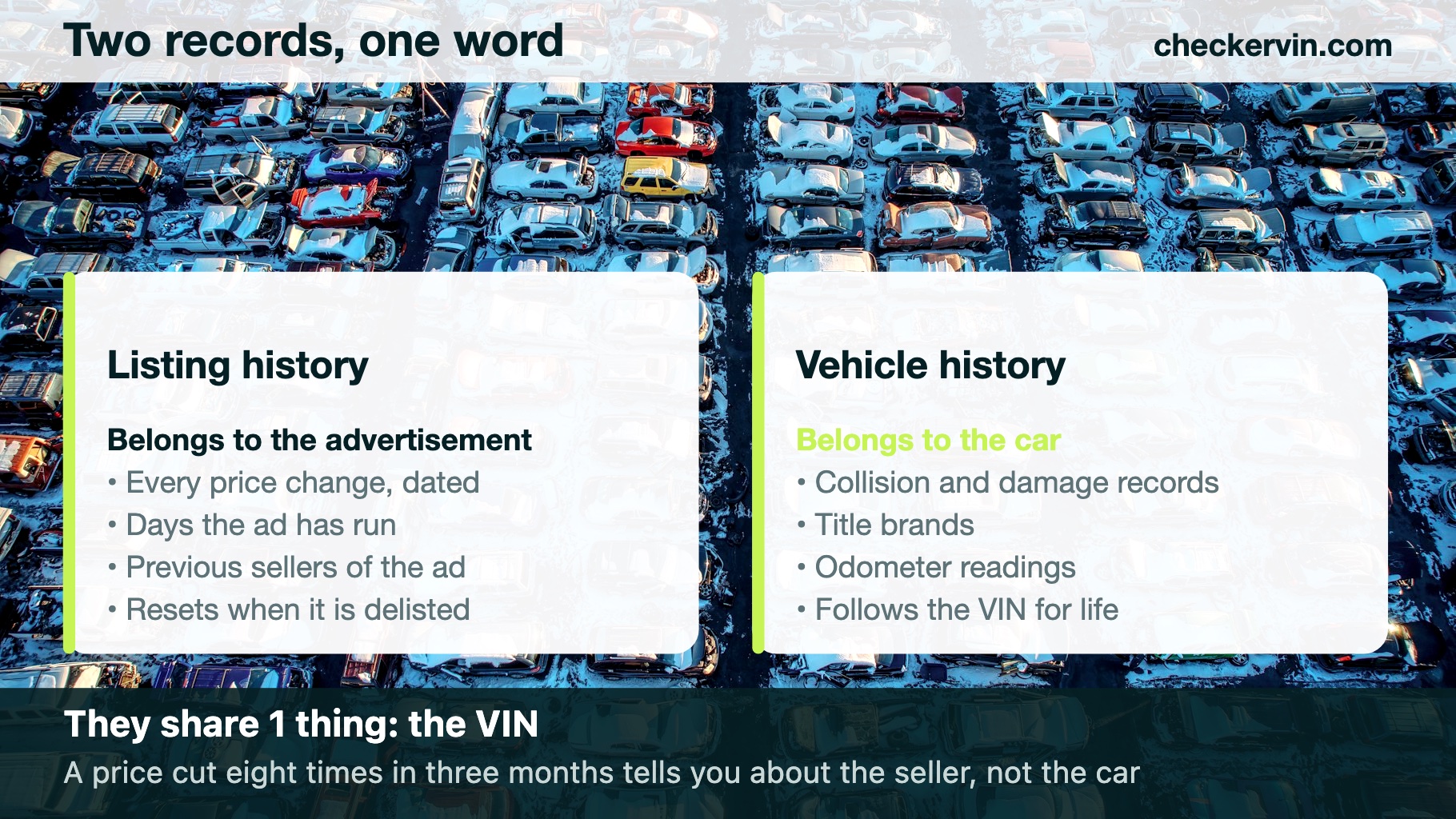
This is the section worth reading if you read only one. Two very different records travel under the same word, and confusing them is how a buyer ends up feeling informed while knowing nothing about the car.
| Listing history | Vehicle history |
|---|---|
| Belongs to the advertisement | Belongs to the vehicle |
| Starts when the car was listed | Starts when the car was built |
| Price changes, dates, mileage as advertised | Collision and damage records, title brands, odometer readings |
| Resets when a listing is taken down | Follows the VIN across every owner and state |
| Tells you about the seller's position | Tells you about the car's past |
The example we looked at made the point neatly. The listing had been live for ninety-nine days and its price had been cut eight separate times, from the original asking figure down to the current one, with the mileage unchanged throughout. That is a rich, genuinely useful record — it tells you the seller has been trying and failing to move this car for over three months, which is a negotiating position.
It tells you nothing whatsoever about whether the car has been in a collision. Those are different filing cabinets, and Visor only opens one of them.
The market signals, and what they are good for
Beyond the price trail, the listing page carries a set of computed comparisons: how many of that exact specification sold nationwide recently, the average number of days those took to sell, how this particular car compares, and an estimated likelihood that it sells in the coming week.
Used carefully, these are the most commercially useful numbers on the page, because they convert a static asking price into a position. A car that has sat for triple the average and had its price cut repeatedly is a different negotiation from an identically priced car that appeared last week.
- Days advertised, against the average for that exact specification
- The full price-change trail, with the date and the mileage at each step
- Whether the current price is the lowest the listing has been
- How many of the same specification sold nationwide in the recent window
- Whether a used car was previously listed by a different seller
Treat them as signals rather than facts. They are computed from aggregated listing data, and the site’s own footer describes that data as independently sourced and provided as is, without warranty of accuracy or completeness, with pricing signals stated to be informational rather than advice. That is an honest disclaimer and the right expectation to hold.
The new-car side, which is a different product again
Most of this review is about used cars, because that is where a VIN search usually starts. Visor also runs a new-vehicle analysis layer, and it computes things that ordinary listing sites do not attempt.
The site publishes worked examples of it on its own front page — how a model’s sales split between units sold while still in production, units sold in transit, and units sold off the lot; how long a hybrid variant takes to sell against the gasoline version in one state; how trims of competing trucks compare on retained value after three years.
Those are its numbers rather than ours and we have not audited them. What they demonstrate is the shape of the capability, which is real: it is answering questions about how a market is behaving, not merely showing you what is for sale in it. If you are ordering a new vehicle, knowing that most of a model sells before it reaches a lot is a genuinely different piece of information from a list of dealer prices.
Deal Check, and why we are not reviewing it
Visor advertises a free tool called Deal Check that analyzes a dealer’s deal sheet — the itemized figures for fees, add-ons and financing — and compares them against the local market. On paper that is the most interesting thing in the whole product, because the deal sheet is where a good price quietly becomes a bad one.
We could not exercise it. The URLs we tried for it returned the site’s own 404 page, and rather than guess at the feature from its description we are recording that we did not see it work. A review that assesses a tool it never opened is worth less than one that says so.
Take the concept seriously regardless of who provides it. Add-ons and fees are where a negotiated discount is routinely recovered, and any instrument that itemizes them before you sign is doing the part of the job that most buyers skip. That is a separate exercise from the one this site is mainly about, and it is closer to reading your paperwork than to checking a car.
How it is paid for, and why the shape is interesting
There is a free tier and a paid tier called Visor Plus. Per our own rule we describe pricing models rather than printing figures, and here the model is more interesting than the figures anyway.
Visor Plus is sold four ways: weekly, monthly, annually, and as a single one-time purchase that does not recur. All four are presented as cancel-anytime with no hidden fees. The weekly option is the unusual one, and it fits the behavior better than anything the history-report market offers — people shop for a car intensively for a few weeks and then stop, and almost every subscription in this space is designed to outlast that window rather than match it.
What the paid tier unlocks is search depth rather than records: filtering by manufacturer-installed options and features, seeing installed options on every listing, documents found across the web for a listing, advanced filter controls, and the previous-seller check on used cars.
The transparency signals, and what they are worth
A tool that asks you to trust its numbers should be legible about itself, and this is a dimension the vehicle-data market generally scores badly on. Visor does several things here that are worth naming, precisely because they are cheap to do and most of its larger competitors do not.
- A public changelog, so you can see what changed and when
- A public roadmap, so you can see what is claimed as coming rather than shipped
- A direct email address for the people who run it, published on every page
- A stated policy of never having paid for a review, printed above its testimonials
- A footer disclaimer that describes its data as provided as is, rather than implied as authoritative
- An explicit note that third-party marks appear for comparison and do not imply endorsement
None of that is verification. A changelog says what a company chose to publish, a no-paid-reviews claim is a claim, and a roadmap is an intention. What they establish is a posture: this is an operation that expects to be checked, and has made checking it possible.
Weigh that against the alternative pattern, which our billing-transparency work runs into repeatedly — a headline offer whose recurring terms are discoverable only after purchase, and a support channel that exists to slow cancellation down. Publishing a one-time purchase option and a working email address is not a small thing in this market.
What it is genuinely good at
Being fair about a competitor is easier when the product is good, and this one is. Three things stand out.
- 1Turning an asking price into a positionThe dated price-change trail with mileage at each step is the single most useful artifact on the site, and it is not available from the listing itself. Knowing a price has been cut eight times in three months changes how you open a conversation.
- 2Searching by what is actually on the carFiltering by manufacturer-installed options rather than by marketing package names is a real gap in the mainstream listing sites, and it matters most to exactly the buyers who care which options a car has.
- 3Getting out of the wayNo lead form, no interstitial, no deal-rating badge computed from criteria nobody publishes. For a research tool that absence is a feature.
What it will not do for you
Equally plainly, and none of this is a defect, because the product does not claim otherwise.
- It will not tell you whether the car has been in a collision
- It will not tell you whether the title has ever been branded
- It will not give you an odometer record from previous years
- It will not tell you whether the vehicle is reported stolen or carries a lien
- It will not tell you about open safety recalls on that specific VIN
- It cannot inspect a car, which is still the only thing that examines the vehicle itself
The last two are worth separating. Recalls are free from the federal regulator by VIN and take a minute, so nobody should be paying anyone for that. The others are what the commercial history-report market exists to sell, and what a physical inspection exists to check.
Using it in the right order
Order matters more than tool choice, because each step is cheap enough to make the next one worth doing and each one can end the process early.
- 1Decode the VIN, freeConfirm the car is the specification the advertisement claims. A trim or engine that does not match the number is a conversation to have before anything else, and it costs nothing to find out.
- 2Check open recalls, freeThe federal regulator answers this by VIN at no charge. An open recall is not a reason to walk away, but it is a repair someone owes you and it belongs in the negotiation.
- 3Read the market positionThis is where a tool like Visor earns its place. How long has the listing been up, how many times has the price moved, is the current figure the lowest it has been, and how does that compare with how fast the specification sells.
- 4Buy one history report, on one carOnce you are serious about a specific vehicle. Reports are priced per vehicle or per bundle, and buying one for every car you glance at is how people spend more on reports than on the inspection that would have told them more.
- 5Pay for the inspectionLast, and non-negotiable on anything with structural or flood history in its record. It is the only step that examines the car rather than a file about it.
Notice that the first two steps are free and the third is inexpensive. Most of the money in that sequence sits in the last two, and most of the decisions get made in the first three.
Three tools, three questions
The reason this review spends so long on categories is that buyers who understand them stop shopping for the one right tool and start asking which question they are on.
| The question | What answers it |
|---|---|
| What did the factory build? | A VIN decode — free, instant, from the manufacturer's own filed data |
| What is it worth, and is this price real? | A market tool like Visor — listings, price trails, days to sell |
| What has been recorded about this car? | A paid vehicle history report, from a provider that buys those records |
| What is actually wrong with it? | An inspection. No database of any kind replaces this one |
Nothing in that table competes with anything else in it. A buyer who runs the free decode, uses a market tool to sanity-check the asking price, buys one history report on the car they are serious about, and then pays a shop to look at it has spent very little and covered all four questions.
How we checked this
Reviews age badly when nobody says what was looked at or when. Everything above comes from reading the product directly in August 2026: the home page, the subscription page, and a live used-vehicle listing page reached by its VIN, read field by field.
We did not create an account, so account-gated features are described as gated rather than assessed — warranty status on the listing we read, for instance, showed as login-required and we have not seen what it returns. We did not test the paid tier. We have no commercial relationship with Visor and were not asked for this review.
What this review does not tell you
It does not tell you how complete Visor’s listing coverage is in your area, which would need a systematic comparison against the local market that we have not run. It does not tell you how accurate the sold-and-velocity figures are, because the underlying sold data is not something we can independently verify. And it does not tell you what the paid tier feels like in use.
What it does establish is the category, which is the thing most people arriving at that name have wrong: it is a search and pricing tool, it is good at that, and the word history on its pages refers to the advertisement rather than the vehicle.
Our own free check sits in the first row of that table and nowhere else. It returns the factory build and specifications from the VIN, and open safety recalls, at no cost and without an account. It does not return accident, title, odometer or theft history, and we would rather say so plainly than let a comparison imply otherwise.
Where this information comes from
- NHTSA — check for open recalls by VINThe federal safety recall lookup, free, and not something any commercial tool needs to sell you
- U.S. Department of Justice — NMVTISThe federal title and brand record built from state data, and the approved providers who resell it
- eCFR — 16 CFR Part 455, the FTC Used Car RuleWhat a dealer must disclose on the Buyers Guide, and the rule that the window form overrides contrary contract terms
Keep reading
Frequently asked questions
Is Visor a vehicle history report?
No. Visor is a car search and market-pricing tool. It aggregates dealer listings and tracks what happens to them — price changes, how long a car has sat, how fast the model is selling. It does not sell accident, title-brand, odometer or theft records, and its “History” tab means the history of the listing, not of the vehicle.
Why does it have a .vin domain if it isn't a VIN report?
Because it uses the VIN as a lookup key. Every listing lives at a URL ending in the vehicle's VIN, so pasting a VIN takes you to that specific car's listing page. That is a sensible use of a VIN and a sensible domain, and it is also why a large number of people arrive expecting something the product does not claim to be.
Is Visor free?
There is a free tier and a paid tier called Visor Plus. The unusual part is the shape of the paid tier rather than its price: it is offered as a weekly, monthly, annual or one-time purchase, all described as cancel-anytime. A weekly option fits how people actually shop for a car — intensively for a few weeks, then not at all.
Does Visor sell my details to dealers?
Its stated position is the opposite: the site says it does not sell personal information as leads or run dealer ads, and that the paid tier is what lets it be funded by buyers rather than dealers. That is the company describing its own model, which is worth knowing and is not the same as an audit of it.
Should I use Visor instead of a history report?
They answer different questions, so it is not a choice between them. Visor tells you what the car is listed at and how that price has moved. A history report tells you what has been recorded about the vehicle itself. A free VIN decode tells you what the factory built. Serious buyers end up using all three plus an in-person inspection.
What does Visor show that a normal listing site does not?
Chiefly the listing's own history: every price change with its date, how long the car has been advertised, and whether a used car was previously listed by a different seller. It also shows market velocity for the same specification — how many sold recently and how long they took.
What is Visor's Deal Check?
A free tool the site advertises for analyzing a dealer's deal sheet — the fees, add-ons and financing lines — against the local market. We could not reach a working page for it when we checked, so we are describing what it claims rather than assessing what it does. The underlying idea is sound: add-ons are where a negotiated discount usually gets recovered.
Does Visor cover new cars as well as used?
Yes, and the new-car layer is arguably the more distinctive half. It analyzes how a model's sales split between vehicles sold in production, in transit and off the lot, how quickly variants sell in a given market, and how trims retain value over several years. Those are aggregate market signals rather than valuations of any one car.
Is Visor accurate?
Its own footer describes listing data as independently sourced and provided as is, without warranty of accuracy, completeness or timeliness, and says pricing signals are informational rather than advice. That is a fair disclaimer for aggregated listing data and it is the right expectation to hold: confirm anything decisive with the seller.
Start with what the factory recorded
Decode any 17-character VIN free for the factory build, specifications and open safety recalls. No account required.
Run a free VIN check