The short answer
- What is VINwiki?
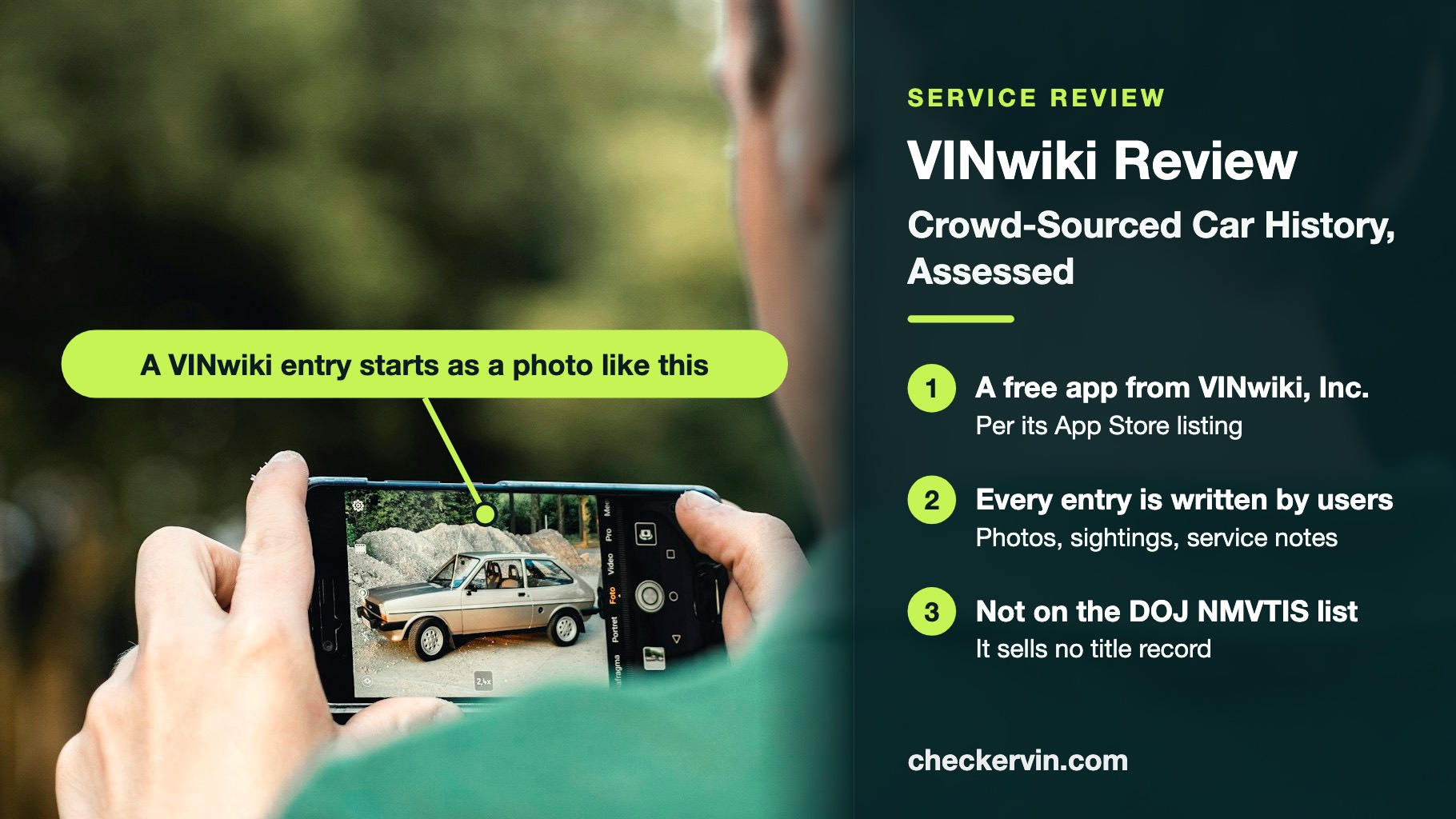
- A social app run by VINwiki, Inc. of Atlanta. Users post photos, sightings, mileage and service notes against a car's VIN and follow cars over time.
- Is VINwiki free?
- The App Store lists the app as free with no in-app purchases, and we found no paid plan on its site.
- Can it replace a title check?
- No. Posts are written by users, and VINwiki is not an approved NMVTIS provider. Use it as a lead, then check the title record.
Free
App price on the App Store
No in-app purchases listed
Users
Who writes each entry
Photos, sightings, service notes
Not listed
DOJ NMVTIS provider status
It sells no title records
2016
Founded in Atlanta
Per its Our Story page
The short verdict
VINwiki is a good idea that does one thing no paid report does: it lets the people who actually saw a car say what they saw. For a collector car, a rare trim or anything with a following, that can be gold. A photo from a show ten years ago, an owner’s note about a rebuilt engine, a sighting in a state the seller never mentioned.
What it does not do is verify any of it. Nothing on VINwiki’s site or in its app listings says posts are checked against state title data, and VINwiki is not one of the businesses the Department of Justice approves to sell the federal title record. So the honest way to use it is as a source of leads and questions, never as proof that a title is clean. Read it, then check the title.
What VINwiki is, and who runs it
The company’s privacy policy names the operator as VINwiki, Inc., and both the App Store and Google Play list VINwiki, Inc. as the developer; the Play listing gives a mailing address in Duluth, Georgia. Its Our Story page says the company was founded in February 2016 by a team of car enthusiasts in Atlanta, and names four people: Ed Bolian as founder and CEO, Chris Rasco as CTO, and Dan Huang and Dave Black as founding partners.
The pitch on the homepage is storytelling. It opens with the line “Every vehicle has a story” and invites you to look a car up, add it if it is missing, record where you saw it, and build a timeline for your own car that a future buyer might value. The site also links an iOS app, an Android app, a web version, a merchandise store and a YouTube channel. There is no checkout for reports, and none of its sponsor links leads to a vehicle history report seller.
What the VINwiki app does
The App Store description calls the VINwiki app a platform that lets users create, contribute to and curate vehicle history reports. In practice, from the listings and the homepage, that means:
- Look up a car by VIN, or by year, make and model, and read what others have posted about it
- Add a car that is not there yet and say where you saw it
- Keep a timeline for your own car: photos, dates, mileage and service records
- Follow friends and individual cars to see what happens to them
- Build lists, such as cars you have owned or cars at an event
- Post to a car from its license plate with the PL82VIN tool instead of typing the VIN
Its version history on the App Store adds some useful detail. A 2016 release allowed VINs shorter than 17 characters, which the release note ties to pre-1981 and non-U.S. cars, a detail that matters to classic owners. Another 2016 release says users can now update the information for any vehicle. The most recent iOS release in the listing extends the plate tool to Canadian and UK plates. On Android, the current listing describes a ground-up rewrite that still lists post deletion and post reporting as to-do items.
The App Store lists the app under Lifestyle, not under a utility or reference category, and rates it 9+ with a note that it contains user-generated content. That categorization is a fair summary of what it is: a community for car people, with a VIN as the index.
Is VINwiki free?
As far as its own listings show, yes. The App Store marks the app free and shows no in-app purchases section, the homepage advertises no subscription, and we found no price anywhere on vinwiki.com. The Google Play page we retrieved did not display a price line, so for Android we can only say we saw no paid tier described.
The business around the app is visible on the homepage: a row of sponsors, a merchandise store and the YouTube channel. VINwiki’s privacy policy, last modified in May 2016, says it may work with third-party advertising companies and mentions processing payments, so a paid feature is something the policy allows for. We simply did not find one.
One gap worth knowing: we could not find terms of service. The homepage links none, and the usual addresses for a terms page on vinwiki.com returned “not found” when we checked. So we cannot tell you what the company promises about the accuracy of posts or who owns the photos you upload. If that matters to you, ask the company before you post.
Who writes VINwiki vehicle history
This is the part that decides how much weight a VINwiki entry can bear. A paid history report is assembled from records that someone was obliged, or paid, to send: state title offices, insurers, salvage yards, auctions, repair shops. A VINwiki entry is assembled from whatever its users chose to post.
| Who contributes | What that tends to mean |
|---|---|
| Current owners | Detailed and well-photographed, but written by the person who may later sell the car |
| Past owners | Often the most valuable posts: work done, problems, why they sold |
| Spotters at shows and on the street | Proof a car existed in a place and condition on a date, little more |
| Anyone else | The app lets users edit vehicle details, so a wrong year or trim can be added in good faith |
None of that is a criticism of the people posting. It is just the nature of the source. An owner who documents every oil change is telling you something real. An owner who documents only the good parts is also telling you something real, just not everything. The listing itself says it allows users to report inappropriate comments, but nothing we read describes any check on whether a post is true.
Is crowd-sourced VIN history a substitute for a title record?
No, and the reason is not that VINwiki is poor. It is that the two answer different questions. A title record answers “what has the state, an insurer or a salvage yard formally recorded about this car?” A VINwiki entry answers “what have people who saw this car chosen to say about it?” A buyer needs the first answer before the second is worth anything.
The federal title record is NMVTIS, the National Motor Vehicle Title Information System. State titling agencies, insurers and junk and salvage yards report into it. The Department of Justice describes an NMVTIS report as “intentionally concise” and built around five indicators aimed at fraud and theft: the current title, brand history, the latest odometer reading, total-loss reports and junk or salvage transfers. That is exactly the layer that catches a washed title, because a brand applied in one state stays in the record after the car is retitled in another.
Only businesses on the department’s approved list may sell that record. On November 24, 2026, the list named 12 providers for public and commercial customers: Bumper, Carsforsale, CarVertical, CheckThatVIN, ClearVin, EpicVin, GoodCar, TitleCheck, VinAudit, VinData, VinReport, Vinsmart. VINwiki is not among them, and it does not claim to be. The department also notes that NMVTIS is not complete, so even a clean result means nothing was reported, not that nothing happened. Our NMVTIS report guide explains each indicator.
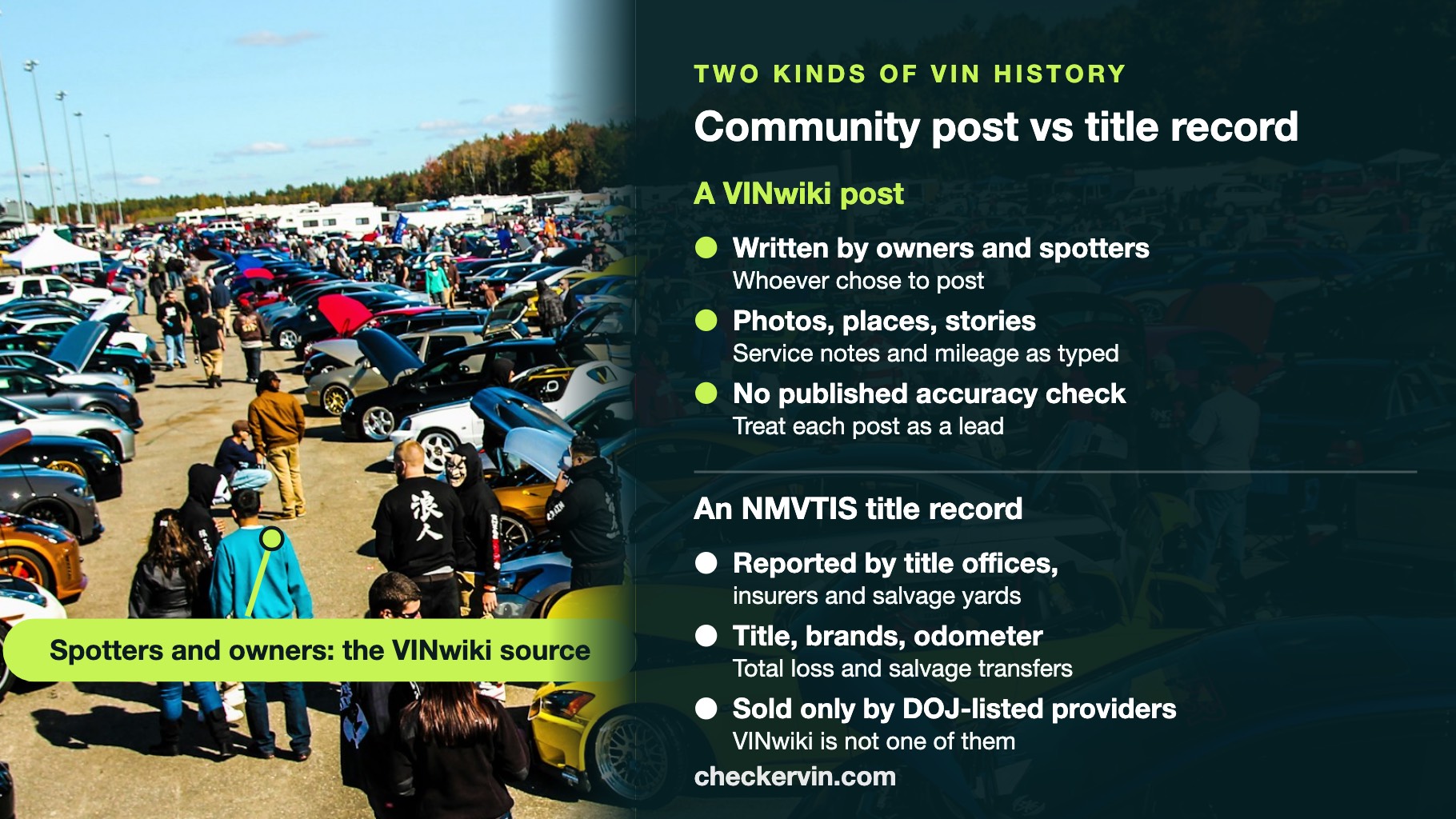
A VINwiki post next to an NMVTIS record
Put side by side, the two sources cover almost entirely different ground. That is why they work better together than either does alone.
| A VINwiki entry | An NMVTIS title record |
|---|---|
| Written by: owners, past owners and spotters | Reported by: title offices, insurers, salvage yards |
| Checked: nothing published says it is | Checked: reporting is required by federal law |
| Holds: photos, places, stories, service notes | Holds: title, brands, odometer, total loss, salvage |
| Odometer: whatever the poster typed | Odometer: the reading recorded at title events |
| Coverage: cars someone cared to post about | Coverage: most U.S. vehicles, with known gaps |
| Cost: free app | Cost: a fee per report from a listed provider |
The useful overlap is narrow but real. If a VINwiki owner posted a photo of the odometer five years ago and the title record shows a lower reading since, you have found a question worth asking. If a spotter photographed the car on a flatbed with front-end damage and the title shows no brand, you have found another. The crowd supplies the clue; the record tells you whether anyone made it official.
Where VINwiki is genuinely useful
Fairly assessed, there are buyers for whom VINwiki is worth opening before anything else.
- Collector and enthusiast cars, where owners tend to document builds, restorations and provenance
- Pre-1981 and non-U.S. cars with VINs shorter than 17 characters, which the app accepts
- Cars with a story to verify, such as a claimed celebrity owner, race history or limited-run trim
- Your own car, if you want a running service and photo log to hand to the next buyer
- Checking that a car existed in the color and configuration the seller describes
It is much less likely to help with an ordinary commuter car. Most of those were never photographed by anyone who cared, so a search may return nothing at all. That empty result tells you nothing about the car’s condition, in either direction.
How to read a VINwiki post without being misled
- Match the VIN on the post to the VIN on the car, the title and the listing, character by character
- Note who posted it: the current seller, a past owner or a stranger
- Look for dated photos that show the same car, not a similar one
- Treat any mileage figure as a claim to compare with the title record, not a reading
- Ask the seller about anything a post raises; a good seller will have an answer
- Never let a glowing timeline replace a title check or a mechanic's inspection
The most common trap is the well-documented car posted by its own seller. A beautiful timeline can be completely honest and still leave out the one event a buyer most needs to know about. The federal record and an inspection exist to catch exactly that.
The license plate tool, and what it is not
VINwiki’s PL82VIN tool lets a user post to a car from its license plate instead of its VIN, and its latest iOS release extends it to Canadian and UK plates. That is a convenience for spotters. It is not an owner lookup: the federal Driver’s Privacy Protection Act restricts the release of personal information from state motor vehicle records, and the App Store privacy summary for VINwiki lists only users’ own contact details and identifiers as data linked to them.
If you are starting from a plate yourself, our license plate lookup guide covers what a plate search can legally return and how to get from the plate to the VIN.
The YouTube side of VINwiki
Many people meet VINwiki through its videos rather than its app. The website’s own Videos menu links to youtube.com/vinwiki, so the company presents the channel as part of the same brand. The videos are car stories: road trips, unusual purchases, odd histories. They are entertaining and often feature cars that also have entries in the app.
They are not, however, a history record for the car you are thinking of buying, and a story told on camera carries no more verification than a post. We have not embedded one here because none is about checking a used car’s title.
VINwiki and CarCheckerVIN, compared fairly
These are different tools, and it would be easy to make the comparison flattering. Here it is straight.
| CarCheckerVIN today | VINwiki |
|---|---|
| Price: free, no card field | Price: free app, per its App Store listing |
| Factory build and specifications: decoded from the VIN | Factory build and specifications: whatever users entered |
| Open safety recalls: yes, from NHTSA | Open safety recalls: not described as a feature |
| Photos filed against the VIN: yes | Photos: user posts, often the richest part |
| Market and listing prices: yes | Market prices: not described as a feature |
| Title brands and salvage: launching soon, not available yet | Title brands and salvage: no; not an NMVTIS provider |
What our free scan returns today:
- Factory build and specifications decoded from the VIN
- Factory warranty terms
- Open NHTSA safety recalls
- Photos filed against the VIN
- Market and listing prices
Run the free decode and recall check
Decoded from official manufacturer and NHTSA records
A sensible order of checks
- Decode the VIN free and confirm the year, make, model and trim match the listing
- Check open recalls free; the repairs themselves are free at a dealer
- Search VINwiki for the VIN and note anything that raises a question
- Run the free NICB VINCheck for theft and insurer total-loss records
- Buy one NMVTIS report from a listed provider for the car you are serious about
- Have an independent mechanic inspect it, which no database or post replaces
Run in that order, the community layer costs nothing and sharpens the questions you ask, and the only money spent before the inspection buys the one record VINwiki cannot provide. Our guide to free vehicle history reports lays out every free source alongside it, and pre-purchase inspection covers the last step.
Where this information comes from
- VINwiki homepageWhat the platform says it does, its app links, Videos and Merch menus and sponsors; retrieved November 24, 2026
- VINwiki — Our StoryFounding date, city and the four founders named by the company
- VINwiki — Privacy PolicyNames VINwiki, Inc. as operator; last modified May 10, 2016; advertising and payments language
- VINwiki on the App StoreFree price, category, age rating, description, version history and privacy summary
- VINwiki on Google PlayDeveloper details, update date, Android rewrite notes and data-safety summary
- NMVTIS — approved data providers (DOJ / BJA)The businesses approved to sell the federal title record; VINwiki is not listed; retrieved November 24, 2026
- NMVTIS — information for consumers (DOJ / BJA)Who reports into NMVTIS, the five indicators and the false-negative warning
- Driver's Privacy Protection Act, 18 U.S.C. § 2721Why a plate tool identifies a vehicle, not its owner
- NICB VINCheckFree theft and insurer total-loss screen
- How we made this pageWritten by the CarCheckerVIN editorial team with AI assistance from public records: VINwiki's own pages and app store listings, the Department of Justice's NMVTIS pages and federal law; facts checked November 2026.
Keep reading
Frequently asked questions
Is VINwiki free?
The App Store lists the VINwiki app as free and shows no in-app purchases, and neither its website nor its app listings describe a paid plan. The company also runs sponsors, a merchandise store and a YouTube channel. Check the listing yourself before you download, since terms can change.
What is the VINwiki app?
It is a social app from VINwiki, Inc., an Atlanta company founded in February 2016. Users post photos, sightings, mileage and service notes against a car's VIN, follow cars and other users, and build a timeline for their own vehicles. Its App Store listing calls it a platform to create, contribute to and curate vehicle history reports.
Is VINwiki vehicle history reliable?
It is as reliable as the person who posted it. VINwiki posts are written by its users, and nothing on its site or app listings says they are checked against state title records. A post can be a useful lead, especially for enthusiast cars, but it is not evidence of a clean title or an accurate odometer.
Can VINwiki replace an NMVTIS or Carfax report?
No. VINwiki is not on the Department of Justice's list of approved NMVTIS data providers and does not sell title records. The federal title record, with its brands, latest title odometer reading and salvage reports, comes from a listed provider. Treat VINwiki as a complement to that record, not a replacement.
Who owns VINwiki?
Its privacy policy names the operator as VINwiki, Inc., and its Our Story page says it was founded in Atlanta in February 2016, with Ed Bolian as founder and CEO and Chris Rasco as CTO. Both app store listings name VINwiki, Inc. as the developer.
Is the VINwiki YouTube channel the same company as the app?
The VINwiki website links its Videos menu to youtube.com/vinwiki, so the company presents the channel as part of the same brand. The channel's car stories are entertainment and are not a vehicle history record for any particular VIN.
Start with the free layer
Decode any VIN free for the factory build, specifications and open safety recalls. Full vehicle history reports are launching soon.
Run a free VIN check